Hood design-Week 2
DESIGN OF HOOD
OBJECTIVE:
To design hood outer panel, inner panel from the given hood skin(styling surface) using master section and to assemble the striker and hinge assembly according to the design parameters.
SOFTWARE USED:
Siemens NX12.0.
WHAT IS HOOD?
A car hood also referred to as a bonnet in some other countries is the hinged cover that rests over the engine of a front-engine vehicle. Its purpose is to provide access to the engine for repair and maintenance. Car hoods are typically constructed from steel and sometimes from aluminum.
The hood release system is common on most vehicles and typically consists of an inner hood latch/lock handle, a hood release cable, and a hood lock assembly. The hood lock handle is usually located under the steering wheel, next to the driver’s seat, or in the door frame.
DESIGN CONSIDERATION:
- Head clearance zone:
Head clearance zone is the clearance such that when the hood is in fully open condition it does not hurt the head of the person that is standing next to the hood. This is controlled by the opening angle of the hood. The opening angle of the hood is decided for the region the car is manufactured.
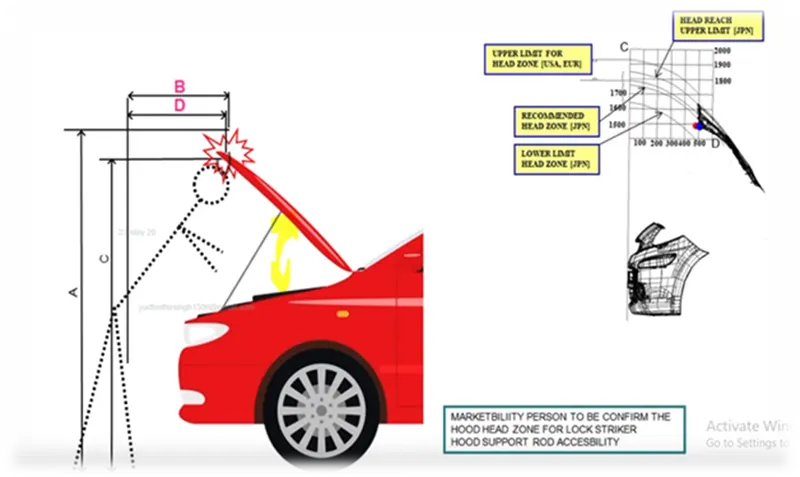
A hood stay is an device which is used to keep the hood in an open position.
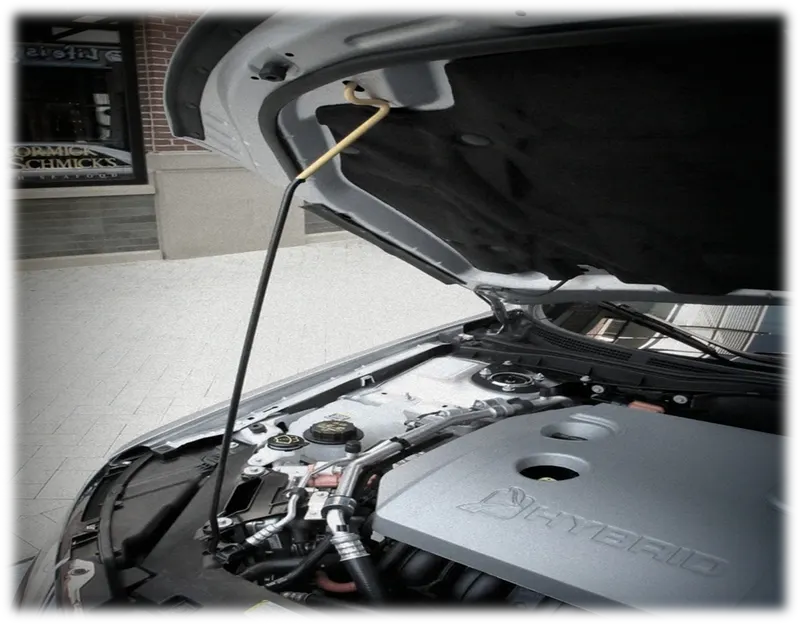
- Support rod
Support rod is basically long cylindrical rod. It safely keep an engine hood in an open state even if external forces are abruptly generated due to vibration & wind.
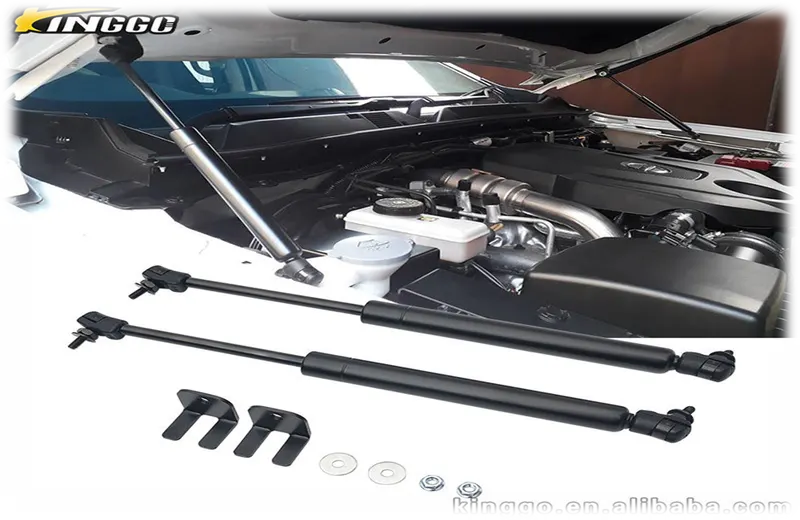
- Gas stay
Gas stay/strut is a another kind of support rod that opens and hold the hood by gas expansion inside the strut. This can be achieved by applying a slight external force to the hood.
- Noise Vibration and Harness(NVH):
Noise, vibration, and harshness (NVH), also known as noise and vibration (N&V), is the study and modification of the noise and vibration characteristics of vehicles, particularly cars and trucks. While noise and vibration can be readily measured, harshness is a subjective quality, and is measured either via "jury" evaluations, or with analytical tools that can provide results reflecting human subjective impressions.
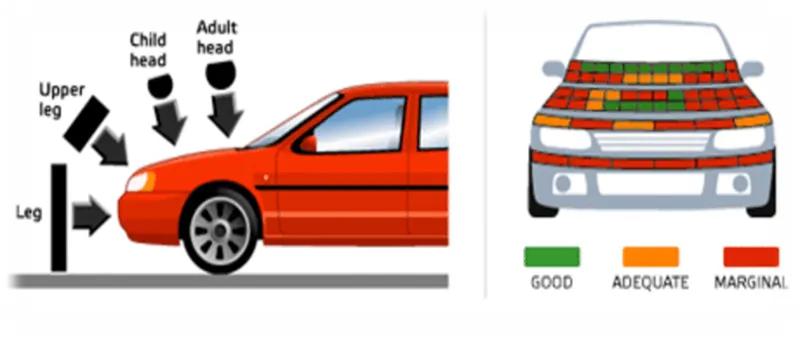
- Pedestrian safety:
In Japan and Europe, regulations have come into effect that place a limit on the severity of pedestrian head injury when struck by a motor vehicle. This is leading to more advanced hood designs, as evidenced by multicone hood inner panel. Other changes are being made to use the hood as an active structure and push its surface several centimeters away from the hard motor components during a pedestrian crash. This may be achieved by mechanical (spring force) or pyrotechnic devices.
MANUFACTURING CONSIDERATION:
The design should be in such a way that it should satisfy the manufacturing constraints that includes cost reduction and easy to produce the components. For example: The embosses are in positive drafts with the minimum tolerance of 7degree.
DESIGN PARAMETERS:
- Hood Thickness Information
- Outer Panel Thickness = 0.75mm
- Inner Panel Thickness = 0.75mm
- Reinforcement Thickness = 1.5mm
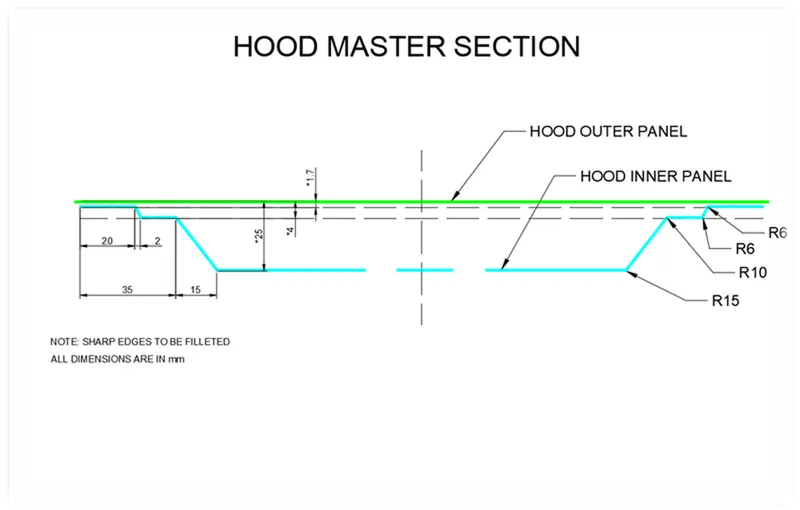
- Master Section:
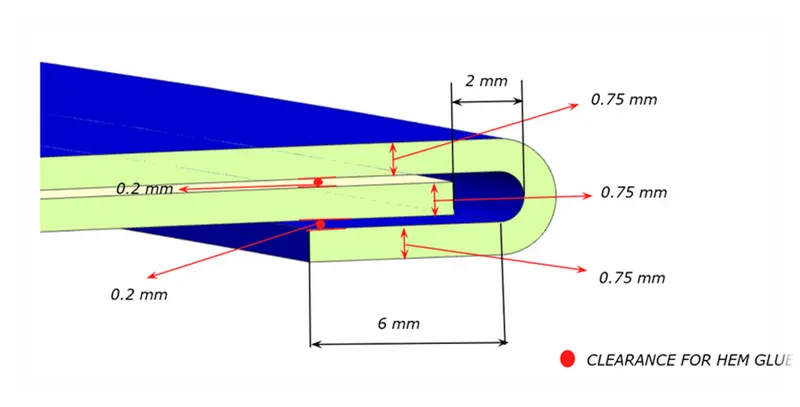
- Hemming Data:
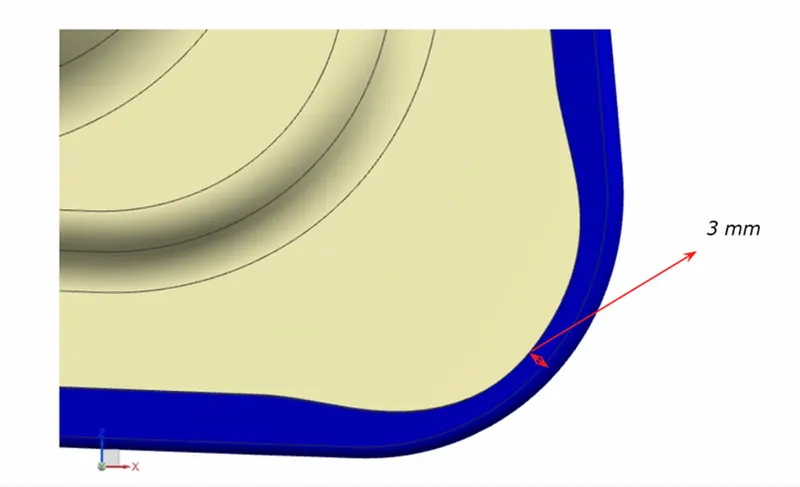
- Relief rear section:
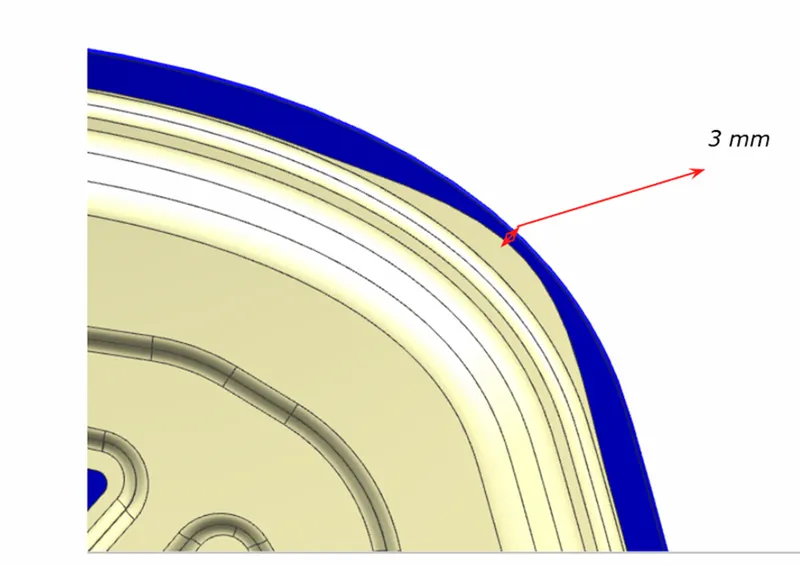
- Front relief:
COMPONENTS OF HOOD:
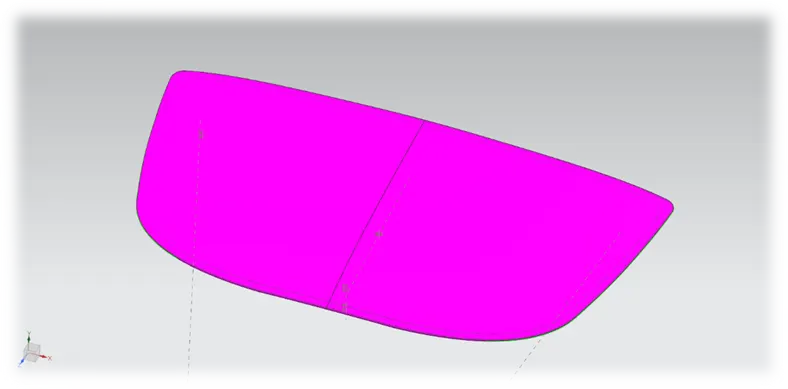
- OUTER PANEL:
The outer panel is the outer most surface of the hood that are provide by the styling team. The shape and size of the outer panel should satisfy the safety norms. Keeping pedestrian safety in mind the outer panel is designed. A relief of about 3mm is given at the front and rear of the hemming to satisfy the design consideration.
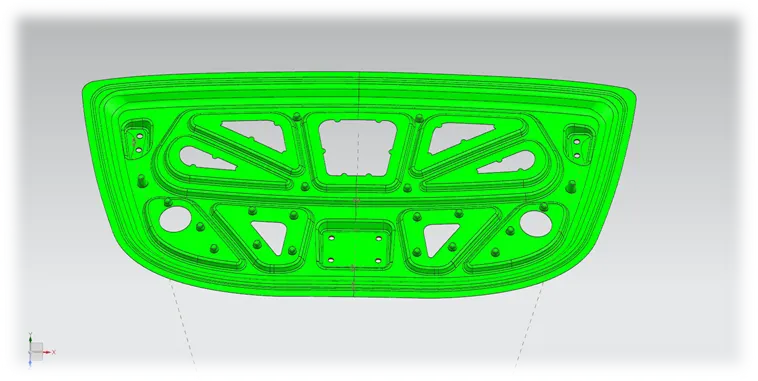
- INNER PANEL:
The inner panel provides additional strength to the outer panel. It is designed based upon the master sketch provided. The emboss and reinforcement gives additional strength to the inner panel.
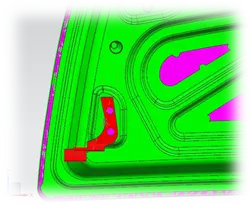
- HINGE ASSEMBLY:
Hinge is a component that fixes the hood to the fenders of the car. The latch must be fixed perpendicular to the hinge axis so that the hood opens or closes properly.
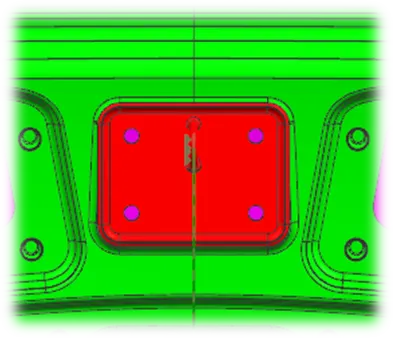
- STRIKER:
A hood striker is a component that ensures the hood is securely connected to your vehicle and that it doesn't pop open unexpectedly.
- EMBOSS:
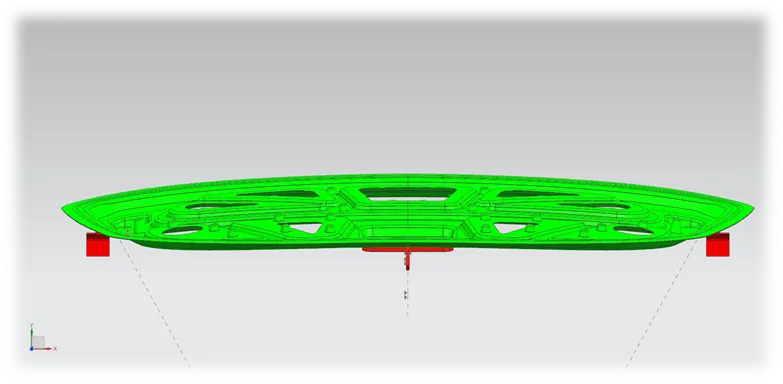
Sheet metal embossing is the stamping process to obtained raised or sunken edges for the desired design pattern on the sheet metal. This is done with help of male and female dies between which sheet metal is placed and the dies are pressed against the sheet metal to obtain the designed pattern. In some cases, roller dies are used to get the raised edges in the sheet metal.Emboss are designed all over the inner panel that provides additional strength to the inner panel. Cut-outs are provided in between the emboss in-order to reduce the weight and also acta as a safety feature while pedestrian collision. The embosses are designed in such a way that the force distributed towards the sides and the hinges during frontal collision.
- MASTIC SEALENT DATAS:
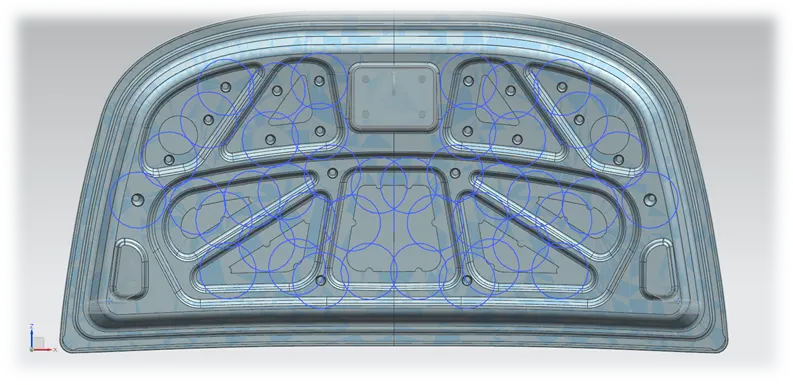
Mastic sealant helps to locally improve strength of the hood. It is generally a hard rubber part, which is introduced as a paste in between inner and outer panel of the hood, which will get hardened inside the furnace. Every mastic sealant point will have a tendency to improve the local strength in around 80 mm diameter. Considering this, the mastic points are positioned such that most of the hood region is covered.
- REINFORCEMENT:
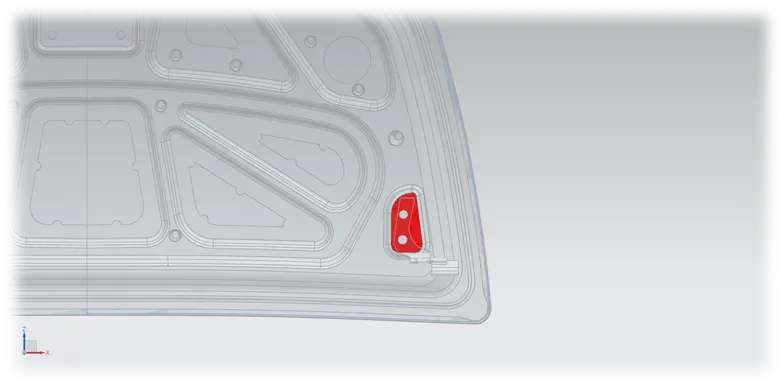
The reinforcement added to the embosses of left and right hinge-hood compartment to provide extra strength locally with the assembled components. The reinforcement thickness is about 1.5mm. Reinforcement is not essential for the striker emboss since the striker is itself a reinforcement.
- LATCH TRAJECTORY:
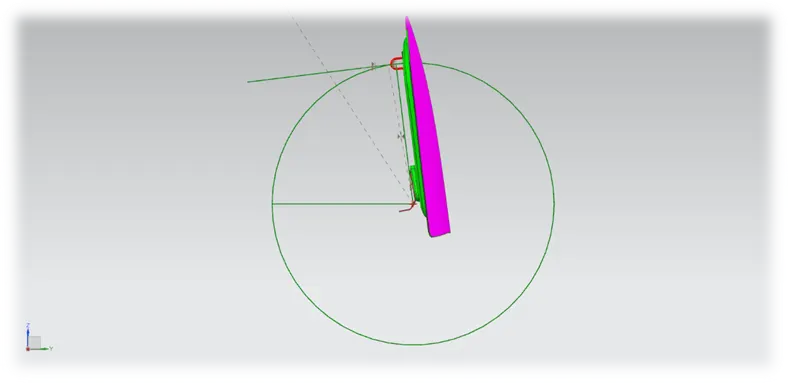
It is the path along which the hood rotates during opening and closing movement. The striker on the hood follows a particular path while opening or closing the hood, which is along circumference of a circle with center at the hinge axis. This path is nothing but latch trajectory. It is a very important aspect in hood design, in order to decide hinge, latch and striker installation points.
DEEP DRAWING:
The molding process where by means of pressure and tensile stress a sheet metal blank is changed into a curved body.
Deep drawing is a form of metal forming, where rigid tools such as punch, die and blank holder is used. The blank is placed between the die and the holder and then deformed by the punch pushing the sheet into the die and the blank finally assumes the shape of the die. The metal plate is fixed between the die and the holder before processing begins, this prevents the formation of undesired deformations such as wrinkles.
Deep drawing changes metal sheets into curved parts or create curved parts with smaller diameter from already curved details. Often a series of deep draws are done to achieve the final shape.
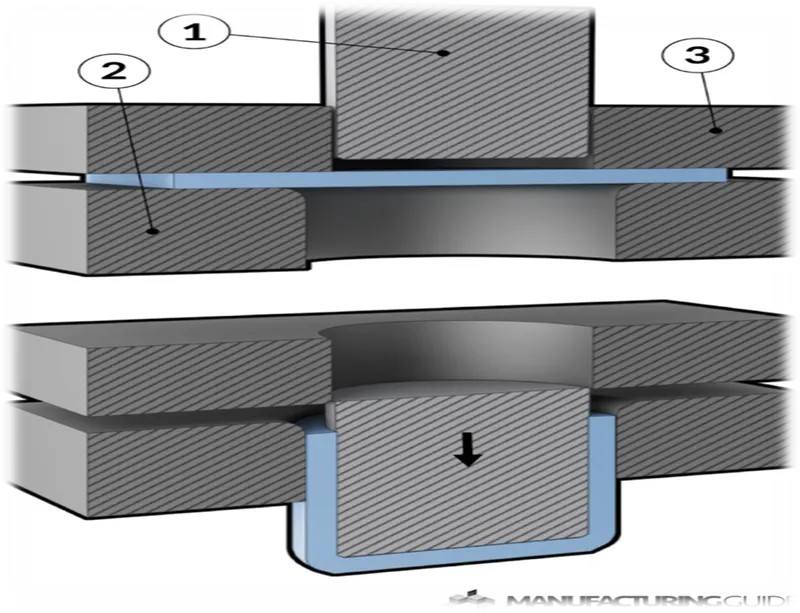
1.Punch
2.Die
3.Blank holder
HEMMING:
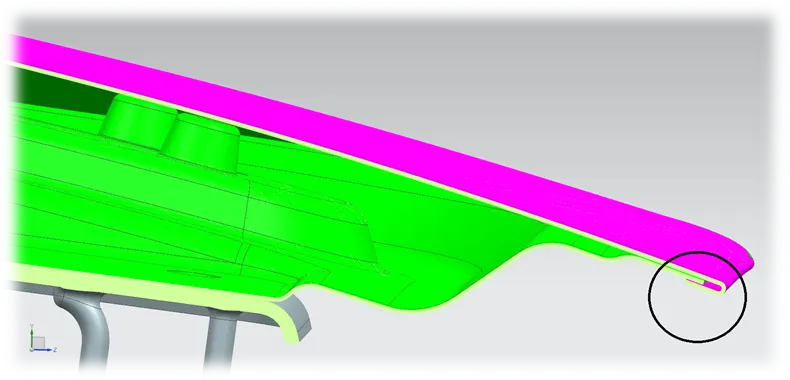
Hemming is a forming operation in which the edges of the sheet are folded or folded over another part in order to achieve a tight fit. Normally hemming operations are used to connect parts together, to improve the appearance of a part and to reinforce part edges.
In car part production, hemming is used in assembly as a secondary operation after deep drawing, trimming and flanging operations to join two sheet metal parts (outer and inner) together. Typical parts for this type of assembly are hoods, doors, trunk lids and fenders.
The accuracy of the hemming operation is very important since it affects the appearance of the surface and surface quality. Material deformations, which occur during the hemming process, can lead to dimensional variations and other defects in parts. Typical hemming defects are splits or wrinkles in the flange, material overlaps in the corner areas or material roll-in. This is why it is important to use simulation tools in order to, on the one hand, better understand the hemming process and, on the other hand, significantly reduce the number of “trial and error” loops during tryout und production.
There are various types of hemming operations:
- Conventional die hemming
- Roll hemming
Conventional die hemming:
Conventional die hemming is suitable for mass production. In die hemming, the flange is folded over the entire length with a hemming tool. Normally the actual hemming is a result of a forming operation in which the flange is formed with a hemming tool after the drawing and trimming operations have been completed. The formed flange is then hemmed in several process steps. These steps include, for example, the pre-hemming and final hemming depending on the respective opening angle of the flange. Production plants for conventional die hemming are very expensive, but the cycle times are very low.
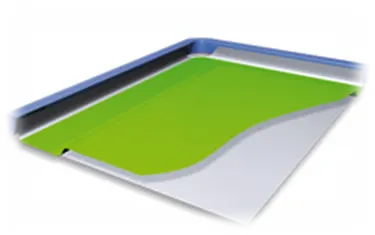
In conventional die hemming, the flange is folded over the entire length with a hemming tool.
Roll hemming:
Roll hemming is carried out incrementally with a hemming roller. An industrial robot guides the hemming roller and forms the flange. Roll hemming operation can also be divided into several pre-hemming and final hemming process steps. Roll hemming is very flexible to use and tool costs are significantly lower as compared to those of conventional die hemming. However, the cycle times are much higher since the hemming is realized using a hemming roller which follows a defined path.

In roll hemming, the hemming roller is guided by an industrial robot to form the flange.
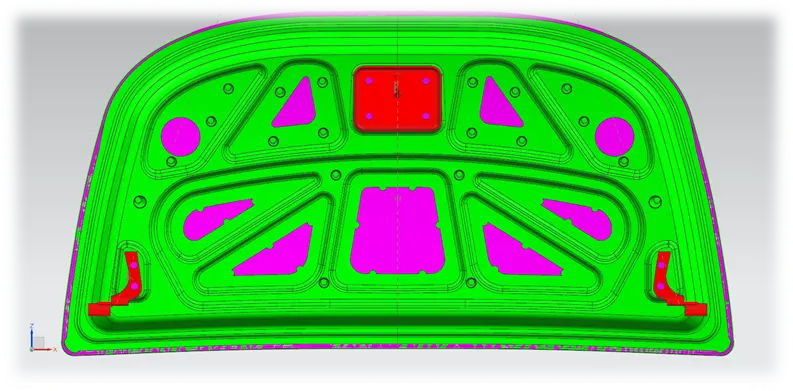
FINAL ASSEMBLY:
CONCLUSION:
Thus the hood is designed with respect to the parameters and the design, manufacturing consideration.