Roof challenge
Roof:
An automobile roof or car top is the portion of an automobile that sits above the Passenger compartment, protecting the vehicle occupants from sun, wind, rain, and other external elements. Because the earliest automobiles were designed in an era of horse drawn carriages, early automobile roofs used similar materials and designs.
In later years, many variations on the automobile roof developed. These include:
- Convertible roofs
- Hardtops
- Sunroofs
- T-tops
- Targa tops
- Vinyl roofs
The roof panel serves as a compartment shielding and connection of body sides, front and rear roof cross members.
Steel sheets of thickness in range of 0.70 to 0.85 are used conventionally for the construction of the roof.
Front Roof Cross Members: Front members are usually open section of thickness ranging from 0.7 to0.8mm of thickness. For heavier cars more robust sections are used.
Rear Roof Cross Members: These has a completely different cross section depending on the tail gate. For cars without a tailgate, the section will be an open section and is designed only for torsion.
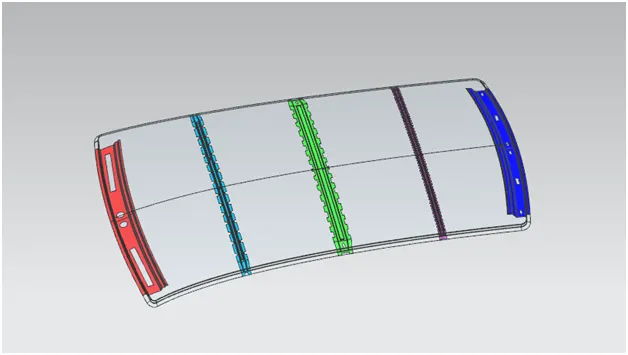
Bow Roofs: Bow roofs provide a connection between body side and roof in case of a side impact. Bow roofs are preferably screwed to the body side for tolerance adjustment.Steel sheets of 0.75 to 1mm thickness are commonly used for making bow roofs.
Picture of a sample Bow roofs.
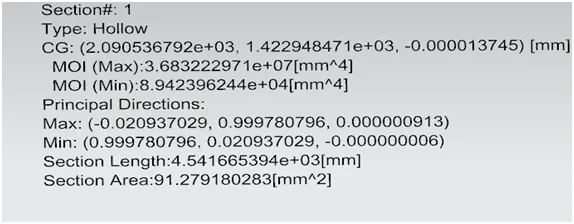
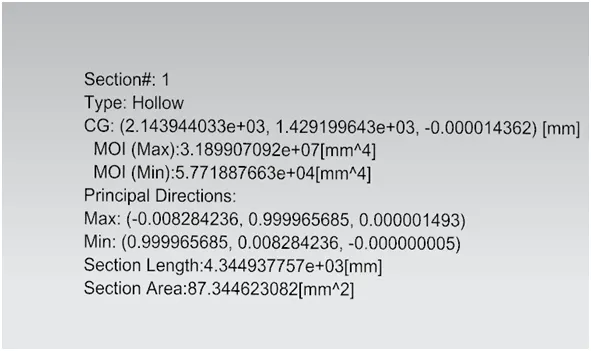
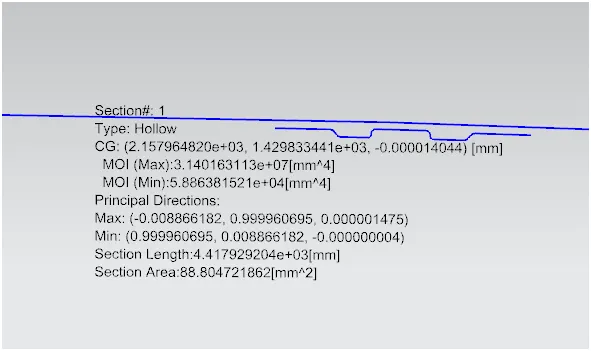
Section Inertia analysis of a different roof rails:
Front Roof rail.
Bow roof 1.
Center roof rail.
Bow roof 2.
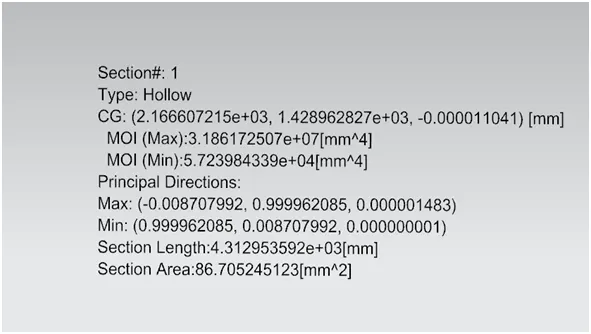
Rear roof rail.
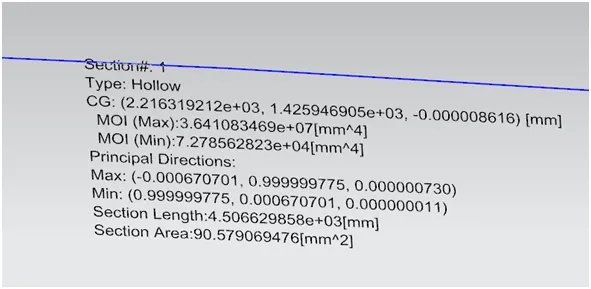
Calculations to determine the position of the Bow-roof:
- Bow – roof prediction Formula
W = [1.73 x 10^(-3) x L] + [1.85 x 10^(-8) x (R^2)/t] + [ 1.10x10^(-3) x l] - 2.68
Judgement Condition : OK< 2.7> NG
Where
L = Roof Length in X-Direction[mm](Roof dimension in 0-Y)
R = Roof curvature
R = 2(Rx*Ry)/(Rx+Ry)
Rx = X curvature
Ry = Y curvature
t = Roof plate thickness [mm]
l = Bow Roof Span [mm]
The below chart shows the data for different variables used in the equations along with the calculations.
|
Roof |
L |
Rx |
Ry |
R |
t |
I |
W |
condition |
|
FR&1st Bow |
2072 |
3329 |
13490 |
5340 |
0.75 |
407 |
1.56 |
Ok |
|
1st bow¢er |
2072 |
4267 |
10150 |
6008 |
0.75 |
442 |
2.28 |
Ok |
|
Center&2nd bow |
2072 |
6050 |
6636 |
6329 |
0.75 |
438 |
2.04 |
Ok |
|
2nd bow&RR |
2072 |
6464 |
2685 |
3794 |
0.75 |
369 |
1.89 |
Ok |
- Snow load Prediction formula
Qr = [Iy x t2] / [α x s x [(Rx + Ry)/2]2 x 10-8]
Note: The Qr value given over here is correct. There was a typo error in the formula given in the video.
Where
α = My x Lx2 x 10-12 , My = Y(Ly-Y)
Judgement condition = Qr ≥ 3.1
250 ≤ s ≤ 380
t = Roof plate thickness [mm]
Ly = Distance between the front and rear roof Rails on the Vehicle along with 0Y[mm]
Length of Roof panel with the center point between Roof rail Front /Rear as the reference point of the front and the rear.
Lx = Distance between the Left and Right end of the roof on the Roof BOW [mm]
Width of the roof panel exposed on the surface.
Y = Distance front Front Roof Rail to Roof BOW[mm]
s = Distance for which Roof BOW bears divided load [mm]
s = L1/2 + L2/2
Iy = Geometrical moment of inertia of Roof BOW (Y cross-section )[mm4]
Rx = Lateral direction curvature radius of roof panel Y cross-section on Roof BOW [mm]
Roof panel curvature Radius of the Length Lx in Front view
Ry = Longitudinal Direction curvature radius of the Roof panel X cross-section on Roof BOW [mm]
Roof panel X curvature radius of length s in Side view
|
Roof |
MOI |
t |
Y |
L(Y) |
L(X) |
My |
α |
L1 |
L2 |
s |
Rx |
Ry |
Q |
OK/NG |
|
FR&1st Bow |
8942 |
0.75 |
435 |
1930 |
1055 |
650325 |
0.7238 |
430 |
672 |
551 |
3320 |
13490 |
41.85632 |
Ok |
|
1stbow& cen |
5775 |
0.75 |
587 |
1930 |
1065 |
788341 |
0.9356 |
672 |
484 |
578 |
4365 |
10100 |
9.81243 |
Ok |
|
Cen&2nd |
5886 |
0.75 |
467 |
1930 |
1127 |
683221 |
0.8623 |
484 |
283 |
383.5 |
6050 |
6605 |
36.12061 |
ok |
|
2nd &RR |
5724 |
0.75 |
403 |
1930 |
1157 |
615381 |
0.8536 |
283 |
0 |
141.5 |
6460 |
2680 |
NIL |
|
Since all values are greater than 3.1 this design has passed the requirement.