Roof challenge
Roof BIW- Design criteria
Introduction
Roof BIW is an important load bearing commodity in a vehicle. The proper research must be done prior to designing of roof BIW as these could greatly affect critical factors such as head room clearance, front visibility criteria, weight of the car, position of bow roofs and support structures in case of roll over. Roof design is also affected by the market it is targeting provision of sun roof is not given as an option in all job markets.
Steps involved in designing
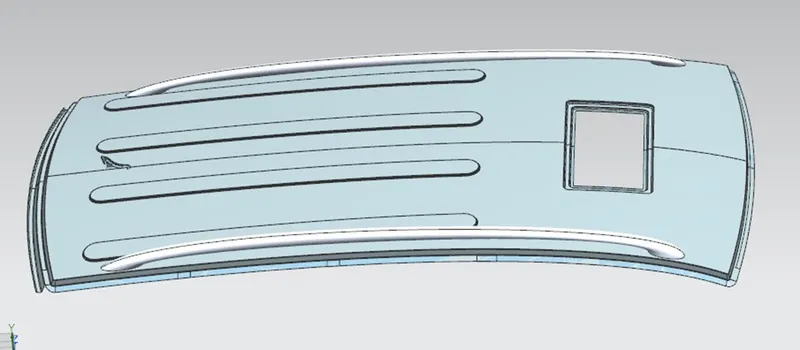
Roof design could be broken down to several steps after receiving the styling from the design team.
Step 1:
Since the roof is symmetric for most parts, the design could be simplified by modelling only half of the roof along its length later mirroring and sewing them together.
Step 2:
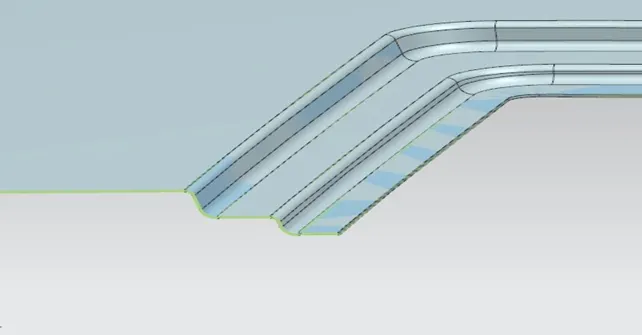
Step 1 is followed by design of front and rear roof rails according to master section provided. These could be done in either order. Design of front and rear roof rails is of utmost importance as they could affect the front visibility criteria, head room clearance and in case of rear roof rail, control the placement of hinges to mount the back door. Depending on placement of hinges to mount the backdoor, the rear roof rail design could show very high variation.
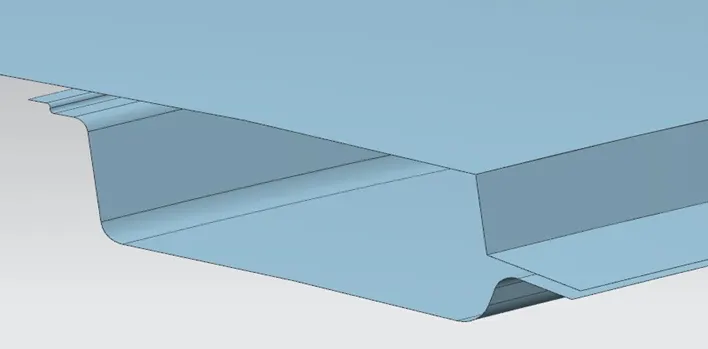
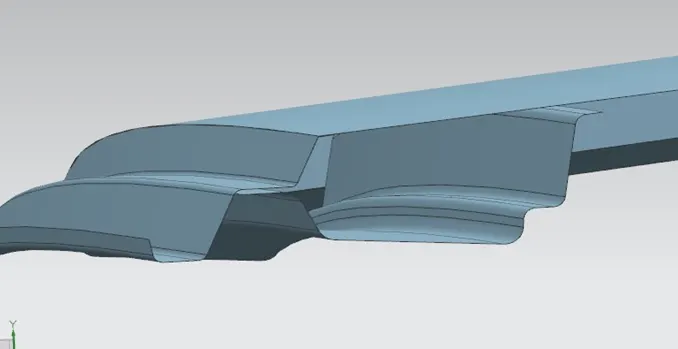
Step 3:
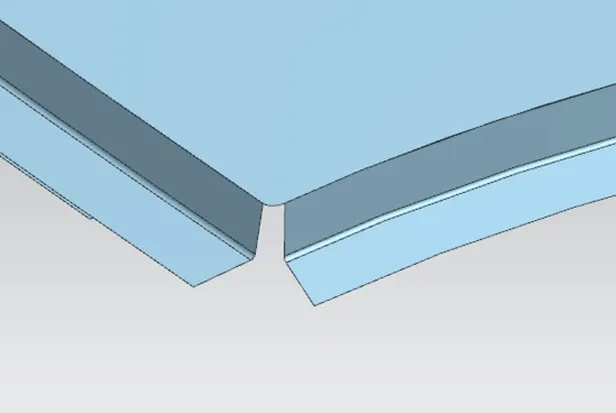
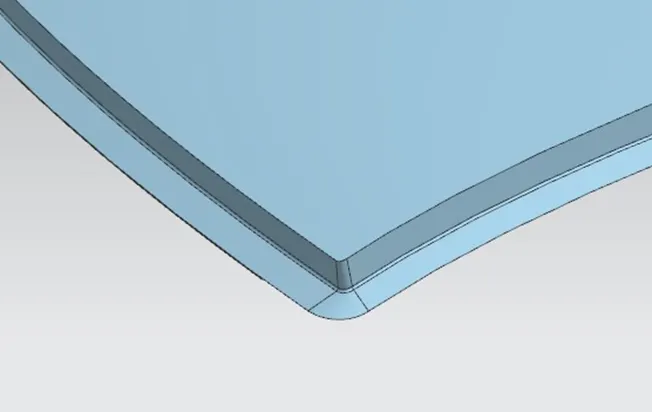
This is later followed by creation of side rails of the roof and making it blend with the front and rear roof rails. All or most of the surface are created using law extension and they are merge together by creating bridge curves that are later used as guide curves in studio surface. The bridge curve ensures the surface created it using follows proper tangency.
Step 4:
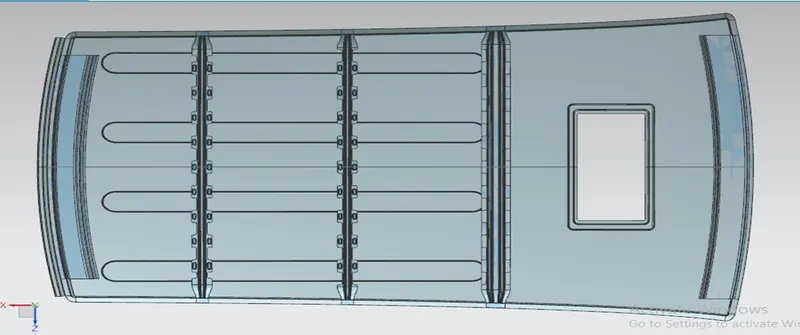
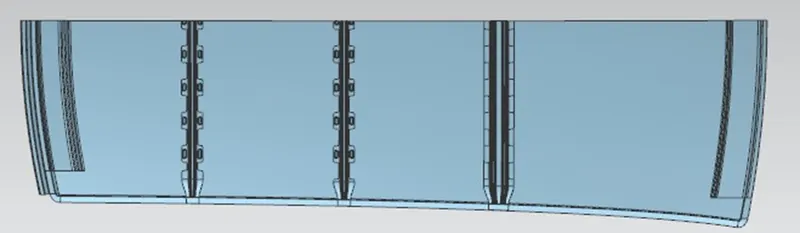
Creation of bow roofs and central roof rails: The placement and the number of support structures needed are dependent on the roof styling. They vary mostly depending on the length of roof and curvature of roof. Small vehicles such as Maruthi Alto could get by only using one roof rail, whereas bigger vehicles such as Ford Endeavour may require 4 or 5 bow roof. Also the more flat the roof surface is, higher are the chances of failures at that portion as sheet metals shows more structural properties when they are blended or deformed.
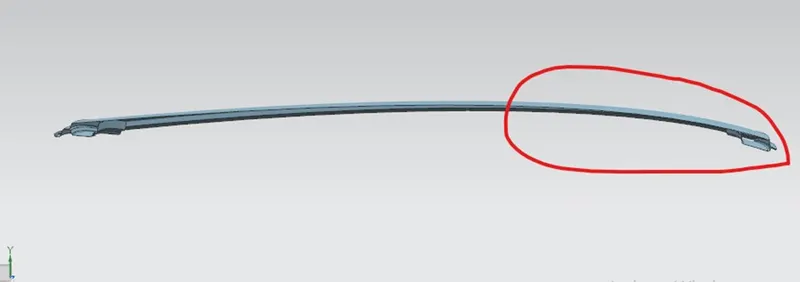
In the given roof styling, it can be easily seen that there is a roof curvature towards the front of the styling. This indicates that the first support structure could be placed further back where the surface is more flat. In the given roof styling, 2 roof rails and one central roof rails were used as the roof styling was more than 2 meters long.
Step 5:
Validation of the design: Design validation must be done by the designers prior to sending to the CAE team. Criteria such as heat distortion and snow load criteria could be checked for and controlled by the design team. Factors such as the number of bow roof and their positions could be controlled and adjusted in order to get better results in such test. It needs to be noted that both heat distortion and snow load prediction formula can be used only after mirroring and thickening all the components.
Heat distortion criteria: W={1.73*10^(-3)*L} + {1.85*10^(-8)*R^(2)/t} + {1.1*10^(-3)*l} - 2.68
The points are created at intersection points created on the roof surface and later an arc is created in X and Y directions and this radius is used to calculate R in the heat distortion formula.
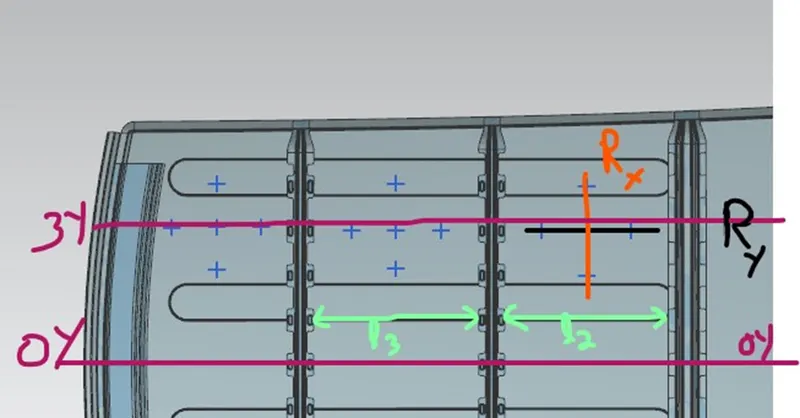
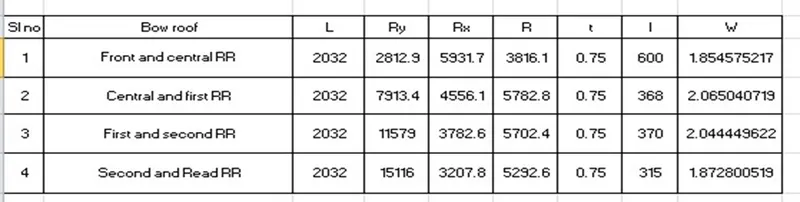
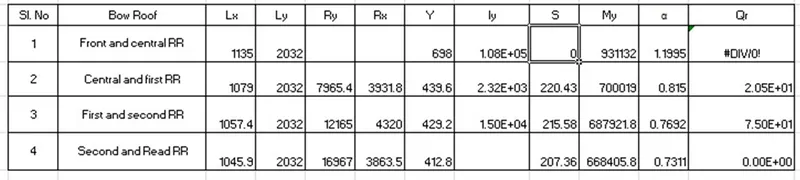
Snow load Prediction formula : Similar to heat distortion criteria, points are made at the centre of the roof and the intersection points are taken at 0Y and exactly between the roof rails and also at intersection of curves offset 100mm in both X and Y directions.
Qr= ly*t^(2)]/[α*S*[(Rx+Ry)/2]^2*10^(-8)]
Were, s=(L1+L2)/2 ; α=My*Lx^2*10^-12 ; My=Y(Ly-Y)
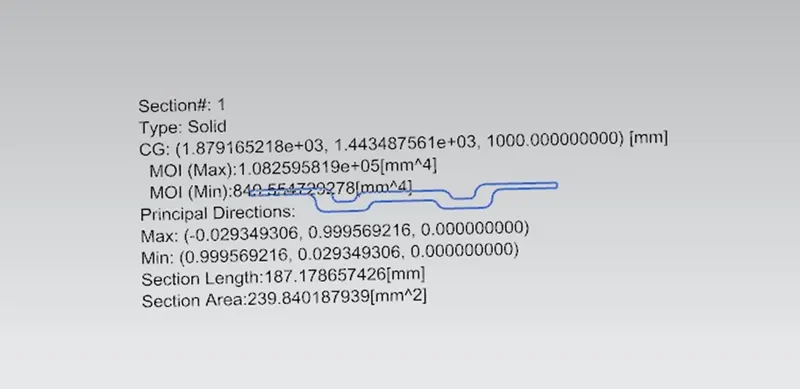
Iy is the moment of inertia. It is taken by projecting the outer surface of the bow roof onto a plane parallel to the surface and analysing while considering the surface to be solid.
Step 6:
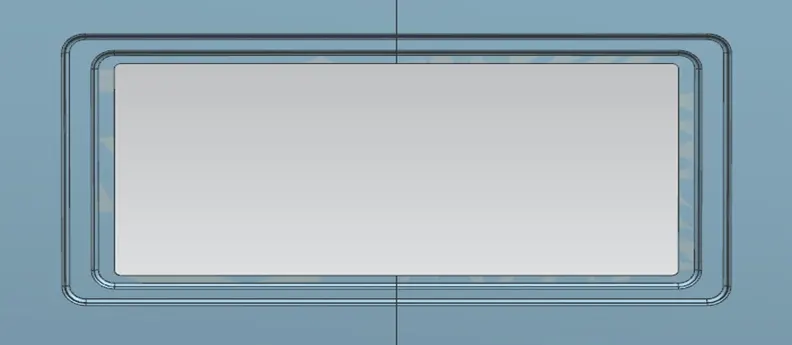
The position of first support structure could be brought further back by providing sun roof at the front in the marked region as creation of local embosses could help improve the strength locally at those position.