Roof challenge
AIM:-
1.For the given Car Roof styling, design and develop the essential flanges and reinforcements, namely the Ditch Area, Front Roof Rail, Rear Roof Rail, Centre Roof Rail and Bow-Roofs.
- Do a curvature study on the roof and perform calculations for Heat Distortion and Snow load criterion to determine and justify the position of the Bow-roofs.
- Do a Section Modulus study for the Master sections created for the Front Roof Rail, Rear Roof Rail, Bow Roof Rails and Centre Roof Rail
- Perform Draft Analysis of each reinforcement.
Introduction:-
Roof is used to protect the passengers from the rain, sun, wind and any external accidents or elements hitting. It will cover the overall part of the car or vehicle.
It will be placed on the top of the car with some reinforcements and roof rails. All roof rails and reinforcements placed under the styling roof and inside of the roof. They are used to increase the strength. Front roof rail, bow roof rails, center roof rail, rear roof rail. The no. of bow roof rails depends on the requirements of vehicle and length of the vehicle. All roof rails are attached with outer panel of the roof by the ditch areas of them.
Roof and roof rails design& draft analysis:-
Roof outer panel:-
Outer roof panel is panel which is created from the given skin data of the car outer roof, which can be taken from the parent car. This skin data is major criteria in creating of the roof and roof rails.in roof design we need to consider the head room clearance, visibility criteria, clearance for wind shield and back door and some more factors should be considered while designing the ditch are. We should give the thickness of the 0.75mm and the clearance between the ditch area and roof should be minimum of 0.2mm.
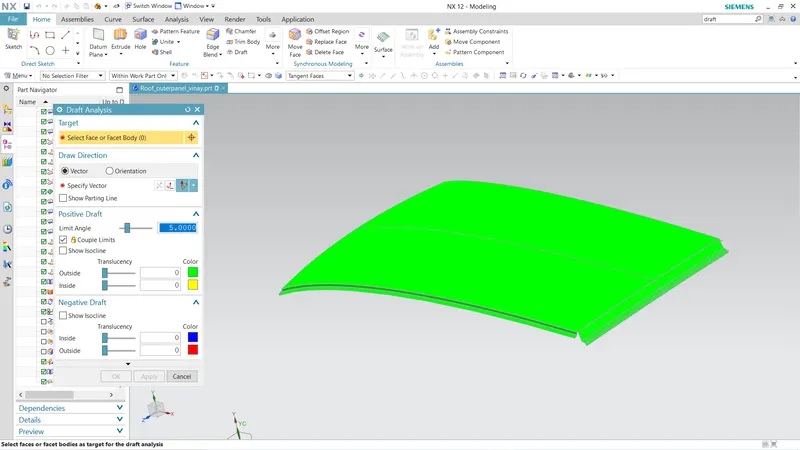
draft analysis of the outer panel
Ditch area:-
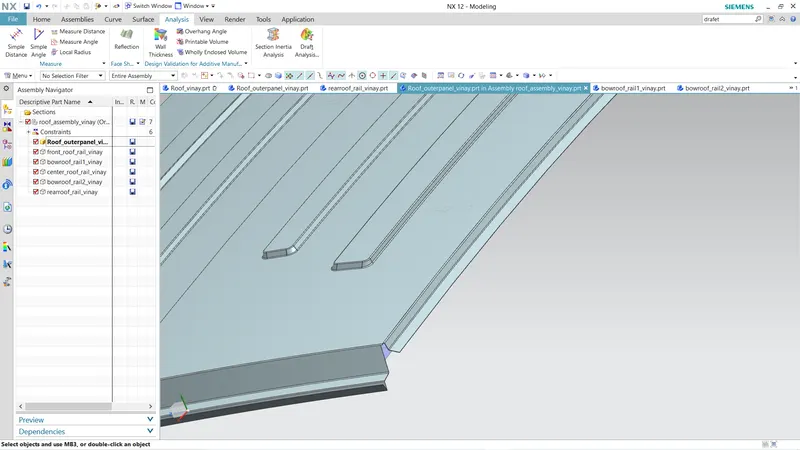
The ditch area is the extended portion of the roof concealed by other BIW panels. The
Rail supports of the roof are attached to the ditch area using spot welds, since it is not a styling surface and remains concealed. Headroom clearance, visibility criteria for wind shield and some other factors in designing. Thickness should be given 0.75mm and clearance must be greater than 0.2mm.
Front roof rail:-
The front roof rail is placed in the front of the roof. Which is joined with the shield glass, body side outer and the inner panels. It is usually made from body side outer scrap and therefore the thickness of the rail 0.75 mm and clearance between the outer roof and the front roof clearance should be greater than 0.2mm.the draft angle should be greater than 5 degrees for deep drawing operation. The bottommost flange is decided after taking into consideration the visibility criteria and the headroom clearance of the passenger. Spot welds are applied at wind shield end of the rail and the other end is joined with the roof using mastic sealants which also contributes to increased strength.
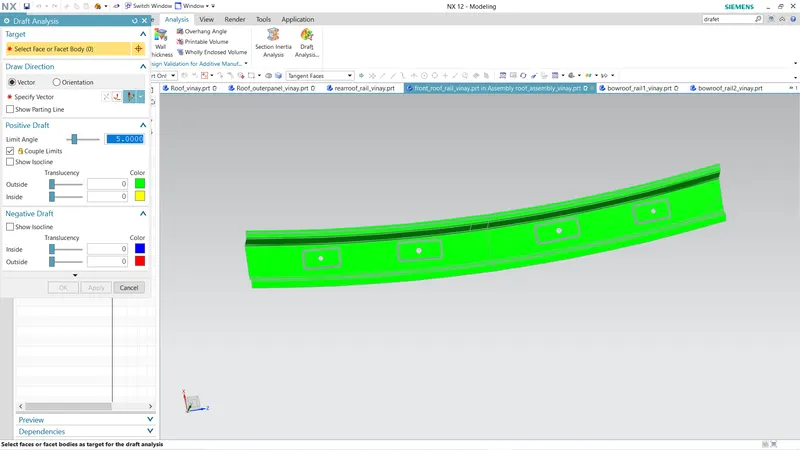
draft analysis of the front roof rail
Rear roof rail:-
It is the support which is joined to the Back Door and the Body Side Outer and the inner panels. It is also usually made from Body Side Outer scrap and therefore the thickness of the rail is 0.75 mm. Similar to the Front Roof Rail design, we have to take into consideration the rear Headroom Clearance and the rear visibility criteria while designing the Rear Roof Rail. Inputs from the backdoor design is also taken to accommodate the required clearance. Spot Welds are applied at the Back doorend of the rail and the other end is joined with the roof using Mastic Sealants.
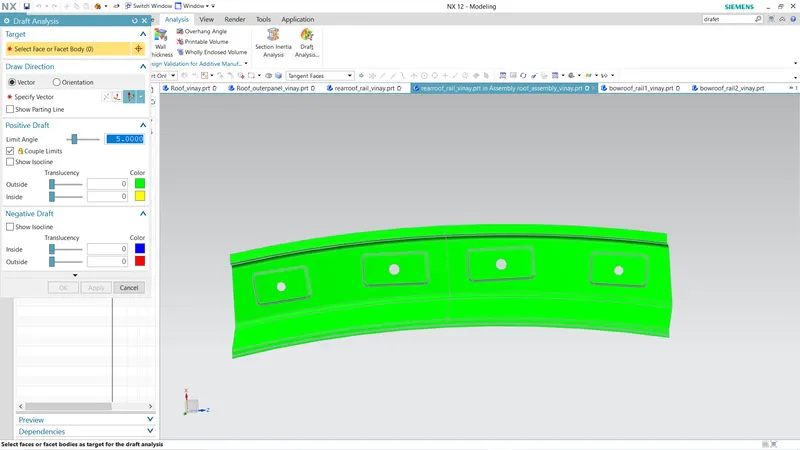
draft analysis of the rear roof rail
Center roof rail:-
Similar to other Rails design, we have to take into consideration the Headroom Clearance and the visibility criteria while designing the Centre Roof Rail and Bow Roofs. But unlike the Front and Rear Rails, Spot Welds are not applied for Joining these rails to the roof. Instead Mastic sealants are introduced at both the ends since Centre Roof Rail and Bow Roofs are fully positioned under the Styling surface of the Roof. For increasing the strength of the rails, embossing is done. To reduce the weight of the material used, a different styling has been followed with a thickness of 0.75 mm. The length of this roof in y direction should be 80 to 100mm.
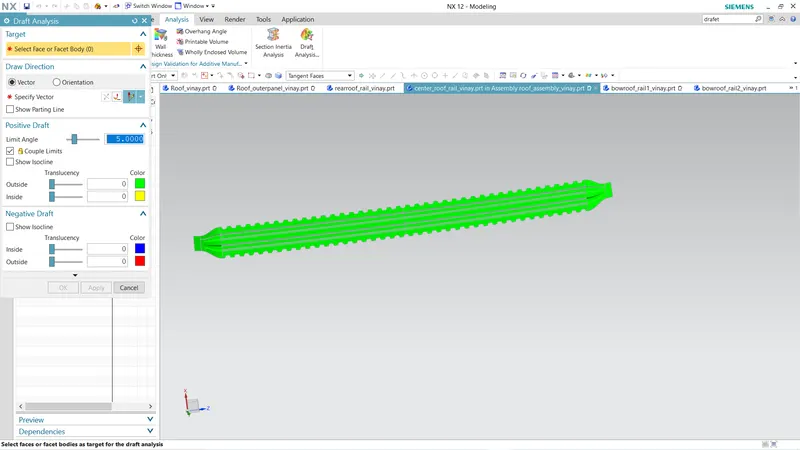
draft analysis of the center roof rail
Bow roof rail:-
Bow roof rails is used give the strength to the roof. This design is similar to center roof rail, we consider the headroom clearance and the visibility criteria. This roof have I change from the center roof rail is the length of the roof rail is 60 to 80mm. The number of bow roofs creations is depends on requirements and parent car analysis.
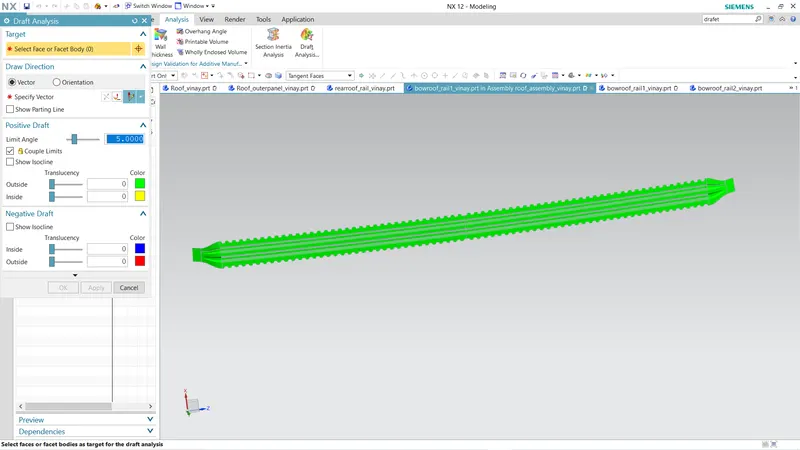
draft analysis of the bow roof1
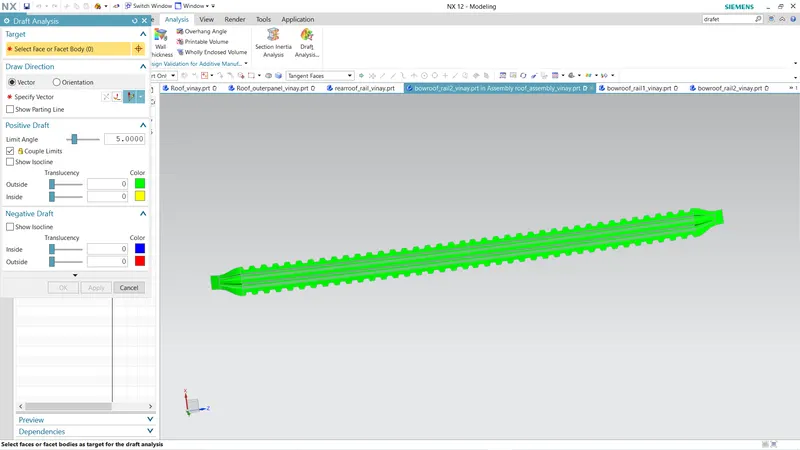
draft analysis of the bow roof2
assembly:-
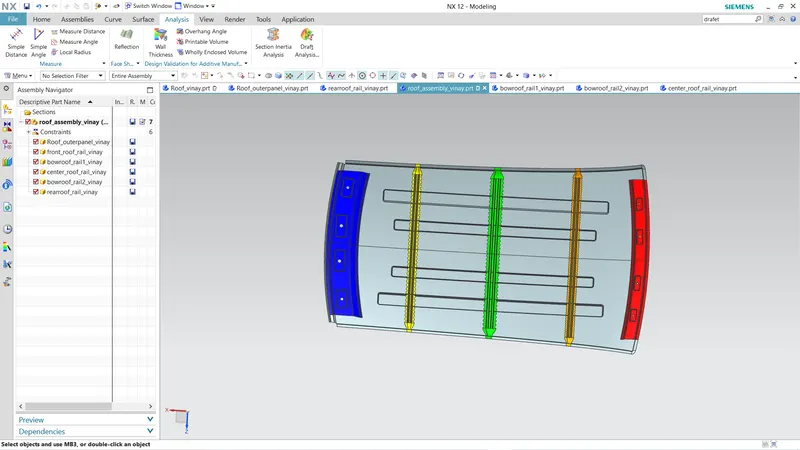
Analysis-
- Curvature Study
It is done to justify the positioning of the Bow Roofs. There are mainly three criterion to fulfil
- Roof Crush test
- Heat Distortion Criteria
- Snow Load Criteria
Roof Crush Testing is done only after the part or prototype is manufactured in physical conditions.
Roof crush test
For roof crush test we need physical body to it. But here in design we can’t do that. So, we are leaving this test. But we can do remaining two calculation.
Heat Distortion Criteria
Heat distortion temperature is the temperature at which the metal softens and deforms under a specific load. This study is done to check the ability of the roof to withstand high temperature with respect to the positioning of the reinforcements which contribute to increased strength.
Prediction Formula : W=1.73×10^-3×L+1.85×10^-8×R2t+1.10×10^-3×l-2.68">W=1.73×10^−3×L+1.85×10^−8×R^2t+1.10×10^−3×l−2.68
W=1.73×10^-3×L+1.85×10^-8×R^2t+1.10×10^-3×l-2.68">Judgement Condition: OK < 2.7mm ≤ NG
Where,
L = Roof Length in X-Direction [mm] (Roof dimension in 0-Y)
R = Roof curvature= 2(Rx*Ry) / (Rx+Ry)
Rx = X curvature
Ry = Y curvature
t = Roof plate thickness (mm)
l = Bow Roof Span (mm)
When applying the corresponding measurements into the formula, the criterion is met for all the reinforcements.
 Snow Load Criteria
Snow load criteria study is done to check the ability of the roof to withstand snowfall and bounce back to its original shape without any permanent deformation once the load is removed.
Prediction Formula:
Qr=Iy×t^2/α×s×(Rx+Ry/2)^2×10-8">Qr=Iy×t^2/α×s×(Rx+Ry/2)^2×10−8
Judgment condition: Qr ≥ 3.1
Where,
α=My×Lx^2×10⁻¹², My=Y(Ly−Y)
t = Roof plate thickness (mm)
Ly = Distance between front and rear roof rails on vehicle 0-Y (mm) i.e. Length of Roof panel with the centre point between Roof rail FR/RR as the reference point of the front/rear.
Lx = Distance between the left and right end of roof on the roof BOW (mm) i.e. Width of the Roof panel exposed on surface
Y = Distance from Front roof rail centre to Bow roof (mm)
s = Distance for which Bow roof bears divided load (mm) = L1/L2 + L2/2
Iy = Geometrical moment of inertia of Bow roof (Y cross section) (mm4)
Rx = Lateral direction curvature radius of roof panel Y cross section on Bow roof (mm) i.e. Roof panel curvature radius of the length Lx in front view
Ry = Longitudinal direction of curvature radius of roof panel X cross section on Bow roof (mm) i.e. Roof panel X curvature radius of the length s in side view
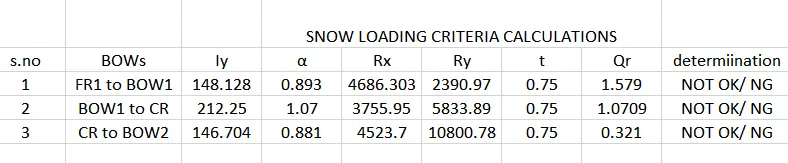
When applying the corresponding measurements into the formula, the criterion is met for all the reinforcements.
Remedy or solution:-
We calculated the heat distortion values they passed the requirements. But for the snow loading criteria they didn’t passed the requirements. In that case we have three solutions.
- To change the positions of the bow roofs and check the with is correct position for roof.
- Increase the thickness of the roof rails for better MOI for the roof rails. That can also increase the Qr value.
- Creating the embosses on the roof outer panel for better strength. That embosses should have 5mm length (not includes blends)
For first two cases they require more time consumption, here I have less time so I will follow the 3rd solution CREATING THE EMBOSSES.
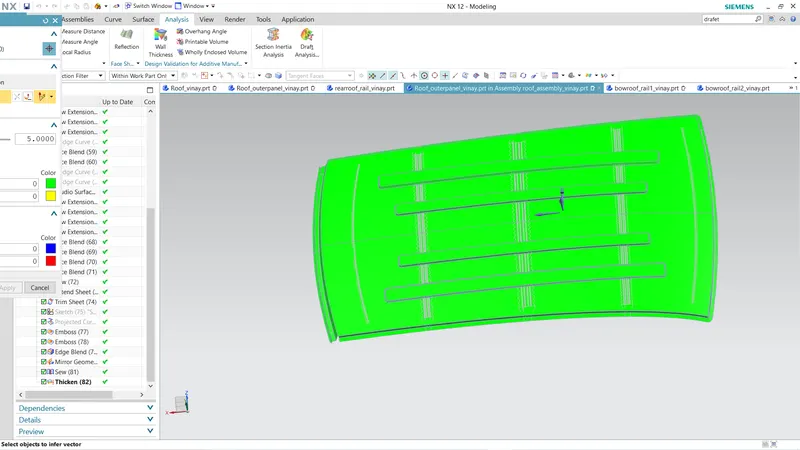
draft analysis of the roof outer panel after creating embosses
Conclusion:-
As per given dimensions and master sections we created the roof and roof rails for a car. And we also calculated the heat distortion and snow load criteria. For not passing of the snow loading criteria, we given the solution by creating the embosses. Hence it will pass the snow load criteria and heat distortion. we have done draft analysis for each bow roofs and outer panel also. we determined the positions of roof rails.