Roof challenge
Roof :
The roof is the part that is present on top of the vehicle. It prevents the rain and other things from entering into the vehicle from the top. The roof also plays a vital role in accident as it prevents the fatal condition for the passengers and the driver in the vehicle in the case of toppling. Also in places like Germnay and other snowy Countries, the roof prevents the snow entering in to the vehicle and thereby preventing the uncomfortable conditions for the driver and the passengers while commuting. The headroom also plays a avital role in deciding the visibility of the vehicle. If the vehicle's headroom clearance id very less, driver often might bang his head on the roof while driving over any bump or pothole or even while braking. To avoid these uncomfortable situations for drivers, the headroom clearance is calculated according to the type of the car before starting to designing.
The roof also plays a vital role in the aesthetics of the vehicle where the looks and also the other features in the roof contribute to the cost and profit of the vehicle.
The size of the hinges in the rear part of the roof is also calculated with respect to the boot space and other constraints that are involved in the vehicle.
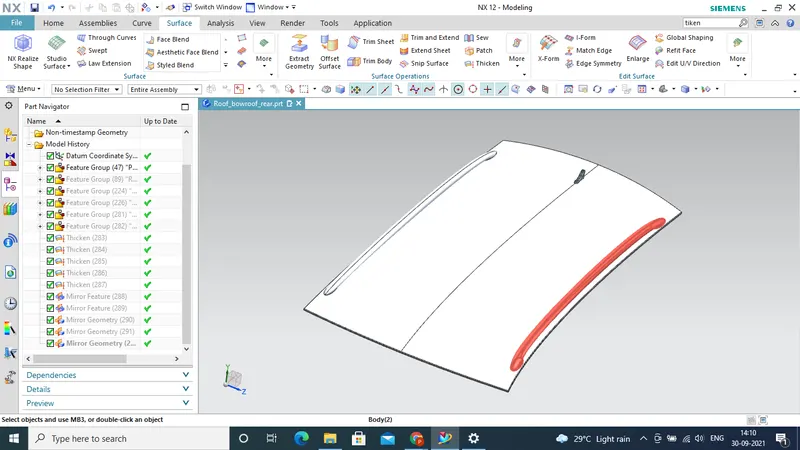
The roof has three important parts that supports the entire system.
They are
- Roof outer panel
- Roof inner panel
- Roof bow panel including center roof rail (the number of bow roofs are decided upon the length and load bearing conditions)
Roof Outer Panel :
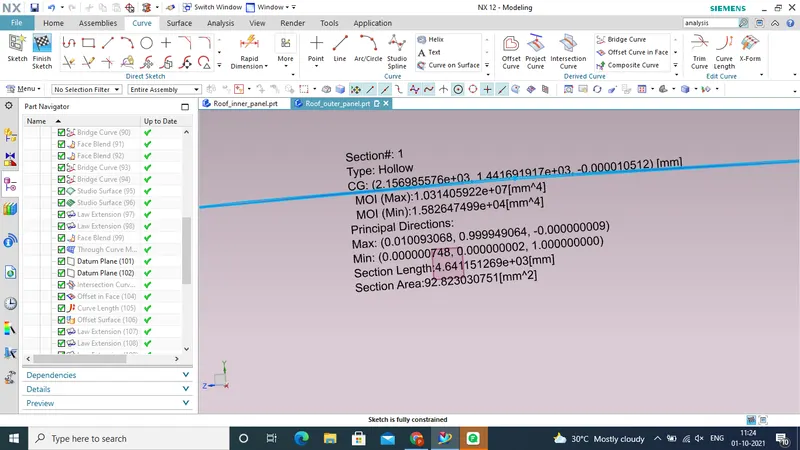
The roof outer panel is the one where all the other panels and rails are connected. The roof outer panel's front end is designed with considering design aspects of the front mirror assembly, front rubber sealants, weather sealants, mastics and also the thickness of the panel that is going to be designed. The drafting angles are given respectively and the faces are blended with their respective radii. All the panels and rails that are attached to the outer panel are being spot welded to it.
The general roof design.
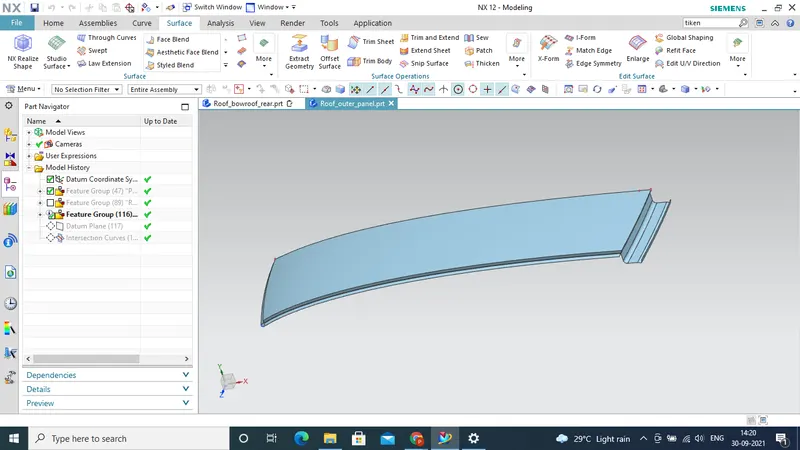
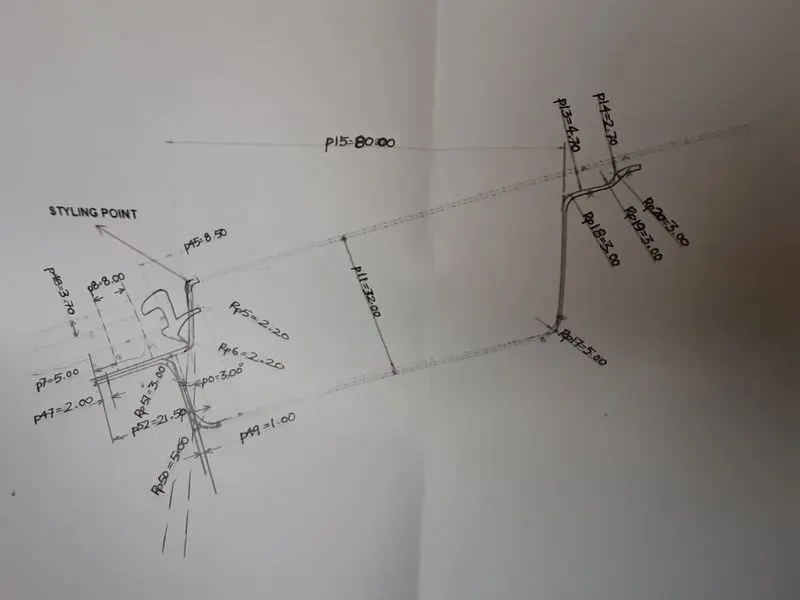
The place where the bow rails and reinforcements are joined by spot welds.
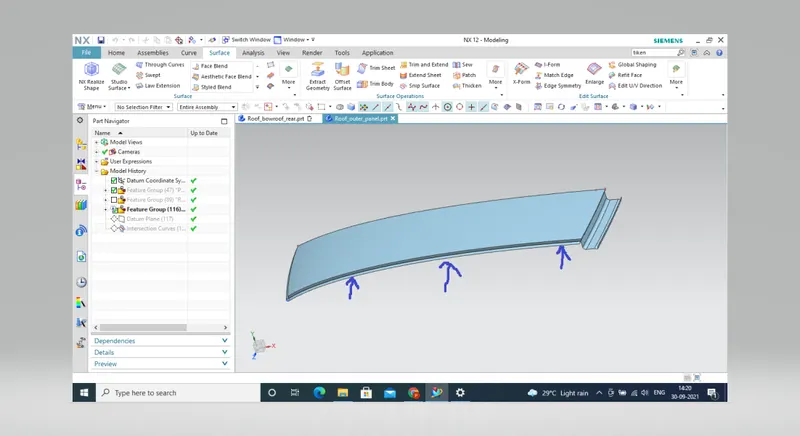
The number of rails and reinforcements are designed according to the Snow loading conditions and bow roof prediction fromula.
Roof Inner Panel :
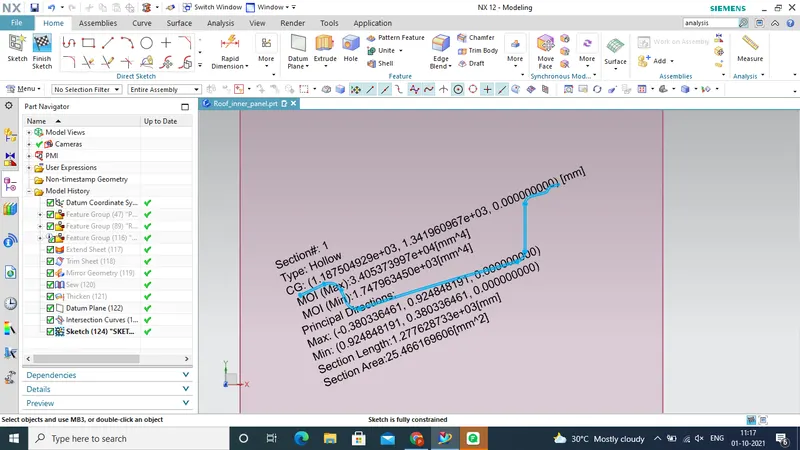
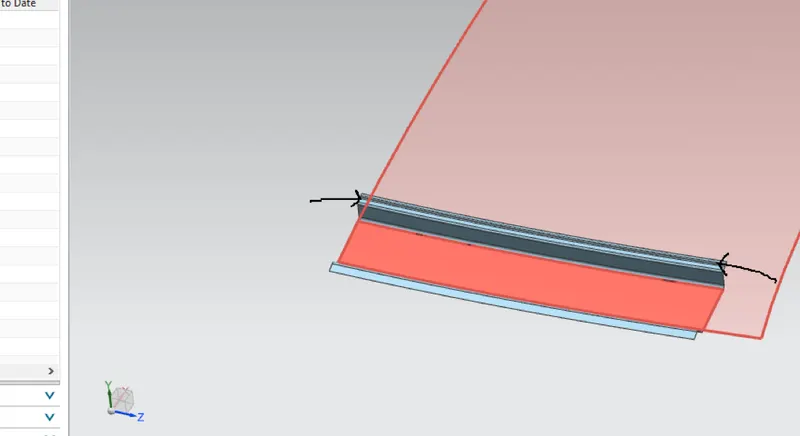
The roof inner panel is the one where the front mirror and the weather sealant is also assembled. The inner panel is the one where the front windscreen is attached along with the mastics and weather sealants.
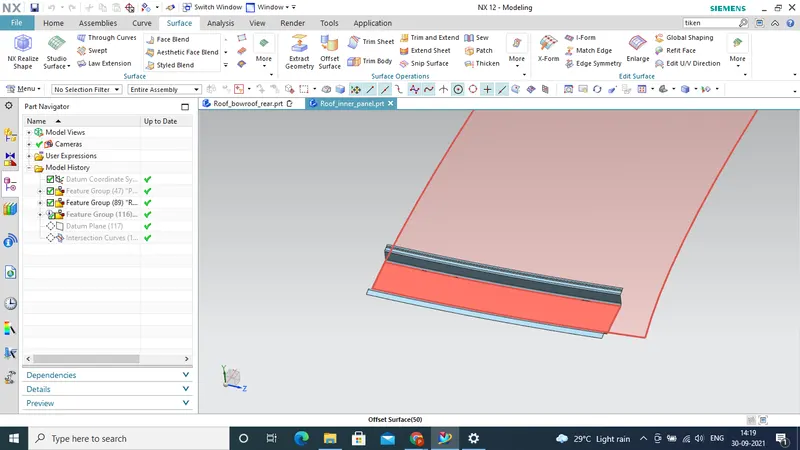
The region where spot weld are done to connect the adjoining parts along with mastics.
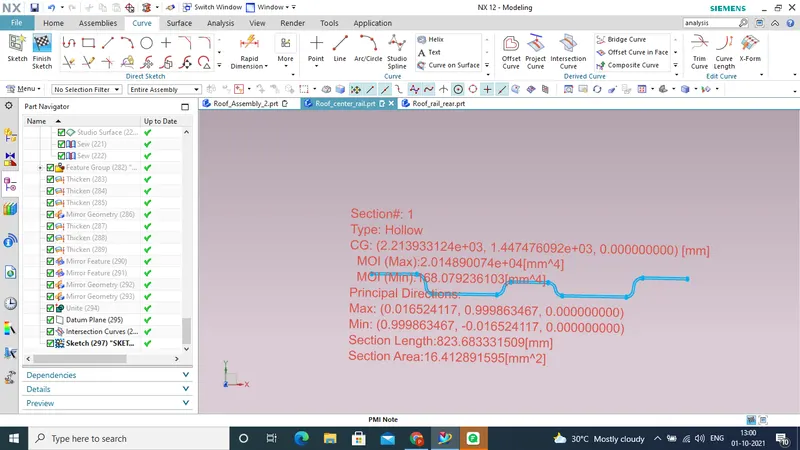
Bow Roof along with reinforcements or center rail :
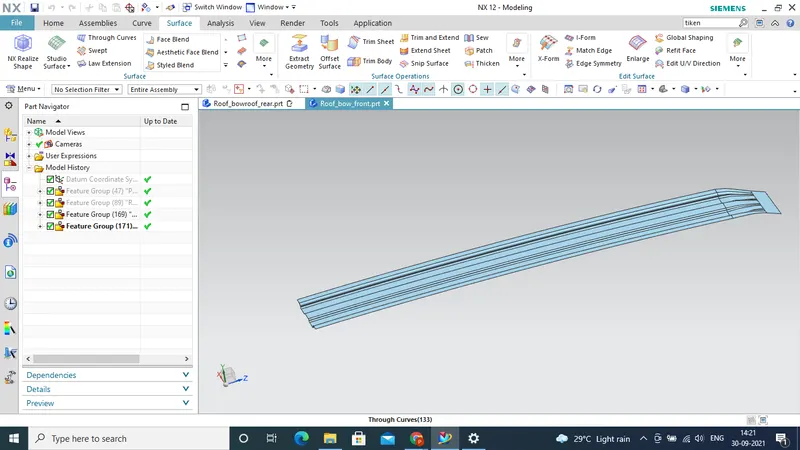
The bows are the supporting section where the roofs strength is increased by the addition of it. If the snow load of the vehicle is higher or the length of the roof or even if the safety standards should be a problem, the number of the bow rails are increaed. For the low end vehicles, there are no rails included in the roof whereas the highend vehicles uses extra bow rail for the sake of safety. They are also connected to the roof with mastics and spot welding. For example, the mastic beads are provided to bow roof with 5mm gap between each mastics beadings and also they are assited with spot welding in them.
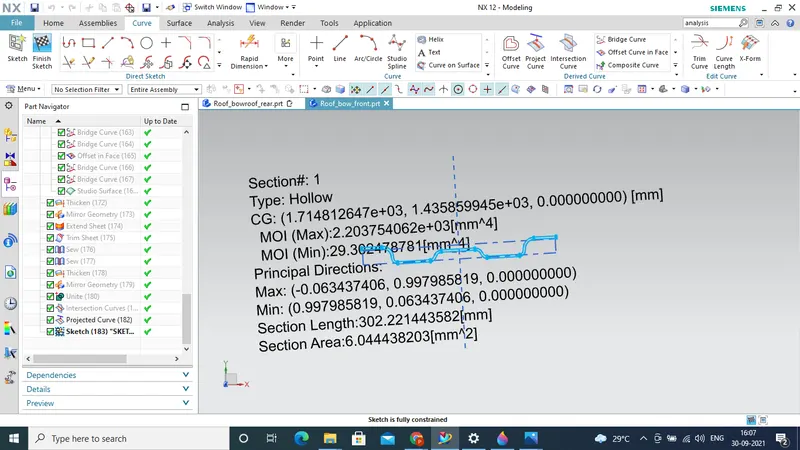
The image of the bow rail
The snow loading of the roof is calculated with the formula,
Snow load Prediction formula
Qr = [Iy x t2] / [α x s x [(Rx + Ry)/2]2 x 10-8]
Where
α = My x Lx2 x 10-12 , My = Y(Ly-Y)
Judgement condition = Qr ≥ 3.1
250 ≤ s ≤ 380
where
t = Roof plate thickness [mm]
Ly = Distance between the front and rear roof Rails on the Vehicle along with 0Y[mm]
Length of Roof panel with the center point between Roof rail Front /Rear as the front and rear reference point.
Lx = Distance between the Left and Right end of the roof on the Roof BOW [mm]
Width of the roof panel exposed on the surface.
Y = Distance front Front Roof Rail to Roof BOW[mm]
s = Distance for which Roof BOW bears divided load [mm]
s = L1/2 + L2/2
Iy = Geometrical moment of inertia of Roof BOW (Y cross-section )[mm4]
Rx = Lateral direction curvature radius of roof panel Y cross-section on Roof BOW [mm]
Roof panel curvature Radius of the Length Lx in Front view
Ry = Longitudinal Direction curvature radius of the Roof panel X cross-section on Roof BOW [mm]
Roof panel X curvature radius of length s in Side view
| S.no | Bow | Iy | alpha | Lx | Ly | y | s | Rx | Ry | t | Qr | Validation |
| 1 | Front Bow rail and Center Rail | 3997.4 | 0.89772 | 1217.4 | 2049.4 | 433.7 | 249.887 | 5211.2 | 2577.77 | 0.75 | 66.4778 | satisfied |
| 2 | Center and rear bow rail | 40273 | 0.84233 | 1256.9 | 2049.4 | 496.6 | 241.67 | 3877.8 | 9766.87 | 0.75 | 203.543 | satisfied |
Heat Distortion Test :
The roof will be subjected to a lot oh heat exposure in places where the climate is very sunny and also the vehicle has to stand in there for a long time. The bow roof should withstand the heat and then should not deform for the subjected heat. So the deformation rate and the curvature are calculated upon using the fromula mentioned below,
W = [1.73 x 10^(-3) x L] + [1.85 x 10^(-8) x (R^2)/t] + [ 1.10x10^(-3) x l] - 2.68
Judgement Condition : OK< 2.7> 3.1
Where
L = Roof Length in X-Direction[mm](Roof dimension in 0-Y)
R = Roof curvature
R = 2(Rx*Ry)/(Rx+Ry)
Rx = X curvature
Ry = Y curvature
t = Roof plate thickness [mm]
l = Bow Roof Span [mm]
| S.no | Bows | Rx | Ry | R | I | L | t | W | Vadidation |
| 1 | Front and 1st bow rail | 2455.19 | 5344.21 | 1755.34 | 2.203e+03 | 1988.7 | 0.75 | 1.188 | ok |
| 2 | 1st and Center bow rail | 6443.22 | 4388.23 | 2677.98 | 2.0148e+03 | 1988.7 | 0.75 | 1.254 | ok |
| 3 | center and Rear bow rail | 9877.26 | 3988.72 | 2702.87 | 3.776e+03 | 1988.7 | 0.75 | 1.433 | ok |
Section modulus of Bow roof rail 1