Design of backdoor
Back Door
The back door is considered as the most important part of the vehicle as importnat as any other part of the vehcile. It protects the vehicle from crash and also prevent any foreign materials and dust and other particulates from entering the body of the vehicle. The Back door is created with reference to the roof of the vehicle if the roof is created firt. Sometimes the design of the roof is genarated with respect to the design of the back door if the roof is created at last. With respect to the opening of the back door, the position od the honges are placed in two different places. They are
- Hinge inside the back door
- Hinge outside the back door
Hinge inside the backdoor :
If the hinge is placed on the inside of the back door, then hinges will be small and the back door will be opened inside the roof's rear part. The sealant flange is placed in such fashion that it doesnt affect the opening and the closing of the back door.
Hinge outside the back door :
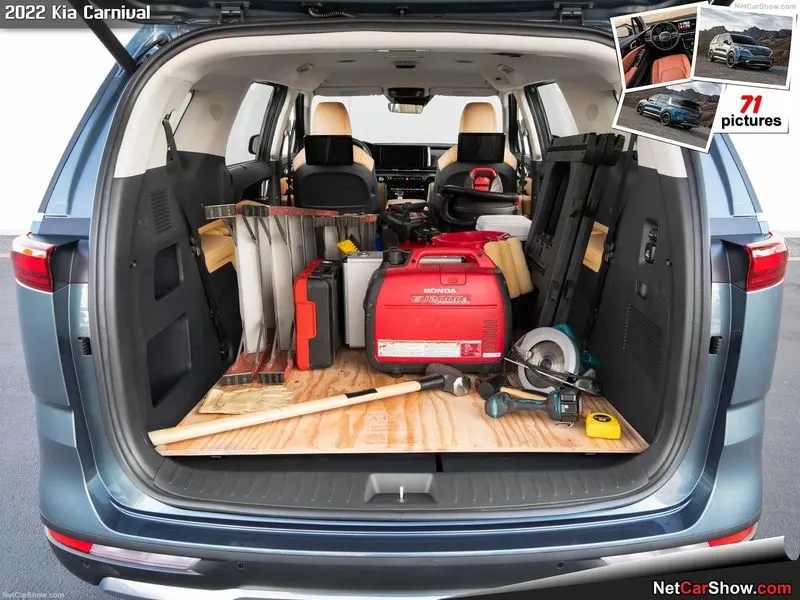
If the hinge is placed on the outside of the back door, then the support of the hinge to the back door will be large and the back door will be opened outside of the rear part of the roof. The design of the sealant flange is not considered as the back door is opened outside of the rear part of the roof.
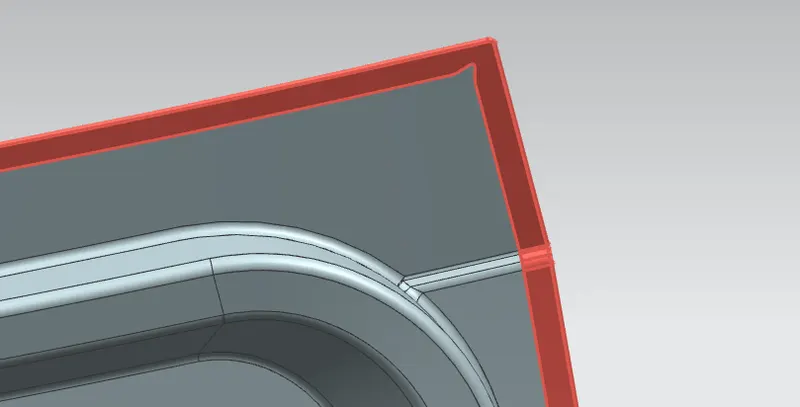
The Sealant Flange
The sealant flange consist of the sealant that seals the vehicle almost air tight making it difficult to the foreign particles such as the dust and other chemical substances along with water or snow from entering into the body of the vehicle. The sealants are the rubber substances that also help in smooth opening and the closing of the vehicle where as it provides cushion for the door while it is slammed into the latch for locking. This reduces the stress for the door thereby prolonging the life of the door.
Every car has different types of sealant and the common sealant that is used in the vehicles are of 20 to 25mm in width and goes through the entire place of the back door where it comes into contact with the adjoining face.
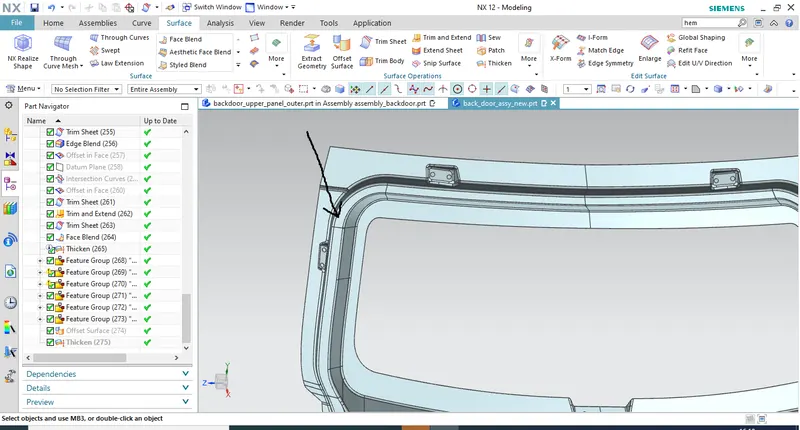
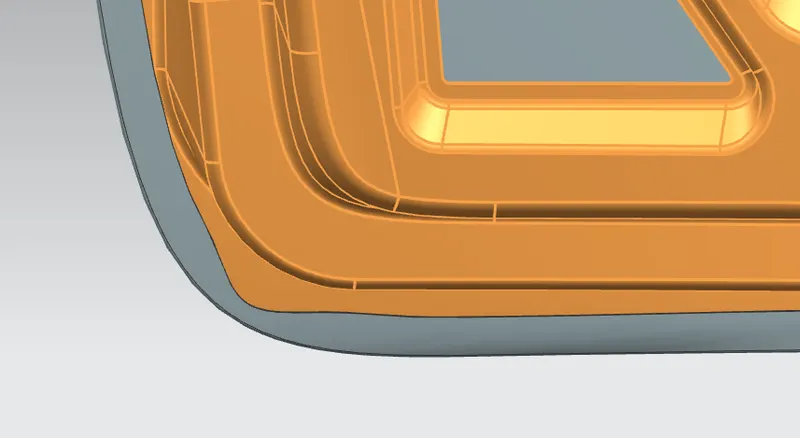
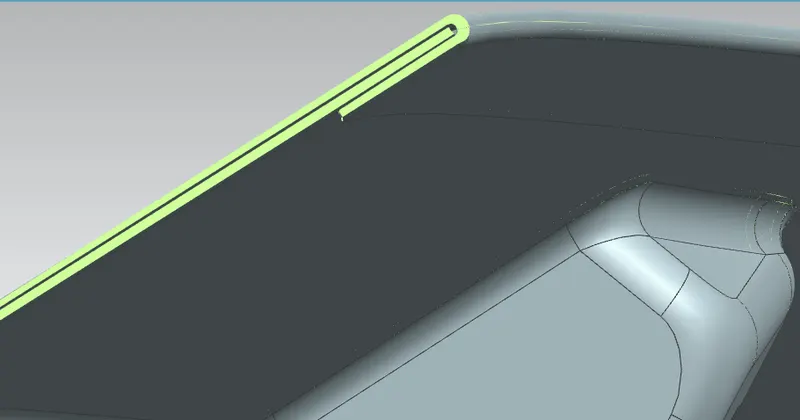
The sealant flange after the application of the sealant will look something like this,
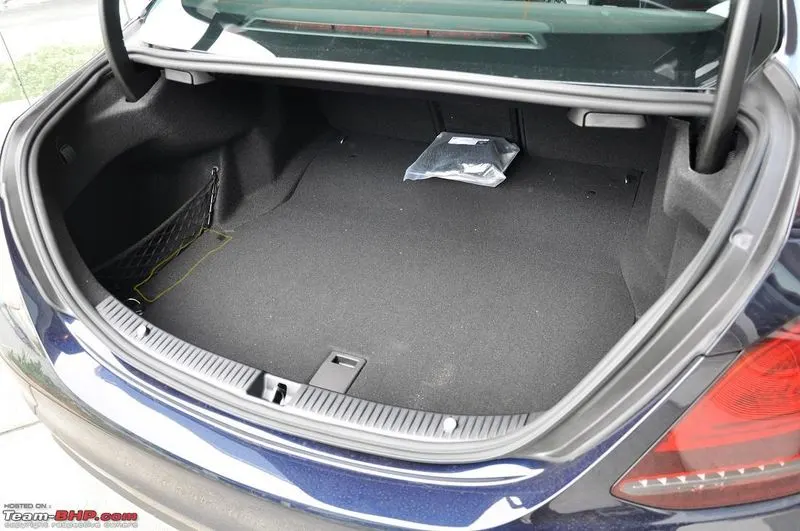
The back door also has room for the rear windscreen to get fixed so the driver also has the viewing advantage when he has to change the lane or overtake other vehicles.
While designing the back door, apart fromm the stunning looks tthe designer also has to take into consideration that he has to fix other parts such as the tail lights, the indicators and other accesories necesary to make the ride safe for both himself and the other drivers on the road. most of the parts that are assembled here are the plastic parts so their clamps are not fixed in the BIW part mostly.
The bottom part of the door also is a important one where the designer has to design accordingly to leave comfortable place for the hemming operation and efficiency of the production.
In here, most of the cars have parking sensors and the rear view cameras, which are not included in the design. They are included in the bumper that are placed in top of the product.
Reinforcements
The back door has reinforcements for the hinge emboss, gas stay and the wiper emboss along with the latch and striker emboss. All the reinforcements are made of an unique thickness to meet the requirements. The reinforcements are the part that are provided to a model at a particular point to increase the force that can be withstanded by the model.
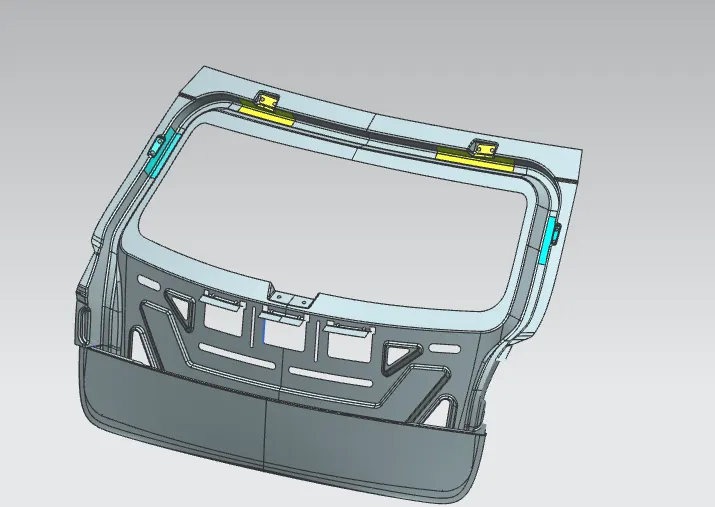
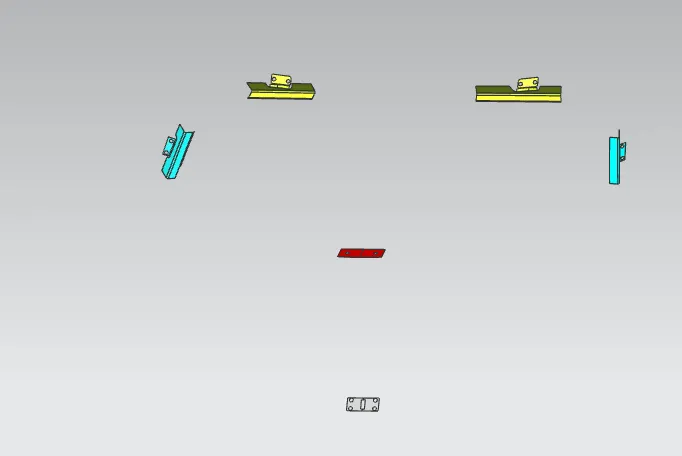
Cyan coloured are the Gas stay reinforcements
Yellow coloured are the Hinge reinforcements
Red coloured is the Wiper motor reinforcement
Grey coloured is the Latch and striker reinforcement
During the hinge emboss, The axis of the hinge is considered while designing the reinforcement. The hinge axis is taken as the base and a circle is drawn in the face and this circle acts as the perimeter of the circle that corresponds to the opening and closing of the surface of back door. Through this method the exact motion of the back door is formed in motion and the perfect design of the latch and striker is formed.
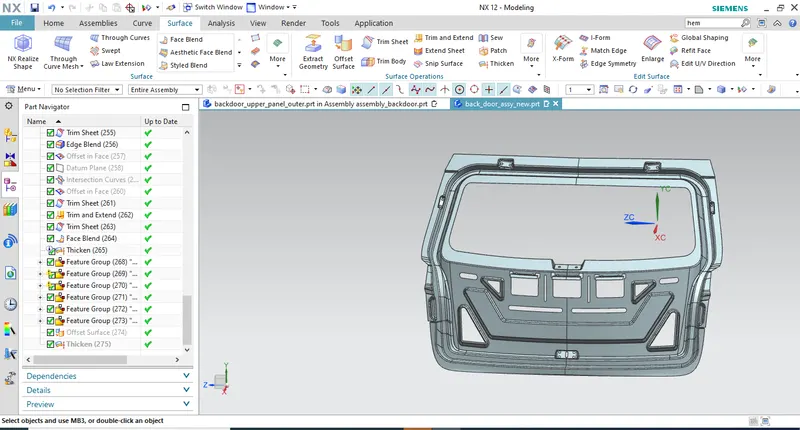
The center portion of the inner panel of the back door is given with emboss in such a fashion that the emboss directs all the forces generated during a accident into the edges of the door so that the door breaks and a major part of the force gets dissipated along with the breakage.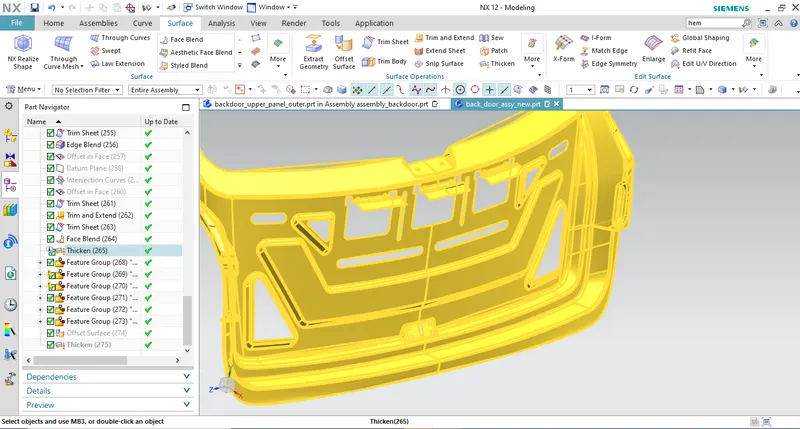
The tooling direction also plays a vital role in determining the cost of the manufacturing process. The reason behind is that usage of one tool in one direction in manufacturing will reduce the cost, time consumption and thereby increasing the profit of the company. If there are two tooling direction, machine expenditure will increase along with the time consumption ultimately decreasing the profit or increasing the cost of the model. Therefore it is essential for a designer to consider the tooloing direction while for a model of the component he designs. The tooling direction in a model can be defined by drawing a bisector line between the model from the approximate center.
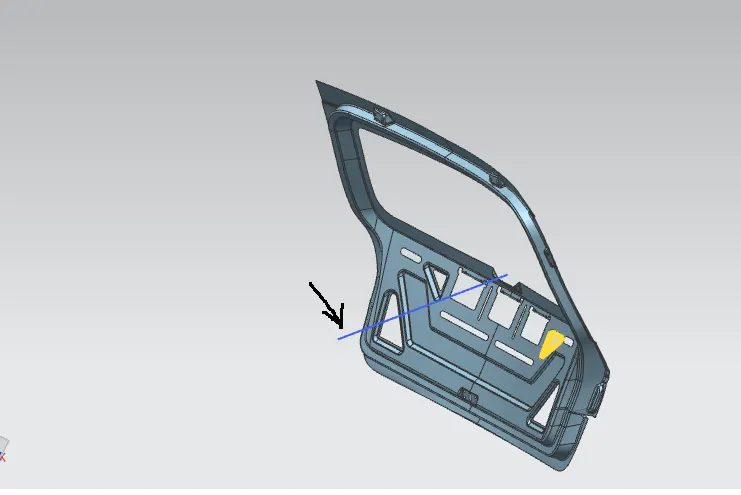
Draft Analysis is done to determine the draft of the angle of every flanges for easier and cost reduced manufacturing.
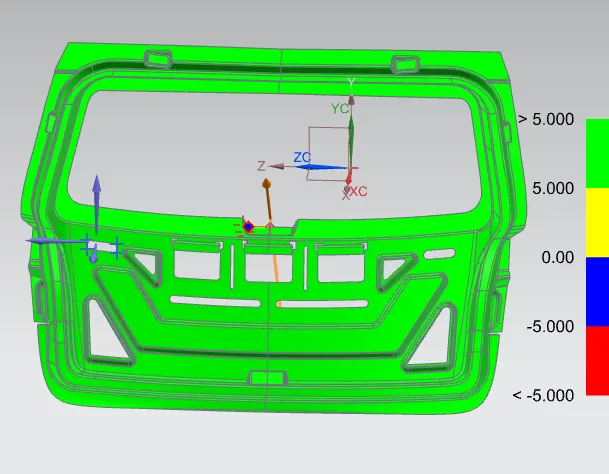
The color green indicates that the drafting process is possible in all the directions at ease.
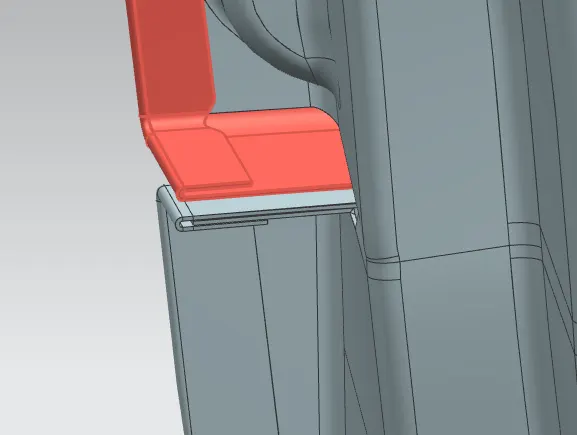
The outer panel and inner panel are joined togather by hemming process amd then by spotwelding. The mastics plays a vital role in joining the inner and the outer panel. It expands by heating and will be made into a glue like substance sticking the inner and the outer panel.
The process of hemming aso plays a vital role in joining the panels togather. They are done because in some spots of the panel spot welding cannot be done as it creates a bad surface in the class A area while processing, which leaves the customer to give a bad report or a degrading report on the manufacturing of the vehicle. This is easily overcome by Hemming where the inner and outer panel are turned togather with a little gap between them providing support for the adjoining flanges whithout the implementation of the welding process.
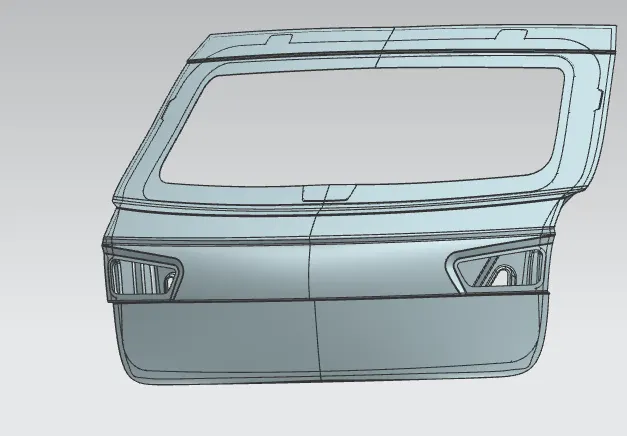
The complete assembly of the Back door looks like
The releifs are also made to support the hemming flanges and this supports the body to withstand some more force when compared to simple hemming without releif.