Roof challenge
AUTOMOTIVE DESIGNING OF ROOF OF A CAR
Aim:
To design a roof of a car with its required component and analyze the design with heat distortion, snow load calculation and draft analysis.
Introduction:
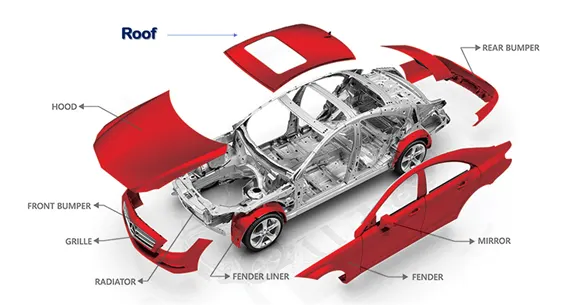
An automobile roof or car top is the portion of an automobile that sits above the passenger compartment, protecting the vehicle occupants from sun, wind, rain, and other external elements. Because the earliest automobiles were designed in an era of horse-drawn carriages, early automobile roofs used similar materials and designs.
In later years, many variations on the automobile roof developed. These include:
- Convertible roofs
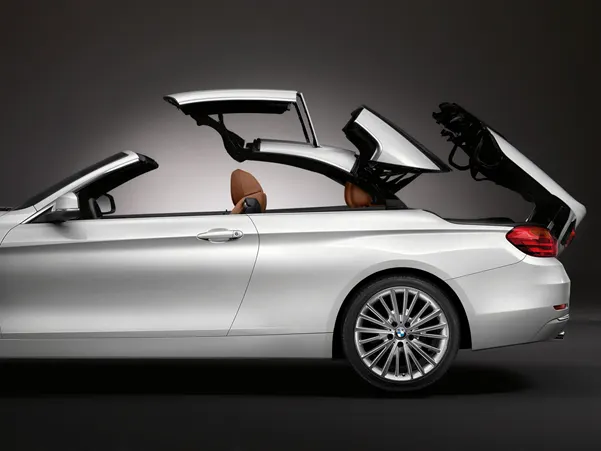
- Hardtops
A hardtop is a rigid form of automobile roof, which for modern cars is typically constructed from metal. A hardtop roof can be either fixed (i.e. not removable), detachable for separate storing or retractable within the vehicle itself.
Pillarless hardtop (often referred to as simply "hardtop") is a body style of cars without a B-pillar, which are often styled to give the appearance of a convertible design.
- Sunroofs
A sunroof is a movable panel that opens to uncover a window in an automobile roof, allowing light and fresh air to enter the passenger compartment. Sunroofs can be manually operated or motor driven, and are available in many shapes, sizes and styles. While the term sunroof is now used generically to describe any glass panel in the roof, the term "moonroof" was historically used to describe stationary glass panes rigidly mounted in the roof panel over the passenger compartment. A moonroof has a glass panel that is transparent and usually tinted. Previous terms include Sunshine Roof, Sliding Head and Sliding Roof.
- T-tops
A T-top (UK: T-bar) is an automobile roof with a removable panel on each side of a rigid bar running from the center of one structural bar between pillars to the center of the next structural bar. The panels of a traditional T-top are usually made of auto grade safety glass.
- Targa tops
Targa top, or targa for short, is a semi-convertible car body style with a removable roof section and a full width roll bar behind the seats. The term was first used on the 1966 Porsche 911 Targa, and it remains a registered trademark of Porsche AG.
- Vinyl roofs
Vinyl roof refers to a vinyl covering for an automobile's top.
Most of the early automobiles were open-air vehicles without any roof or sides.
As car engines became more powerful by the end of the 19th century, folding textile or leather roofs (as had been used on victoria or landau carriages) began to appear on cars.
Examples of early cars with roofs include the phaeton (a two-seat car with a temporary roof), the brougham or a coupé de ville, having an enclosed passenger compartment at the rear, while the driver sat in front either in the open, or the landaulet, where the driver has a fixed roof and the passenger compartment has a folding roof. Less expensive cars, such as the runabouts, sporting roadsters, or sturdy touring cars, remained either completely open air or were fitted with a rudimentary folding top and detachable side curtains.
In the 1920s, when steel bodies began to be mass-produced, closed cars became available to the average buyer, and fully open cars began their disappearance from the mainstream market.
In this project we are going to design a hard top roof with given skin and master section.
Master Sections:
These Master Sections of Front Roof Rail, Bow Roof, Centre roof rail and Centre roof rail reinforcement and rear roof rail are given as a reference for modelling our Car Roof
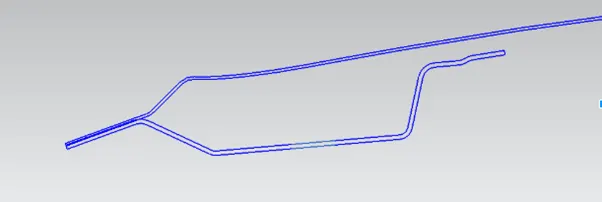
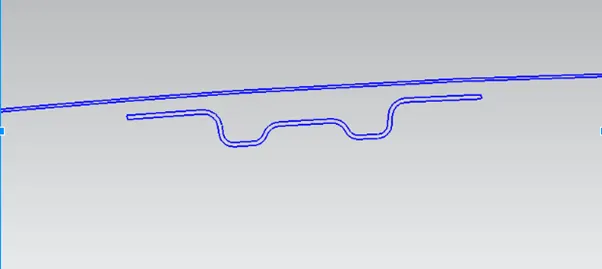
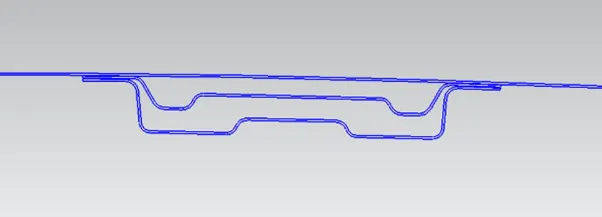
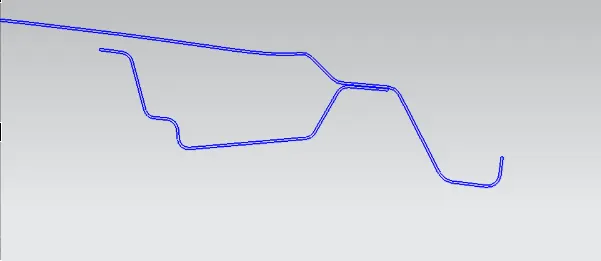
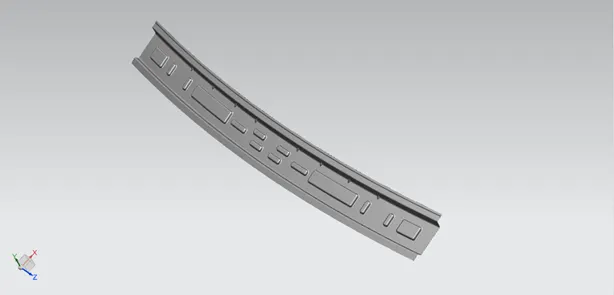
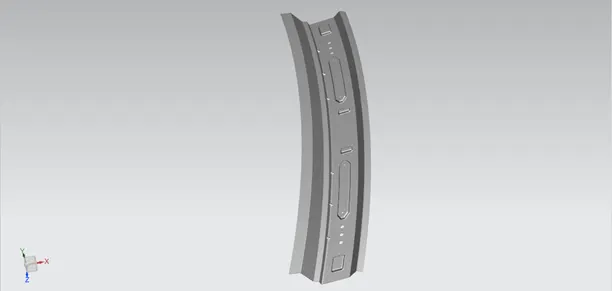
Flanges and reinforcements are made with reference to the master section and also with consideration of manufacturing process with the standard draft angle. Embosses, beads and holes are made to provide more strength to the rails.
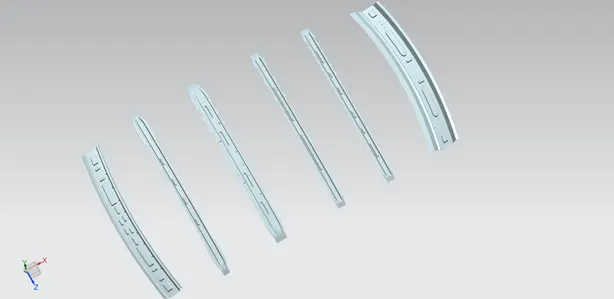
Front Roof Rail:
Rear Roof Rail:
Bow Roofs:
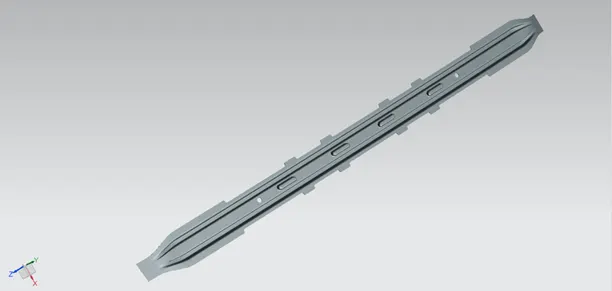
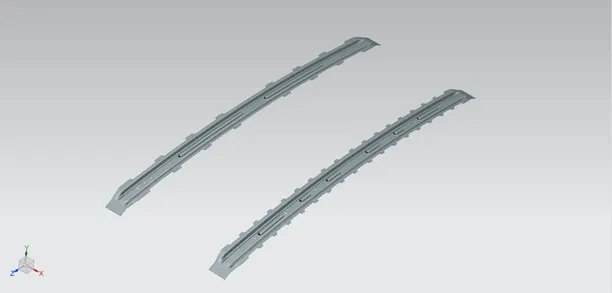
Fig. Bow Roofs 2 and 3
Centre Roof Rail:
Center roof rail is the most important part which holds the roof in position along support from body side of the car.
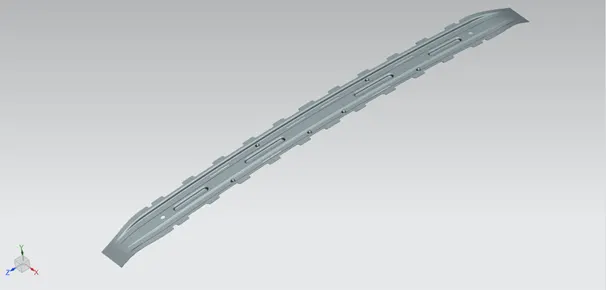
Centre Roof Reinforcement:
Centre Roof Reinforcement have been implemented to add more strength to the Centre roof rail because Centre roof rail provides maximum supports to the roof of weight load and structure.
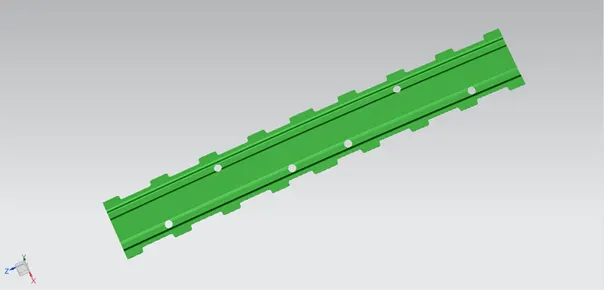
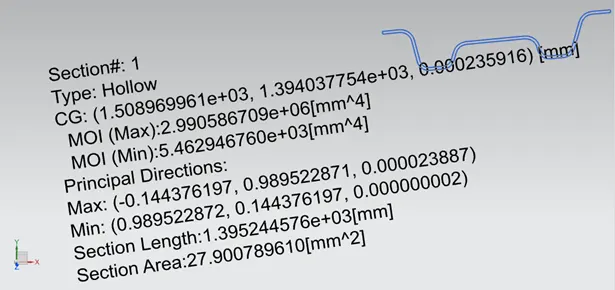
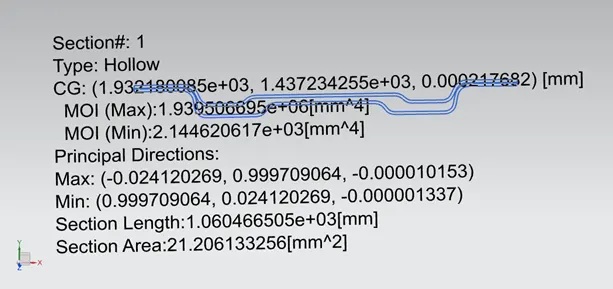
Section Inertia:
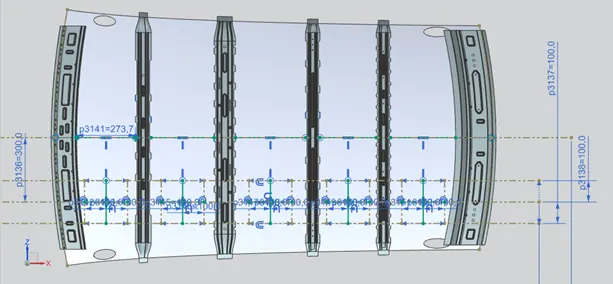
Curvature Study for Heat Distortion and Snow Load Analysis:
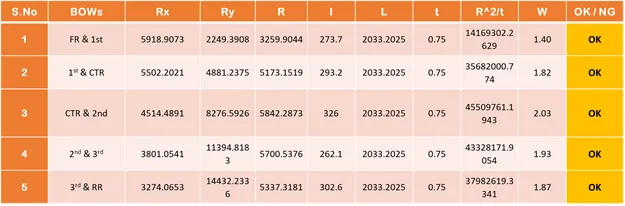
W=1.73*10-3*L+1.85*10-8*R2/t+1.10*10-3*l-2.68
Judgement condition: OK<2.7mm<NG
However, if the value is in the range of 2.7< W < 3.5 , we can provide outer panel reinforcement in the planning stage, and determine whether the reinforcement is needed or not through tests.
L:Roof length in X-direction(mm) (ROOF dimension with 0Y)
R:Roof Curvature
R=2(Rx*Ry) / (Rx+Ry)
Rx : X Curvature
Ry : Y Curvature
t : ROOF plate thickness [mm]
l : BOW ROOF span [mm]
Snow Load Criteria:
Prediction Formula : Qr = Iy * t2 / α*s*[(Rx+Ry)/2]2* 10-8
Where α = My*Lx2*10-12, My = Y(Ly-Y)
Judgement condition: Qr > 3.1 , 250 < s < 380
t: Roof plate thickness [mm]
Ly: Distance between the front and rear roof RAILs on vehicle 0Y [mm]
Length of ROOF panel with the center point between ROOF RAIL FR/RR as the reference point of the front/rear.
Lx: Distance between the left and right end of the roof on the roof BOW [mm]
Width of ROOF exposed on the surface
Y: Distance from FR roof RAIL center to roof BOW [mm]
s: Distance for which roof BOW bears divided load [mm]
s= L1/2 + L2/2
Iy: Geometrical moment of inertia of roof BOW (Y cross section) [mm4]
Rx: Lateral direction curvature radius of roof panel Y cross section on roof BOW [mm]
Roof panel curvature radius of the length L, in FR/VIEW
Ry: Longitudinal direction curvature radius of roof panel X cross section on roof BOW [mm]
Roof panel X curvature radius of the lengths in SIDE/VIEW
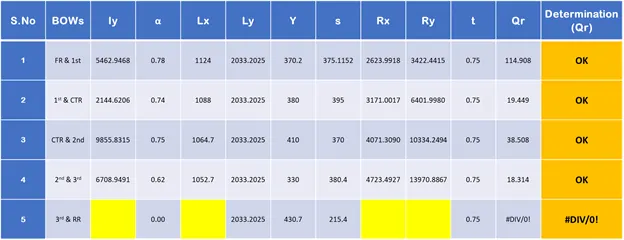
The above are values of each individual roof BOWs.
From Snow load Calculation of Roof it is clear that our roof model passes the snow load test, we conclude that this roof model with stand the loads of the snow during winter in the regions like Europe.
And we also see that at (1st & CTR) & (2nd & 3rd) bow roof region, the value of distance (s) for bow roof bearing the load exceeds 380. So we have added embosses to the roof outer panel to compensate this and these embosses will add more strength to the roof.
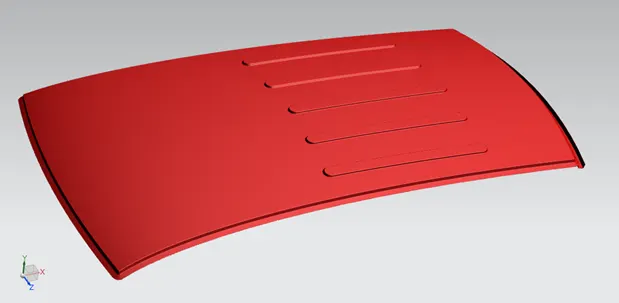
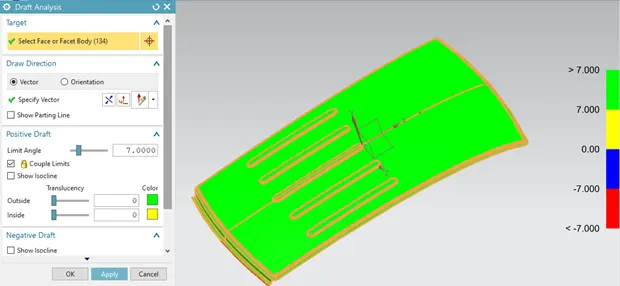
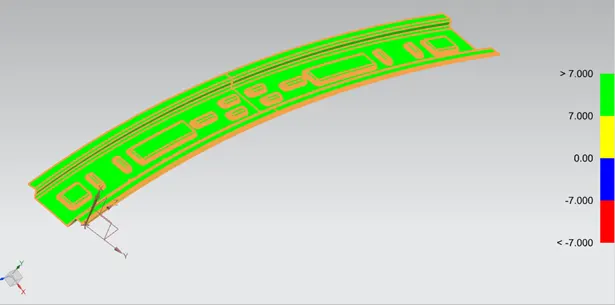
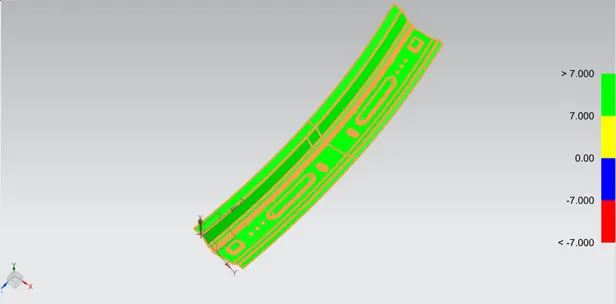
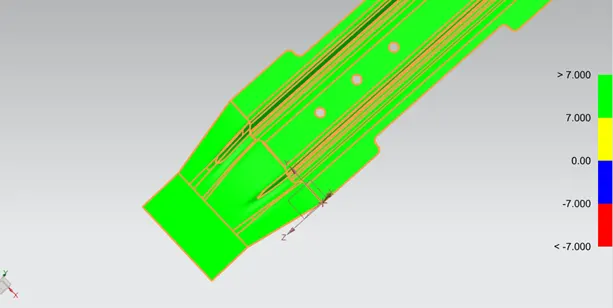
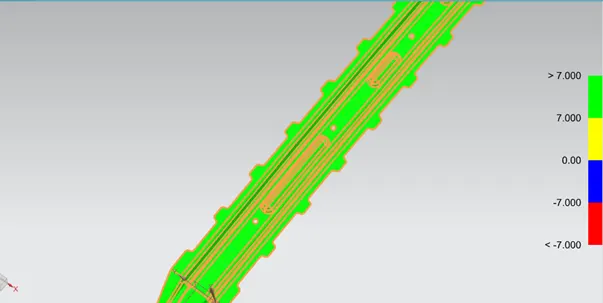
After completing the BOWs and ROOFs, we have check drafting angle provided in the model can be machined and manufactured, for that we do draft analysis of each part.
Draft analysis:
With minimum angle as 7 degree each parts are analyzed for error less in further process of manufacturing of our model.
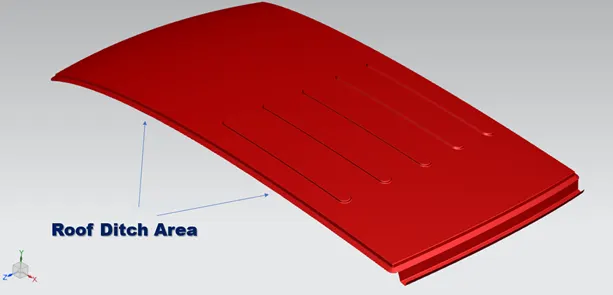
Roof Ditch Area:
Roof ditch area is the region where side outer panels from side door or pillar side will get in contact while assembly.
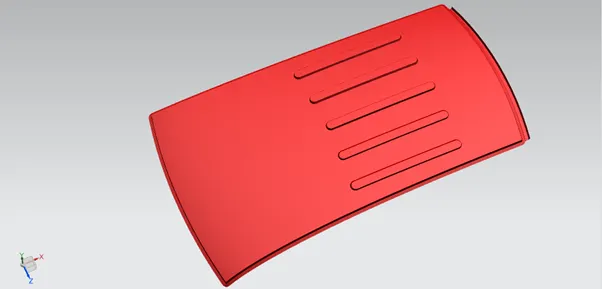
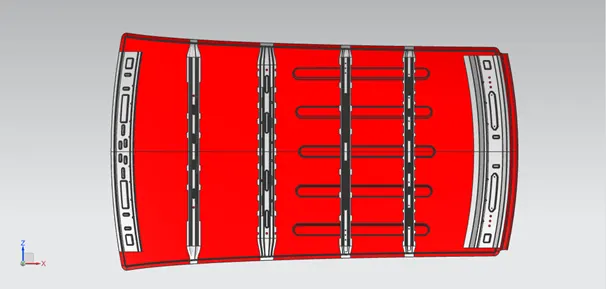
Final Model:
Conclusion:
A roof of a car with its required component is designed and analysis of the design with heat distortion, snow load calculation and draft analysis is carried out and a better strengthen roof model is designed.