Roof challenge
AIM:
Design of Roof Panel
OBJECTIVE:
To design and calculate the performance criteria for the Roof and Rail Reinforcement design, Adding necessary features to develop the strength of the roof.
INTRODUCTION:
Roof is not just a styling surface, it provides protection to the vehicle occupants so we need a good structure to the roof. In the roof assembly we have roof rail, roof bow, roof support etc which make the roof stronger.
As a safety point of view roof panel is undergone through varies test in which crush test and roll over test look for the strength of the part. So when designing we have to consider strength as an important point.
Design consideration of roof:
- Visibility criteria
- Head clearance
- Curvature study
- Heat distortion and snow load criteria
- Draft analysis
- Safety parameters
Design of roof:
Inputs Given:
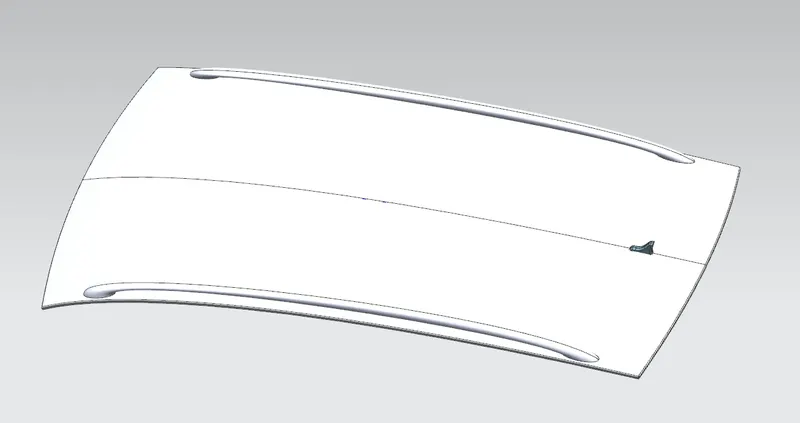
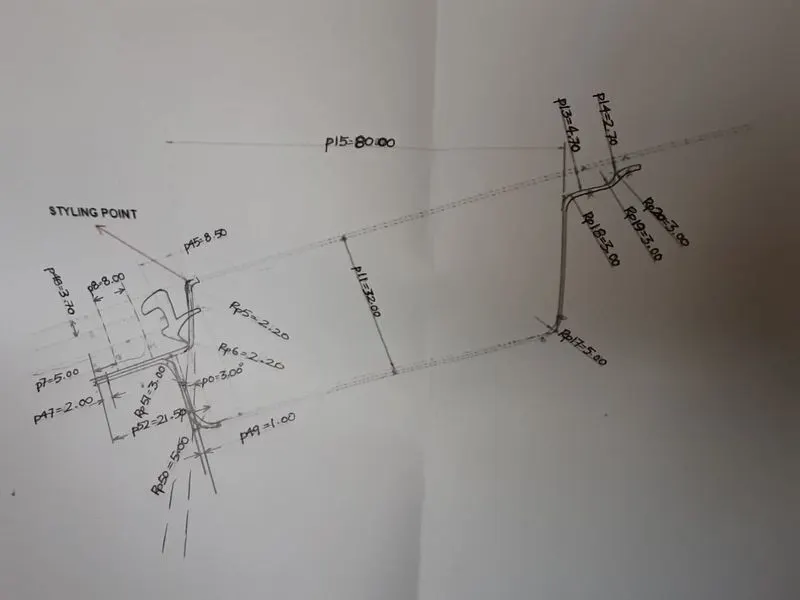
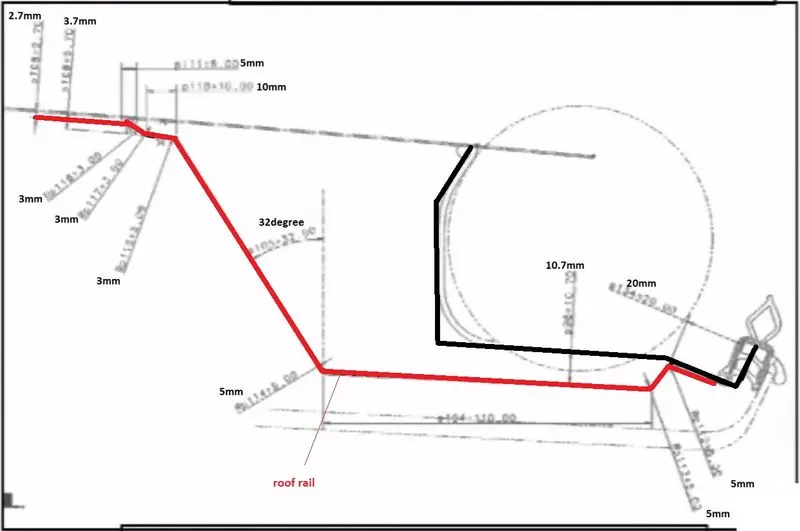
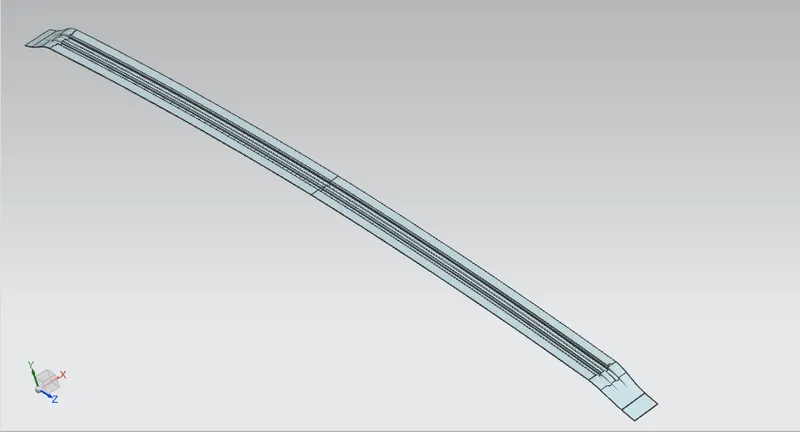
Front Rail:
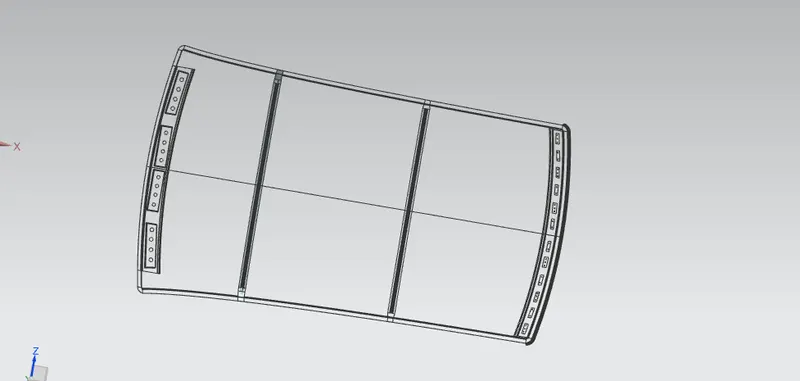
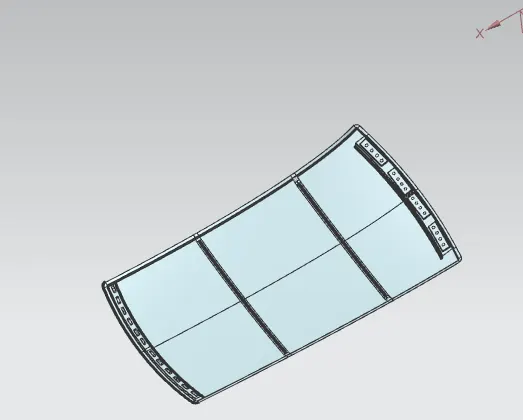
The front roof rail is designed considering the visibility of the driver and headroom clearance. Front rail is a support to the roof panel so it should have good structure and also it should have features to hold the light assembly, rear view mirror etc. The thickness given to the rail is 0.75mm.
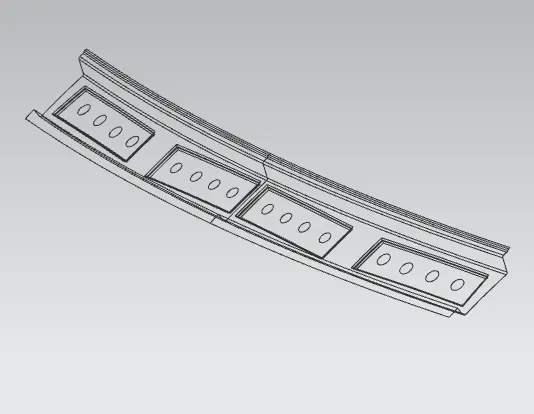
Bow Roof:
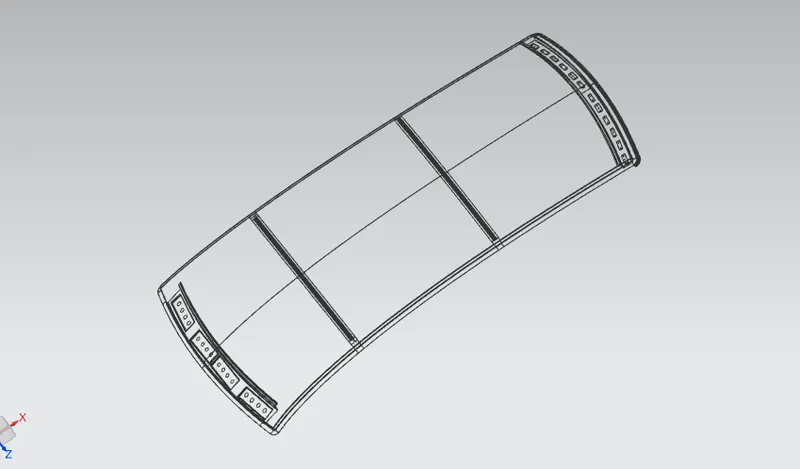
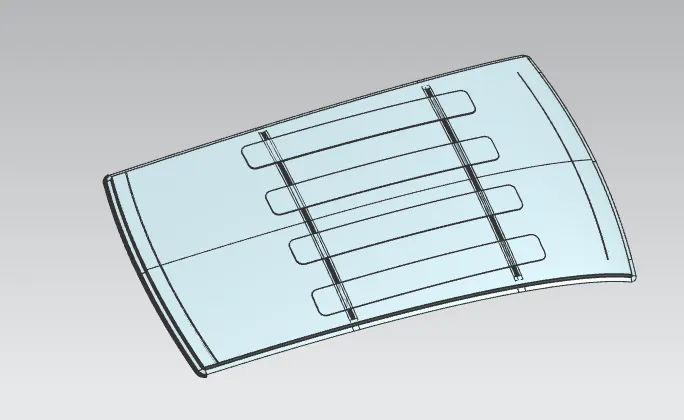
The bow roofs gives torsional stiffness and load bearing capacity of the roof structure. The bow roof is positioned based on the curvature of the roof panel. The heat distortion and snow load criteria are checked to analyze the position of the bows.
Rear Rail:
Rear rail is designed according to the master section given. Consider the headroom clearance and also the rear visibility. If there is requirement, lamp holding positions can be given. Thickness of rear rail is given as 0.75mm.
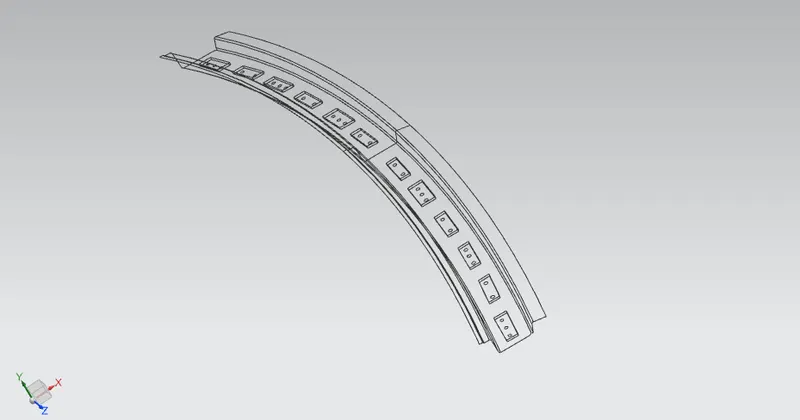
FIG: PROJECTING THE POINTS TO ROOF PANEL
Bow–roof prediction Formula
W = [1.73 x 10^(-3) x L] + [1.85 x 10^(-8) x (R^2)/t] + [ 1.10x10^(-3) x l] - 2.68
Judgement Condition : OK< 2.7> 3.1
Where
L = Roof Length in X-Direction[mm](Roof dimension in 0-Y)
R = Roof curvature
R = 2(Rx*Ry)/(Rx+Ry)
Rx = X curvature
Ry = Y curvature
t = Roof plate thickness [mm]
l = Bow Roof Span [mm]
| Slno | RX | RY | R | I | L | T | R^2/t | W | Ok/Not |
| 1 | 3328.47 | 13785.76 | 5362.23 | 721.73 | 2089.123 | 0.75 | 41672631 | 2.49 | satisfy |
| 2 | 4600.52 | 7122.66 | 5590.28 | 714.71 | 2089.123 | 0.75 | 3.78E+08 | 1.31 | satisfy |
From the above table it can be concluded that all values of W<2.7. It shows that the position of bow roof are optimum as per design and found ok
Snow load study:
Snow load study is done to check the durability of the roof to withstand snowfall and the roof goes back to the original shape without any permanent deformation once the load is removed. For snow load study we take 0Y axis check the curvature. The Qr value should be greater than 3.1, then the design is optimized.
Snow load Prediction formula
Qr = [Iy x t2] / [α x s x [(Rx + Ry)/2]2 x 10-8]
Note: The Qr value given over here is correct. There was a typo error in the formula given in the video.
Where
α = My x Lx2 x 10-12 , My = Y(Ly-Y)
Judgement condition = Qr ≥ 3.1
250 ≤ s ≤ 380
t = Roof plate thickness [mm]
Ly = Distance between the front and rear roof Rails on the Vehicle along with 0Y[mm]
Length of Roof panel with the center point between Roof rail Front /Rear as the front and rear reference point.
Lx = Distance between the Left and Right end of the roof on the Roof BOW [mm]
Width of the roof panel exposed on the surface.
Y = Distance front Front Roof Rail to Roof BOW[mm]
s = Distance for which Roof BOW bears divided load [mm]
s = L1/2 + L2/2
Iy = Geometrical moment of inertia of Roof BOW (Y cross-section )[mm4]
Rx = Lateral direction curvature radius of roof panel Y cross-section on Roof BOW [mm]
Roof panel curvature Radius of the Length Lx in Front view
Ry = Longitudinal Direction curvature radius of the Roof panel X cross-section on Roof BOW [mm]
Roof panel X curvature radius of length s in Side view
| Slno | ly | l1 | l2 | LY | LX | RX | RY | T | Y | S | MY | alpha | OR |
| 1 | 2089.123 | 650 | 714.23 | 721.73 | 1087.87 | 3900.4 | 2349.94 | 0.75 | 735.83 | 682.11 | 995813.45 | 1.17 | 5.71 |
| 2 | 2089.123 | 714.23 | 443.22 | 714.71 | 1088.13 | 3887.19 | 6240.03 | 0.75 | 752.81 | 578.72 | 1005987.8 | 1.16 | 1.19 |
From the above table we can conclude that there is one NG condition. At that NG condition when changing the curvature Rx and Ry we can see the changes in Qr. This correction can be communicated to the Styling team to improve the curvature of the surface.
Conclusion
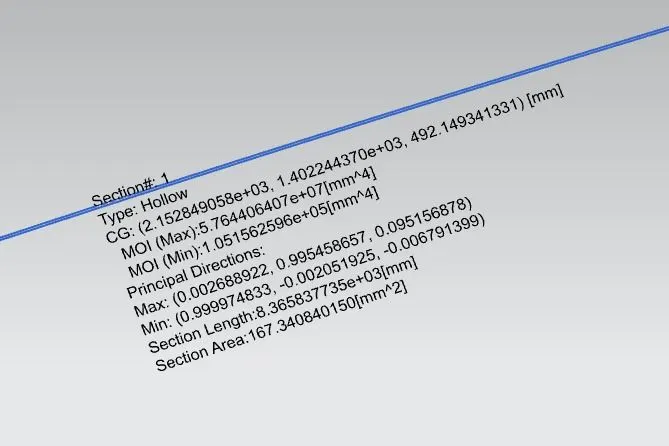
Using roof styling, developing the essential flanges and reinforcement. Designed is provided at appropriate dimension and checked with Draft analysis and also made the section modulus report on 0-Y section.