Rayleigh Taylor Instability Challenge
AIM:
To perform the Rayleigh Taylor Instability CFD simulation.
- Set up multiphase simulation
- Carry out RTI simulation for three different mesh sizes.
- Define Atwood number and find out the Atwood number for all cases
- Study the effect of variation of Atwood number in the behavior of instability.
INTRODUCTION:
Rayleigh Taylor Instability takes place when a lighter fluid is placed below a heavy fluid, then any perturbation of the interface grows and leads to spikes of the heavier fluid penetrating into the lighter one and the interface becomes unstable. It is a dynamic process whereby the two fluids seek to convert their potential energy into kinetic energy, causing bubbles of the low density fluid to rise, and spikes of the high density fluid to sink.
IMPORTANCE IN PRACTICAL APPLICATION
The turbulence and mixing in RTI has significant consequences in many natural and man- made flows. RTI occurs at very large scale e.g. interstellar gas, pushed out of the galactic plane by magnetic fields and cosmic rays. RTI has a profound effect on earth’s climate. RTI plays a crucial role in all forms of fusion, whether confinement be magnetic, inertial or gravitational.
Flow instabilities are used to increase the heat and mass transfer rates as well as to fuse the fluids of dissimilar properties. These instabilities are accountable to unstable the multilayer and free surface flows. Multilayer flows are used in coating processes and lubricated pipeline transport.
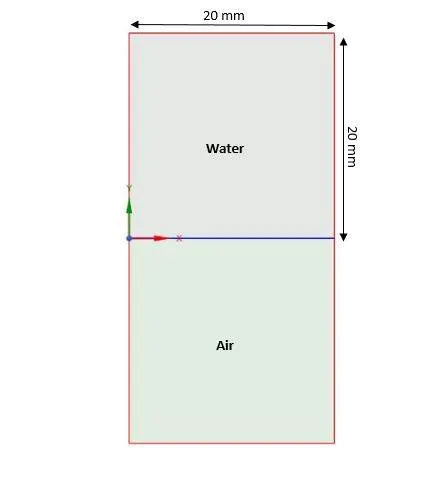
GEOMETRY: - The geometry consists of two components water and air each having the dimension of 20 × 20 mm.
CFD CASE SETUP
- SOLVER – Pressure based solver
- TIME – Transient calculation has been performed to capture the interface instability over a period of time.
- Compressible fluid flow is chosen.
- Multiphase Model is turned on along with Volume of Fluid and number of Eulerian phases is chosen as 2 and implicit scheme is selected.
- Viscous model-Laminar is used.
- Patching of the volume fraction of the two phases is performed before the start of simulation. Phase used for patching was water as volume fraction of 1 is taken for water surface and 0 for air surface.
- In Pressure velocity coupling SIMPLE scheme is used. For the momentum second order upwind scheme is used and for pressure, PRESTO is selected. For the transient formulation first order implicit scheme is chosen for better results and for stability and convergence of the residuals.
CASE 1:-
Element size = 1mm
No. of elements = 800
Max Skewness = 1.6124e-002
Min orthogonality = 0.99983
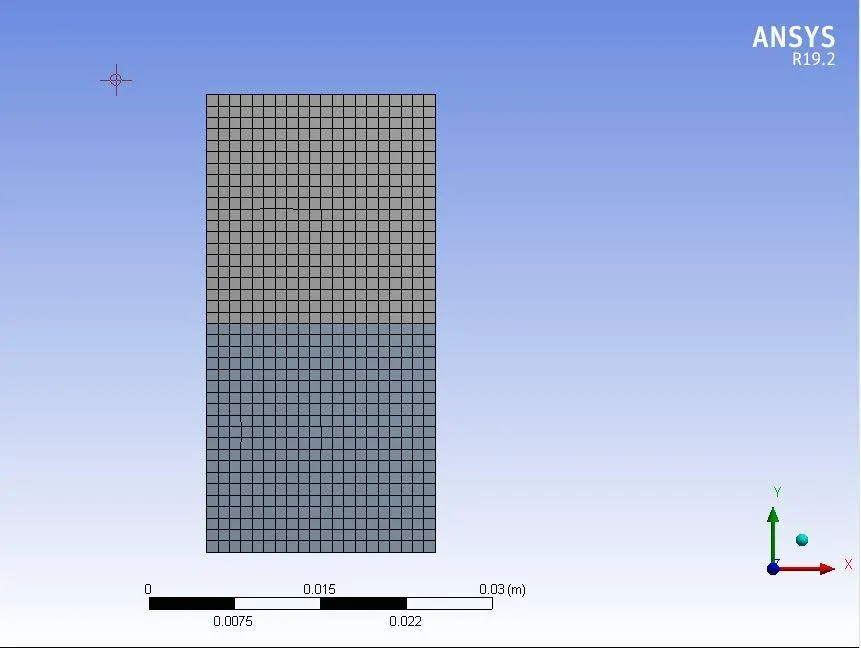
Animation for case 1:-
CASE 2:-
Element size = 0.5 mm
No. of elements = 3200
Max Skewness = 1.6945e-002
Min orthogonality = 0.99978
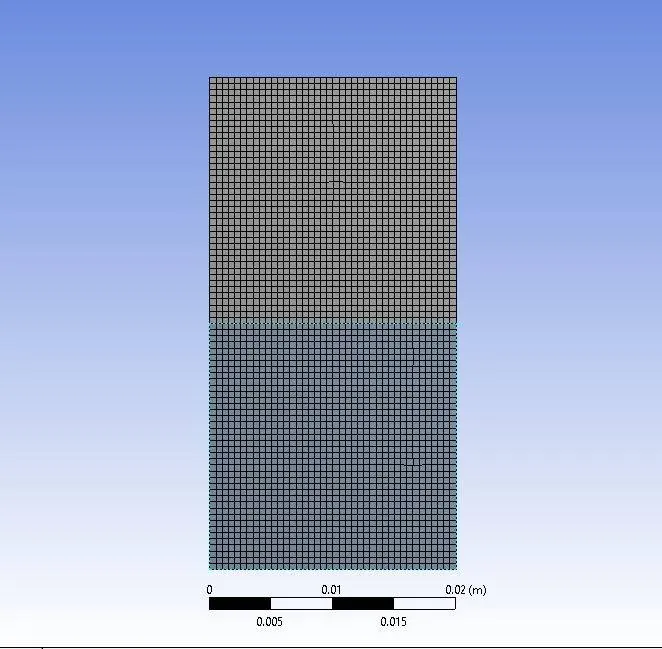
Animation for case 2:-
CASE 3:-
Element size = 0.2 mm
No. of elements = 20000
Max Skewness = 3.1757e-002
Min orthogonality = 0.9989
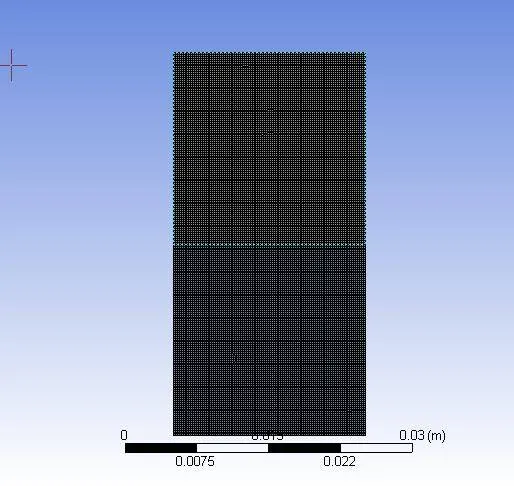
Animation for case 3:-
CONCLUSION
The transient simulation was run for the 1500 steps with a time step of 0.005. It was observed that with fine mesh more defined results were obtained, which has been shown in the above animation.
Atwood Number
The Atwood number (A) is a dimensionless number in fluid dynamics used in the study of hydrodynamic instabilities in density stratified flows. It is a dimensionless density ratio defined as
Where is the density of heavier fluid and is the density of lighter fluid.
So, in the present case A = (998.3-1.225)/(998.3+1.225) = 0.997
The Atwood number (A) close to 0 signifies that the flow takes the form of symmetric fingers of fluid and for A close to 1 the lighter fluid below the heavier fluid takes the shape of large bubble like plumes.
In the present case the A = 0.997 and hence the heavier fluid is seen taking the bubble shape, which validates our simulation.