Rayleigh Taylor Instability Challenge
AIM: To perform the Rayleigh Taylor instability simulation for different Mesh sizes and to compare the results.
Introduction:
Rayleigh Instability:
The Rayleigh–Taylor instability, or RT instability is an instability of an interface between two fluids of different densities which occurs when the lighter fluid is pushing the heavier fluid.
Examples include the behavior of water suspended above oil in the gravity of Earth, mushroom clouds like those from volcanic eruptions and atmospheric nuclear explosions, supernova explosions in which expanding core gas is accelerated into denser shell gas, instabilities in plasma fusion reactors and inertial confinement fusion.
In general the RTI is created when a high density fluid is located above a lower density fluid and
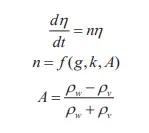
immersed in a gravitation field. The wave amplitude can be expressed as
where
n is the wave amplitude and n is a function, to be determined, of gravity, wave number (k) and the
Atwood number (A).
Mathematical models adapted for CFD calculations:
1. K-L turbulence model for the self similar growth of Tayleigh-Taylor and Richtmyer-Meshkov instabilities:
The k-epsilon model for turbulence is the most common to simulate the mean flow characteristics for turbulent flow conditions. It belongs to the Reynolds-averaged Navier Stokes (RANS) family of turbulence models where all the effects of turbulence are modeled.
It is a two-equation model. That means that in addition to the conservation equations, it solves two transport equations (PDEs), which account for the history effects like convection and diffusion of turbulent energy. The two transported variables are turbulent kinetic energy, which determines the energy in turbulence, and turbulent dissipation rate, which determines the rate of dissipation of turbulent kinetic energy.
2. Diffuse Interface model:
The basic concept of the diffuse interface approach involves the spread of the sharp metal/void interface into a narrow interfacial layer between the metal phase and the void phase. In the limit of vanishing interface layer thickness, the two models will perfectly match.
GEOMETRY:
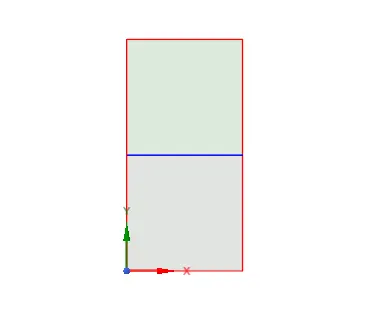
The geometry is created by Spaceclaim with the dimensions of 20*20mm of each domain which is water and air.
Case-1:
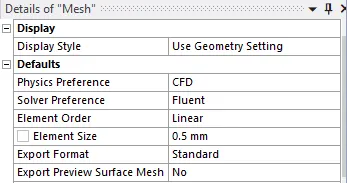
Mesh size = 0.5mm:
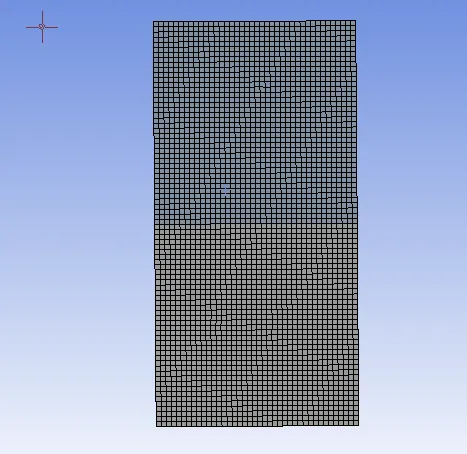
Mesh details:
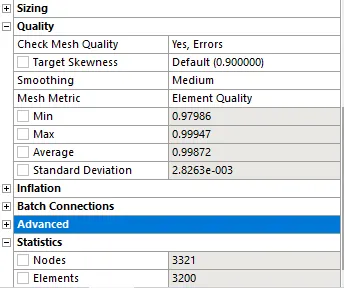
Case-2:
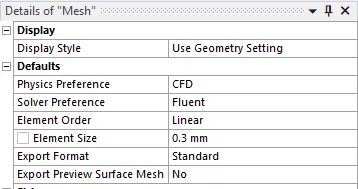
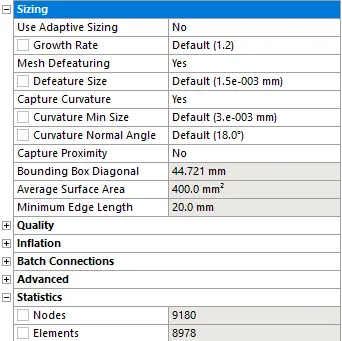
Mesh size=0.3mm
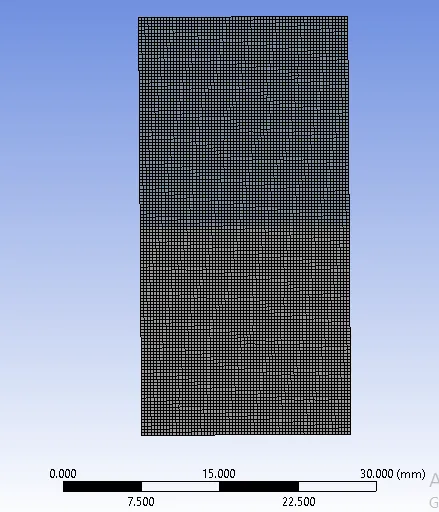
Mesh details:
Case-3:
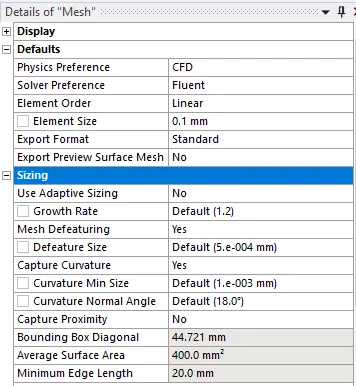
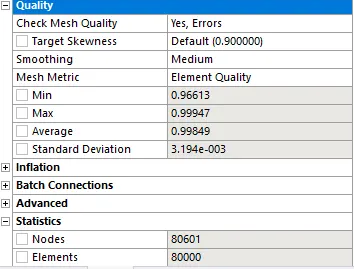
Mesh size=0.1:
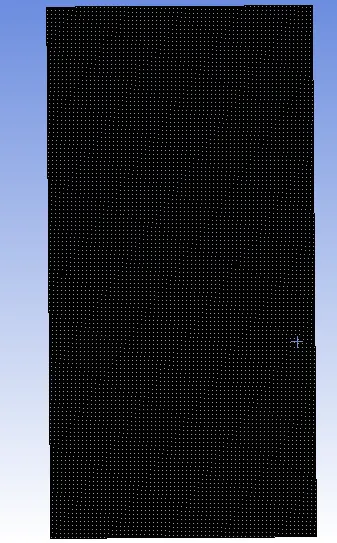
Mesh details:
Setup:
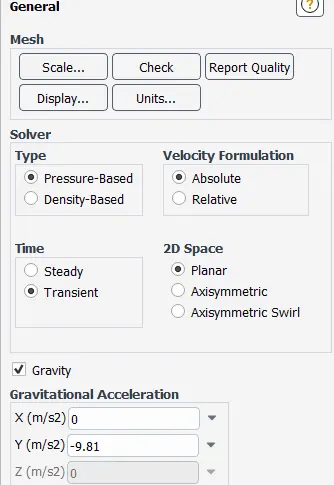
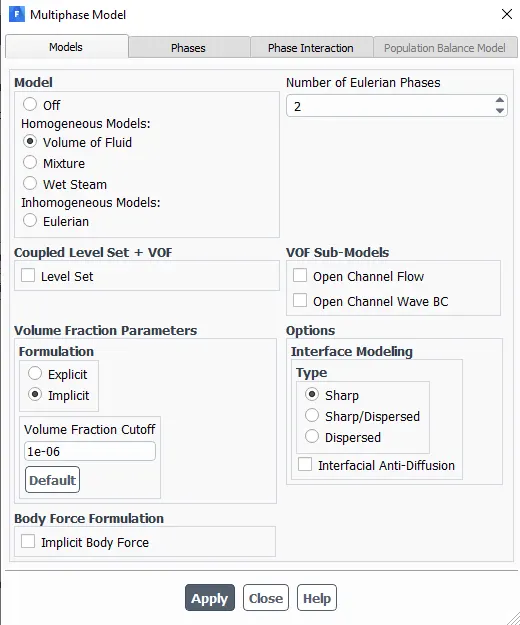
In multiphase, volume of fluid is selected with implicit.
Results:
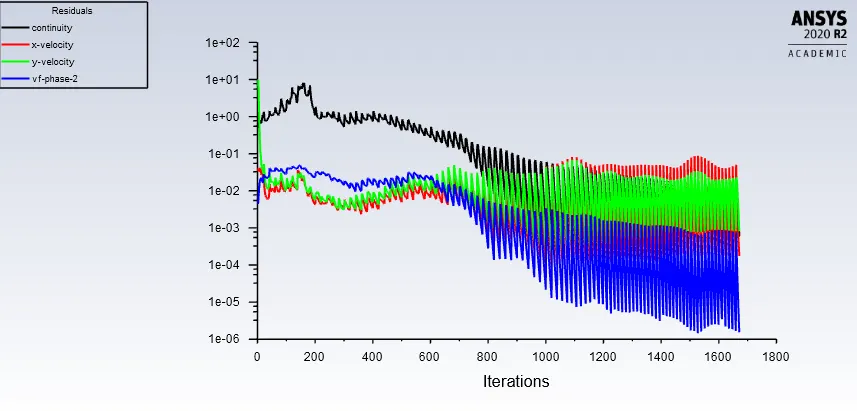
Case-1(0.5mm):
Residual Plot:
Contours of Volume Fraction:
https://drive.google.com/file/d/1xtytI5t5o9di-nrnaumKntZUczGA6N0P/view?usp=sharing
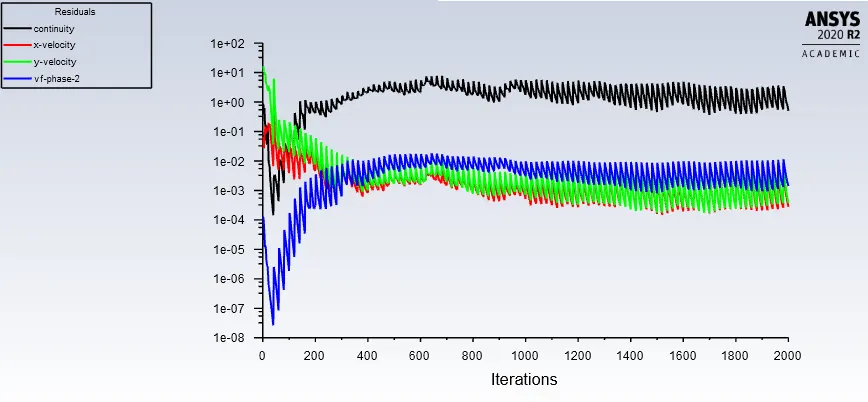
Case-2(0.3mm):
Residual Plot:
Contours of Volume Fraction:
https://drive.google.com/file/d/1inmwyCQRkCrpx22a-O1J5xjwsCFpfX_B/view?usp=sharing
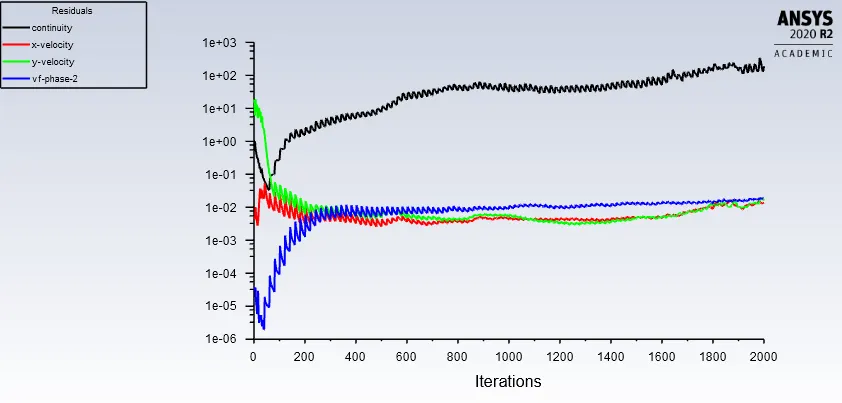
Case-3(0.1mm):
(a)
Residual Plot:
Contours of Volume Fraction:
https://drive.google.com/file/d/1yxqMChNgo2wRiynpA6FAbDKmD12Ls0hD/view?usp=sharing
(b)(density = 400 kg/m3, viscosity = 0.001 kg/m-s)
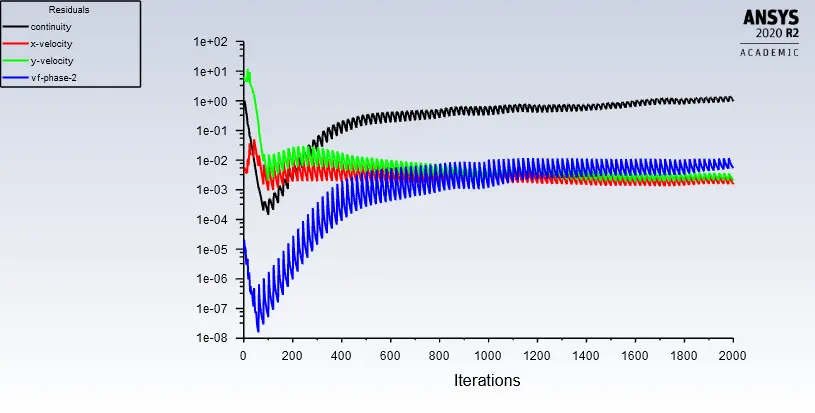
Contours of Volume Fraction:
https://drive.google.com/file/d/1wy_xe1zOoleU8TYKu0FEUMTaqf5zsuOe/view?usp=sharing
From the above results we can conclude that
- bubble formation increases with increase in Mesh.
- the formation of air bubbles and vortex generation increases with mesh size but simulation gets smoother.
* Steady state approach might not be suitable for this approach because it doesnot depend on time and generates only end result of simulation.
so it is not possible to observe instability. thus we can say that it is better to use Transient to use such types where we can observe results with respect to time.
Atwood Number:
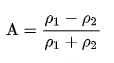
The Atwood number (A) is a dimensionless number in fluid dynamics used in the study of hydrodynamic instabilities in density stratified flows. It is a dimensionless density ratio defined as
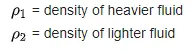
 where
where
Atwood number is an important parameter in the study of Rayleigh–Taylor instability and Richtmyer–Meshkov instability.
In Rayleigh–Taylor instability, the penetration distance of heavy fluid bubbles into the light fluid is a function of acceleration time scale.
(i) A = (998.2 - 1.225) / (998.2 + 1.225)
= 0.9975
(ii) A = (998.2 - 400) / (998.2 + 400)
= 0.427