Rayleigh Taylor Instability Challenge
Rayleigh Taylor Instability
Aim- To simulate rayleigh taylor instability between two fluids.
Introduction
The Rayleigh Taylor instability is an instability of an interface between two fluids of different densities which occurs when the lighter fluid is pushing the heavier fluid in a gravitational field. The problem was governed by the Navier-Stokes and Cahn-Hilliard equations in a primitive variable formulation.
Practical CFD models
1. SPH method
Smoothed-particle hydrodynamics (SPH) is a computational method used for simulating the mechanics of continuum media, such as solid mechanics and fluid flows. It was developed by Gingold and Monaghan and Lucy, initially for astrophysical problems. It has been used in many fields of research, including astrophysics, ballistics, volcanology, and oceanography. It is a meshfree Lagrangian method (where the co-ordinates move with the fluid), and the resolution of the method can easily be adjusted with respect to variables such as density.
2. Single fluid model
It is used to analyse two-phase flows in a mixture. This model have five equations consisting of mass, momentum and energy for a vapour/liquid mixture and two equations describing the formation and growth of the liquid phase
3. Two fluid model
In this model separate sets of the equation for vapour and liquid phase are used. The interaction between the drop of fluid and the heat exchange between the liquid phase and solid boundary are not modelled.
Simulation of Rayleigh Taylor instability
1) Preparing the Geometry
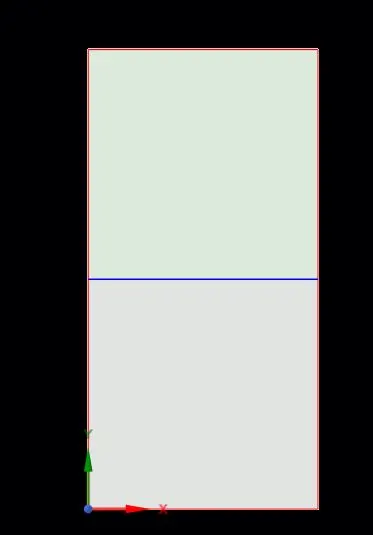
A 2D surface with two components one for air and the other for water. The image is givem below.
2) Meshing
After preparing the geometry the mesh was generated. One mesh is of element size of 0.5mm and the other of 0.2mm.By changing the element size of the mesh we can capture more accurate and smooth formation of the Wave formed.The Finer the mesh the more accurate formation will be captured.
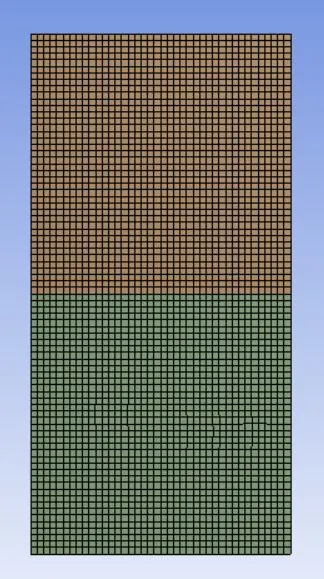
Snaplet of mesh for element size 0.5mm
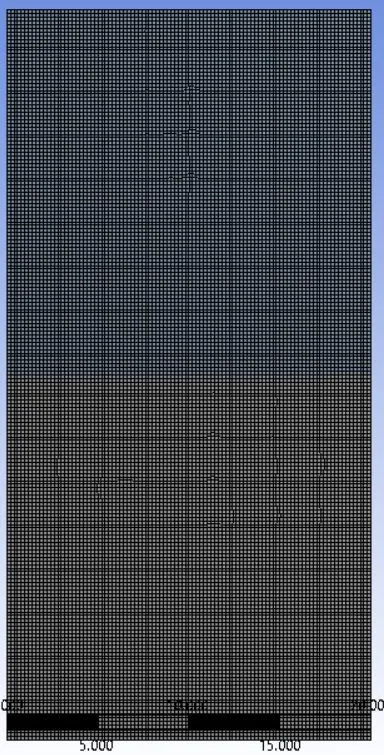
Snapplet of mesh of element size 0.2mm
3) Simulation
In the simulation there are 2 cases. In both the cases, transient approach for the simulation is done. For the first case the working fluids are air the water and for the second case the working fluid is water and a user defined fluid of density 400kg/m3 and viscosity = 0.001 kg/m-s.
Case 1.1- Mesh element size 0.5mm
The link for the animation video is given below-
https://drive.google.com/file/d/1pehrf0ryRwj65G7rfUVPcWsiR1SrEoEJ/view?usp=sharing
Case 1.2- Mesh element size 0.2mm
The link for the animation video is given below-
https://drive.google.com/file/d/1MN-RXRZoTOVG3h7MppDce8LCbjkpiN4d/view?usp=sharing
Case 2- Mesh element size is 0.2mm with water and user defined material
The link for the animation video is given below-
https://drive.google.com/file/d/1l1Cxji0SVmsZthGrt3z-JNrisiO9NhA7/view?usp=sharing
why a steady-state approach might not be suitable for these types of simulation ?
Steady state approach used when we are Conserned only with the Final state result and flow is not of major consern. But in this case we want to simulate the growth and formation of the waves form the a heavier fluid is poured in a ligher fluid under gravity.Therefore we have used transient approach for this simulation so that we the capture the Instability of the wave an the desired time step which is not possible in Steady state approach
Atwood Number
The Atwood number (A) is a dimensionless number in fluid dynamics used in the study of hydrodynamic instabilities in density stratified flows. It is a dimensionless density ratio defined as
`A=(rho1-rho2) /(rho1+rho2`
where
`rho1` is the density of the heavier fluid
`rho2` is density of lighter fluid
For case 1
Density of water (`rho1`)=998.2kg/m3
Density of air (`rho2`)= 1.225 kg/m3
Therefore
A=`(998.2-1.225)/(998.2+1.225`
A=0.997
For case 2
Density of water (`rho1`)=998.2kg/m3
Density of user material (`rho2`)= 400kg/m3
Therefore
A=`(988.2-400)/(988.2+400`
A=0.424
When A is close to 0, Then Rayleigh Taylor waves takes form of Symmetric fingurs like figure
When A is close to 1, Then Rayleigh Taylor waves takes form of large bubbles
Atwood number is an important parameter in the study of Rayleigh–Taylor instability and Richtmyer–Meshkov instability. In Rayleigh–Taylor instability, the penetration distance of heavy fluid bubbles into the light fluid is a function of acceleration time scale, `Ag t^2` where g is the gravitational acceleration and t is the time.