Project - Position control of mass spring damper system
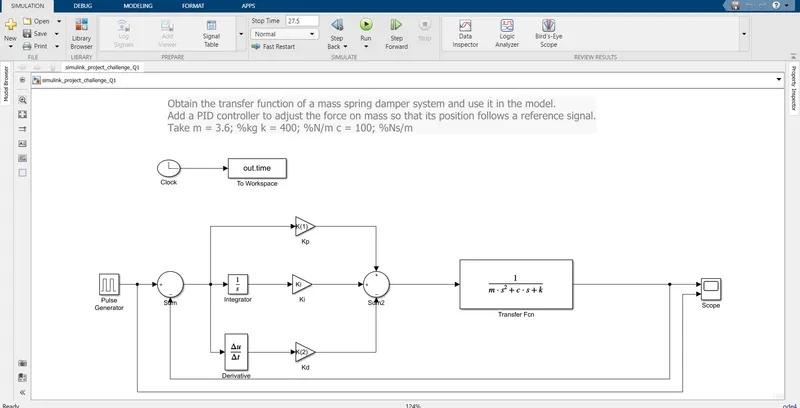
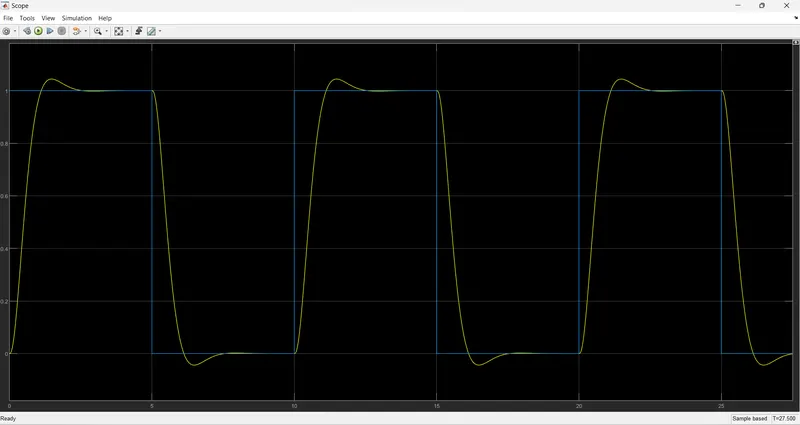
Q1.Obtain the transfer function of a mass spring damper system and use it in the model. Add a PID controller to adjust the force on mass so that its position follows a reference signal.
Take m = 3.6; %kg k = 400; %N/m c = 100; %Ns/m
>>PID controller:- A proportional-Integral-Derivative(PID) controller is a control loop mechanism employing feedback that is widely used in industrial control system and varity of other application which required continuously modulated control.The composite controller including the combination of the proportional , Integral and Derivative control mode is called PID control mode and the controller is called three mode controller. It is very much complex to design but very powerful in action.
Mathematically such control mode can be expressed as, P(t)= Kp*e(t) + Ki*∫e(t)dt + Kd*(de(t)/dt) + p(0)
where, p(0)= initial value of the output
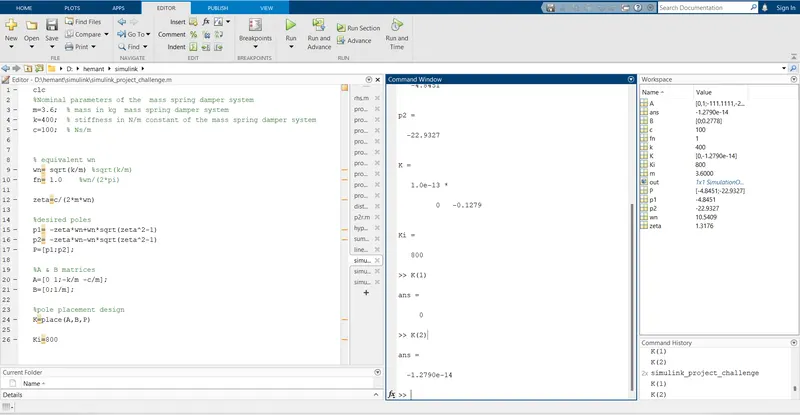
PID control was done using pole placement technique which was fed into a text file to make changes easy