Project - Position control of mass spring damper system
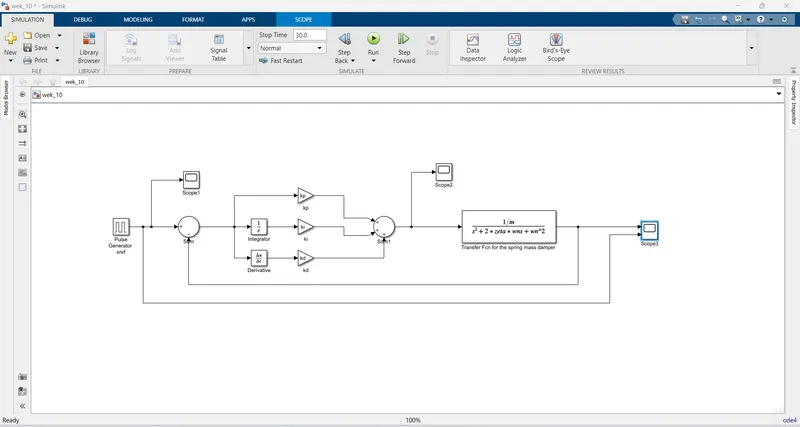
q: Obtain the transfer function of a mass spring damper system and use it in the model. Add a PID controller to adjust the force on mass so that its position follows a reference signal.
Take m = 3.6; %kg k = 400; %N/m c = 100; %Ns/m
Aim : To btain the transfer function of a mass spring damper system and Add a PID controller to adjust the force on mass so that its position follows a reference signal
model: the transfer function for the mass spring damper system is
T/F=x(s)/F(s)=1/(m*s^2+c*s+k)
=1/m/(s^2+c/m*s+k/m)
=k/(s^2+2*zeta*wn*s+wn^2)
where c/m=2*zeta*wn
k=1/m
k/m=wn^2
model
command for parameter pid
clc
clear all
% parameter that given in question
m=3.6; % mass in kg
k=400; % stiffness or spring constant in N/m
c=100; %dashpot or damper in Ns/m
% A&B matrices
A=[0 1 ; 111.11 27.79];
B=[0;0.27];
% defining wn
fn=1.0; % 1 hz natural frequency
wn=2*pi*fn; % natural frequency rds/sec
% design parameter
zeta=0.5; % damped co-efficient
%Desired poles
p1=-zeta*wn+wn*sqrt(zeta^2-1);
p2=-zeta*wn-wn*sqrt(zeta^2-1);
p=[p1;p2];
%pole placement desgin
k=place(A,B,p);
%Difining kp,kd &ki from k
kp=k(1)
kd=k(2)
ki=1000
command for the transfer function for the mass spring damper system
% transfer function for spring mass damper
m=3.6 % mass in kg
k=400; % stiffness or spring constant in N/m
c=100; %dashpot or damper in Ns/m
% defining wn
fn=1.0; % 1 hz natural frequency
wn=2*pi*fn; % natural frequency rds/sec
% design parameter
zeta =0.5; % damped co-efficient
% transfer function
s=tf('s');
s=1/m/(s^2+2*zeta*wn*s+wn^2)
% transfer function for spring mass damper
Ans :
kp =
557.7349
kd =
126.1970
ki =
1000
m =
3.6000
s =
0.2778
---------------------
s^2 + 6.283 s + 39.48
Continuous-time transfer function.
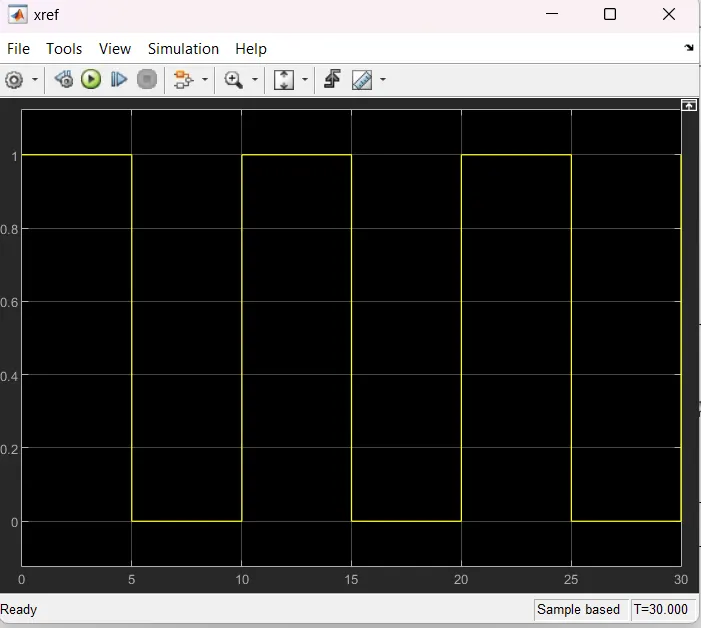
output for xref
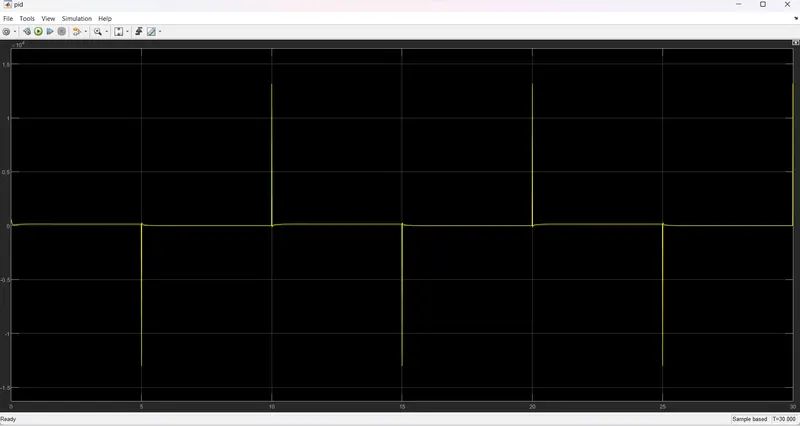
output for pid controller
output for spring mass damper
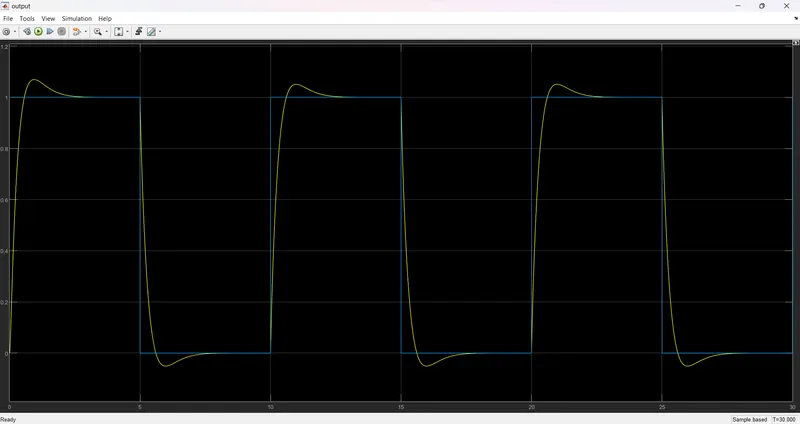
conclusion for this project
the input of squre wave is fed to pid by controlling by the ki value and output is squre is pid controller