Challenge

Project - Position control of mass spring damper system

To obtain the transfer function of a mass-spring-damper system, we can start with the equation of motion for the system:

m * x'' + c * x' + k * x = F

where x is the displacement of the mass, m is the mass, c is the damping coefficient, k is the spring constant, F is the external force applied to the mass, and ' denotes differentiation with respect to time.

Taking the Laplace transform of the above equation and assuming zero initial conditions, we get:

s^2 * M(s) + c * s * X(s) + k * X(s) = F(s)

where M(s), X(s), and F(s) are the Laplace transforms of m, x, and F, respectively. Solving for X(s), we get:

X(s) = F(s) / (s^2 * M(s) + c * s + k)

Substituting the given values of m, c, and k, we get:

X(s) = F(s) / (3.6 * s^2 + 100 * s + 400)

This is the transfer function of the mass-spring-damper system.

Lets us Input the following in a Matlab script to:
clear all;
clc;
% Parameters
m = 3.6; % kg
k = 400; % N/m
c = 100; % Ns/m
zeta = c / (2 * sqrt(k * m));
wn = sqrt(k / m);
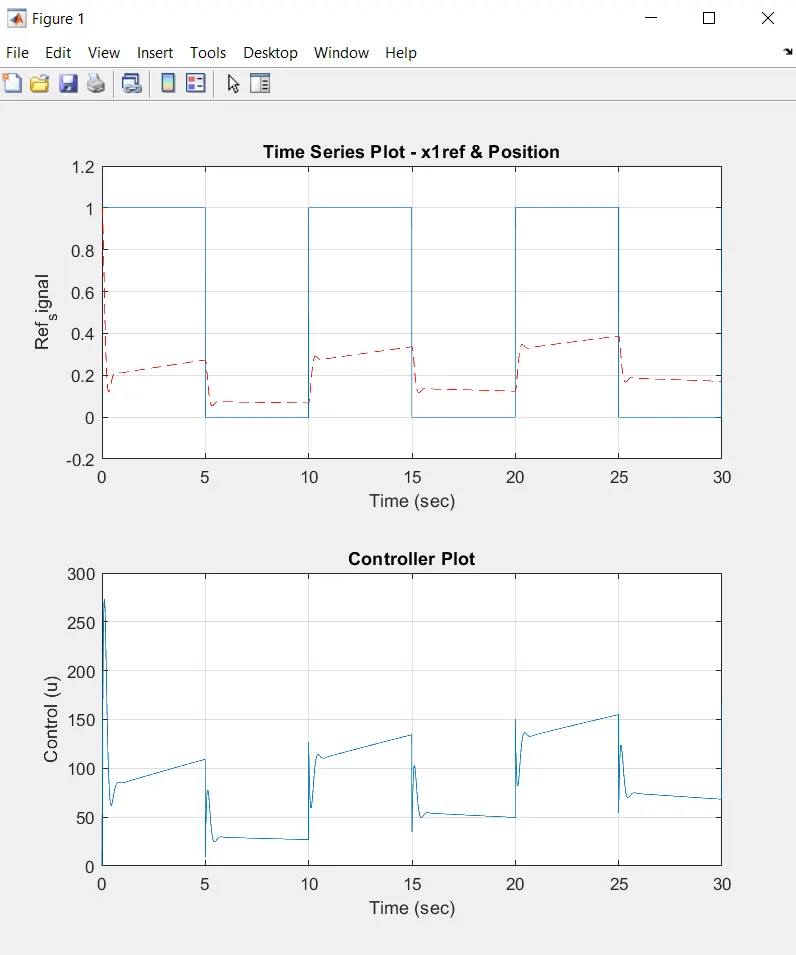
Let us provide a some reference gain values (Kp, Kd, Ki):
% Proportional, integral, and derivative gains
Kp = 100;
Ki = 10;
Kd = 50;
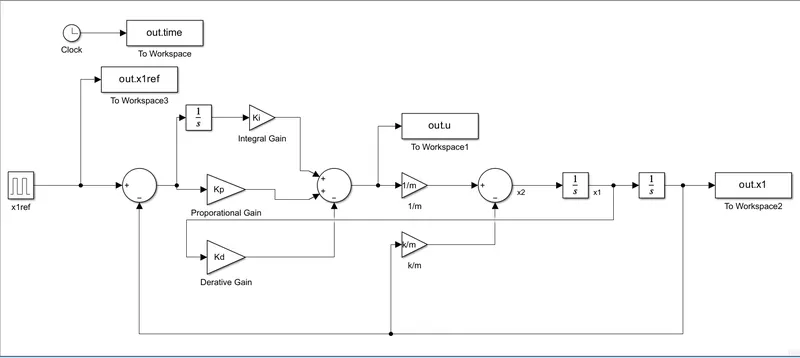
Let us use the below simulink model with a Pulse generator as a reference signal:
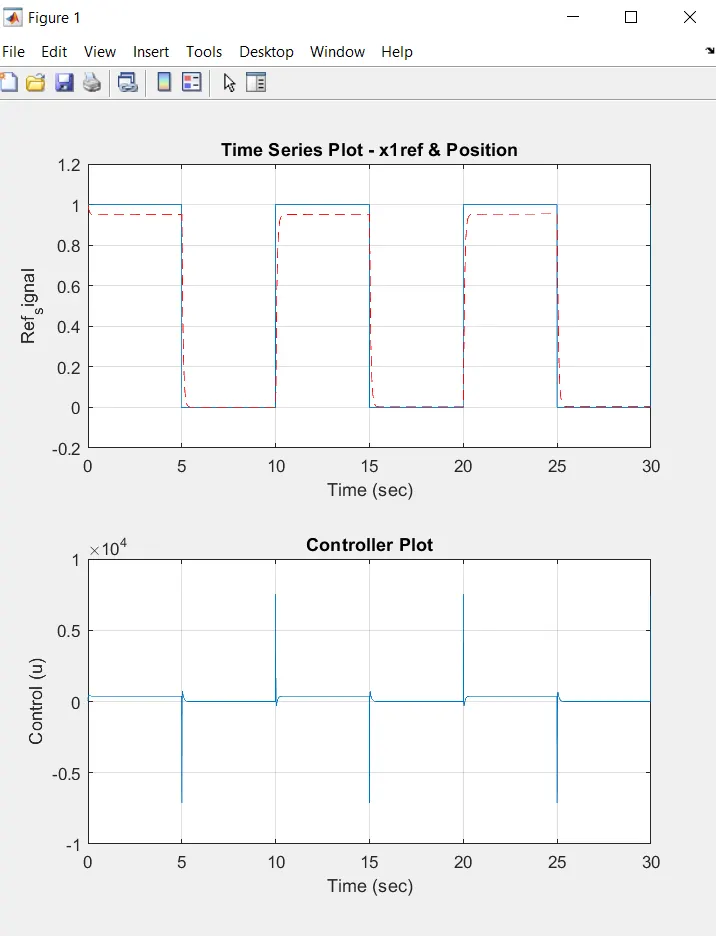
Let us plot for above gain values we get :
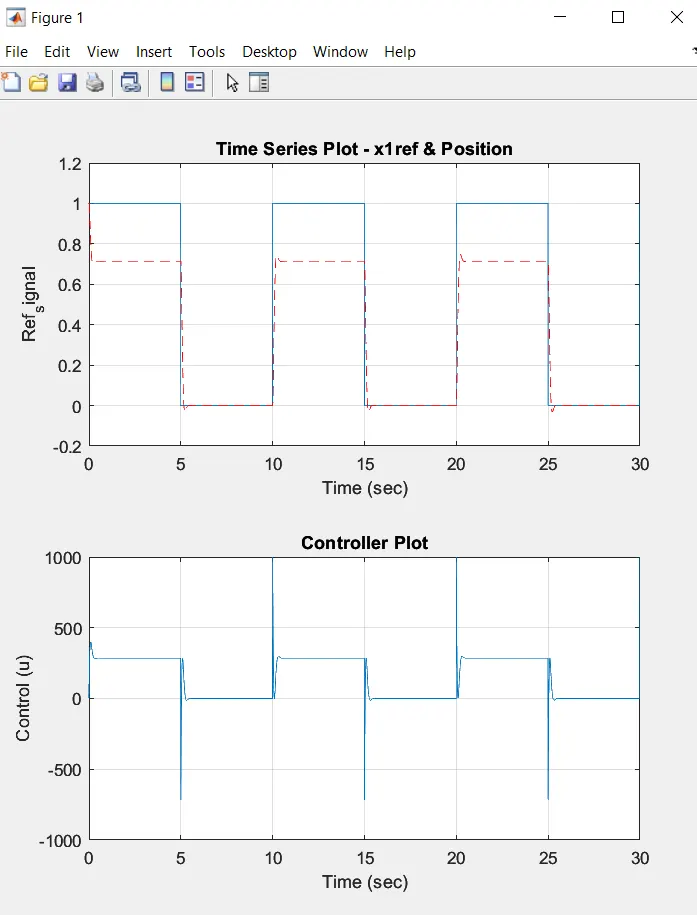
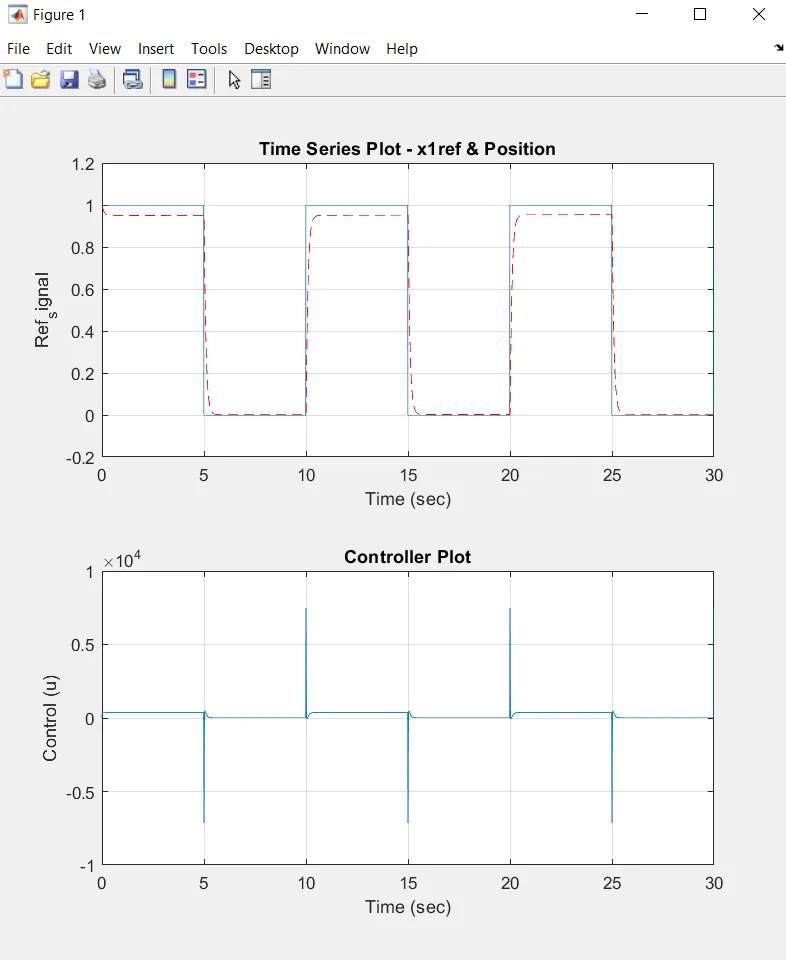
Let us change the gain values to Kp = 1000; Ki = 0; Kd = 100:
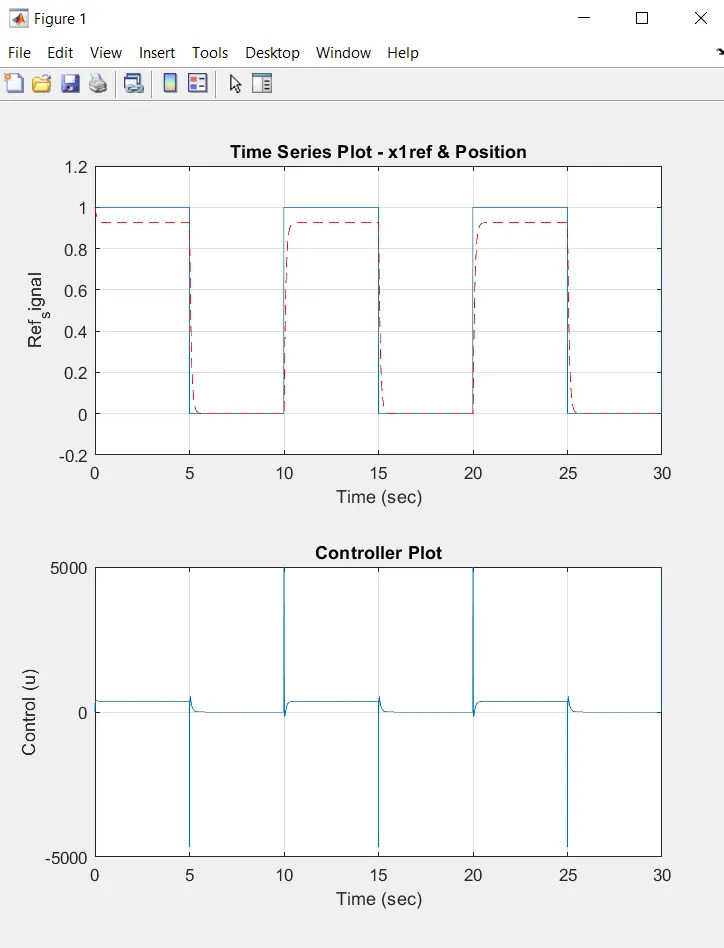
Let us change the gain values to Kp = 5000; Ki = 0; Kd = 500:
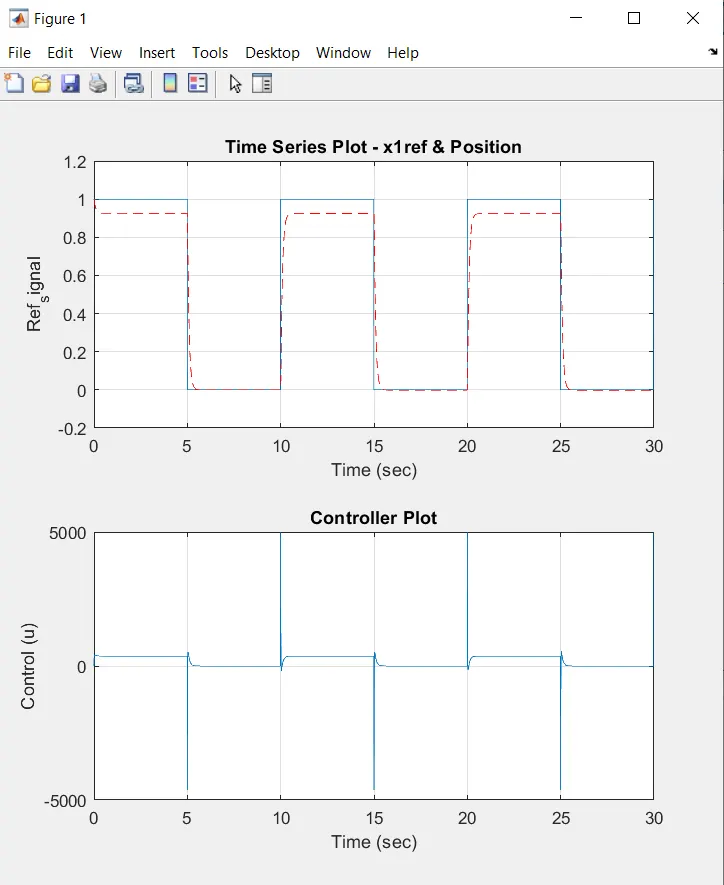
Let us change the gain values to Kp = 5000; Ki = -10; Kd = 500:
Let us change the gain values to Kp = 7500; Ki = 50; Kd = 550:
Let us change the gain values to Kp = 7500; Ki = 50; Kd = 750:
By further increasing and adjusting the gain values we can make the position plot to follow the reference signal plot.
Your portfolio, next

Ship work like this
in your own course.

Talk to a career counsellor

Free 20-minute call. We'll map the right course to where you want to work.

By submitting you agree to our Terms and Privacy Policy.