Project on Concrete Mix Design for various grades of Concrete
1. Calculate the concrete Mix design fro M35 grade concrete with fly ash.
AIM:
To Calculate the Concrete Mix Design for M35 grade concrete with replacing of optimum level of fly ash with cement.
INTRODUCTION:
The designing of concrete mix design for M35 grade concrete with replacing the optimum levelof fly ash with cement with referance of Indian standard codes with have been signified in each steps where the codes are used. And Concrete Mix Design are followed the various clauses, tables and figures given in the IS codes. It is obvious that these codes give important guidelines for designing a concrete mix depending upon the basic properties of constituent materials, behaviour of individual constituent, economy and many other considerations.This Project critically compares the Concrete Mix Design of M35 grade with replacement of fly ash with cement carried out by using Indian Standard codes.
PROCEDURE:
STEP 1: Stipulation of propotioning.
- Grade design : M30
- Type of cement : OPC 43 grade conforming to IS 8112
- Type of mineral admixture : Fly ash conforming to IS 3812(Part 1)
- Maximum Nominal size of aggregate : 20 mm aggregate
- Minimun cement content : 320 kg/m^3 (from table 5 of IS 456: 2000. exposure conditon severe).
- Maximun water content : 0.45 (from table 5 of IS 456: 2000. exposure conditon severe).
- Workability: 100mm slump
- Exposure conditon: severe.
- Methos of concrete placing : Pumping.
- Degree of supervision : Good
- Type of aggregate : Crushed angular aggregate.
- Maximun cement content : 450kg/m^3.
- Chemical Admixture type : superplasticizer.
STEP 2: Test data for materials.
- Cement used : OPC 43 grade conforming to IS 8112.
- Specific gravity of cement : 3.15.
- specifi gravity of
1.) coarse aggregate : 2.74
2.) Fine aggregate : 2.74
d. Water absorbtion:
1.) coarse aggregate : 0.5%
2.) Fine aggregate : 1.0%
e. surface moisture:
1.) coarse aggregate : Nil
2.) Fine aggregate : Nil
f. Seive analysis:
1.) coarse aggregate : Conforming to Table 2 of IS 383.
2.) Fine aggregate : Conforming to Table 4 of IS 383.
g. Chemical admixture : superplasticizer Conforming to IS 9103
STEP 3: Target strength for Mix propotion.
From Table 1 of IS 10262: 2009.
Target mean strength of concrete, ft = fck + 1.65s
Where,
ft = Target average compressive strength at 28 days
Fck = Characteristic Compressive strength of concrete at 28 days
S = Standard deviation obtained from the table.
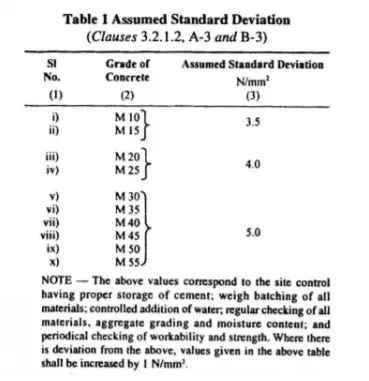
Target mean strength, ft = 35+(1.65 X 5).
ft = 43.25 N/mm^2.
STEP 4: Selection of water cement ratio.
From the table 5 of IS 456: 200 for the severe conditon the water cement ratio is 0.45
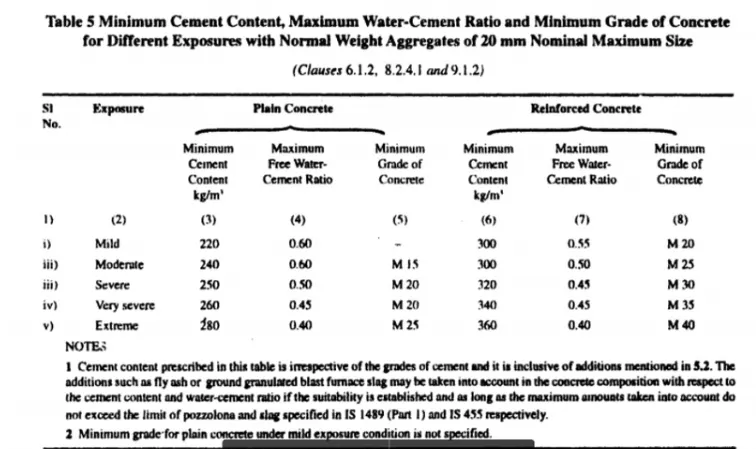
Based on the experience the adopted water cement ratio is 0.40.
0.40 < 0.45, hence ok.
STEP 5: Selection of water content.
From Table 2 of IS 10262: 2009, Maximum water content for 20mm aggregate = 186 liter (for slump range 25mm to 50mm)
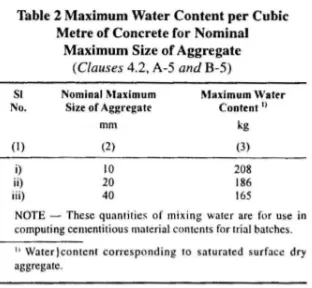
The maximun water content for slump value 25mm to 50mm slump is 186 liter based on table 2 of IS 10262: 2009. For additional 3% may be added for every 25mm slump.
In the case of 100mm slump:
Estimated water content for 100mm slump = 186+6/100*186
= 197 litre.
As superplasticizer is used, the water conctent can be reduce upto 30%
Based on the trails water content reduction of 29% is achieved with plasticizer.
Hence the arrived water content = 197 x 0.71 = 140 liter.
STEP 6: Calculation of cement content.
- Water cemnet ratio = 0.4
- Cementitious material(cement+fly ash)content =140/0.4 =350 kg/m^3
- Water (W) = 140 kg .
From the table 5 of IS 456, minimum water cement content for severe exposure conditon = 320 kg/kg^3.
350 kg/m^3 > 320 kg/m^3. hence ok.
Adopting the amount of fly ash used is 30%.
Increasing the cementitious material up to 10% based on trial and experience.
- cementitious matrial content = 350 x 1.10 = 385 kg/m^3
- water content = 140 kg/m^3
- The new W/C ratio is = 140/385 = 0.364
- Fly ash of 30% of cementitous content = 385 X 0.30 = 115.5 kg/m^3
- Cement (OPC) = 385-115.5 = 269.5 kg/m^3
- Saving of cement while using fly ash = 350-269.5 = 80.5 kg/m^3
- Fly ash being utilized = 115.5 kg/m^3.
STEP 7: Propotion of volume of coarse aggregate and fine aggregate content.
From Table 3, volume of coarse aggregate corresponding to 20 mm size aggregate and fine aggregate (Zone1) for water-cement ratio of 0.50 = 0.60.
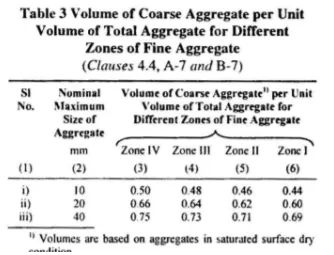
In the present case the water cement ratio is 0.40.
Therefore, the volume of coarse aggregate need to be increased to decrease the fine aggregate.
If reduce the water cement ratio 0.1 is equal to the increase in volume of aggregate can be taken 0.02,
Therefore in the 0.40 W/C ratio will be 0.62 volume aggregate.
For pumpable concrete these values should be reduced by 10 percent.
- Volume of coarse aggregate = o.62 X 0.9 = 0.56
- volume of fine aggregate = 1 − 0.56 = 0.44
STEP 8: Mix Calculation.
The mix calculation per unit volume of concrete shall be as follows.
a) Volume of concrete = 1m^3.
b) Volume of cement = (Mass of cement / specific gravity of cement) X 1/1000
= (269.5/3.15 X 1/1000) = 0.0855 m^3
C) Volume of fly ash = (Mass of fly ash / specific gravity of fly ash) X 1/1000
= (115.5/2.2 X 1/1000) = 0.0525 m^3
d) Volume of water = (Mass of water / specific gravity of water) X 1/1000
= (140/1 X 1/1000) = 0.140 m^3
e) Volume of chemical admixture = (Mass of chemical admixture / specific gravity of chemical admixture) X 1/1000
= (7.6/1.145 X 1/1000) = 0.006 m^3
f) Volume of CA and FA = (voulme of concrete−(Volume of cement+volume of water+volume of chemical admixture+Volume of fly ash )).
= (1− (0.0855+0.0525+0.140+ 0.006))
= 0.715 m^3.
g) Mass of Coarse aggregate = volume of CA and FA x Volume of coarse aggregate x specific gravity of coarse aggregate x 1000.
= 0.715 X 0.56 X 2.75 X 1000
= 1098 kg/m^3.
f) Mass of Fine aggregate = volume of CA and FA x Volume of Fine aggregate x specific gravity of Fine aggregate x 1000.
= 0.715 X 0.44 X 2.74 X 1000
= 862 kg/m^3.
STEP 9: Mix propotion.
- Cement = 269.5 kg/m^3.
- Fly ash = 115.5 kg/m^3.
- Water = 140 kg/m^3.
- Fine aggregate = 862 kg/m^3.
- Coarse aggregate = 1098 kg/m^3.
- Chemical admixture = 7 kg/m^3.
- Water cement ratio = 0.364.
Trial Mix Ratio = 1:2.23:2.85.
1. Calculate the concrete Mix design fro M50 grade concrete without fly ash.
AIM:
To Calculate the Concrete Mix Design for M50 grade concrete without fly ash.
INTRODUCTION:
The designing of concrete mix design for M50 grade concrete with referance of Indian standard codes with have been signified in each steps where the codes are used. And Concrete Mix Design are followed the various clauses, tables and figures given in the IS codes. It is obvious that these codes give important guidelines for designing a concrete mix depending upon the basic properties of constituent materials, behaviour of individual constituent, economy and many other considerations. This Project critically compares
the Concrete Mix Design of M35 grade by using Indian Standard codes.
PROCEDURE:
STEP 1: Stipulation of propotioning.
- Grade design : M50
- Type of cement : OPC 43 grade conforming to IS 8112
- Maximum Nominal size of aggregate : 20 mm aggregate
- Minimun cement content : 320 kg/m^3 (from table 5 of IS 456: 2000. exposure conditon severe).
- Maximun water content : 0.45 (from table 5 of IS 456: 2000. exposure conditon severe).
- Workability: 100mm slump
- Exposure conditon: severe.
- Methos of concrete placing : Pumping.
- Degree of supervision : Good
- Type of aggregate : Crushed angular aggregate.
- Maximun cement content : 450kg/m^3.
- Chemical Admixture type : superplasticizer.
STEP 2: Test data for materials.
- Cement used : OPC 43 grade conforming to IS 8112.
- Specific gravity of cement : 3.15.
- specifi gravity of
1.) coarse aggregate : 2.74
2.) Fine aggregate : 2.74
d. Water absorbtion:
1.) coarse aggregate : 0.5%
2.) Fine aggregate : 1.0%
e. surface moisture:
1.) coarse aggregate : Nil
2.) Fine aggregate : Nil
f. Seive analysis:
1.) coarse aggregate : Conforming to Table 2 of IS 383.
2.) Fine aggregate : Conforming to Table 4 of IS 383.
g. Chemical admixture : superplasticizer Conforming to IS 9103
STEP 3: Target strength for Mix propotion.
From Table 1 of IS 10262: 2009.
Target mean strength of concrete, ft = fck + 1.65s
Where,
ft = Target average compressive strength at 28 days
Fck = Characteristic Compressive strength of concrete at 28 days
S = Standard deviation obtained from the table.
Target mean strength, ft = 50 +(1.65 X 5).
ft = 58.25 N/mm^2.
STEP 4: Selection of water cement ratio.
From the table 5 of IS 456: 200 for the severe conditon the water cement ratio is 0.45
Based on the experience the adopted water cement ratio is 0.40.
0.40 < 0.45, hence ok.
STEP 5: Selection of water content.
From Table 2 of IS 10262: 2009, Maximum water content for 20mm aggregate = 186 liter (for slump range 25mm to 50mm)
The maximun water content for slump value 25mm to 50mm slump is 186 liter based on table 2 of IS 10262: 2009. For additional 3% may be added for every 25mm slump.
In the case of 100mm slump:
Estimated water content for 100mm slump = 186+6/100*186
= 197 litre.
As superplasticizer is used, the water conctent can be reduce upto 30%
Based on the trails water content reduction of 29% is achieved with plasticizer.
Hence the arrived water content = 197 x 0.71 = 140 liter.
STEP 6: Calculation of cement content.
- Water cemnet ratio = 0.4
- Cement content =140/0.4 =350 kg/m^3
- Water (W) = 140 kg .
From the table 5 of IS 456, minimum water cement content for severe exposure conditon = 320 kg/kg^3.
350 kg/m^3 > 320 kg/m^3. hence ok.
STEP 7: Propotion of volume of coarse aggregate and fine aggregate content.
From Table 3, volume of coarse aggregate corresponding to 20 mm size aggregate and fine aggregate (Zone1) for water-cement ratio of 0.50 = 0.60.
In the present case the water cement ratio is 0.40.
Therefore, the volume of coarse aggregate need to be increased to decrease the fine aggregate.
If reduce the water cement ratio 0.1 is equal to the increase in volume of aggregate can be taken 0.02,
Therefore in the 0.40 W/C ratio will be 0.62 volume aggregate.
For pumpable concrete these values should be reduced by 10 percent.
- Volume of coarse aggregate = o.62 X 0.9 = 0.56
- volume of fine aggregate = 1 − 0.56 = 0.44
STEP 8: Mix Calculation.
The mix calculation per unit volume of concrete shall be as follows.
a) Volume of concrete = 1m^3.
b) Volume of cement = (Mass of cement / specific gravity of cement) X 1/1000
= (350/3.15 X 1/1000) = 0.111 m^3
c) Volume of water = (Mass of water / specific gravity of water) X 1/1000
= (140/1 X 1/1000) = 0.140 m^3
d) Volume of chemical admixture ( superplasticizer) 2% by mass od cementitious material = (Mass of chemical admixture / specific gravity of chemical admixture) X 1/1000
= ((350*0.02)/1.145 X 1/1000) = 0.006 m^3
e) Volume of CA and FA = (voulme of concrete − (Volume of cement +volume of water +volume of chemical admixture )).
= (1− (0.111+0.140+ 0.006))
= 0.743m^3.
f) Mass of Coarse aggregate = volume of CA and FA x Volume of coarse aggregate x specific gravity of coarse aggregate x 1000.
= 0.743 X 0.56 X 2.75 X 1000
= 1140 kg/m^3.
g) Mass of Fine aggregate = volume of CA and FA x Volume of Fine aggregate x specific gravity of Fine aggregate x 1000.
= 0.743 X 0.44 X 2.74 X 1000
= 896 kg/m^3.
STEP 9: Mix propotion.
- Cement = 350 kg/m^3.
- Water = 140 kg/m^3.
- Fine aggregate = 896 kg/m^3.
- Coarse aggregate = 1140 kg/m^3.
- Chemical admixture = 7 kg/m^3.
- Water cement ratio = 0.40..
Trial Mix Ratio = 1:2.56:3.26.