Project on Concrete Mix Design for various grades of Concrete
M35 Grade Mix Design with Fly ash
1] AIM AND INTRODUCTION :
Aim of this procedure is to Design the Concrete of M35 Grade by using fly ash with the Guidelines of IS 10262 : 2009 and IS 456 : 2000
Assuming Data :
STIPULATIONS FOR PROPORTIONING
a) Grade designation : M35
b) Type of cement : OPC 43 grade conforming to IS 269
c) Type of mineral admixture : Fly ash conforming to IS 3812 (Part1)
d) Maximum nominal size of aggregate : 20 mm
e) Exposure conditions : Severe
f) Workability : 100 mm (slump)
g) Method of concrete placing : Pumping
h) Degree of supervision : Good
j) Type of aggregate : Crushed angular aggregate
k) Maximum cement content (OPC content) : 450 Kg/'m^3'
m) Chemical admixture type : Superplasticizer- normal
TEST DATA FOR MATERIALS
a) Cement used : OPC 43 grade conforming to IS 269
b) Specific gravity of cement : 3.15
c) Fly ash : Conforming to IS 3812 (Part 1)
d) Specific gravity of fly ash : 2.2
e) Chemical admixture : Superplasticizer conforming to IS 9103
f) Specific gravity of
1) Coarse aggregate (at SSD condition) : 2.74
2) Fine aggregate (at SSD condition) : 2.65
3) Chemical admixture : 1.145
g) Water absorption
1) Coarse aggregate : 0.5 percent
2) Fine aggregate : 1.0 percent
h) Free (surface) moisture
1) Coarse aggregate : Free moisture = Nil
2) Fine aggregate : Free moisture = Nil
2] PROCEDURE IN DETAIL
TARGET MEAN STRENGTH
f’ck = fck + 1.65 S
where
f’ck = target average compressive strength at 28 days,
fck = characteristic compressive strength at28 days
S = standard deviation
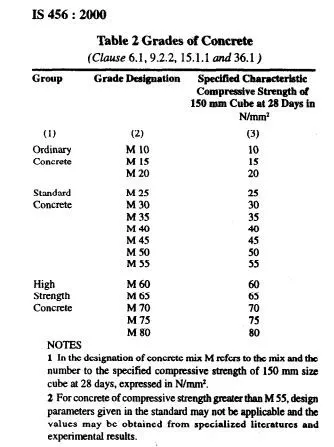
From Table 2 of IS 456, fck for M35 Grade Concrete is 35 N/`mm^2`
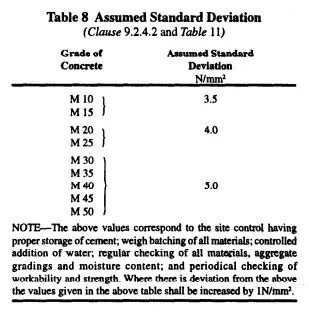
From Table 8 of IS 456, Assumed standard deviation, S = 5 N/`mm^2`
Therefore, target strength using both equations,
that is, f’ck =fck+ 1.65 S
= 35+ 1.65 × 5 = 43.25 N/`mm^2`
SELECTION OF WATER·CEMENT RATIO
Clause 4.1 of IS 10262
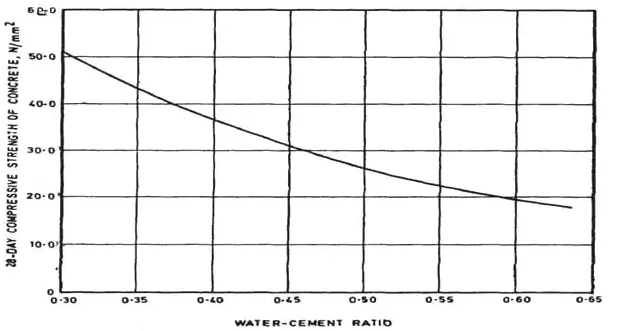
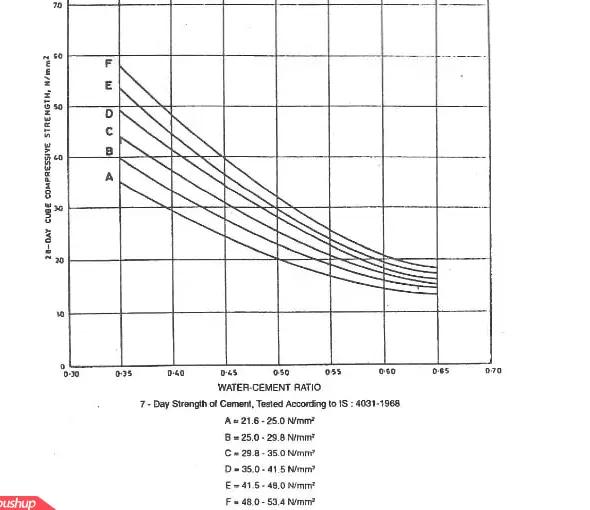
Fig 1 Fig 2
From Table 5 of IS 456, maximum water-cement ratio (see Note under table 5) for Severe Exposure = 0.45.
From Figure 1 of IS 10262 : 1982, w/c ratio for target mean strength of 43.25 N/`mm^2` is = 0.35
From Figure 2 of IS 10262 : 1982, w/c ratio for 43.25 N/`mm^2` for 'E' Curve is found to be =0.43
Considering lowest of above 3 values = 0.35
But Based on Experience Adopting w/c ratio = 0.40
SELECTION OF WATER CONTENT
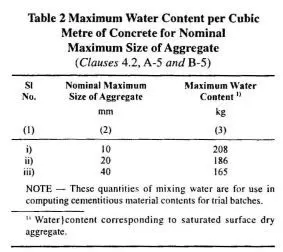
From Table 2 of IS 10262 Clause 4.2,
maximum water content for 20 mm aggregate = 186 litre (for 25 to 50 mm slump range)
Here we Require 100 mm slump,
Estimated water content for 100 mm slump= 186+ 6 X 186 = 197 litres
100
As superplasticizer is used, the water content can be reduced up to 30 percent. (Clause 4.2 of IS 10262)
Based on trials with superplasticizer, water content reduction of 29 percent has been achieved,
Hence, the arrived water content = 197 x 0.71 = 140 litres.
CALCULATION OF CEMENT AND FLY ASH CONTENT
Water-cement ratio from clause 4.1 of IS 10262
(NOTE - The supplementary cementitious materials. that is.mineral admixtures shall also be considered in water-cement ratio calculations in accordance with Table 5 of IS 456. 4.1.1 The free water-cement ratio selected according to 4.1 should be checked against the limiting watercement ratio for the requirements of durability and the lower of the two values adopted.)
w/c ratio =0.4
Cementitious material (cement + fly ash) content = 140 = 350 kg/m3 0.4
From Table 5 of IS 456, minimum cement content for Reinforced concrete under 'severe' exposure conditions 320 kg/m3
350kg/m3> 320 kg/m3, hence OK.
Now, to proportion a mix containing fly ash the following steps are suggested:
a) Decide the percentage fly ash to be used based on project requirement and quality of materials
b) In certain situations increase in cernentitious material content may be warranted, The decision on increase in cementitious material content and its percentage may be based on experience and trial,
NOTE - here we will increase 10 % cementitious material content.
Cementitious material content = 350 x 1.10 = 385 kg/m3
Water Content = 140 kg/m'
So. water-cement ratio = 140 = 0.36 385
Fly ash @ 30% of total cementitious material content= 385 x 30% =115 kg/`m^3`
Cement (OPC) = 385 - 115 =270 kg/`m^3`
Saving of cement while using fly ash = 350 - 270 = 80 kg/`m^3`, and
Fly ash being utilized = 115 kg/`m^3`
PROPORTION OF VOLUME OF COARSE AGGREGATE AND FINE AGGREGATE CONTENT
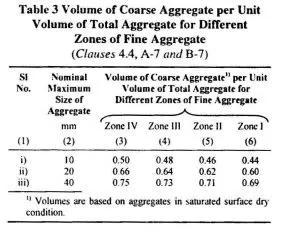
From Table 3 of IS 10262, volume of coarse aggregate corresponding to 20 mm size aggregate and fine aggregate (Zone I) for water-cement ratio of 0.50 =0.60.
In the present case water-cement ratio is 0.40. Therefore. volume of coarse aggregate is required to be increased to decrease the line aggregate content. As the water-cement ratio is lower hy 0.10. the proportion of volume of coarse aggregate is increased by 0.02 (at the rate of -/+ 0.01 for every ± 0.05 change in water-cement ratio), Therefore. corrected proportion of volume of coarse aggregate for the water-cement ratio of 0.40 = 0.62
NOTE - In case the coarse aggregate is not angular one. then also volume: of coarse aggregate may he required to be increased suitably. based on experience.
For pumpable concrete these values should be reduced by 10 percent.
Therefore. volume of coarse aggregate =0.62 x 0.9 =0.56.
Volume of fine aggregate content = 1 - 0.56 = 0.44.
MIX CALCULATIONS
The mix calculations per unit volume of concrete shall be as follows:
a) Volume of concrete = 1`m^3`
b) Volume of cement = Mass of cement x 1
Specific gravity of cement 1000
= 270 x 1 = 0.086 `m^3`
3.15 1000
c) Volume of fly ash = Mass of Fly ash x 1
Specific gravity of Fly ash 1000
= 115 x 1 = 0.052 `m^3`
2.2 1000
d) Volume of water = Mass of water x 1
Specific gravity of Water 1000
= 140 x 1 = 0.140`m^3`
1 1000
e ) Volume of chemical admixture = Mass of Admixture x 1
(superplasticizer) @ 2.0% by Specific gravity of Admixture 1000 mass of cementitious material)
= 7.7 x 1 = 0.0067`m^3`
1.145 1000
f) Volume of all in aggregate = [a - (b + c + d + e)]
= [1- (0.086+ 0.052+0.14+0.0067)]
= 0.715 `m^3`
g) Mass of coarse aggregate = f x volume of coarse aggregate x Specific gravity of coarse aggregate x 1000
= 0.715 X 0.56 X 2.74 X1000
= 1097 Kg
h) Mass of fine aggregate = f x volume of fine aggregate x Specific gravity of fine aggregate x 1000
= 0.715 X 0.44 X 2.65 X1000
= 834 Kg
3] RESULT :
MIX PROPORTIONS
Cement = 270 kg/'m^3'
flyAsh = 115 kg/'m^3'
Water = 140 kg/'m^3'
Fine aggregate = 834 kg/'m^3'
Coarse aggregate = 1097 kg/'m^3'
Chemical admixture = 7.7 kg/'m^3'
Water-cement ratio
(see Note under 4.1) = 0.36
hence Ratio propotion = 1: 0.44 :0.35
NOTE - Aggregates should be used in saturated surface dry condition. If otherwise. "when computing the requirement of mixing water. allowance shall hemade for the free (surface) moisture contributed by the fine and coarse aggregates.
On the other hand . if the aggregates are dry. the amount of mixing water should be increased by an amount of equal to the moisture likely to be absorbed aggregates . Necessary adjustments and also required to be made In mass of aggregate. The surface water and percent water absorption of aggregates shall be determined according to IS 2386 (Part 3).
The slump shall be measured and the water content and dosage of admixture shall be adjusted for achieving the required slump based on trial. if required, The mix proportions shall he reworked for the actual water content and checked for durability requirements,
Two more trials having variation of ± 10 percent of water-cement ratio shall be carried out and a graph between three water-cement ratios and their corresponding strengths shall he plotted to work out the mix proportions for the given target strength for field trials. However, durability requirement shall be met.
--------------------------------------------------------------------------------------------------------------------------
M50 Grade Mix Design without Fly ash
1] AIM AND INTRODUCTION :
Aim of this procedure is to Design the Concrete of M50 Grade with the Guidelines of IS 10262 : 2009 and IS 456 : 2000
Assuming Data :
STIPULATIONS FOR PROPORTIONING
a) Grade designation : M50
b) Type of cement : OPC 43 grade conforming to IS 269
c) Maximum nominal size of aggregate : 20 mm
d) Exposure conditions : Very Severe (Reinforced Concrete)
e) Workability : 75 mm (slump)
f) Method of concrete placing : Pumping
g) Degree of supervision : Good
h) Type of aggregate : Crushed angular aggregate
i) Maximum cement content (OPC content) : 450 Kg/'m^3'
j) Chemical admixture type : Superplasticizer- normal
TEST DATA FOR MATERIALS
a) Cement used : OPC 43 grade conforming to IS 269
b) Specific gravity of cement : 3.15
c) Chemical admixture : Superplasticizer conforming to IS 9103
d) Specific gravity of
1) Coarse aggregate (at SSD condition) : 2.74
2) Fine aggregate (at SSD condition) : 2.65
3) Chemical admixture : 1.145
e) Water absorption
1) Coarse aggregate : 0.5 percent
2) Fine aggregate : 1.0 percent
f) Free (surface) moisture
1) Coarse aggregate : Free moisture = Nil
2) Fine aggregate : Free moisture = Nil
2] PROCEDURE IN DETAIL
TARGET MEAN STRENGTH
f’ck = fck + 1.65 S
where
f’ck = target average compressive strength at 28 days,
fck = characteristic compressive strength at28 days
S = standard deviation
From Table 2 of IS 456, fck for M50 Grade Concrete is 50 N/`mm^2`
From Table 8 of IS 456, Assumed standard deviation, S = 5 N/`mm^2`
Therefore, target strength using both equations,
that is, f’ck =fck+ 1.65 S
= 50+ 1.65 × 5 = 58.25 N/`mm^2`
SELECTION OF WATER·CEMENT RATIO
Clause 4.1 of IS 10262
Fig 1 Fig 2
From Table 5 of IS 456, maximum water-cement ratio (see Note under table 5) for Very Severe Exposure = 0.45.
From Figure 1 of IS 10262 : 1982, w/c ratio for target mean strength of 43.25 N/`mm^2` is = 0.28
From Figure 2 of IS 10262 : here we cannot assusme the data from Fig 2 because for 58.25 N/`mm^2`, 7 day strength curve is not available.
Considering lowest of above 2 values = 0.28
But Based on Experience Adopting w/c ratio = 0.35
SELECTION OF WATER CONTENT
From Table 2 of IS 10262 Clause 4.2,
maximum water content for 20 mm aggregate = 186 litre (for 25 to 50 mm slump range)
Here we Require 100 mm slump,
Estimated water content for 100 mm slump= 186+ 3 X 186 = 192 litres
100
As superplasticizer is used, the water content can be reduced up to 30 percent. (Clause 4.2 of IS 10262)
Based on trials with superplasticizer, water content reduction of 29 percent has been achieved,
Hence, the arrived water content = 192 x 0.71 = 137 litres.
CALCULATION OF CEMENT CONTENT
Water-cement ratio from clause 4.1 of IS 10262
w/c ratio =0.35
Cement content = 137 = 392 kg/m3 0.35
From Table 5 of IS 456, minimum cement content for Reinforced concrete under 'Very severe' exposure conditions 340 kg/m3
392kg/m3> 340 kg/m3, hence OK.
PROPORTION OF VOLUME OF COARSE AGGREGATE AND FINE AGGREGATE CONTENT
From Table 3 of IS 10262, volume of coarse aggregate corresponding to 20 mm size aggregate and fine aggregate (Zone II) for water-cement ratio of 0.50 =0.62.
In the present case water-cement ratio is 0.40. Therefore. volume of coarse aggregate is required to be increased to decrease the line aggregate content. As the water-cement ratio is lower hy 0.10. the proportion of volume of coarse aggregate is increased by 0.02 (at the rate of -/+ 0.01 for every ± 0.05 change in water-cement ratio), Therefore. corrected proportion of volume of coarse aggregate for the water-cement ratio of 0.35 = 0.65
NOTE - In case the coarse aggregate is not angular one. then also volume: of coarse aggregate may he required to be increased suitably. based on experience.
For pumpable concrete these values should be reduced by 10 percent.
Therefore. volume of coarse aggregate =0.65 x 0.9 =0.585.
Volume of fine aggregate content = 1 - 0.585 = 0.415.
MIX CALCULATIONS
The mix calculations per unit volume of concrete shall be as follows:
a) Volume of concrete = 1`m^3`
b) Volume of cement = Mass of cement x 1
Specific gravity of cement 1000
= 392 x 1 = 0.124 `m^3`
3.15 1000
c) Volume of water = Mass of water x 1
Specific gravity of Water 1000
= 137 x 1 = 0.137`m^3`
1 1000
d) Volume of chemical admixture = Mass of Admixture x 1
(superplasticizer) @ 2.0% by Specific gravity of Admixture 1000 mass of cementitious material)
= 7.84 x 1 = 0.0068`m^3`
1.145 1000
e) Volume of all in aggregate = [a - (b + c + d + e)]
= [1- (0.124+0.14+0.0068)]
= 0.729`m^3`
f) Mass of coarse aggregate = e x volume of coarse aggregate x Specific gravity of coarse aggregate x 1000
= 0.729 X 0.585 X 2.74 X1000
= 1168 Kg
h) Mass of fine aggregate = e x volume of fine aggregate x Specific gravity of fine aggregate x 1000
= 0.729 X 0.415 X 2.65 X1000
= 801 Kg
3] RESULT :
MIX PROPORTIONS
Cement = 392 kg/'m^3'
Water = 137 kg/'m^3'
Fine aggregate = 801 kg/'m^3'
Coarse aggregate = 1168 kg/'m^3'
Chemical admixture = 7.84 kg/'m^3'
Water-cement ratio
(see Note under 4.1) = 0.35
hence Ratio propotion = 1: 0.48:0.34
NOTE - Aggregates should be used in saturated surface dry condition. If otherwise. "when computing the requirement of mixing water. allowance shall hemade for the free (surface) moisture contributed by the fine and coarse aggregates.
On the other hand . if the aggregates are dry. the amount of mixing water should be increased by an amount of equal to the moisture likely to be absorbed aggregates . Necessary adjustments and also required to be made In mass of aggregate. The surface water and percent water absorption of aggregates shall be determined according to IS 2386 (Part 3).
The slump shall be measured and the water content and dosage of admixture shall be adjusted for achieving the required slump based on trial. if required, The mix proportions shall he reworked for the actual water content and checked for durability requirements,
Two more trials having variation of ± 10 percent of water-cement ratio shall be carried out and a graph between three water-cement ratios and their corresponding strengths shall he plotted to work out the mix proportions for the given target strength for field trials. However, durability requirement shall be met.
--------------------------------------------------------------------------------------------------------------------