Project - Analysis of a practical automotive wiring circuit
Title - Analysis of a practical automotive wiring circuit
Objectives:-
- Identify each of the major elements in the above automotive wiring diagram.
- Explain the purpose and working of any three elements briefly
- If the total load is 10A from the battery, what should be the fuse rating?
- If 500W is the load, what is the voltage and capacity of the battery you recommend?
- Identify any two elements which are connected parallel to each other. Why they are connected in parallel
- Identify any two elements which are connected in series. Why they are connected in series?
1. Major elements in the above automotive wiring diagram are
- Battery - A battery is a device that stores chemical energy and converts it to electrical energy. The chemical reactions in a battery involve the flow of electrons from one material (electrode) to another, through an external circuit.
- Generator - The function of the generator is to supply current for the operation of the ignition system, the lighting system, and all other electrical parts when the engine is running and to replenish the battery after it has supplied current for starting and other purposes when the engine is at rest.
- Starter - A starter is a machine that helps the starting process of an electrical device. If a starter solenoid receives insufficient power from the battery, it will fail to start the motor. They can also stop, reverse, accelerate and protect the motors.
- Ignition coil - An ignition coil (also called a spark coil) is an induction coil in an automobile's ignition system that transforms the batterys voltage to the thousands of volts needed to create an electric spark in the spark plugs to ignite the fuel.
- Distributor - A distributor is an electric and mechanical device used in the ignition system of older spark ignition engines. The distributor's main function is to route electricity from the ignition coil to each spark plug at the correct time.
- Junction block - An electrical junction box is an enclosure housing electrical connections. Junction boxes protect the electrical connections from the weather, as well as protecting people from accidental electric shocks.
- Fuse - An electrical fuse is a safety device that operates to provide protection against the overflow of current in an electrical circuit. An important component of an electrical fuse is a metal wire or strip that melts when excess current flows through it.
- Breaker - A circuit breaker is an electrical switch designed to protect an electrical circuit from damage caused by overcurrent/overload or short circuit. Its basic function is to interrupt current flow after protective relays detect a fault.
- Current and voltage regulator - In voltage regulators, the current is varied to achieve the required voltage level, while current regulators usually involve variations in voltage/resistance to achieve the required current output.
- Horn
- Ignition switch
- Tail stop
- Gas tank unit
- Earthing
2. Explanation the purpose and working of any three elements briefly
Battery
Purpose of the battery : A battery is a device that stores chemical energy and converts it to electrical energy. The chemical reactions in a battery involve the flow of electrons from one material (electrode) to another, through an external circuit. The flow of electrons provides an electric current that can be used to do work. The first purpose of an auto battery is to provide power for starting your vehicle. It also acts as a surge protector for the car's computer and provides power for short-term use of things like lights, stereo, GPS or wipers when the engine is off.
Working of battery : From a physics standpoint, a battery is made up of three basic types of components:
- A separator
- An electrolyte
- Two electrodes
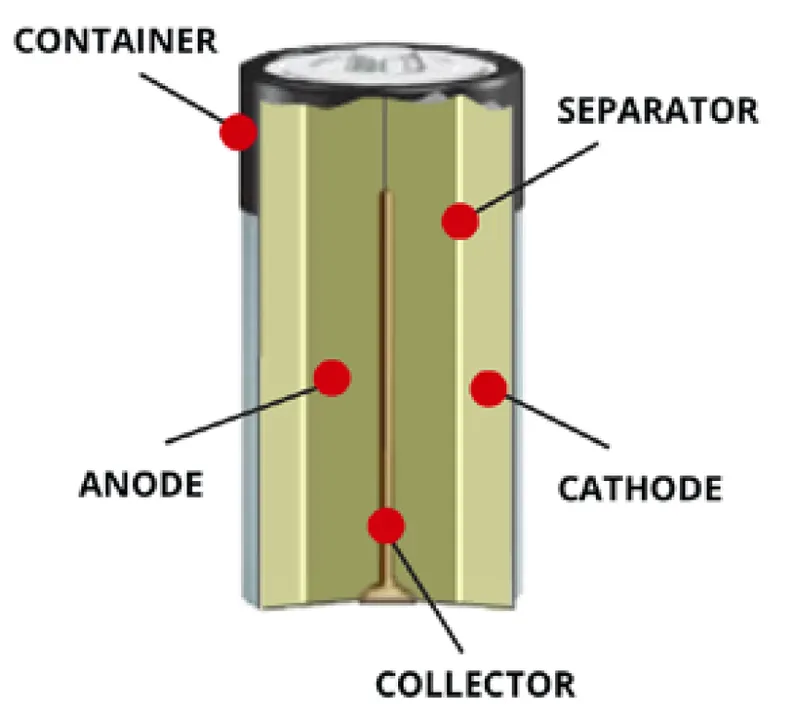
The two electrodes are specifically called the anode and the cathode, and both are made up of conductive materials that allow electrical current to pass through them. The two electrodes serve different roles within the battery.
The cathode attaches to the battery’s positive end. The positive end is also where the current comes out of the battery. This happens when the power within it is being discharged, or when power from the battery is used.
While the battery is discharging, electrical current comes into the battery on the opposite end, the negative end. This side is called the anode.
When the electrical current is entering through the anode, the electrons are exiting through it. Hence they are moving in opposite directions.
Between the electrodes inside the battery, and inside them as well (since the electrodes are both sponges that also absorb the electrolyte mixture) is the electrolyte.
These particles, also known as ions, combine and react with the material that each of the electrodes is made of, and a chemical reaction is obtained. The chemical reaction allows the battery to generate an electrical current that can power the things connected to it.
The battery receives the electrical charge from the car’s alternator. The alternator Is a component made up of a magnetic coil and rod, inside the car’s engine, that converts the mechanical energy into electrical energy.
The electrical energy is fueled through the battery, giving it a charge. The battery is then able to, in turn, power the electrical components of the car’s engine, most notably the starter, without which it I impossible to start the car.
Generator
Generates electricity from the rotating wheels while braking, transferring that energy back to the traction battery pack.
Purpose :
- The generator is used for starting and for running the vehicle.
- The generator generates electrical energy.
- It's responsible for generating electricity to charge the battery while the engine is running. They also keep the electrical components in the vehicle charged.
- Converts mechanical energy to electricity for transmission and distribution over power lines to domestic, commercial, and industrial customers.
- Then this electrical energy is converted into mechanical energy.
Working of generator :
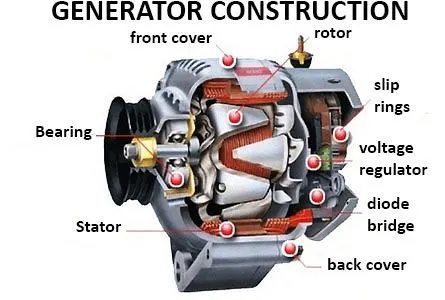
In a gas-powered generator, an internal combustion engine provides the mechanical force needed to generate a current. The engine spins a shaft which rotates an electromagnet (armature). The rotating armature spins inside a stationary magnetic field (stator) to produce electrical current through copper wiring. Essentially, the engine drives a rotating shaft that turns the armature and produces electricity.
The main components of an electric generator can be broadly classified as follows:-
- Engine - The engine is the source of the input mechanical energy to the generator. The size of the engine is directly proportional to the maximum power output the generator can supply.
- Alternator - The alternator, also known as the ‘genhead’, is the part of the generator that produces the electrical output from the mechanical input supplied by the engine. It contains an assembly of stationary and moving parts encased in a housing. The components work together to cause relative movement between the magnetic and electric fields, which in turn generates electricity.
- Fuel System - The fuel tank usually has sufficient capacity to keep the generator operational for 6 to 8 hours on an average.
- Voltage Regulator - As the name implies, this component regulates the output voltage of the generator. The voltage regulator takes up a small portion of the generator’s output of AC voltage and converts it into DC current.
- Cooling and Exhaust Systems - Continuous usage of the generator causes its various components to get heated up. It is essential to have a cooling and ventilation system to withdraw heat produced in the process. Raw/fresh water is sometimes used as a coolant for generators. And also it is essential to install an adequate exhaust system to dispose of the exhaust gases.
- Lubrication System - Since the generator comprises moving parts in its engine, it requires lubrication to ensure durability and smooth operations for a long period of time. The generator’s engine is lubricated by oil stored in a pump.
- Battery Charger - The battery charger keeps the generator battery charged by supplying it with a precise ‘float’ voltage. If the float voltage is very low, the battery will remain undercharged. If the float voltage is very high, it will shorten the life of the battery.
Fuse
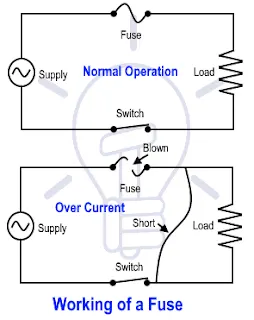
Purpose : An electrical fuse is a safety device that operates to provide protection against the overflow of current in an electrical circuit. An important component of an electrical fuse is a metal wire or strip that melts when excess current flows through it.
Working :
- A fuse consists of a piece of wire made of a metal or an alloy of an appropriate melting point, for example, aluminum, copper, iron, lead etc. If a current larger than the specified value flows through the circuit, the temperature of the fuse wire increases. This melts the fuse wire and breaks the circuit.
- The fuses work on the principle of the heating effect of the current.
- This is connected between the ends of the terminals. Fuse is always connected in series with the electrical circuit.
- When the excessive current or heat is generated due to heavy current flows in the circuit, the fuse melts down due to the low melting point of the element and it opens the circuit. The excessive flow may lead to the breakdown of wire and stops the flow of current. The fuse can be replaced or changed with the new one with suitable ratings.
- They also act as a circuit breaker which is used to break the circuit when the sudden fault occurs in the circuit. This is not only a protector but it is also used as a safety measure to prevent humans from hazards.
3. If the total load is 10A from battery, what should be the fuse rating?
`implies` Given in the question statement , current (I) = 10 A.
We know that, the standard automotive battery in today's vehivles is a 12 volt battery.
Power (P) = Voltage (V) * Current (I)
`therefore`Power (P) = 12*10 = 120 Watt
The fuse rating is more than the maximum load of the appliance to avoid the short circuits or damage of appliance due to over flow of load. we must maintain the fuse rating 25% greater than the total load.
So, power of fuse rating = 120 +120*`(25/100)` = 150 Watt
P = VI
I = P/V = 150/12 = 12.5 A
4. If 500W is the load, what is the voltage and capacity of battery you recommend?
Given in the question statement P = 500 W and Current (I) = 10 A , from the previous question.
Now, Voltage (V) = P/I = 500 / 10 = 50 Volt
Battery capacity (C) = I*T
= 10 * 1 = 10 Ah [Consider time = 1 hour]
`therefore` Recommend battery voltage and battery capacity are 50 V and 10 Ah respectively.
5. Identify any two elements which are connected parallel to each other. Why they are connected in parallel?
- Parking lamp
- Horn
- Sealed beam
- Tail stop
- dome light
- Plastic light
- Generator is connected with current voltage and regulater in parallel combination.
Every light is connected in a parallel combination. They are connected in parallel to avoide voltage drop across each connection and also if they are connected in series if any one light fails the others in the grid will not glow. Because if one component in a series circuit fails, then all the components in the circuit fail because the circuit has been broken.
But in parallel connection if there is a fault in one of the electric appliances, the current is able to pass through different paths of the circuit as there is numerous channels for electricity to go.
6. Identify any two elements which are connected in series. Why they are connected in series?
- Starter is connected in series with Battery because same current flows through it.
- Ammeter is connected in series. Ammeter is used to measure the current flowing through a component/circuit. Since, current remains same in series connection and also the resistance of an ammeter is very small due to which it doesn't affect the current to be measured. So, an ammeter is connected in series to measure current.