Project - Analysis of a practical automotive wiring circuit
Fundamentals of Electrical System & Electrical Architecture
1 . Identify each of the major elements in the above automotive wiring diagram.
- Battery : To supply electricity to the electrical systems in the circuit.
- Starter: The starter motor give the crank shaft initial torque to start rotating.
- Ammeter: The divice used to measure current in the circuit
- Ignition Switch : Its the switch with which an engine is started and stopped.
- Ignition Coil : It is a coil used for converting a low-voltage current into a voltage which is sufficient to produce the spark.
- Distributor : The divice that provides high voltage current to each spark plug depending on the firing order.
- Breaker : Used to interrupt the current flowing in the ignition coil to produce high voltage for creating arc in spark plug.
- Current & Voltage Regulator : It regulates current and voltage in the circuit constantly irrespective of load conditions.
- Generator : It converts mechanical energy into electrical energy and store in battery while engine is running.
- Foot selector switch : It is used for selecting between high beam and low beam of headlight.
- Fuse : The safty device in a circuit which is used to protect circuit from over loading and damage to other components.
- Gas tank Unit : The place to store gasoline which is used to produce power by burning.
- Fuel gauge : It is used to show the fuel level in the gas tank.
- Spark plug : It is device that produce spark in the engine cylinder inorder to ignite the air/fuel mixture.
2.
a) Distributor
It is an enclosed rotating switch used in internal combustion engines which have mechanically timed ignition.The distributor's main function is to route high voltage current from the ignition coil to the spark plug in the required firing order, and for the correct amount of time. As the distributor turns, the rotor turns as well, distributing voltage to each of the cap’s outer terminals one at a time. The voltage then travels from each of the distributor’s outer terminals, through individual spark plug wires, to each of the spark plugs. Then the spark plug fires, igniting the air/fuel mixture inside the engine.
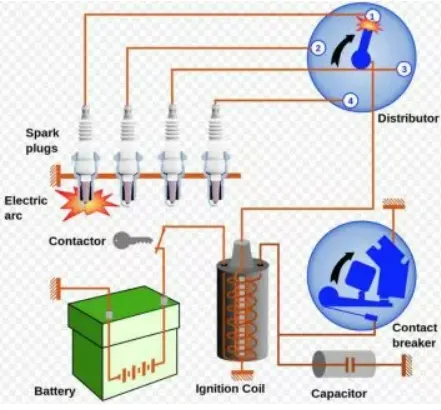
A distributor consists of a rotating arm or rotor inside the distributor cap, on top of the distributor shaft, but insulated from it and the body of the vehicle. On such distributors, the timing advance is controlled electronically by the Electronic Control Unit (ECU). This allows more accurate control of ignition timing, as well as the ability to alter timing based on factors other than engine speed and manifold vacuum (such as engine temperature). Additionally, eliminating vacuum and centrifugal advance results in a simpler and more reliable distributor.
b) Fuse
A fuse is a safty device in an electric circuit which is used to protect the electric system from overcurrent.It has a metal wire or strip which will melt whenever more than the rated current pass through it , thereby making the circuit open and stopping the current flow fruther.A fuse is an automatic means of removing power from a faulty system.The fuse will always be connected in series with the wiring circuite since it has to carry all the current passing through the circuit.
c) Ignition Coil
It is also called spark coil which is an induction coil in an ignition system that transforms the battery's voltage to the thousands of volts needed to create an electric spark in the spark plug to ignite the air-fuel mixture. The wire that goes from the ignition coil to the distrubutor and the high voltage wires that go from the distributor to each of the spark plug are called spark plug wires or high tension leads.Every ignition coil system required mechanical contact breaker points and a capacitor (condenser).
An ignition coil consists of a laminated iron core surrounded by two coils of copper wire. Unlike a power transformer, an ignition coil has an open magnetic circuite — the iron core does not form a closed loop around the windings. The energy that is stored in the magnetic field of the core is the energy that is transferred to the spark plug.
3.If the total load is 10A from battery, what should be the fuse rating?
Given data :
Total load - 10A
Voltage - 12 V
p =v* I
p= 120w
4 . If 500W is the load, what is the voltage and capacity of battery you recommend?
Given data :
Power or load = 500 W
Let voltage of battery = 12 v
we know P = V * I
I = 500/12
= 41.67 amps
Charge capacity C = I * t
lets take t = 3 hrs = 41.67 * 3
battery capacity= 125 Ah
5 . Identify any two elements which are connected parallel to each other. Why they are connected in parallel?
- Headlight and other lights : are connected in parallel with the battery.They are connected in parallel to avoide voltage drop across each connection and also if they are connected in series if any one light fails the others in the grid will not glow.
- Horn : They are connected in parallel to avoide voltage drop, if any voltage drop occurs it will effect the sound or loudness of the horn.
6 . Identify any two elements which are connected in series. Why they are connected in series?
- Ammeter : It is a device which is used to measure the current in the circuit.It is known that current remains same in series connection and also the resistance of an ammeter is very small due to which it doesn't affect the current to be measured.If it is connected in parallel due to its low resistance it will draw all the current which will damage the ammeter.
- Fuel gauge : It is used to measure fuel level in the gas tank.It has two parts a sending unit and indicator. The sending unit detect the fuel level using the resistance and this change in resistance changes the voltage in the circuit since it is connected in series which will be used to display.