Project - Analysis of a practical automotive wiring circuit
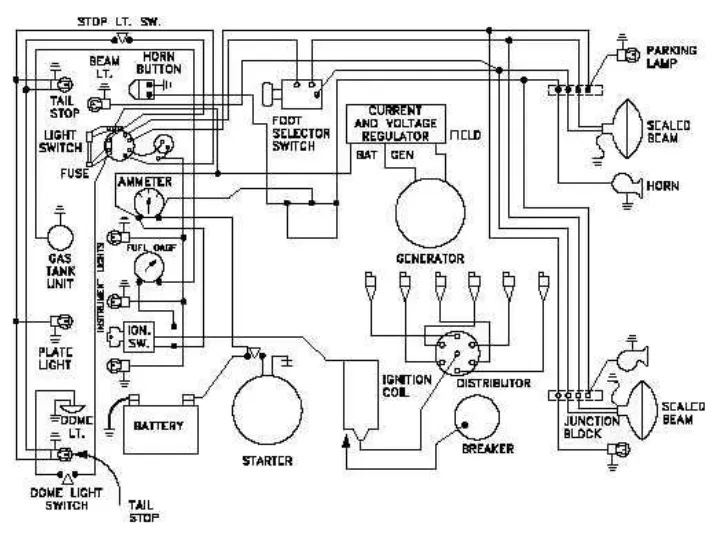
- Identify each of the major elements in the above automotive wiring diagram.
- Explain the purpose and working of any three elements briefly.
- If the total load is 10A from battery, what should be the fuse rating?
- If 500W is the load, what is the voltage and capacity of battery you recommend?
- Identify any two elements which are connected parallel to each other. Why they are connected in parallel?
- Identify any two elements which are connected in series. Why they are connected in series?
Hint- take battery voltage =12V
Considering the above Automotive wiring diagram,
1 ) Identify each of the major elements in the above automotive wiring diagram.
Major element means the automobile cannot operates without these elements such elements given in the above automotive wiring diagram are desicribed below ,
- BATTERY
- STARTER
- IGNITION SWITCH
- IGNITION COIL
- DISTRIBUTOR
- CONTACT BREAKER
- SPARK PLUG
- GENERATOR
- CURRENT VOLTAGE REGULATOR
- FUSES (Rare cases)
2 ) Explain the purpose and working of any three elements briefly
BATTERY
Batteries are devices that accept, store, and release electricity on demand. A battery’s primary function is engine starting here the battery converts chemical energy into the electrical energy, Batteries are made up of three basic components: an anode (the '-' side), a cathode (the '+' side), and some kind of electrolyte (a substance that chemically reacts with the anode and cathode).When the switch is closed, the circuit is complete, and electrons can flow from the anode to the cathode. These electrons enable the chemical reations at the anode and cathode.Batteries are typically made of six galvanic cells in a series circuits Each cell provides 2.1 volts for a total of 12.6 volts at full charge Once the engine is running, power for the car's electrical systems is still supplied by the battery, with the alternator charging the battery as demands increase or decrease.
STARTER
A starter motor is one of the major component use in an internal combustion engine which is electrically powered. Because an engine cannot rotate on its own, a part is required to start the first cycle. The starter motor help to initiate the engine’s which then continually operate on its own power , As soon as the engine begins to run, it got disconnected from the engine a starter consists of a powerful DC motor and a solenoid.
Electromagnetic induction is main principle , Components of Starter are Armature ,Commutator, Brushes, Solenoid, Plunger, Pinion, Field coils .The solenoid is energized by the car battery when the ignition switch or key is pressed. This pushes the plunger to shift the lever that directs the pinion gear. The pinion gear which then meshes with the engine flywheel. So, as the starter motor spin, the flywheel spin along which then begin the engine combustion to run on its own.
IGNITION COIL
The air-fuel mixture is ignited in the combustion chamber by an ignition spark. In order for the spark plug to produce the spark, an ignition voltage of approx. 30,000 Volt is required. This voltage is generated by the ignition coil from the 12 Volt voltage of the vehicle electrical system and transferred to the spark plug at the moment of ignition.
The ignition coil acts like a transformer. By means of two coils, one inside the other, The primary winding of an ignition coil will typically contain 150 to 300 turns of wire; the secondary winding will typically contain 15,000 to 30,000 turns of wire, The secondary winding is made with more windings than the primary winding. the ignition coil transforms the electrical energy from the vehicle battery into high voltage current pulses to the spark plug
When the ignition switch is turned on current flows from battery to ignition coil current flows through primary winding of the ignition coil where one end is connected to the contact breaker , A cam which is connected directely to the camshaft opens and closes the contact breaker points according to number of cycles when the cam lobe pushes CB switch the contact breaker opens which causes the current from the primary circuit to break due to the break an EMF is induced in the secondary winding having more number of turns which increases the battery voltage from 12 V to 22000V . The high voltage is then transferred to the distributor
3 ) If the total load is 10A from battery, what should be the fuse rating?
Here it is given that current is 10A ; So for considering the Fuse rating we are taking FUSE RATING =125 % RATED CURRENT
Here we use rating more than rated current because It's to ensure that in the event of a fault, the wiring doesn't overheat and cause a fire. The fuse needs to be rated slightly higher than the maximum operating current of the protected device, so that the fuse won't blow when the equipment is used , And also withstand the temperature changes
Fuse rating = 10* 125% = 12.5A , since we are taking the standard fuse rating we take next to standard rating
The fuse rating should be 15 A
4 )If 500W is the load, what is the voltage and capacity of battery you recommend?
Here we are assuming the voltage to 12 V , The Load given is 500W
Power= voltage * Current ; Current = Power/ Voltage
Current= 500W/12 V =41.6A = 42 A
So if we are taking 100 Ah battery it would go 100Ah / 42A = 2.36hr = 2Hr 22 min
Assuming we are going for 500 Ah battery = 500Ah/42Ah = 11.90 hr = 12 Hr Approx
5 ) Identify any two elements which are connected parallel to each other. Why they are connected in parallel?
The HORN , HEADLIGHT ( scaled beam ) are connected in parallel in the above automotive wiring diagram.Both the components are connected across each other, forming exactly two sets of electrically common points. In the parallel connection voltage is constant . The current always follows a low resistance path. Thus, the path where there is less resistance will support more current. This allows the product of both resistance (R) and current (I) to be the same in all branches of a parallel circuit. hence if one of component broke other will be able to work with out fault or drop in voltage. parallel circuit is safe to use, reliable, allowing for complex systems to function even if there’s a disruption within the system.
6 ) Identify any two elements which are connected in series. Why they are connected in series?
The Ammeter, Battery, Fuel gauge are coonected in series , Here the current will be same through out ,In a series circuit, all components are connected end-to-end, forming a single path for current flow.Here in the case of fuel gauge the sender in the fuel tank varies its resistance according to the amount of fuel in the tank, and sends a small electrical current to the fuel gauge. which is connected in series such that varying resistance can be noted , The components only share single common node in series connection