Project - Analysis of a practical automotive wiring circuit
1)
- Generator
- Battery
- Fuse
- Startor
- Junction box
- Breaker
- Ammeter
- Foot selection switch
- Distributer
- Ignition coil
- Horn Button
2)
- Ammeter:
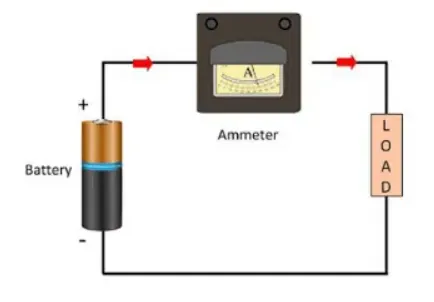
Ammeters were laboratory instruments that depended on the earth’s magnetic field for operation. In the 19th century, the ammeter with the ability of accurate measurements, which could be mounted in any position was invented.Ammeter is a device used to measure either alternating or direct current. We know that ampere is the unit of current. Since this device measures the value in amperes, it’s known as ammeter.
Working:
The ammeter is that it must have a very low resistanceand also inductive reactance. Now, why do we need this? Can’t we connect an ammeter in parallel? The answer to this question is that it has very low impedance because it must have very low amount of Voltage drop across it and must be connected in series connection because current is same in the series circuit. Also due to very low impedance the power loss will be low and if it is connected in parallel it becomes almost a short circuited path and all the current will flow through ammeter as a result of high current the instrument may burn. So due to this reason it must be connected in series. For an ideal ammeter, it must have zero impedance so that it has zero voltage drop across it so the power loss in the instrument is zero. But the ideal is not achievable practically.
Depending on this types of measurement we do, we have-
- DC Ammeter.
- AC Ammeter.
- Battery:
A battery is a device that converts chemical energy contained within its active materials directly into electrical energy by means of an electrochemical oxidation-reduction (redox) recation. This type of reaction involves the transfer of electrons from one material to another via an electric circuit. While the term is often used the cell is activel electrochemical unit used to generate are store electric energy. In understanding the difference between a cell and a battery one should think of a battery as one or more these cell connected in series and parallel or both depending on the both desired output voltage and capacity.
- Generator:
An electric generator is a device that converts mechanical energy obtained from an external source into electrical energy. It uses the mechanical energy supplied to it to force the movement of electric charges present in the wire of its windings through an external electric circuit.
working:
An Electric generator is a device which is used to produce electric energy, which can be stored in batteries or can be directly supplied to the homes, shops, offices, etc. Electric generators work on the principle of electromagnetic induction. A conductor coil (a copper coil tightly wound onto a metal core) is rotated rapidly between the poles of a horseshoe type magnet. The conductor coil along with its core is known as an armature. The armature is connected to a shaft of a mechanical energy so ..source such as a motor and rotated. The mechanical energy required can be provided by engines operating on fuels such as diesel, petrol, natural gas, etc.
3)
Given data
total load battery (I) = 10 A
Fuse rating = ?
Voltage (V) = 12 V
P = VxI
P = 12x10
= 120 kW
Where,
P for power in Watts
V for voltage in volt
I for Current in Amps
I (Amps) = P (Watts) ÷ V (Voltage)
Fues rating (I) = (Px1.5)/V
= (120x1.5)/12
= 180/12
I = 15 A
The fuse rating is more than the maximum load of the appliance to avoid the short circuits or damage of appliance due to over flow of load. we must maintain the fuse rating 25% greater than the total load. so that the fuse rating is to be 15A.
4)
Given data
load =500watt
Time =24hours
voltage = 12V
Capacity = load*time
Capacity = 500*24
=12000Wh
Amp-hours = Watt-hours / Voltage
=12000/12
=1000Ah
5)
- Lights:
Each light in a parallel circuit has its own circuit. The individual currents add up to the total current. The voltage for each light is the same. As opposed to a series circuit, if one light malfunctions in a parallel circuit, the other lights still light up.
- Horn:
parallel switching of high and low tones is used and the main sound frequencies of these signals are harmoniously combined.
6)
- Ammeter:
An ammeter is a device which measures the amount of current flowing in a circuit. It is a very low resistance(nearly zero) device. If it will be connected in parallel, it would draw most of the current and would get damaged.
- Battery:
Connected in series with high voltage to improve the drivability and energy efficiency.