Project - Analysis of a practical automotive wiring circuit
Project –Analysis of a practical automotive wiring circuit
Aim: To analyse the circuit and answer the given questions
Objective: To answer the given questions:
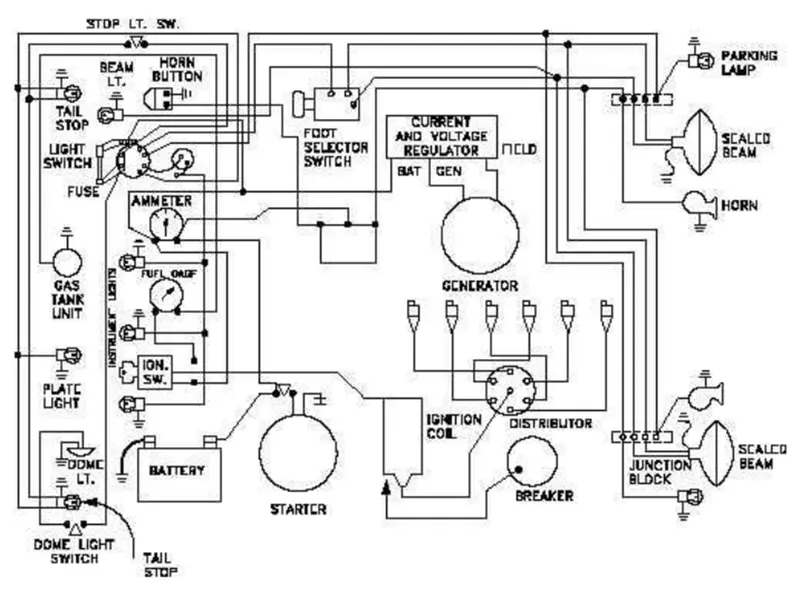
- Identify each of the major elements in the above automotive wiring diagram.
- Explain the purpose and working of any three elements briefly.
- If the total load is 10A from battery, what should be the fuse rating?
- If 500W is the load, what is the voltage and capacity of battery you recommend?
- Identify any two elements, which are connected parallel to each other. Why are they connected in parallel?
- Identify any two elements, which are connected in series. Why are they connected in series?
Hint- take battery voltage =12V
Solution:
1.
The major elements used in the above diagram are:
- Battery
- Starter
- Switches
- Lamps/Lights
- Fuse
- Ammeter
- Current and voltage regulator
- Ignition coil
- Distributor
- Junction block
- Horn
- Generator
- Breaker
- Gas tank
- Fuel flow gauge
- Distributor
2.
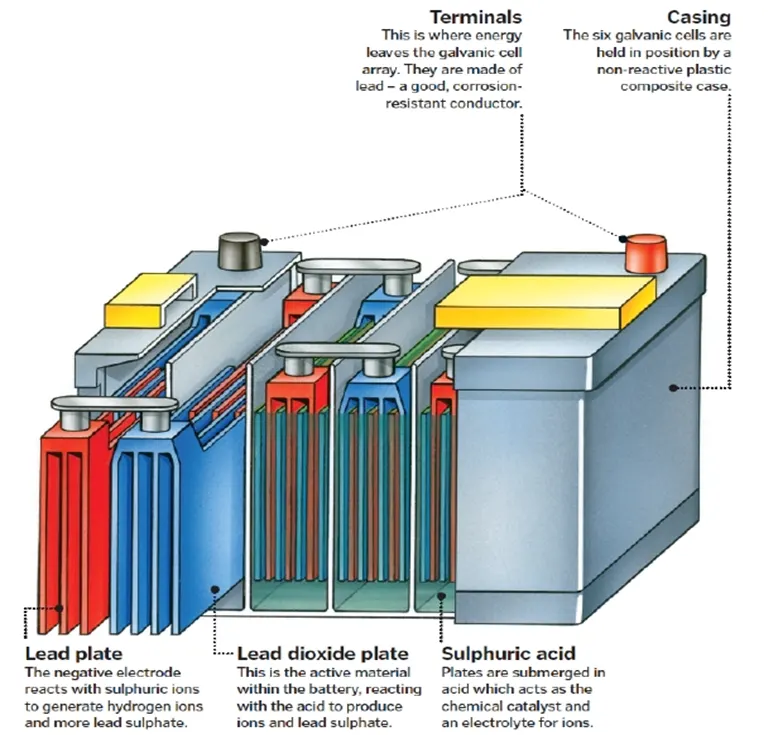
i) Battery: Batteries are devices that translate chemical energy into electrical energy. They are made up of cells that store chemical energy and transform it into electricity on demand. Most petrol and diesel car batteries feature six cells, each of which can produce around two volts of energy - meaning that combined they produce 12 volts.The majority of these car batteries use a lead-acid chemical reaction. Each of the cells features two plates, one made from lead and the other from lead dioxide. These plates are submerged in sulphuric acid, which acts as a catalyst and triggers a chemical reaction between them. This reaction produces electrons, which generate electricity. The electricity then flows from the battery to start your car engine. The reaction is reversible, which is why your battery recharges as your engine runs and why you can jumpstart it when it’s flat.
When you switch the ignition on in your vehicle, this sends a signal to the battery telling it to start the chemical reaction. The electricity produced by this reaction supplies power to the starter motor, which then turns the engine over. At the same time, the battery provides power to the spark plugs, which ignite the air and fuel mixture that is compressed in the engine combustion cylinders.The power provided by the battery is then replaced by the alternator, which is responsible for supplying most of the electrical current to the electrical systems in your car, and for keeping the battery charged.
ii) Starter:
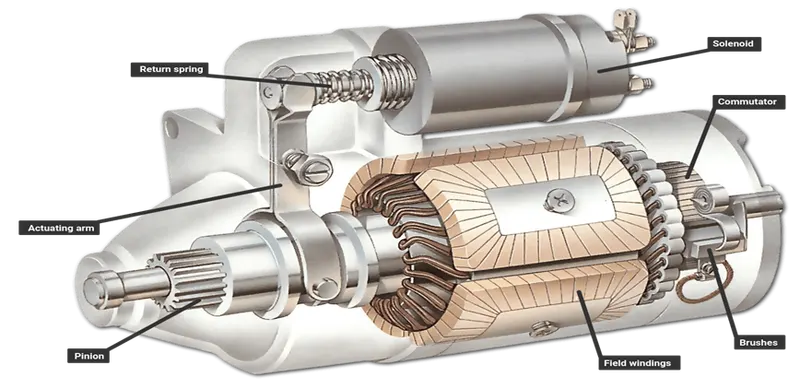
Working: When you turn the key in your car’s ignition, the engine turns over and then cranks. However, getting it to crank is actually much more involved than you might think. It requires a flow of air into the engine, which can only be achieved by creating suction (the engine does this when it turns over). If your engine isn’t turning over, there’s no air. No air means that fuel can’t combust. The starter motor is responsible for turning the engine over during ignition and allowing everything else to happen. When you turn the ignition on, the starter motor engages and turns the engine over allowing it to suck in air. On the engine, a flywheel, with a ring gear attached around the edge, is fitted to the end of the crankshaft. On the starter, the pinion is designed to fit into the grooves of the ring gear. When you turn the ignition switch, the electromagnet inside the body engages & pushes out a rod to which the pinion is attached. The pinion meets the flywheel and the starter motor turns. This spins the engine over, sucking in air (as well as fuel). As the engine turns over, the starter motor disengages, and the electromagnet stops. The rod retracts into the starter motor once more, taking the pinion out of contact with the flywheel and preventing potential damage.
iii) Generator:
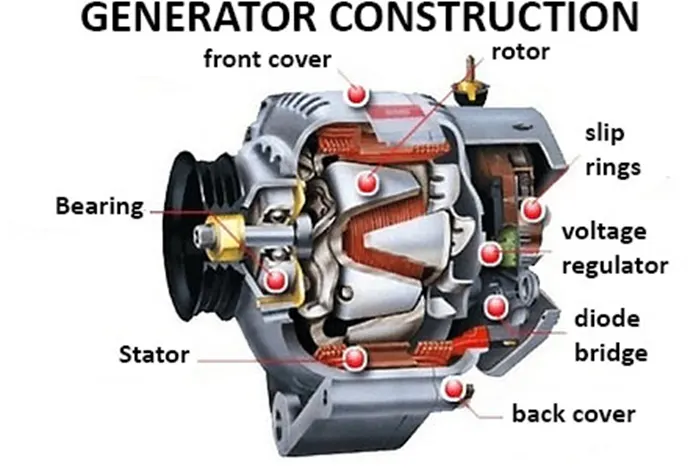
You may think your battery is powering all things electrical in your car, be it your windshield wipers, headlights or radio. In reality, it’s the car alternator that produces the majority of your vehicle’s electricity — your battery is mainly just used to start your vehicle and provide power when the engine isn’t running. The alternator is a critical component of a car’s charging system, so it’s helpful to understand how it operates in case you have to deal with your car not starting. The alternator is a generator whose purpose is to distribute electricity to the car and recharge the battery. Outside of some hybrid models, all vehicles with a standard internal combustion engine will have an alternator. About the size of a coconut, the alternator is generally mounted to the front of the engine and has a belt running around it.
Working: The process of producing electricity begins with the engine. For most modern vehicles, alternators are driven by the engine’s crankshaft via a serpentine belt, though older vehicles may have a separate pulley going from the crankshaft to the alternator. The belt’s movement — the mechanical energy — spins the alternator’s rotor at a high speed within the stator.Electricity is made as the rotor spins. The magnets surrounding the rotor are deliberately placed so that as they pass over the copper wiring in the stator, a magnetic field is created. This magnetic field, in turn, produces voltage that is captured by the stator. This power then reaches the voltage regulator, which disperses electricity to the vehicle and manages the amount of voltage the battery receives.
Before the battery can use the power coming from the alternator, it needs to be converted to a format that the battery can use. That’s because electricity can flow in different currents, or directions. Car batteries operate on one-way direct current (DC) electricity, while alternators output alternating current (AC) electricity, which occasionally flows in reverse. So prior to going to the voltage regulator, power intended for the battery goes through a diode rectifier to turn into DC. After the conversion, the battery can use the power to recharge.
3.
Generally, a fuse is rated at 130 to 150% of the rated load. Here the battery has a rating of 10 A. Hence, the fuse must be rated at 13-15 A.
4.
Load = 500 W
Battery voltage, V = 12 V
We know, that a battery can be rated in Watt-hours or Ampere-hours. Our load has been given to be 500 W. This is the maximum value of load that needs to be supplied by our battery as and when required. Therefore, a 500 Watt-hour battery will suffice the load requirements. To convert it into Ampere-hours, we know,
Watt-hours = V X I X t & Ampere-hours = I X t
`therefore` Ampere-hours = Watt-hours/V
= 500/12
= 41.67 Ah
Thus, a 12 V 41.67 Ah battery is recommended for the given load.
5.
The parking lamps, scaled beam, tail stop, and dome light are in parallel to each other. They are connected in parallel because each has a different function to serve and require to operate independent of each other.
6.
The ignition switch, the battery, the ammeter, the fuse, etc. are connected in series. It is so because the operation of one depends upon the proper functioning of the other. Suppose there is an excess current detected at the ammeter. The fuse will therefore shut-off the power supply to the other components of the vehicle thus preventing any damage.