Project
Aim:
To study and analyse BAJA ALL TERRAIN Vehicle simulation in system vehicle.
Objective:
To prepare a technical report on Baja ATV with and without lookup table. Explanation on simulink , Simscape model.
Therotical breif on ATV :
An all-terrain vehicle (ATV), also known as a light utility vehicle (LUV), a quad bike, or simply a quad, as defined by the ANSI; is a vehicle that travels on low-pressure tires, with a seat that is straddled by the operator, along with handlebars for steering control.
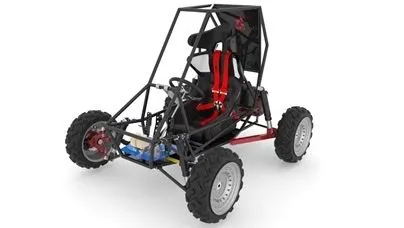
ATVs, or more commonly "quads" in Germany, can be accredited in two different ways in Germany. Usually they are taxed and insured as a regular automobile, which results in the tax being calculated by emissions and displacement in 100ccm steps.
ATVs registered as an automobile have to be restricted to a power output of 20 hp/15 kW and are allowed to be driven with a passenger, provided a passenger seat.
The vehicle needs a high-/low-beam headlight, brake light, indicators, a number plate mount on front and back, a signal horn and is limited.
ATVs under 400 kilograms (880 lb) do not need a reverse gear. Over 400 kilograms (880 lb) empty weight, a reverse gear and reverse light are required.
The maximum engine noise restrictions depend on date of first registration and engine displacement.
On the other hand, ATVs can be registered "as agricultural and silvicultural" (LoF/Land oder Forstwirtschaftlich) giving the owner some benefits: The quad can be driven with power outputs more than 20 hp and tax is much cheaper, being calculated by empty weight. Compared to other agricultural vehicles and ATVs, the insurance cost is much lower.
This ATV Model use to contains Simscape , Simscape driveline , Simulink Modules.
Components of Baja ATV:
1. Vehicle body
2.Tire (4Wheel)
3.Suspension
4.CVT (Continous variable transmission)
5.Engine
Model of BAJA ATV :
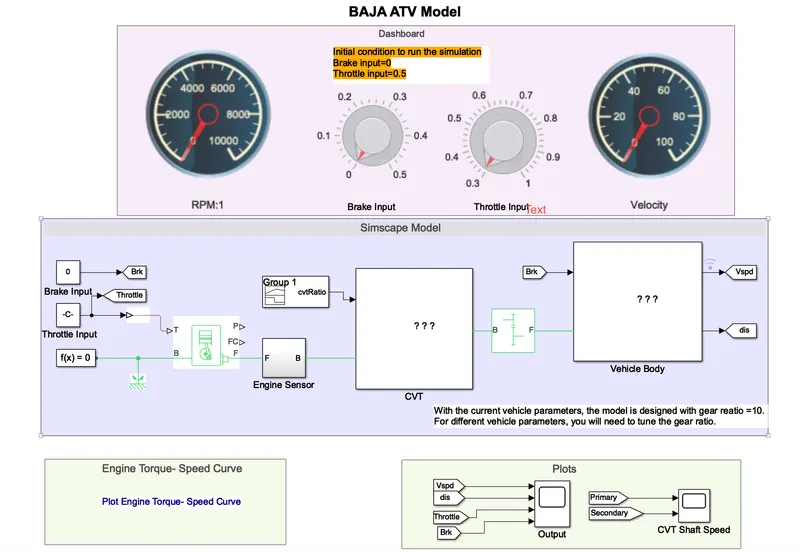
Explanation of this Model:
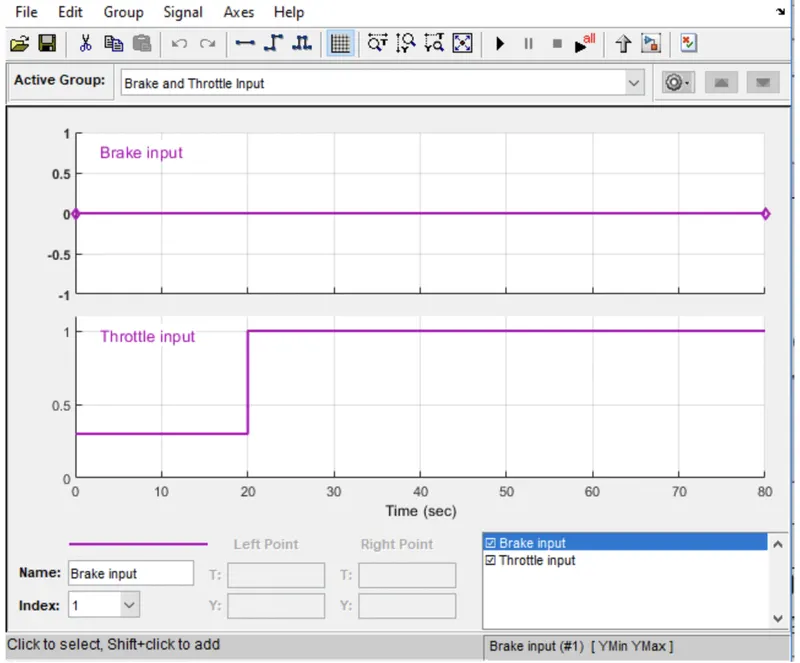
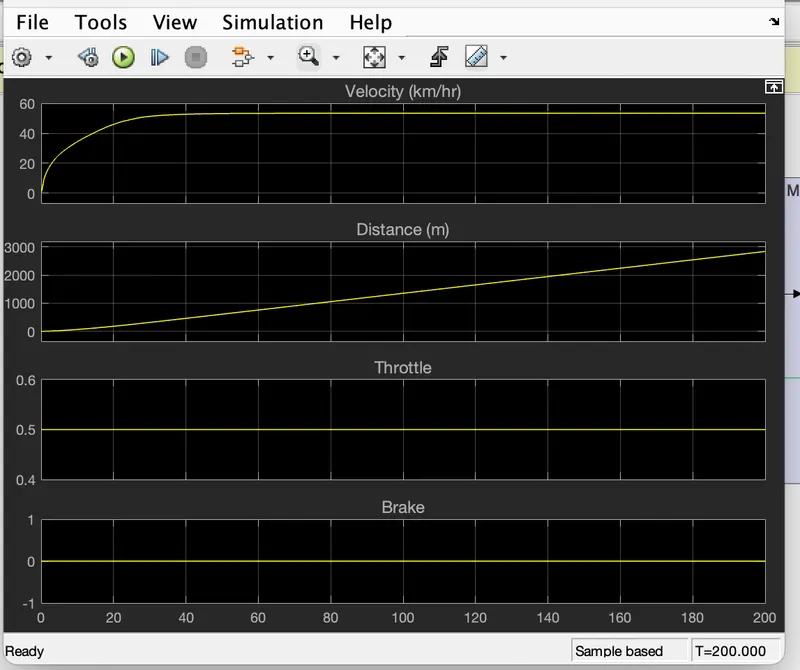
> Signal builder
In this model signal builder used to give the input values to brake and throttle input
whereas
Brake input = 0 , Throttle input = 0.3 for 20sec after 20sec to 1
Engine :
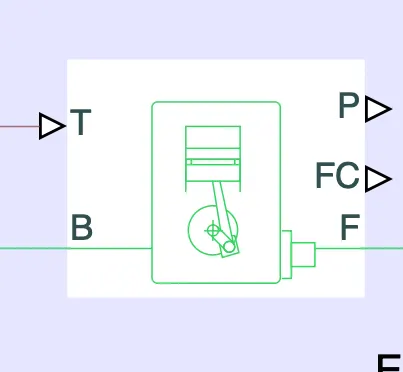
Engines library provides blocks for combustion-engine modeling. You can model a single-cylinder spark-ignition and diesel engines, or a reciprocating engine that contains multiple cylinders.
You can also model just the piston mechanism of a combustion engine using the Piston block.
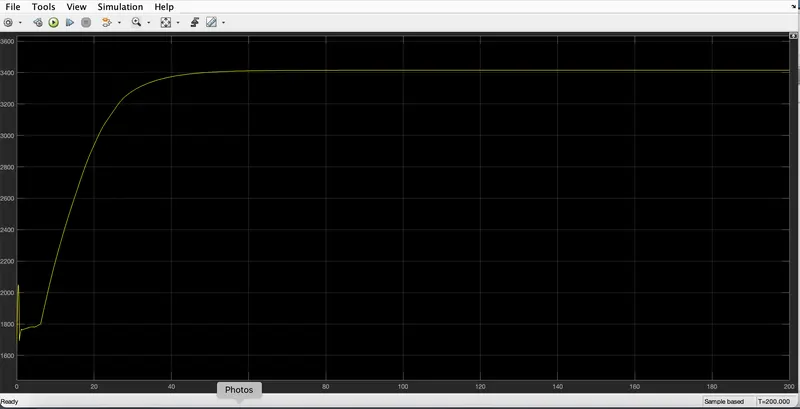
Engine Sensor :
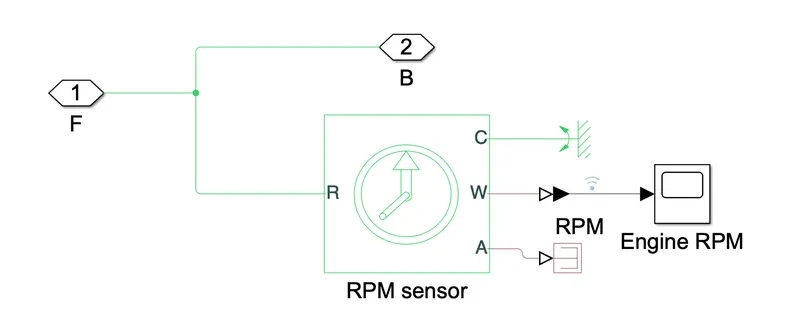
The Ideal Rotational Motion Sensor block represents an ideal mechanical rotational motion sensor, that is, a device that converts an across variable measured between two mechanical rotational nodes into a control signal proportional to angular velocity or angle. You can specify the initial angular position (offset) as a block parameter.
The sensor is ideal since it does not account for inertia, friction, delays, energy consumption, and so on.
Connections R and C are mechanical rotational conserving ports that connect the block to the nodes whose motion is being monitored. Connections W and A are physical signal output ports for velocity and angular displacement, respectively.
The block positive direction is from port R to port C. This means that the velocity is measured as ω = ωR – ωC, where ωR, ωC are the absolute angular velocities at ports R and C, respectively.
CVT (Continious Variable Transmission) :
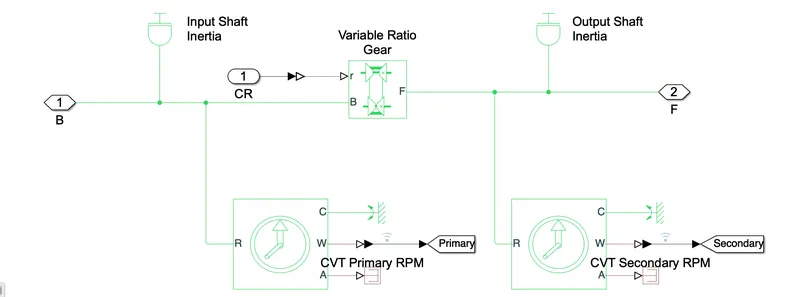
The CVT Controller block implements a push belt continuously variable transmission (CVT) controller. The block uses standard pulley and geometric equations to calculate the kinematic setpoints for the CVT variator. You can use the block to control a CVT.
Result :
Conclusion :
1. Studied about Baja ATV project and simscap block used in this model
2. Reference : MATLAB documentation , Wikipedia , etc.,