Project
Aim:
Carry out a system-level simulation of an all-terrain vehicle.
Theory:
An all-terrain vehicle (ATV), also known as a light utility vehicle (LUV), a quad bike, or simply a quad, as defined by the American National Institute (ANSI); is a vehicle that travels on low-pressure tires, with a seat that is straddled by the operator, along with handlebars for steering control. As the name implies, it is designed to handle a wider variety of terrain than most other vehicles. Although it is a street-legal vehical in some countries, it is not street-legal within most states, territories and provinces of Australia, the United States or Canada.
By the current ANSI definition, ATVs are intended for use by a single operator, although some companies have developed ATVs intended for use by the operator and one passenger. These ATVs are referred to as tandem ATVs.
The rider sits on and operates these vehicles like a motorcycle, but the extra wheels give more stability at slower speeds. Although most are equipped with three or four wheels, six-wheel models exist for specialized applications. Multiple-user analogues with side-by-side seating are called utility terrain vehicles (UTVs) or side-by-sides to distinguish the classes of vehicle. Both classes tend to have similar powertrain parts. Engine sizes of ATVs currently for sale in the United States (as of 2008 products) range from 49 to 1,000 cc (3.0 to 61 cu in).
19th century
Royal Enfield built and sold the first powered quadracycle in 1893. It had many bicycle components, including handle bars. The Royal Enfield resembles a modern ATV-style quad bike but was designed as a form of horseless carraige for road use.
Six-wheeled AATVs
6x6 Polaris Big Boss in use by the Norwegian military in Afghanistan.
The term "ATV" was originally coined to refer to non-straddle ridden, typically six-wheeled, amphibious-ATV, such as the Jiger produced by the Jiger Corporation, the Amphicat produced by Mobility Unlimited Inc, and the Terra Tiger produced by the Allis-Chalmers Manufactureing Company in the mid 1960s and early 1970s. With the introduction of straddle ridden ATVs, the term AATV was introduced to define the original amphibious ATV category.
ATC development
The first three-wheeled ATV was the Sperry-band Tricart. It was designed in 1967 as a graduate project of John Plessinger at the Cranbrook Academy of Arts near Detroit. The Tricart was straddle-ridden with a sit-in rather than sit-on style (similar to the contemporaneous Big Wheel toy). In 1968 Plessinger sold the Tricart patents and design rights to Sperry-Rand New Holland who manufactured them commercially. Numerous small American manufacturers of 3-wheelers followed. These small manufacturers were unable to compete when larger motorcycle companies like Honda entered the market in 1969.
1984 Honda ATC200S, one of the many three-wheeled models made by Honda and other manufacturers
Honda introduced their first sit-on straddle-ridden three-wheeled All Terrain Vehicle in 1969, known as a US90, as a 1970 Model. Variations would be popularized in the James Bond movie, Diamonds Are Forever and TV shows such as Doctor Who, Magnum, P.I and Hart to Hart. In 1973, Honda would trademark the term "All Terrain Cycle" (ATC), applying the moniker to all Honda produced Three-wheeled ATVs, and creating the universal name which now associated with all vehicles of this type. Being directly influenced by earlier 6-wheeled AATVS of the sixties, it utilized balloon tires for both a low environmental impact and to compensate for a lack of mechanical suspension.
Honda entered the 1980s with a virtual monopoly in the market, due to effective patents on design and engine placement. By 1980, other companies would pay patent royalties to Honda to enter the lucrative ATC field with their own machines. Yamaha introduced their first ATC, the Tri-Moto YZ125. Kawasaki followed suit the next year with the KLT200, while Suzuki produced their first effort, the ALT125, in 1982. As the popularity of ATCs increased dramatically, rapid development ensued. The ability to go anywhere on terrain that most other vehicles could not cross soon made them popular with US and Canadian hunters, and those just looking for a good trail ride. As other manufacturers were entering the market, Honda was diversifying, offering the ATC250R, the first Sports ATC intended for competition, in 1981. The 1982 Honda ATC200E Big Red was a landmark model. It featured both suspension and racks, making it the first ATC designed specifically for utility, and would become the world's best-selling ATC. Honda followed that effort in 1983 with the ATC200X, an easy-to-handle 192 cc (0.192 L; 11.7 cu in) Sport ATC four-strok that was ideal for new riders.
Not to be outdone, Kawasaki and Yamaha responded with their own Sport ATCs. 1984 saw the release of the Kawasaki KXT250 Tecate, and Yamaha followed in 1985 with the Tri-Z 250. Both were liquid Cooled 250 cc two-strokes capable of giving the Honda ATC250R competition. In response to growing market, American Specialty manufacturer Tiger also introduced a series of ATCs, Hand-built-to-order models that included the Tiger 500, the largest displacement ATC produced commercially. While Kawasaki and Yamaha both produced Utility ATCs, famously making the KLT 250 Police and Yamahauler respectively, Suzuki turned their attention to building Sport Quads.
Honda continued to diversify their line-up (at peak offering 10 distinct models), releasing the larger, fully suspended 250 cc Big Red Utility ATC, and introduced the 350X Sport ATC, their largest displacement machine, in 1985. But the bulk of their sales would prove to be the 200cc line, offering six models and selling over 500,000 units in 3 years. Honda's response to the Tecate and Tri-Z, the liquid cooled 1985 and 1986 ATC250R, remains one of the most desirable ATCs of the era, and aftermarket support still follows the machine.
American based manufacturers
Main articles: Tiger ATV LTD and Polaris Scrambler 250R/es
American-based manufacturers also produced ATCs in this period, albeit in small numbers. Polarise offered the Scrambler in 1985 and 1986, producing appx 1600 units. Speciality manufacturer Tiger ATV also produces a range of ATCs, but their liquidation in 1991 left no official record of how many units were produced. The collector ATV market estimates vary drastically, from 300 to as many as 1000 units total production. Tiger ATCs were offered for three years, with models using 80 to 500 cc (0.0800 to 0.500 L; 4.88 to 30.5 cu in) tow-stroke engines provided by KTM and Rotax.
The Tiger 500 is notable for being the fastest consumer ATC available, with tested top speeds of +80 mph from the stock 42 horsepower (31.3 kW)@6500rpm engine and 5 speed gearbox. With final drive gearing changes, the ATC could produce speeds exceeding 100 mph. However, due to the rarity of the machines, much of the public was and remains unaware of the brand, and as all Tiger Models were custom ordered and built to the buyers specifications for the purpose of factory ATV racing, Polaris is generally known as the first American ‘Production’ ATV producer.
Voluntary cease of production
Production of three-wheelers was voluntarily ceased by all manufacturers by 1987, in light of safety concerns, and ahead of any legislation. Though future studies would show that three-wheelers were not considered more unstable than four-wheelers (although accidents are equally severe in both classes), manufacturers agreed to a 10-year moratorium on production, as well as collectively financing a +$100 million ATV safety campaign. Despite the moratorium lifting, manufacturers have not returned to the ATC market, focusing instead on four wheeled ATVs. A ban on sales of new or used three-wheelers and a recall of all remaining three-wheelers has been proposed by the American Academy of Pediatics However, it was determined in a CPSC study that three-wheelers are no more dangerous than other ATVs. Because of the cessation of production, it is widely assumed that the machines are unregistrable, uninsurable, and even illegal, despite a lack of any federal restrictions. All ATCs continue to be governed by the same laws as ATVs, with only select states implementing an older minimum age requirement for use of ATCs.
These safety issues with three-wheel ATCs caused a shift in the buying public, as the sales of recently introduced four-wheel ATV models grew rapidly. While three-wheel models ended production in 1987, agreements between the major manufacturers and the Consumer Product Safety Commission to officially cease production and finance safety campaigns moved forward. While the lighter weight of ATCs made them popular with certain riders, manufacturers continued to focus on ATV production.
Safety concerns of ATCs
Safety courses and educational literature has reduced the number and severity of accidents among ATC and ATV riders. As cornering is more challenging on an ATC than with a four-wheeled machine, properly leaning into the turn is required, to counterbalance the weight and keep the machine stable. Operators may roll over if caution isn't used at high speeds. The lighter front end and smaller footprint of ATCs present both a flipping and steering hazard under acceleration and on inclines. Lateral rollovers may also occur when traversing steep inclines. However, in most terrain with the proper riding technique and safety gear, this issues can be mitigated. ATCs require unique techniques to ride properly, and turning lean requires more exaggeration than ATVs; Throttle steering is another technique commonly used on ATCs in soft terrain and at high speeds, leaning to the inside of the turn and manipulating the throttle to break traction with the rear tires, resulting in the machines turning on axis while maintaining a forward direction.
H.R. Bill 4040 (2008)
Bill 4040 of the House of Representatives, becoming law on August 8, 2008, separated ATCs from existing new production ATV safety standards, and requires new standards for three-wheeled ATCs to be drafted. This effectively suspended importation of three-wheeled ATCs, until new standards of safety can be drafted. As of 2020, such standards have not been drafted. While search engines can find informal information suggesting major Japanese manufacturers pressed for this measure due to an influx of inexpensive Chinese ATCs in the American market, no official documentation or cited sources support these claims. Currently, all manufacturers not based in the US are restricted from the manufacture and sale of new Three-Wheeled All Terrain Cycles, until safety standards can be implemented. Below is the segment of Bill 4040 law (section 232) that presents the language effecting the ATC ban.
|
(Sec. 232) Requires the CPSC, notwithstanding any other provision of law, to establish as a mandatory consumer product safety standard a specified American National Standard for four-wheeled all-terrain vehicles developed by the Specialty Vehicle Institute of America. Makes it unlawful for any manufacturer or distributor to import or distribute any new all-terrain vehicle unless: (1) the vehicle complies with the standard, is subject to an all-terrain vehicle action plan, and bears a label certifying such compliance and certain other information; and (2) the manufacturer or distributor is in compliance with the action plan. Prohibits the importation of new three-wheeled all-terrain vehicles until a mandatory consumer product safety standard applicable to three-wheeled all-terrain vehicles is in effect. |
Four-wheelers (1980-today)
ATVs are popular in Saudi Arabia
Suzuki was a leader in the development of mass production four-wheeled ATVs. It sold the first model, the 1982 QuadRunner LT125, which was a recreational machine for beginners.
Adventure Vehicles of Monroe, Louisiana made the first quad ATV in 1980. They called it the Avenger 400. Prior to that, Adventure Vehicles made 3 wheel ATVs and a dump body utility 3 wheeler using Kohler 8 hp engines and Comet drive systems (Comet centrifugal belt-driven clutch, and a Comet forward, neutral, reverse transaxle, with a rigid rear axle or rear differential option.) The Avenger 400 was a rigid suspension vehicle with a fiberglass body and welded tube construction. It was a rudimentary vehicle reminiscent of the Tote Gote of the 1960s.
Suzuki sold the first four-wheeled mini ATV, the LT50, from 1984 to 1987. After the LT50, Suzuki sold the first ATV with a CVT transmission, the LT80, from 1987 to 2006.
In 1985 Suzuki introduced to the industry the first high-performance four-wheel ATV, the Suzuki LT250R QuadRacer. This machine was in production for the 1985–1992 model years. During its production run, it underwent three major engineering makeovers. However, the core features were retained. These were: a sophisticated long-travel suspension, a liquid-cooled, two-stroke motor, and a fully-manual five-speed transmission (for 1985–1986 models), and a six-speed transmission (for the '87–'92 models). It was a machine exclusively designed for racing by highly skilled riders.
Honda responded a year later with the FourTrax TRX250R—a machine that has not been replicated until recently. It currently remains a trophy winner and competitor to big-bore ATVs. Kawasaki responded with its Tecate-4 250. The TRX250R was very similar to the ATC250R it eventually replaced and is often considered one of the greatest sport ATVs ever built.
In 1987, Yamaha Motor Company introduced a different type of high-performance machine, the, Banshee 350 which featured a twin-cylinder liquid-cooled two-stroke motor from the RD350LC street motorcycle. Heavier and more difficult to ride in the dirt than the 250s, the Banshee became a popular machine with sand dune riders thanks to its unique power delivery. The Banshee remains popular, but 2006 is the last year it was available in the U.S. (due to EPA emissions regulations); it remained available in Canada until 2008 and in Australia until 2012. The Warrior 350 was introduced in 1987 and went on for years as a light and fast ATV.
Shortly after the introduction of the Banshee in 1987, Suzuki released the LT500R QuadRacer. This unique quad was powered by a 500 cc liquid-cooled two-stroke engine with a five-speed transmission. This ATV earned the nickname "Quadzilla" with its remarkable amount of speed and size. While there are claims of 100+ mph (160 km/h) stock Quadzillas, it was officially recorded by 3&4 Wheel Action magazine as reaching a top speed of over 79 mph (127 km/h) in a high-speed shootout in its 1988 June issue, making it the fastest production four-wheeled ATV ever produced. Suzuki discontinued the production of the LT500R in 1990 after just four years.
At the same time, the development of utility ATVs was rapidly escalating. The 1986 Honda FourTrax TRX350 4x4 ushered in the era of four-wheel-drive ATVs. Other manufacturers quickly followed suit, and 4x4s have remained the most popular type of ATV ever since. These machines are popular with hunters, farmers, ranchers, and workers at construction sites.
ATV with a tow spreader mounted
Models continue today, to be divided into the sport and utility markets. Sport models are generally small, light, two-wheel-drive vehicles that accelerate quickly, have a manual transmission, and run at speeds up to approximately 80 mph (130 km/h). Utility models are generally bigger four-wheel-drive vehicles with a maximum speed of up to approximately 70 mph (110 km/h). They have the ability to haul small loads on attached racks or small dump beds. They may also tow small trailers. Due to the different weights, each has advantages on different types of terrain. A popular model is Yamaha's Raptor 700, which features a nearly 700 cc four-stroke engine.
Six-wheel models often have a small dump bed, with an extra set of wheels at the back to increase the payload capacity. They can be either four-wheel-drive (back wheels driving only), or six-wheel-drive.
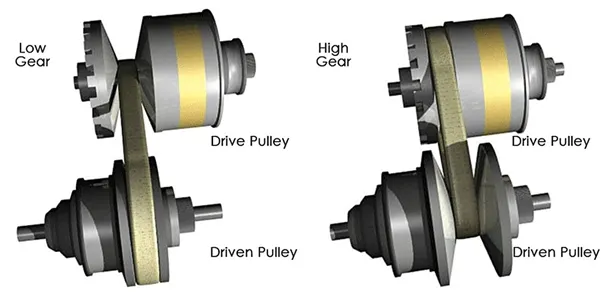
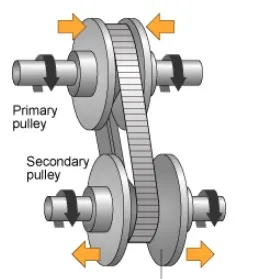
This a figure of transmission of AVT with primary , variator, secondary pulley and a belt , when variator which is connected to the primary pulley move outwards than variator of secondary pulley will move inwards such that radius of primary pulley is less than the radius of secondary pulley which leads to speed reduction and when the variator which is connected to the primary pulley move inwards then variator of secondary pulley will move outwards such that radius of primary pulley is more than the radius of secondary pulley which leads to overdrive.
BAJA ATV Model:
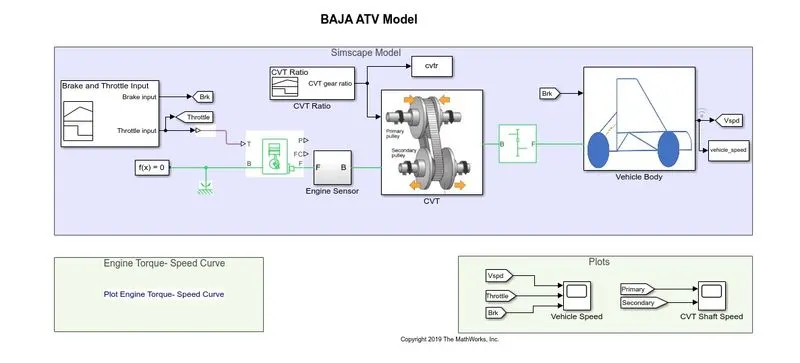
The input signal is provided using signal build:
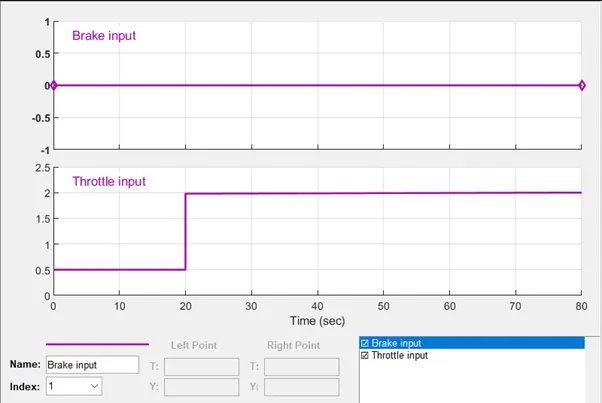
Signal builder is connected break and throttale
Which is connected to Generic engine Represents a system-level model of spark-ignition and diesel engines suitable for use at initial stages of modeling when only the basic parameters are available. Optional idle speed and red line controllers are included.
The throttle input signal T lies between zero and one and specifies the torque demanded from the engine as a fraction of the maximum possible torque. If the engine speed falls below the Stall speed, the engine torque is blended to zero. If the engine speed exceeds the Maximum speed, the simulation stops and issues an error message.
Connections F and B are mechanical rotational conserving ports associated with the engine crankshaft and engine block, respectively. Connections P and FC are physical signal output ports through which engine power and fuel consumption rate are reported
Generic engine is connected to engine sensor which:
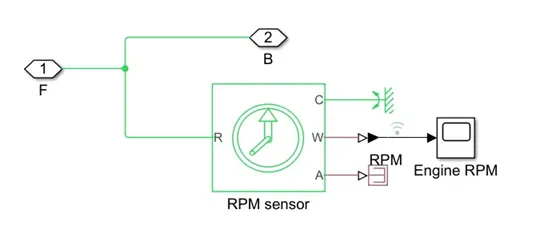
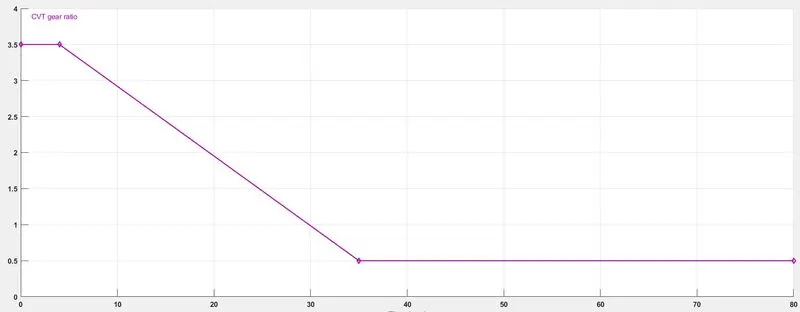
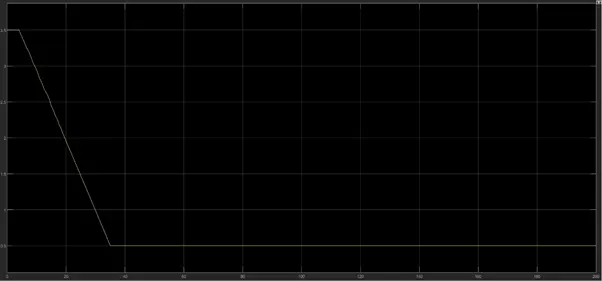
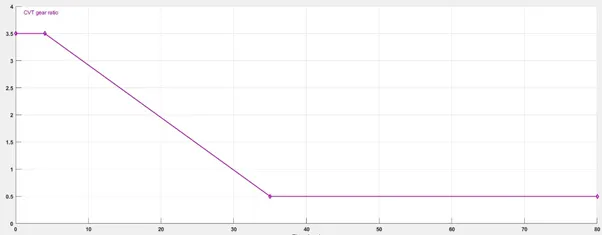
CVT Ratio:
Engine sensor connected to CVT subsystem:
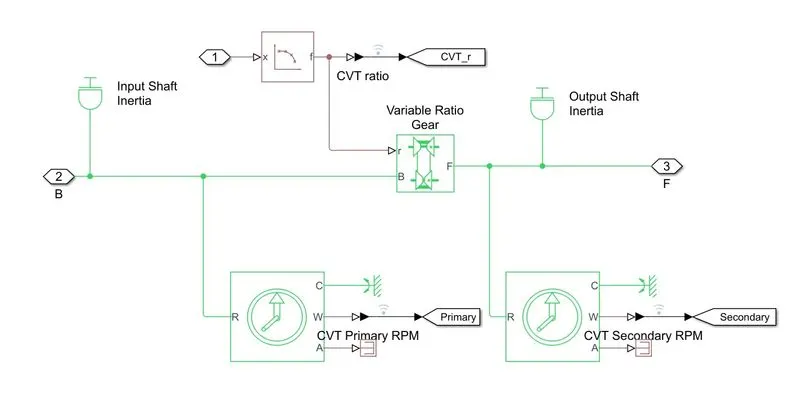
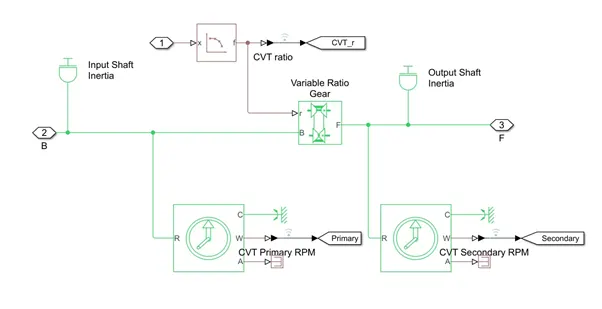
CVT system is connected to Gear system and CVT Ratio signal producer:
Represents a fixed-ratio gear or gear box. No inertia or compliance is modeled in this block. You can optionally include gear meshing, backlash, and viscous bearing losses.
Connections B (base) and F (follower) are mechanical rotational conserving ports. Specify the relation between base and follower rotation directions with the Output shaft rotates parameter. Optionally include thermal effects and expose thermal conserving port H by setting Friction model to a temperature-dependent setting.
The Gear system is connected to Vehicle body subsystem:
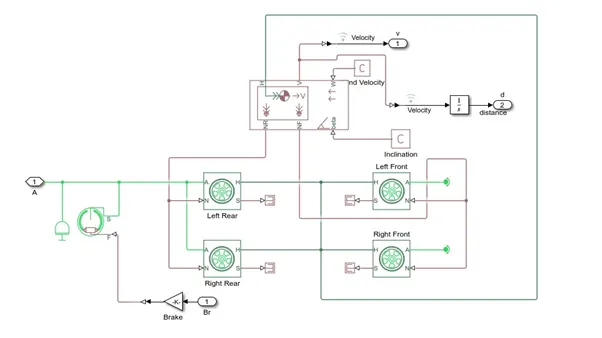
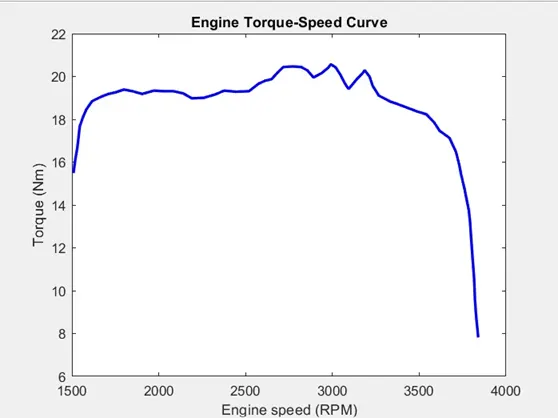
Output of the engine torque speed curve:
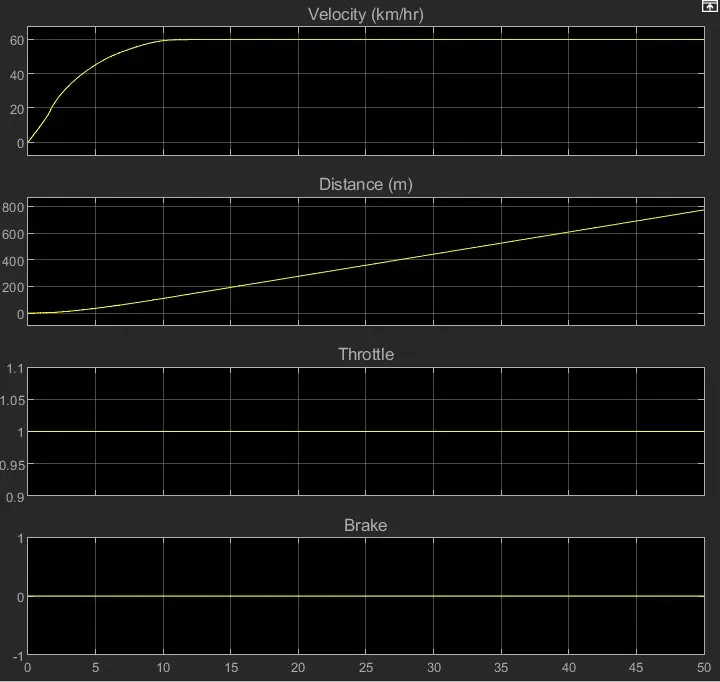
Output Plots:
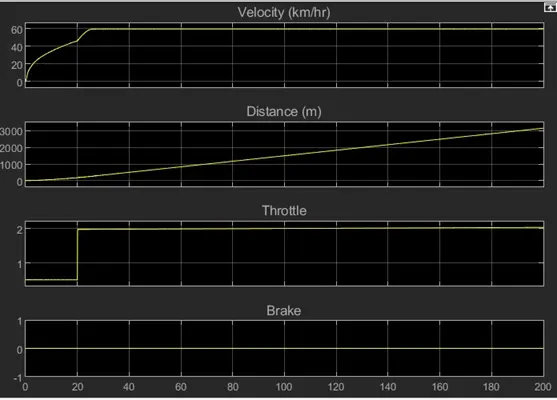
Velocity, displacement , Throttle, Brake
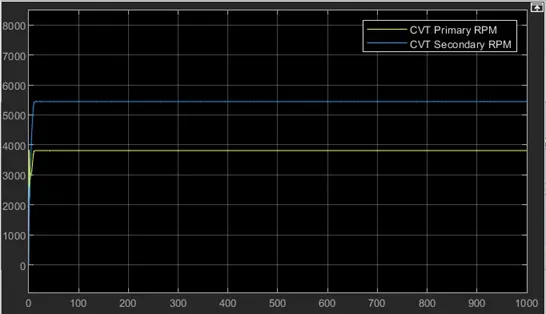
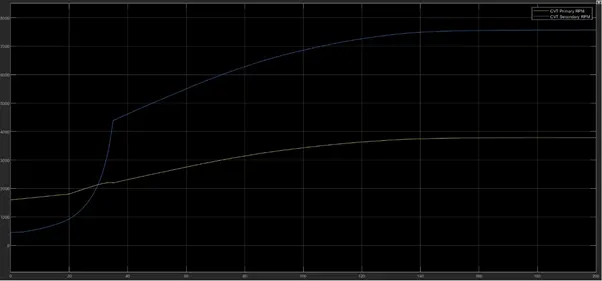
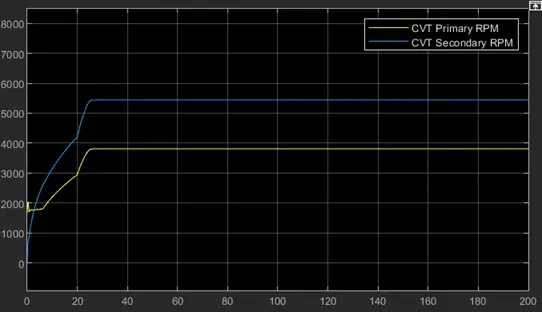
Output of CVT shaft speed:
CVT Primary RPM
CVT Secondary RPM
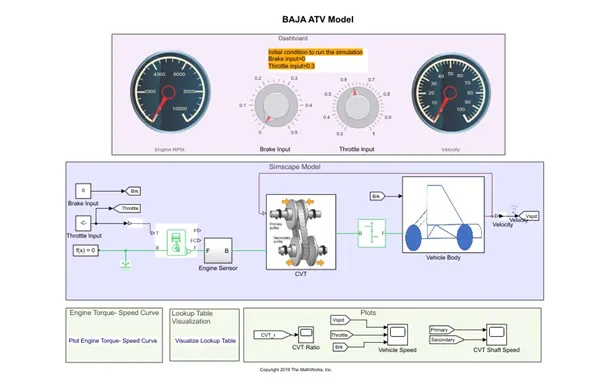
BAJA AVT MODEL Dashboard:
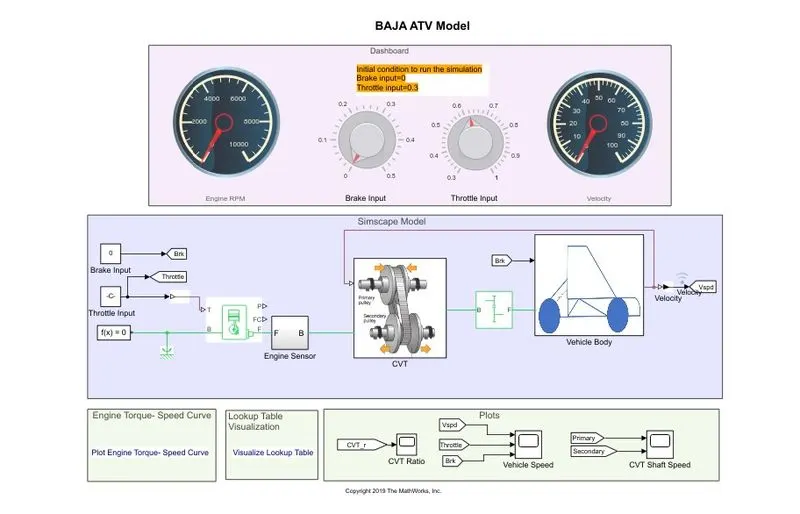
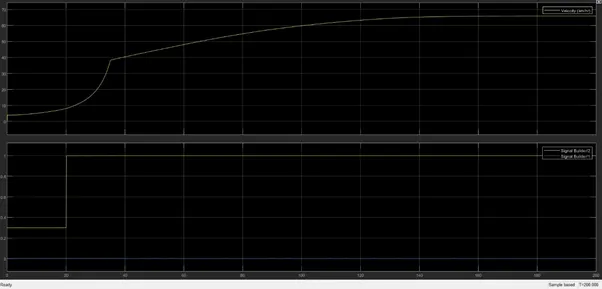
Break Input and Throttle is provided as O and 1 value which show the vehicle throttle power and varying of speed.
CVT Ratio:
Output:
Velocity, Distance, Throttle, Break
Output:
CVT Primary RPM
CVT Secondary RPM
Lookup Table:
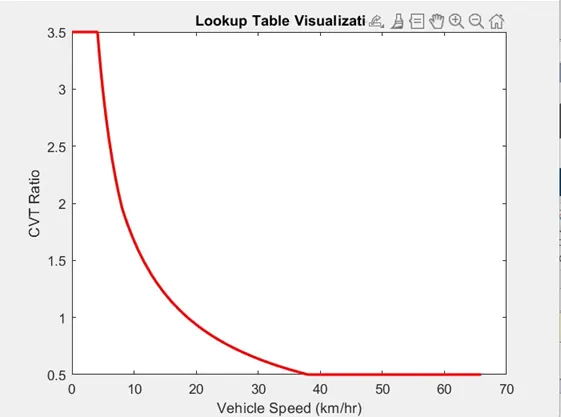
A lookup table is an array of data that maps input values to output values, there by approximating a mathematical function. Given a set for input values, a lookup operation retrieves the corresponding output value of the table. If the lookup table does not explicitly define the input values, Simulink can estimate an output value using interpolation, extrapolation, or rounding,
Where:
An interpolation is a process for estimating a value that lie between known data points.
An extrapolation is a process for estimating values that lie beyond the range of known data points.
A rounding is a process for approximating a value by altering its digits according to a known rule.
CVT subsystem:
Output:
Vehicle speed:
CVT shaft speed:
CVT Ratio:
Baja Model with dashboard:
CVT Ratio:
Wheel speed:
CVT shaft:
Conclusion:
Simulation of all 4 models of Baja ATV vehicle has been performed and output is plotted for corresponding model by varying the input data.