Project 5
For a 10-cell series, calculate the voltage, current, and SOC. Also, simulate the aging and thermal effects at different charge and discharge rates. Comment on the battery pack’s capacity.
In this model, we are connecting 10 battery pack cells in series. The series connection is made by connecting the opposite polarities of the cells i.e positive terminal of one cell is connected to the negative terminal of the next cell in the series. In series combination, the cells have the same current flowing through them but the voltage across the cells is different.
We are estimating the State of charge, temperature effects, aging effects, voltage, and current across the battery pack. The charging and discharging profiles of the battery are given by the signal generator signals via the controlled current source, in which the signals from the signal generator are converted into current.
The lithium-Ion battery is used in this model, and the voltage and current are measured using voltage measurement blocks and current measurement blocks. The voltage measurement block is connected in parallel with the pack, i.e this positive terminal of the voltage measurement block is connected to the positive terminal of the first cell and the negative terminal is connected to the negative port of the last cell in series.
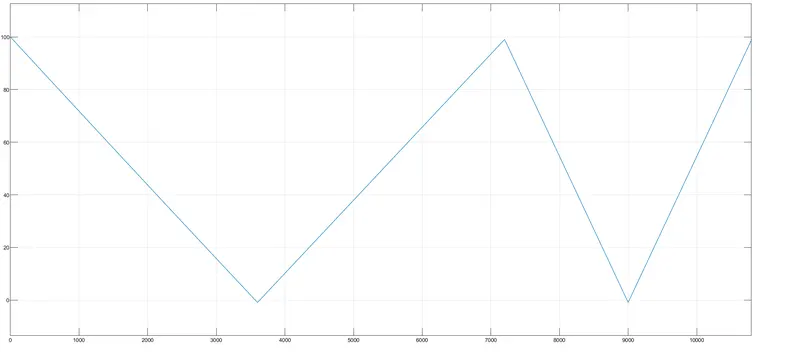
The current measured is used to calculate the SOC by the Coulomb count method, where the reciprocal of the battery capacity rate is multiplied by the integral value of the current measure and is subtracted from the initial SOC to find the final SOC after a certain interval of operation.
The temperature and aging effects of all the cells are enabled to analyze the parameters. A bus selector is used to prioritize the necessary parameters to be displayed among the cell parameters using the scope block.
So to analyze the battery parameters, the cell capacity is 5.4Ah and the nominal voltage is 7.2V. The charging and discharging rate of the cell are specified by the signals from the signal builder. Firstly the cells are discharged at a 1C rate and then for one hour it is charged at a 1C rate, in the next cycle, the cells are discharged and charged at a 2C rate.
The output is shown below.
In the analysis, the signal builder produces a signal in such a way that for the first 3600s the battery is discharged at a 5.4Ah rate and it is charged up for the next hour at the same rate. Then the battery is now discharged at a 2C rate i.e 10.8Ah in 30 mins and then again it is charged up with a 2C rate for the next 30 mins. 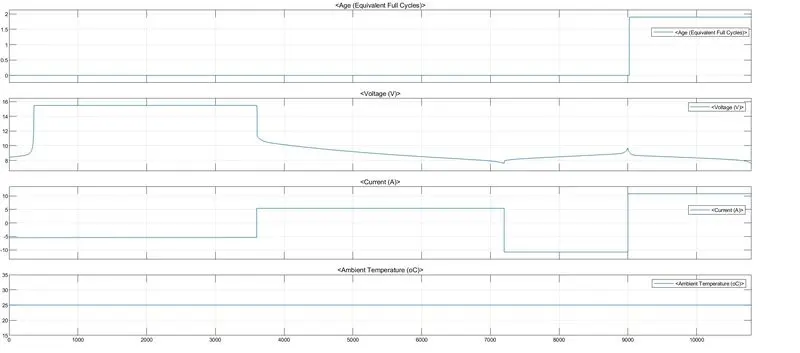
On Conclusion, we can say that
When the ambient temperature is quite high, the electrolyte temperature increases and the capacity of the battery is reduced. Thus maintaining the ambient temperature in the operation can improve the battery life.
The number of partial or full discharging and charging cycles of the battery, also the rate at which it is charged and discharged is very crucial for the battery's performance in the long run. As the charging cycles increase then the aging factor also increases.