Project
Aim: To study and analyze the BAJA All-Terrain Vehicle (ATV) using MATLAB Simulink.
Objective: To prepare a technical report explaining the model properties "BAJA ATV Model" & Also to explain the results in 4 different model set-ups that are:
I. Study the Baja ATV model without a dashboard
II. Study the Baja ATV model with a dashboard
III. Study the Baja ATV model using a lookup table without a dashboard
IV. Study the Baja ATV model using a lookup table with a dashboard
Introduction:
An all-terrain vehicle (ATV), also known as a quad (cycle), three-wheeler, four-track, four wheeler, or quadricycle, as defined by the American National Standards Institute (ANSI) is a vehicle that travels on low-pressure tires, with a seat that is straddled by the operator, along with handlebars for steering control. It is designed to handle a wider variety of terrain than most other vehicles. In this project, the type of ATV is a Baja one.
Major and Crucial Components:
(1) CVT: The meaning of the abbreviation CVT is Continuously Variable Transmission, and it is a type of single-speed automatic gearbox. The CVT gearbox has been used in various cars, but you'll usually find it fitted to a small car. Its compact size and simplicity of construction mean it's more cost-effective to use in a small car than a conventional automatic gearbox.
A CVT is an automatic, single-speed, and gearless transmission that can shift through an infinite number of gear ratios. A continuously variable transmission (CVT) is a transmission that operates on an ingenious pulley system that automatically varies the transmission ratio, allowing an infinite variability (theoretically) between highest and lowest gears with no discrete steps or shifts. CVTs provide more useable power, better fuel economy, and a smoother driving experience than traditional transmissions that use gearboxes with fixed numbers of gear sets.
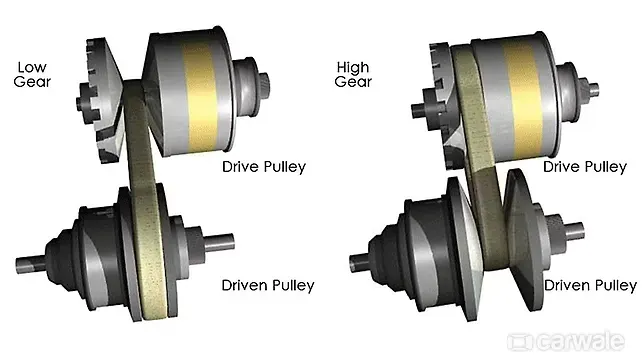
It has a relatively simple arrangement of two cone-shaped pulleys with a V-shaped drive belt connecting them. One pulley is attached to the engine, while the other is joined to the wheels. When you press the accelerator, the engine revs and the cone moves according to the amount of power asked for. The other cone adjusts accordingly so that the drive belt maintains the same tension, and this is what determines how the car accelerates.
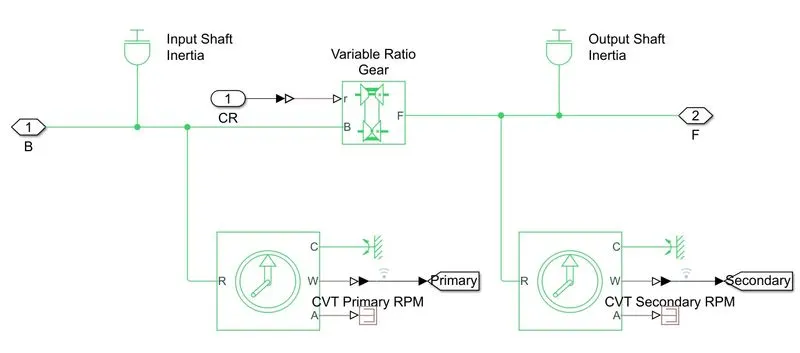
The variable gear arrangements of CVT in this model is represented by the Variable Ratio Gear Block:
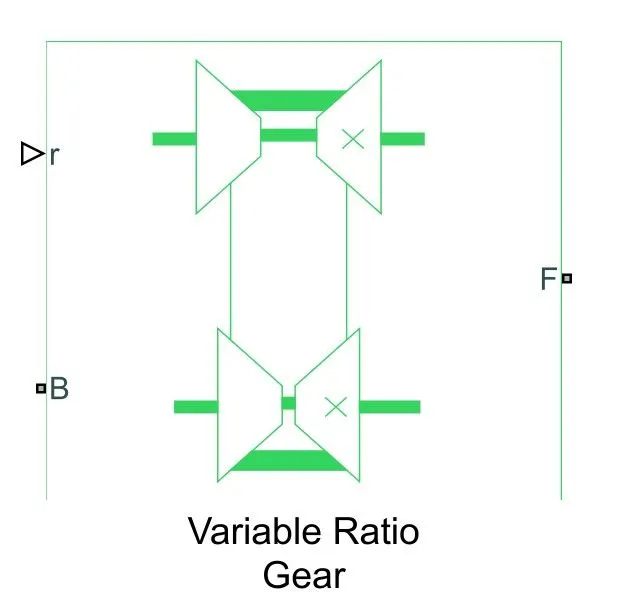
Where,
B-Base Pulley or Drive Pulley,
F - Follower Pulley or Driven Pulley
r- Variable Transmission Ratio (Input).
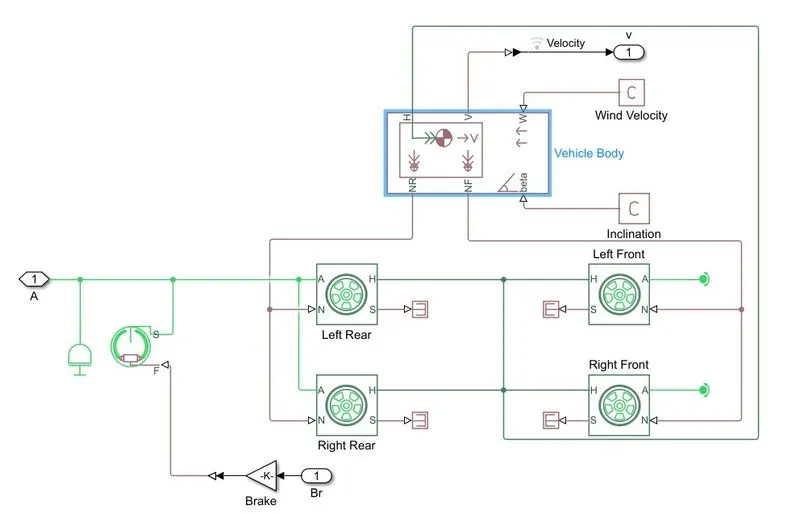
(2) Vehicle body: A Baja ATV of a Two-axle type vehicle with longitudinal dynamics and motion; has adjustable mass, geometry, and drag properties. The vehicle may have the same or a different number of wheels on each axle. For example, two wheels on the front axle and one wheel on the rear axle. The vehicle wheels are assumed identical in size. The vehicle can also have a center of gravity (CG) that is at or below the plane of travel so that it mitigates the chances of rolling over.
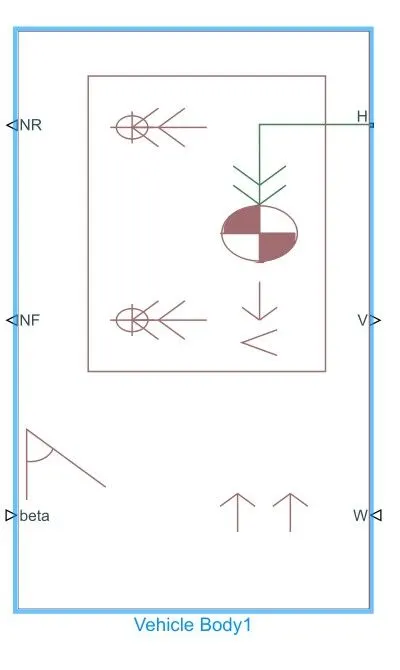
Connection H is the mechanical translational conserving port associated with the horizontal motion of the vehicle body. The resulting traction motion developed by tires should be connected to this port. Connections V, NF, and NR are physical signal output ports for vehicle velocity and front and rear normal wheel forces, respectively. Wheel forces are considered positive if acting downwards. Connections W and beta are physical signal input ports corresponding to headwind speed and road inclination angle, respectively. If variable mass is modeled, the physical signal input ports CG and M are exposed. CG accepts a two- element vector representing the x and y distance offsets from vehicle CG to additional load mass CG. M represents the additional mass. If both variable mass and pitch dynamics are included, the physical signal port J accepts the inertia of the additional mass about its own CG.
Generic Engine-
Represents a system-level model of spark-ignition and diesel engines suitable for use at initial stages of modeling when only the basic parameters are available. Optional idle speed and red line controllers are included.
The throttle input signal T lies between zero and one and specifies the torque demanded from the engine as a fraction of the maximum possible torque. If the engine speed falls below the Stall speed, the engine torque is blended to zero. If the engine speed exceeds the Maximum speed, the simulation stops and issues an error message
Connections F and B are mechanical rotational conserving ports associated with the engine crankshaft and engine block, respectively. Connections P and FC are physical signal output ports through which engine power and fuel consumption rate are reported.
I. Study the Baja ATV model without a dashboard
Simulink Model:-
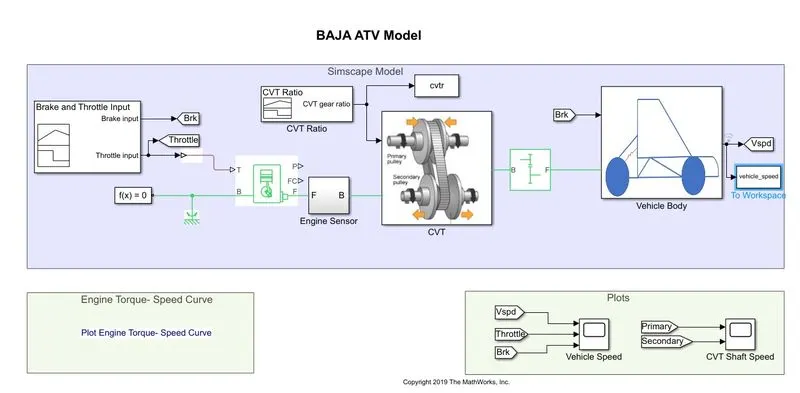
CVT Assembly-
Vehicle Body-
Inputs- The inputs of Throttle and Brake is given via a Signal Builder Block & another one is used to create the required CVT Ratio.
Throttle and Brake Inputs-
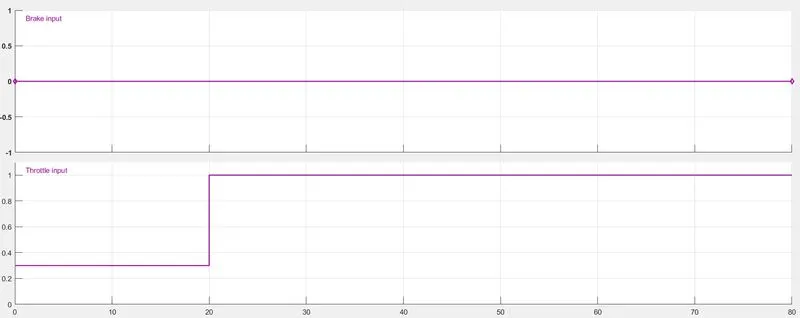
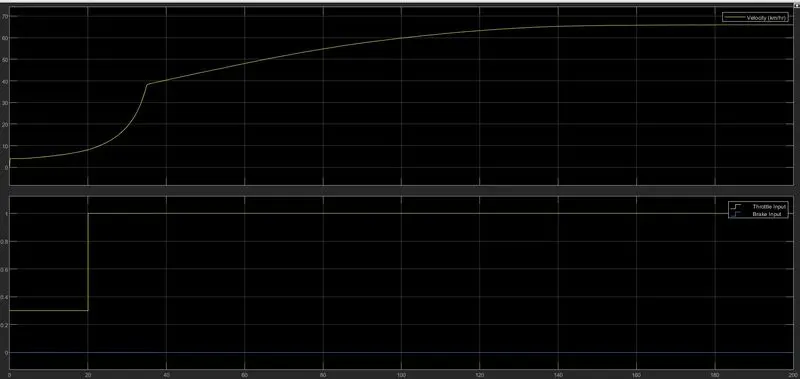
The brake input remained Zero during entire situation and the initial throttle is given 0.3 Value and the after 20 seconds it will goes to 1.
CVT RATIO-
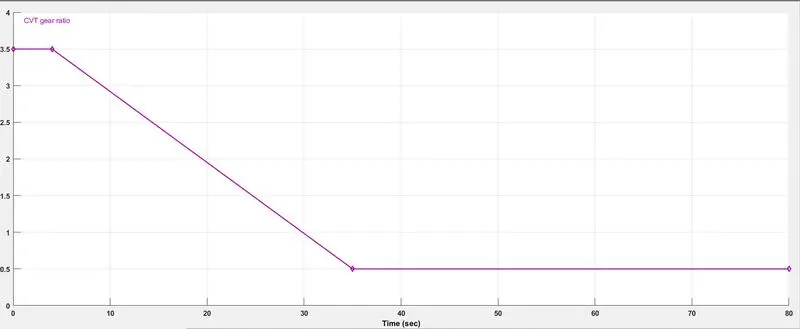
CVT ratio has been varied over a range of 2.3 to 1.8 value throughout the simulation.
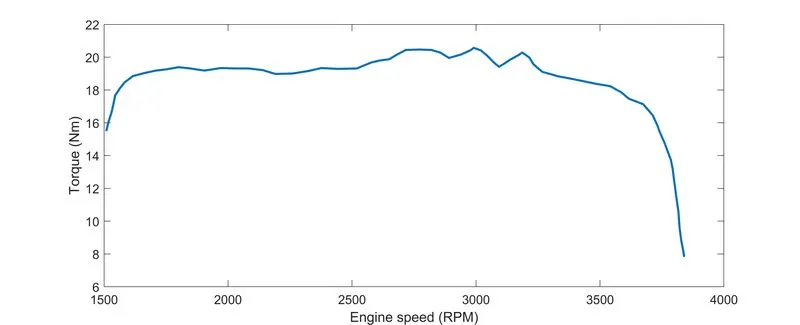
The Engine Torque-Speed Characteristic is given by the following graph-
Output Results-
Variable Speed Variation with throttle and Break
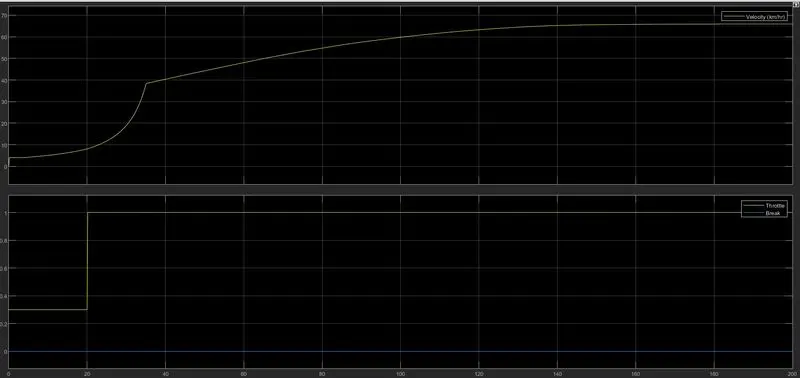
In the graph we can see that he vehicle attains its maximum speed of 65 Km/hr at full throttle 1 at 120th S and then speed remains constant.
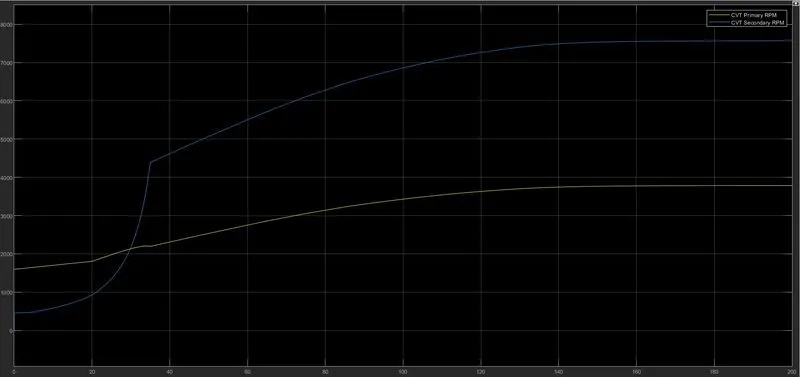
CVT Primary and Secondary Speed
II. Study the Baja ATV model with a dashboard
Simulink Model-
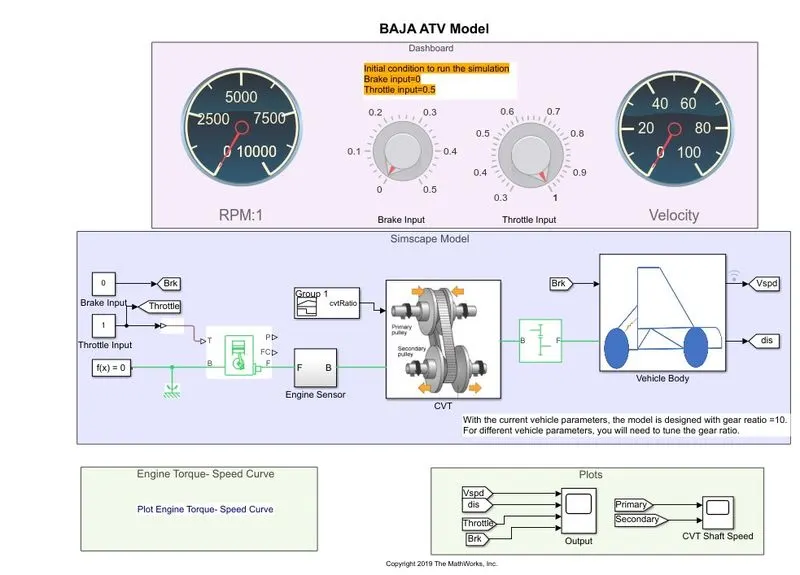
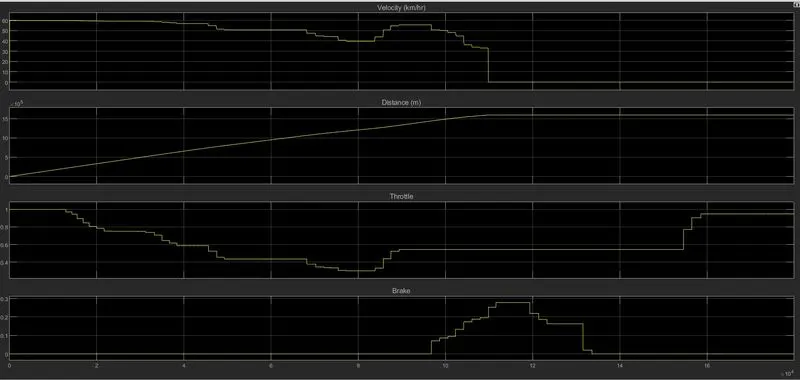
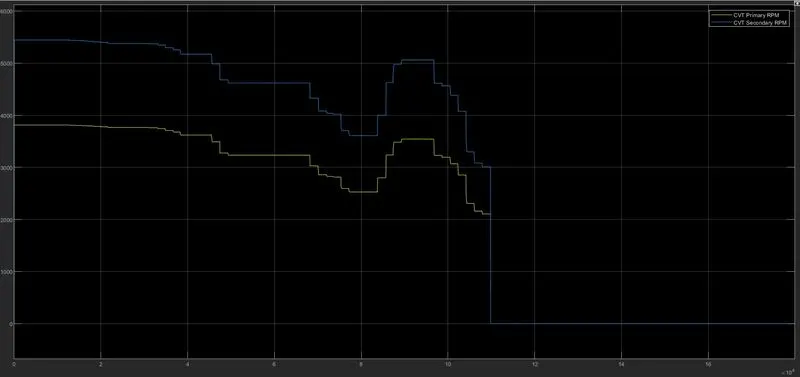
In this model, we have a dashboard that contains knobs to control the Throttle and Brake inputs. In this case, the inputs are not provided using the signal builder. A knob is provided to control both the parameters in real-time for the user. One can vary it as they want and will get the result according to that.
OUTPUT-
CVT Primary and Secondary Speed-
III. Study the Baja ATV model using a lookup table without a dashboard
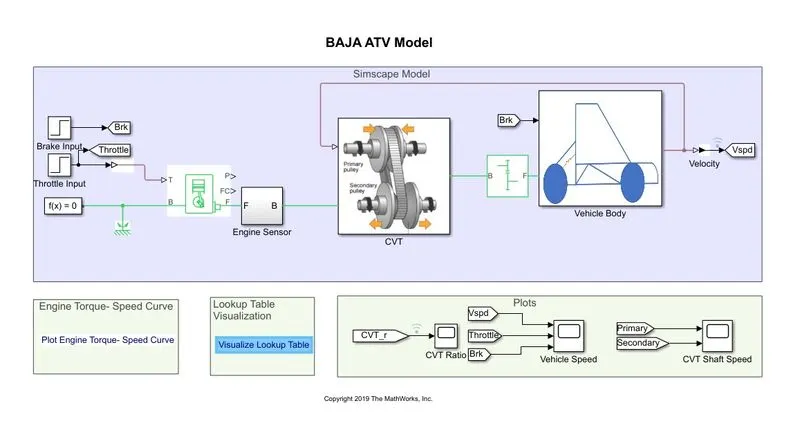
Simulink Model-
CVT Block Assembly-
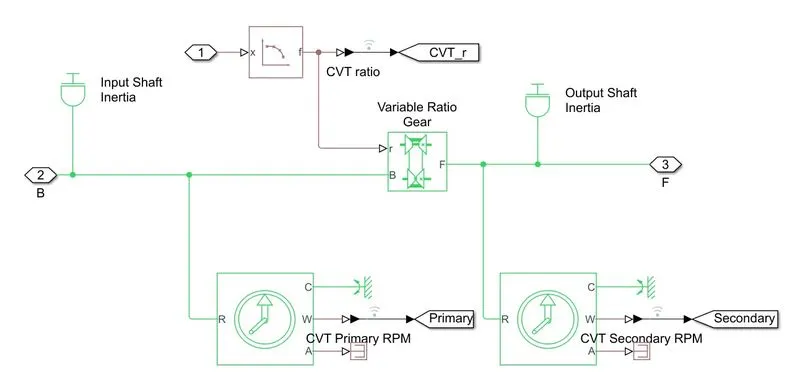
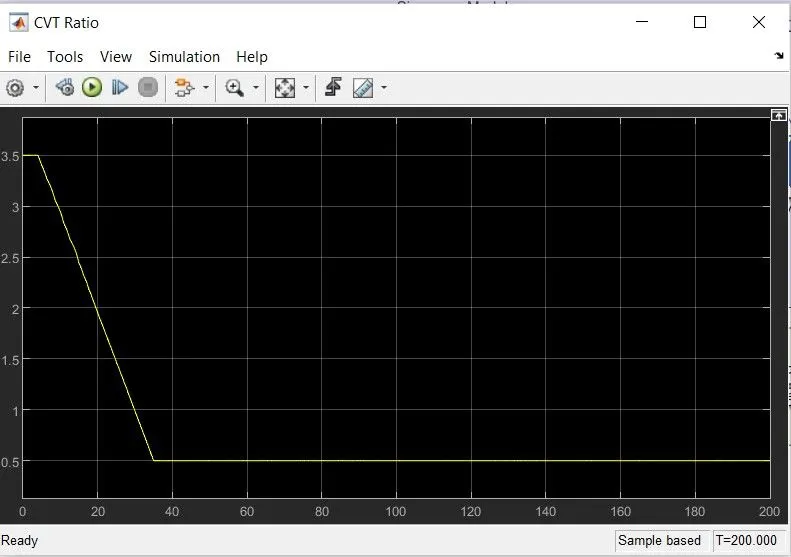
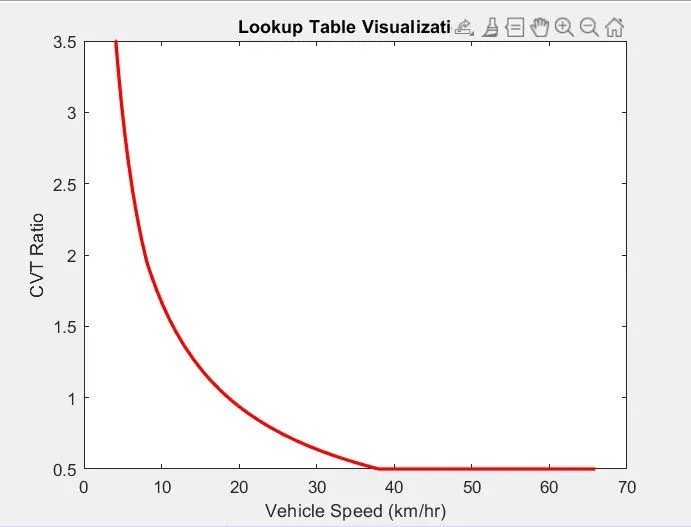
The only difference between this model and the two models before this is how we give the CVT ratio as inputs. The gear ratio input to CVT is provided using a lookup table. The vehicle velocity and shaft rpm outputs are the same as before.
CVT Gear Ratio-
Look-up table-
OUTPUT-
Vehicle speed Variation with throttle and brake
CVT primary and Secondary speed-
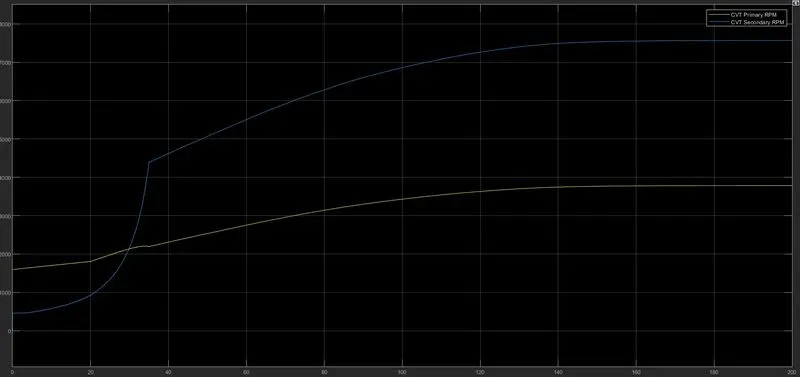
Both the result are the same of first case and third case. because the input parameter are the same for both cases.
IV. Study the Baja ATV model using a lookup table with a dashboard
Simulink Model
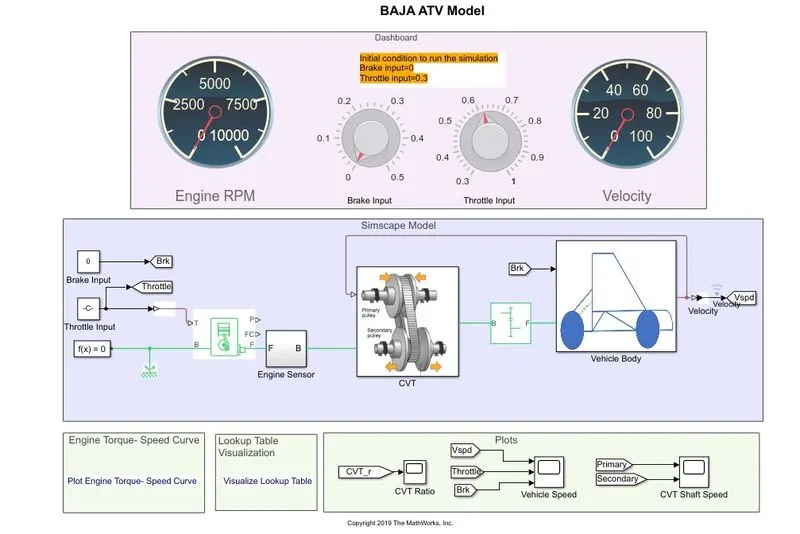
In this model, a dashboard with knobs is used to control both the inputs that are Throttle & Brake.
The visualization of CVT with the lookup table and overall modification of the CVT block is the same as the previous case Simulink model. To make it brief the same results are not being repeated here.
Output Results:
Vehicle Speed variations with Throttle and brake inputs
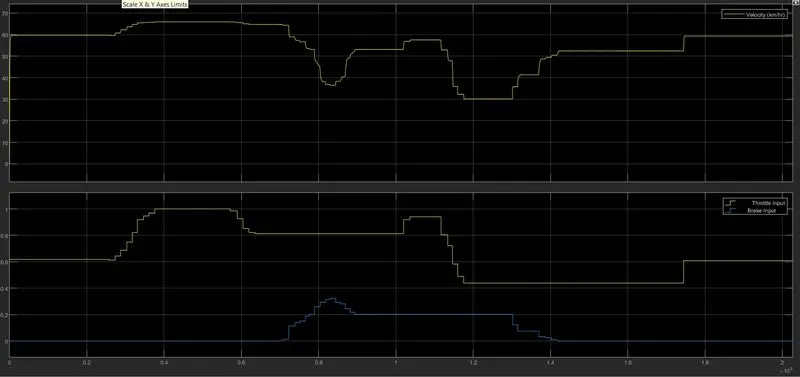
This graph is similar to that of the CVT dashboard case of (II). The variation in Baja vehicle velocity can be observed with the change in both the throttle and brake inputs. With an increase in braking value, the speed of the vehicle decreases. On the other hand, increasing the throttle leads to increased vehicle velocity.
The graph shows that the inputs were given manually to observe the desired variations and the vehicle's speed response for that. The throttle is increased from 0.3 to 1 value in an increasing staircase manner and the brake was applied at different points of time after the throttle gets value 1. Increasing throttle input increases the speed over time, But after that instances where the brake was applied, there is a decrease in the vehicle velocity. So, The graph properly justifies vehicle behavior. The maximum braking value is 0.4 and it hits this value three times in the graph. The highest speed of the Baja Vehicle was 65 Km/Hr.
CVT Output-
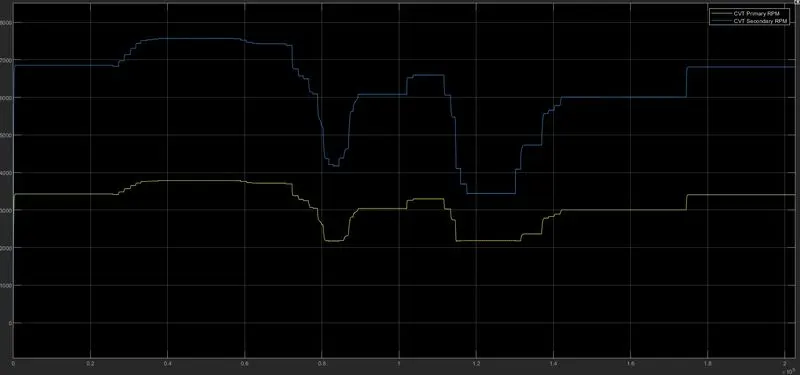
This graph indicates the variation in RPMs of the primary shaft and secondary shafts with variations of input parameters that is the throttle and brake. Here we have both the CVT primary and secondary RPMs; The Initial increase and settlement were for throttle value 0.3 when there is no brake applied yet. After that, the behavior is the result of variations in both the inputs. After the time when the throttle is having a constant value of 1, all the variations basically result from the application of the brake. The downsteps are when the brake is applied and the immediate upsteps are the result of releasing the brake.
CONCLUSION:
Thus we have successfully analyzed 4 different models of BAJA ATV WITH CVT and recorded the outputs that are the Vehicle velocity & CVT shaft rpm, for different variations in input throttle and brake.