Project
AIM:
To carry out a system-level simulation of an all-terrain vehicle.
OBJECTIVE:
To carry out a system-level simulation of an all-terrain vehicle and prepare a techincal report explaning the model properties and comments on the results.
THEORY:
Transmission which transmits the power from engine to the wheels through the shafts. In general it consists of Four types namely,
1.Manulal transmission
2.Continuous variable transmission
3.Semi-Sutomatic transmission
4.Automatic transmission
The term CVT stands for Continuously Variable Transmission.
A CVT is a type of automatic transmission that provides more useable power, good fuel economy and a smoother driving experience than a experience than a traditional automatic transmission.The CVT is a system that makes it possible to vary stepless the transmission ratio without interuption of the torque flow.
An infinte number of ratio without interuption of the torque flow. An infinte number of ratio betweeen a minimum and maximum value are possible. It is an automatic, signal speed geraless transmission that can shift through an infinte number of gear ratios.
This ability to seamless shift through these different gears provides a number of benefits including extremely smooth shifts and exceptional fuel economy. A CVT draws top engine power from a small engine which gives drivers quicker acceleration than standard automatic transmissions.
Because of their greater ability to control the engine speed range, CVT's produce fewer emissions. CVT's are also lighter weight than traditional automatic transmissions.
ALL TERRAIN VECHILE:
An all-terrain vechile is defined as a motorized off-highway vechile designed to travel on four low-pressure (or) non-pneumatic tires, having a seat designed to be straddled by the operator and handlebars for steering control.
PROCEDURE:
BAJA ATV Model without lookup table:
1.WITHOUT DASHBOARD:
SIMULINK MODEL FOR BAJA ATV:
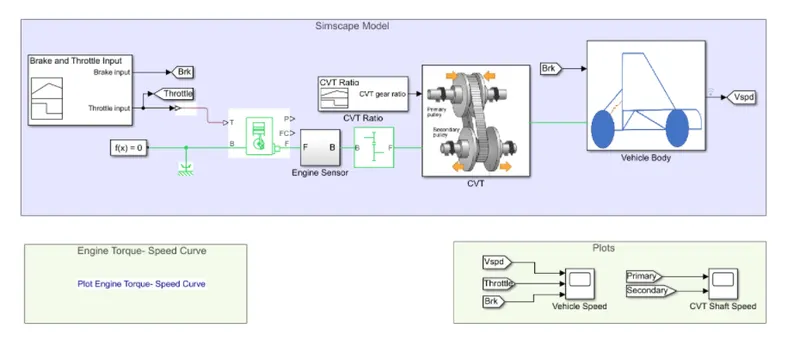
The common blocks used are,
SIGNAL BUILDER:
The signal builder block allows us to create interchargeable groups of piecewise linear signal sources and use them in model. We can quickly witch the signal groups in and out of a model to facilitate testing.
GENERIC ENGINE:
It represents a system level model of spark-ignition and diesel engines suitable for use at initial stages of modeling when only the basic parameters are available. Connections F and B are mechanical rotational conserving ports associated with the engine crankshaft and engine.
Connections P and FC are physical signal output ports through which engine power and fuel consumption rate are reported.
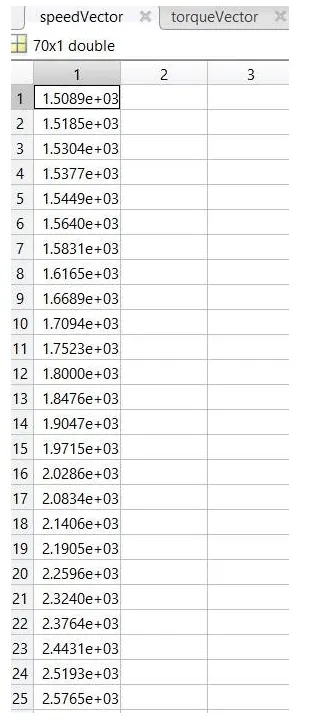
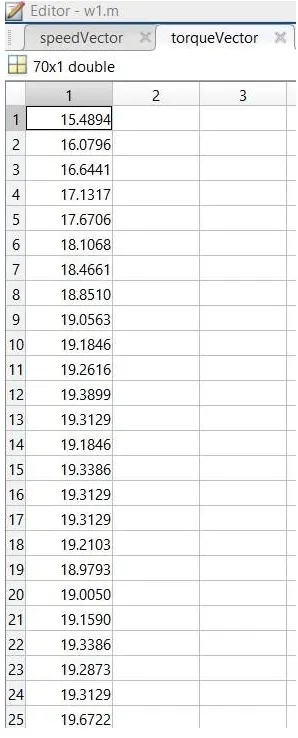
SPEED AND TORQUE VECTOR:
The speed and torque vector are the assigned parameters. They are,
SPEED VECTOR:
TORQUE VECTOR:
IDEAL ROTATIONAL MOTION SENSOR:
This block represents an ideal mechanical rotational motion sensors that is a device that converts an across variable measured between two mechanical rotational nodes into a control signal proportional to angular velocity.
The sensors is ideal since it does not account for inertia, friction, delays, energy consumption and so on. Connections R and C are mechanical rotational conserving ports and connections W and A are physical signal output ports for veloctiy and angular displacement.
SIMPLE GEAR:
No inertia (or) compliance is modeled in this block. we can optionaly includes gear meshing and viscous bearing losses.
Connections B and F are mechanical rotational conserving ports.Specify the relation between base and follower rotation directions with the output shafts rotates parameter.
CVT SUBSYSTEM:
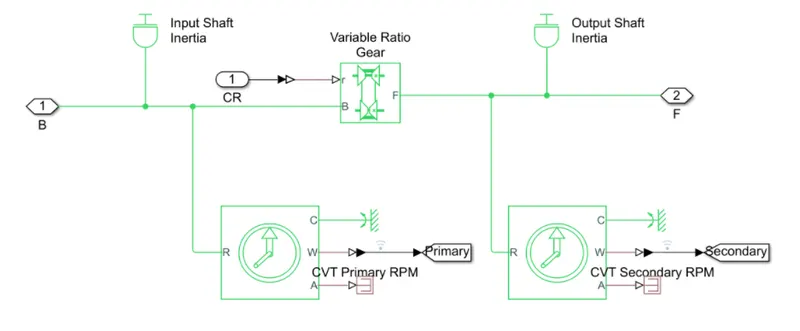
The blocks used are,
INERTIA:
This block represents an ideal mechanical rotational inertia. The block has one mechanical rotational conserving port. The block positive directtion is from its port to the reference point.
This means that the inertia torque is positive if the inertia is accelerated in a positive direction.
VARIABLE RATIO TRANSMISSION:
IT represents a variable ratio gearbox such as implemented by mechanical belt CVT, Electric (or) Hydraulic transmission. The physical signal input r defines the ratio of input to output angular shaft velocities.
Connection B and F are mechanical rotational conversing ports. Specify the relation between base and follower rotation directions with the output shafts rotates parameter.
VECHILE BODY SUBSYSTEM:
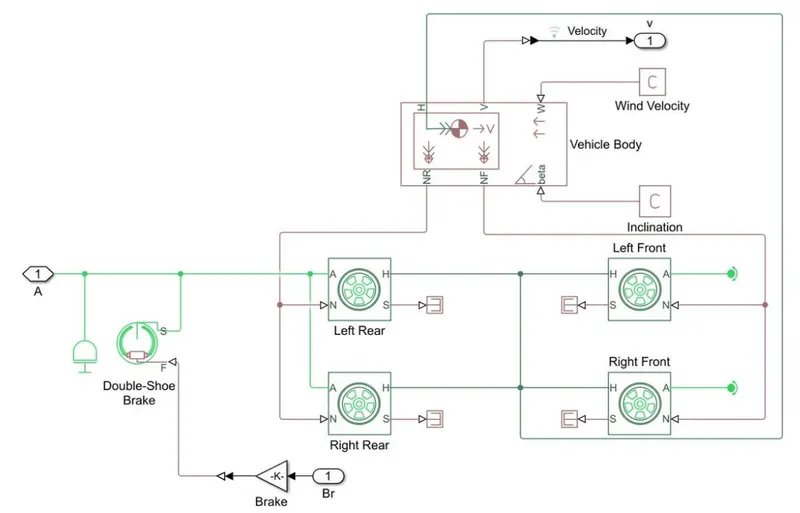
This represents a two axle vechile body in longitudinal motion. The block accounts for body mass, aerodynamic drag, road incline and weeight distibution between axles due to accelration and road profile.
The vechile can have the same or a different number of wheels on each axle. Optinally include pitch and suspension dynamics or additional variable mass and inertia. The vechile does not move vertically relative to the ground.
Connection H is the mechanical translational conserving port associated with the horizontal motion of the vechile body. The resulting traction motion developed by tries should be connected to this port.
Connections V,NF and NR are physically signal output ports for vehicle velocity and front and rear normal wheel forces respectively. Wheel forces are considered positive if acting downwards.
Connections W and betta are physical signal input ports corresponding to headwind speed and road inclination angle, respectively.If the variable mass is modeled the physical signal input ports CG and M are exposed.
CG accepts a two element vector representing the x and y distance offsets from vechile CG to additional load mass CG. M represents the additional mass.
If the both variable mass and pitch dynamics are included the physical signal port J accepts the inertia of the additional mass about its own CG.
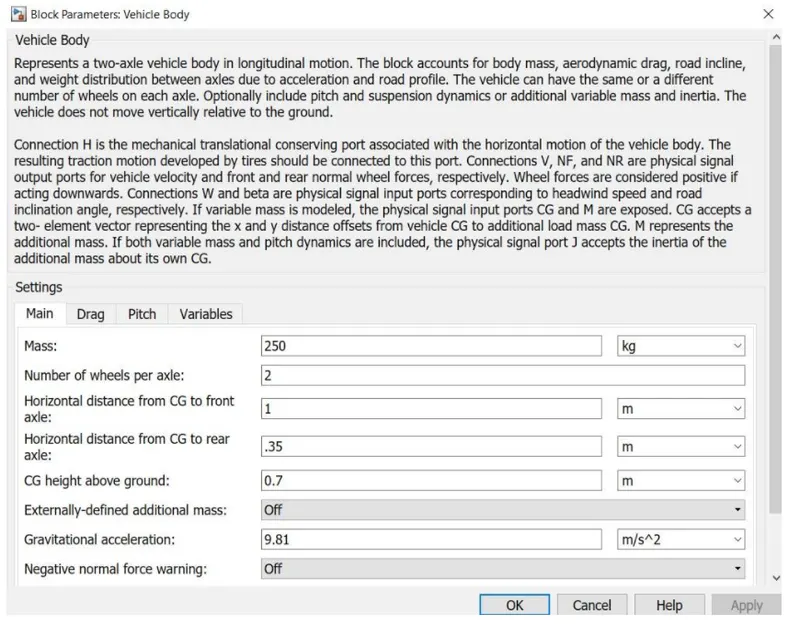
BLOCK PARAMETER FOR VECHILE BODY:
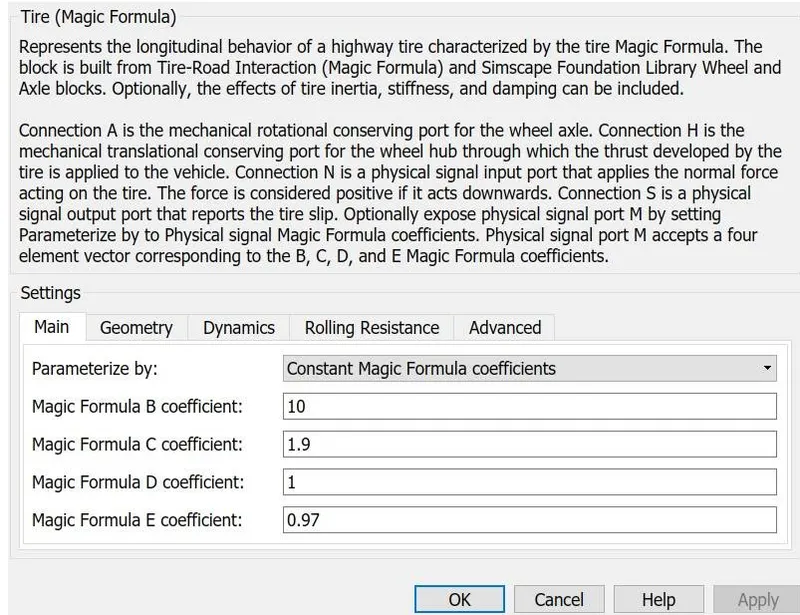
PARAMETERS FOR ALL TIRES:
BLOCK PARAMETER FOR DOUBLE SHOE BRAKE:
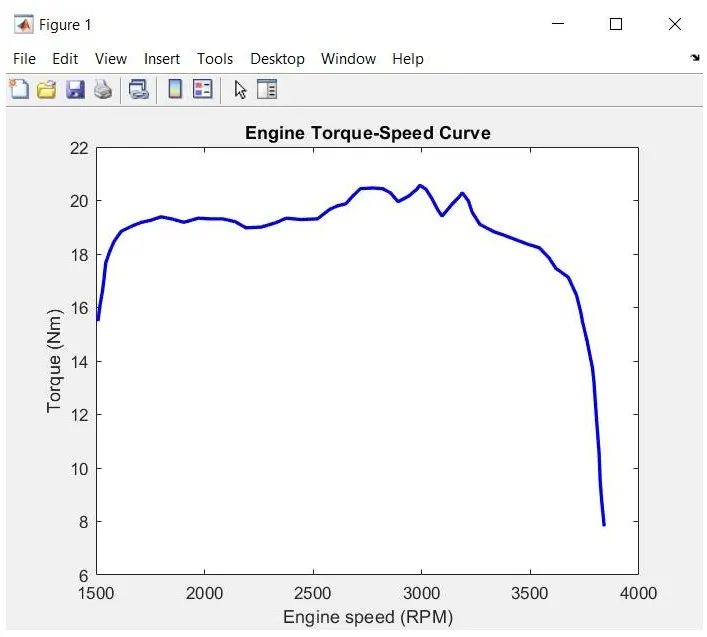
TORQUE VS SPEED:
INPUT:
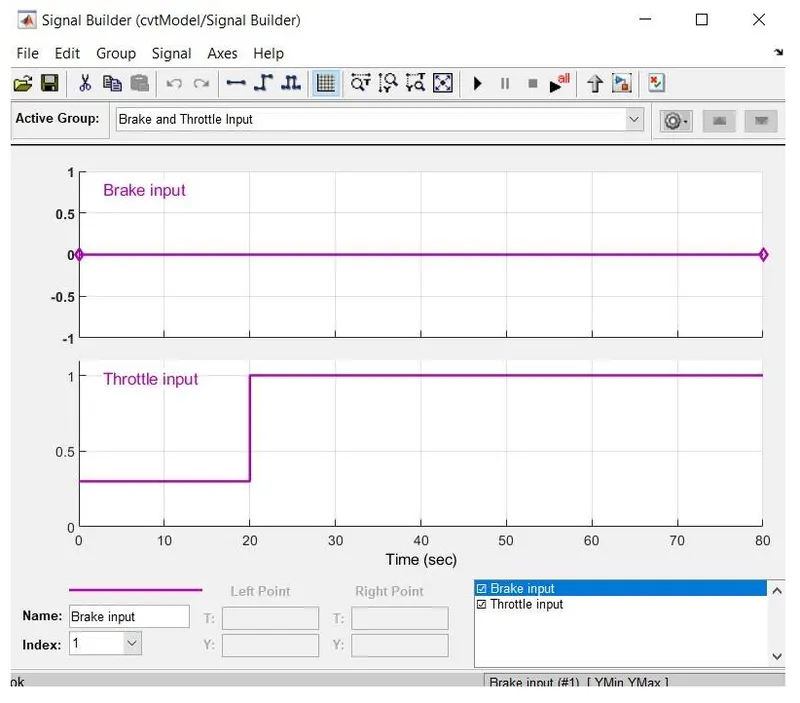
BRAKE AND THROTTLE:
Brake input is constant that is zero throughout the time 80 seconds. Throttle input is 0.3 for first 20 sec. Accelerates to 1 at the same and remains constant throughout the remaining time till 80 seconds.
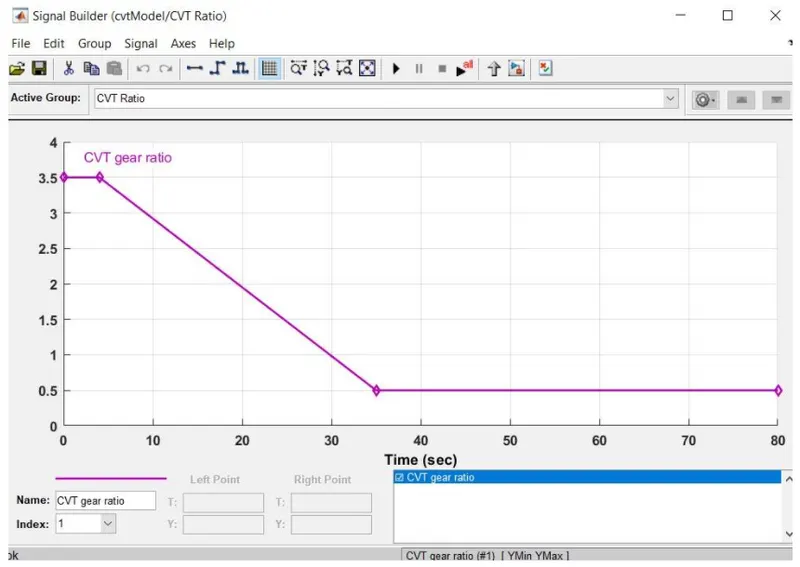
CVT RATIO:
The CVT gear ratio 3.5 for the first 4 seconds then drops down to 0.5 till 35 seconds and remains constant thereafter till 80 seconds.
OUTPUT:
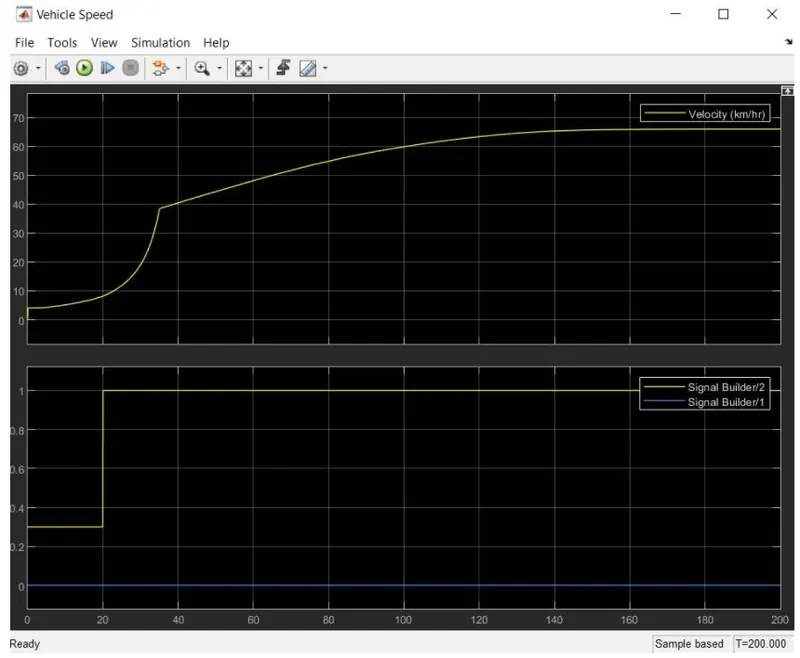
VELOCITY:
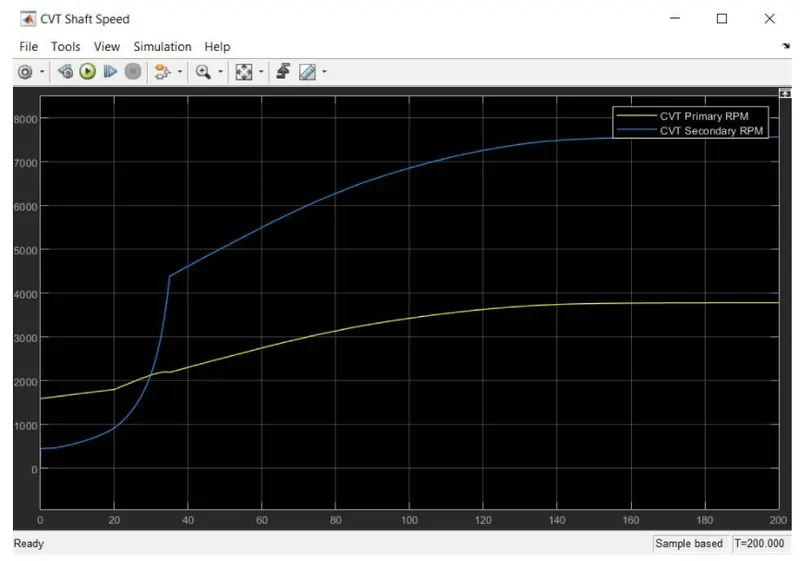
CVT SHAFT SPEED:
WITH DASHBOARD:
A simulink model for for the BAJA ATV model icluding dashboard is,
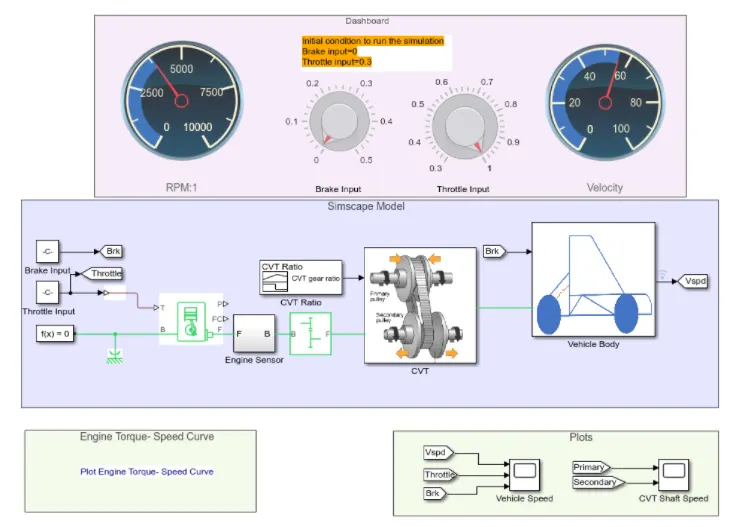
The all other parts are as same as the above part.
DASHBOARD:
A Dashboard is a control pannel usualy located directly ashead of a vehicle's driver, displaying instumentation and controls for the vechile operations. The main thing to usin the dashboard is to study the result by varying the input of brake and throttle which shows the variation of velocity and speed of the engine.
The gear ratio is given by lookup table simulink get the input value from the lookup table and obtain the result according to the lookup table. As the brake input varies from 0 to 0.5 the velocity and speed decreases accordinly which inturn the gear ratio also decreasing.
By increasing the throttle the velocity and speed of the engine and shaft increases. The transmission as primary pulley and secondary pulley in which the radius of primary pulley increases by compacting and the radius of secondary pulley decreases.
As the gear ratio varies the torque is also varies. Gear ratio is directly proportional to the torque which increases by increasing the gear ratio. At the maximum torque the speed and velocity is decreases.
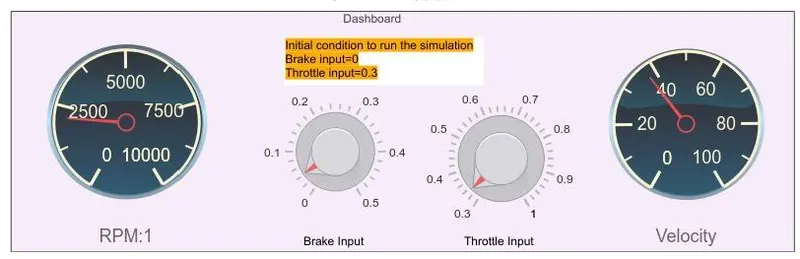
In this model a dash board is used to control the inputs: Throttle and Brake with knobs.
OUTPUT:
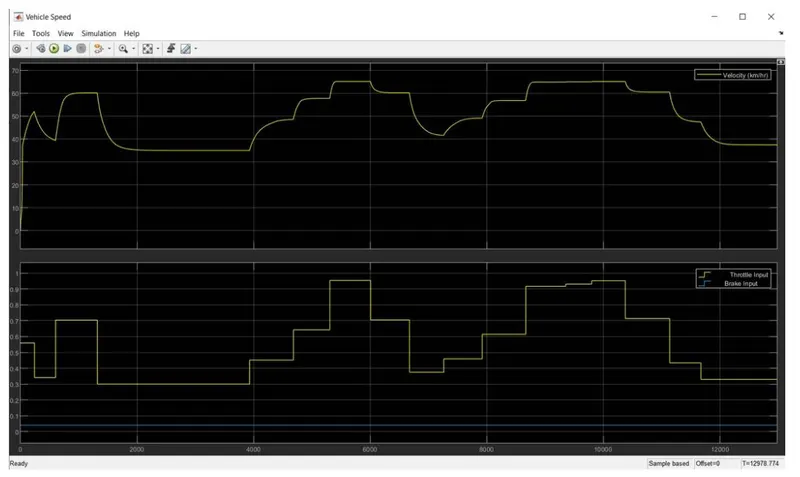
VELOCITY SPEED:
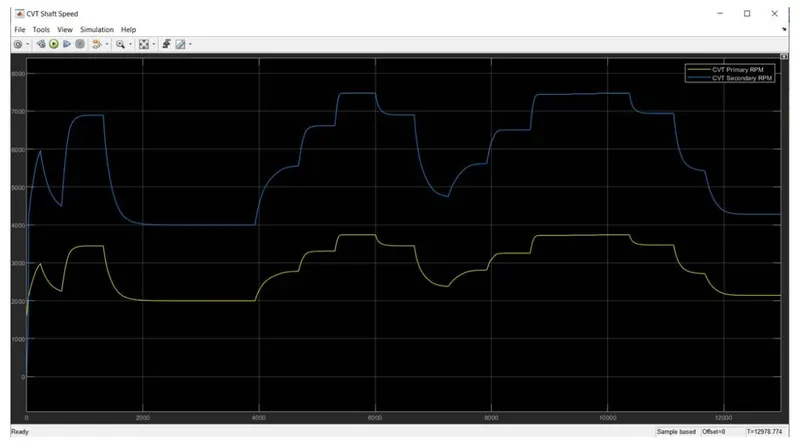
CVT SHAFT SPEED:
OBSERVATION:
Thus the given BAJA ATv model was simulated successfully and from the above result we identify that:
1.Velocity, CVT Shaft Speed and Engine Speed are directly proportional to the Throttle Input and inversly proportional to the Brake Input.
2.CVT primary speed is greater than CVT secondary speed as they are directly proportional to thier shaft diameter.
3.The variation in vehicle velocity can be observed with change in throttle and brake inputs.
4.With increase in braking value, the speed of vehicle decreases. On the other side increasing the throttle leads to increased vechile velocity.
RESULT:
Thus the system-level simulation of an all-terrain vehicle is carried out sucessfully.
REFERENCE:
1.https://in.mathworks.com/matlabcentral/fileexchange/70576-baja-all-terrain-vehicle-atv-model
2.https://en.wikipedia.org/wiki/All-terrain_vehicle
3.https://www.autoexpress.co.uk/car-tech/101267/what-is-a-cvt-gearbox
4.https://www.slideshare.net/matthieua/dashboard-definition-examples