Project 2 Thermal modeling of battery pack
Aim:-
For a 10 cell series lithium ion battery model, simulate the thermal effects and compare life cycle performance at various temperatures, charge & discharge rates using MATLAB.
Lithium-Ion Battery:
A lithium-ion battery is a type of rechargeable battery. Lithium-ion batteries are commonly used for portable electronics and electric vehicles and are growing in popularity for military and aerospace applications. In the batteries, lithium ions move from the negative electrode through an electrolyte to the positive electrode during discharge, and back when charging. Li-ion batteries use an intercalated lithium compound as the material at the positive electrode and typically graphite at the negative electrode. The batteries have a high energy density, no memory effect (other than LFP cells), and low self-discharge. They can however be a safety hazard since they contain flammable electrolytes, and if damaged or incorrectly charged can lead to explosions and fires.
Chemistry, performance, cost, and safety characteristics vary across types of lithium-ion batteries. Research areas for lithium-ion batteries include extending lifetime, increasing energy density, improving safety, reducing cost, and increasing charging speed, among others. Research has been underway in the area of non-flammable electrolytes as a pathway to increased safety based on the flammability and volatility of the organic solvents used in the typical electrolyte. Strategies include aqueous lithium-ion batteries, ceramic solid electrolytes, polymer electrolytes, ionic liquids, and heavily fluorinated systems.
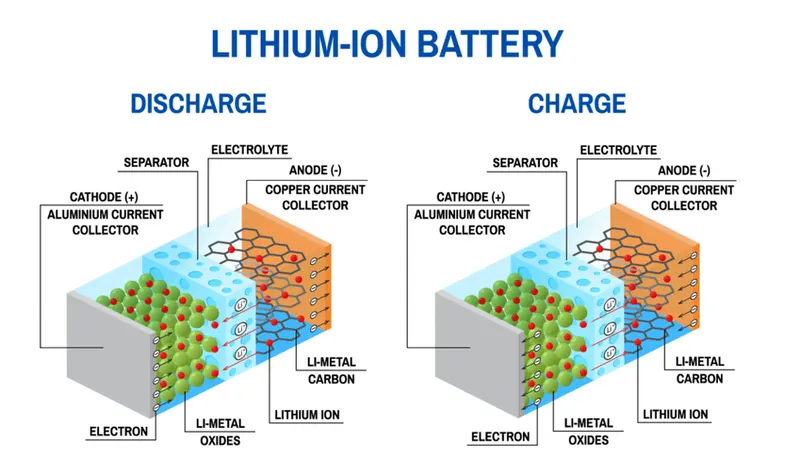
Types of Lithium-ion batteries:
1.Lithium Cobalt Oxide (LCO)
2.Lithium Manganese Oxide (LMO)
3.Lithium Nickel Manganese Cobalt Oxide (NMC)
4.Lithium Iron Phosphate (LFP)
5.Lithium Nickel Cobalt Aluminum Oxide (NCA)
6.Lithium Titanium Oxide (LTO)
Construction:
This example shows how to simulate a battery pack consisting of multiple series-connected cells in an efficient manner. It also shows how a fault can be introduced into one of the cells to see the impact on battery performance and cell temperatures. For efficiency, identical series-connected cells are not just simply modeled by connecting cell models in series. Instead a single cell is used, and the terminal voltage scaled up by the number of cells. The fault is represented by changing the parameters for the Cell 10 Fault subsystem, reducing both capacity and open-circuit voltage, and increasing the resistance values.
Model
THERMAL MODEL subsystem
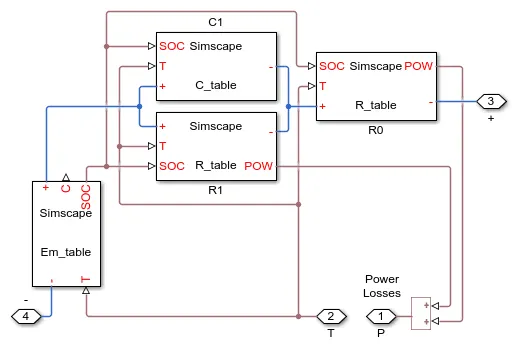
Cell subsystem basically consist of a Thermal Model and Lithium Cell 1RC block which calculate the temperature and thermal effect for cells and overall calculate for the battery pack.
Lithium Cell 1RC Subsystem
Results
Thermal effects and compare life cycle performance at various temperatures, SOC.
Change the temperature to the different temperatures and observe the thermal effects , SOC.
At 300k temperature.
In the below fig. the cell 5 is more than the cell 10 because the cell 5 is with fault. Temperature of cell 5 reaches to 330k and cell 10 reaches to 315 k. and SOC
At 325k temperature.
In the below fig. the cell 5 is more than the cell 10 because the cell 5 is with fault. Temperature of cell 5 reaches to 355k and cell 10 reaches to 345 k. and SOC
AT 350k temperature.
In the below fig. the cell 5 is more than the cell 10 because the cell 5 is with fault. Temperature of cell 5 reaches to 380k and cell 10 reaches to 360 k. and SOC
Conclusion
Hence 10 cell series lithium ion battery model, simulate the thermal effects and compare life cycle performance at various temperatures, charge & discharge rates using MATLAB is completed.