Project 2 Thermal modeling of battery pack
1) For a 10-cell series lithium-ion battery model, simulate the thermal effects and compare life cycle performance at various temperatures, and charge & discharge rates using MATLAB.
ans)
For a 10-cell series lithium-ion battery model, simulate the thermal effects and compare life cycle performance at various temperatures, and charge & discharge rates using MATLAB.
So I take the various temperature like 270K,300K,330K, and 360K.
And Discharge rate is 3.3A.
MATLAB SIMULINK model is shown below.
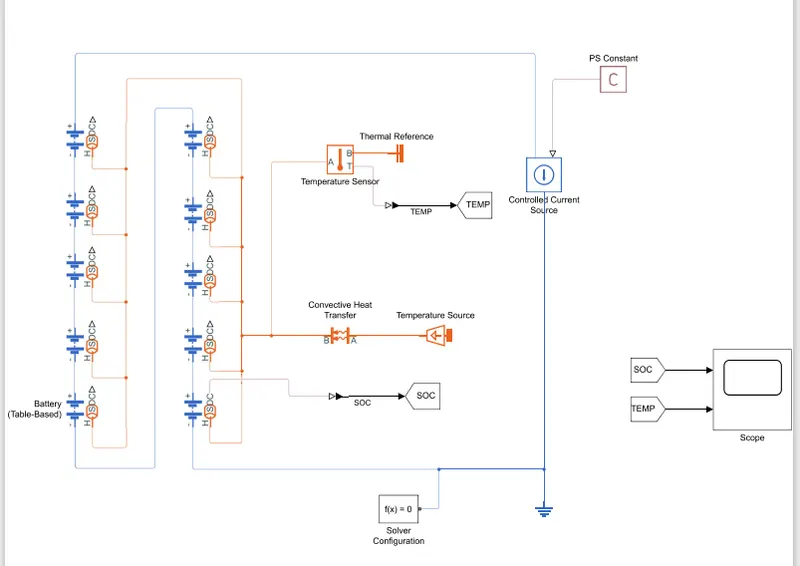
The blocks used for this model are given below:
Battery(Table based):
This block model a battery based on tabulated characteristics as functions of the state of charge (SOC) and optional temperature (T).
to activate the SoC and Thermal Property Click on the battery block then this SIMSCAPE BLOCK will appear then go to simscape block >> Block Choice>> instrumented | Show thermal port
Controlled current source:
The block represents an ideal current source that is powerful enough to maintain the specified current through it regardless of the voltage across it. The output current is I = Is, where Is is the numerical value presented at the physical signal port.
PS constant:
This block creates a physical signal constant:
y = constant
The Constant parameter accepts both positive and negative values. The block output is a physical signal port.
Electrical reference:
Electrical reference port. A model must contain at least one electrical reference port (electrical ground).
Temperature Source:
This block represents an ideal energy source in a thermal network that can maintain a constant absolute temperature at the port regardless of the heat flow rate.
Temperature sensor:
This block measures temperature in a thermal network. There is no heat flow through the sensor. The physical signal port T reports the temperature difference across the sensor. The measurement is positive when the temperature at port A is greater than the temperature at port B.
Thermal reference:
This block represents a reference point in a thermal network where the temperature is equal to absolute zero.
Convective Heat Transfer:
This block models heat transfer in a thermal network by convection due to fluid motion. The rate of heat transfer is proportional to the temperature difference, heat transfer coefficient, and surface area in contact with the fluid
Area=10 m^2
Heat transfer coefficient=20 W/(m^2 * K)
Solver Configuration:
Defines solver settings to use for simulation.
I am Testing the series batteries with the constant discharge current on different operating temperatures ranging from 270K to 360K.
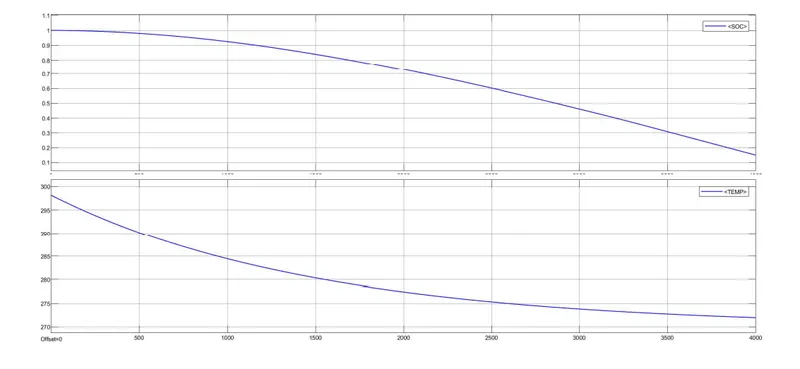
The result on 270K temperature:
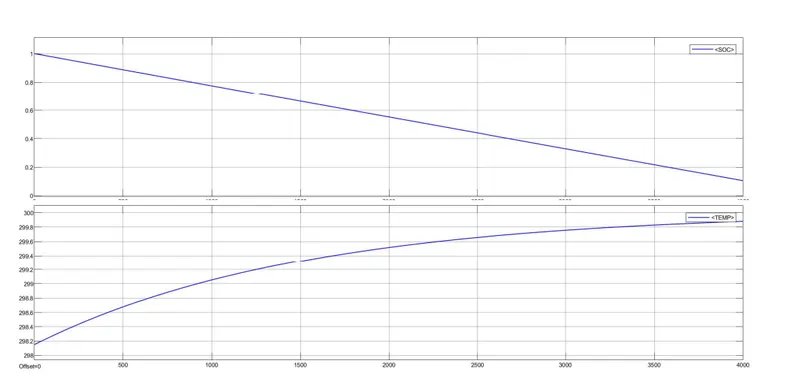
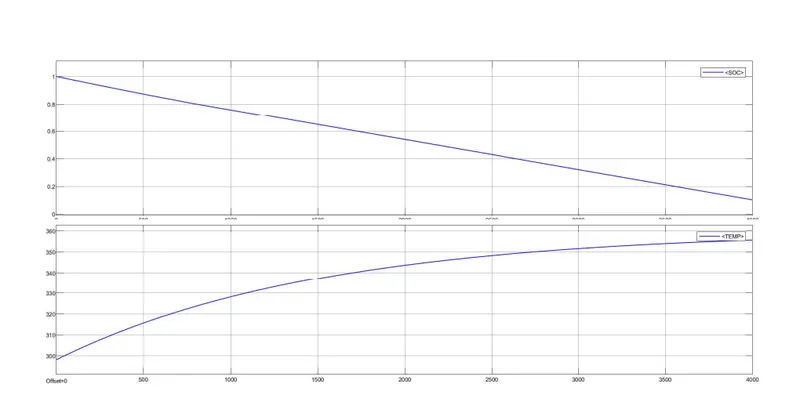
The result on 300K temperature:
The result on 330K temperature:
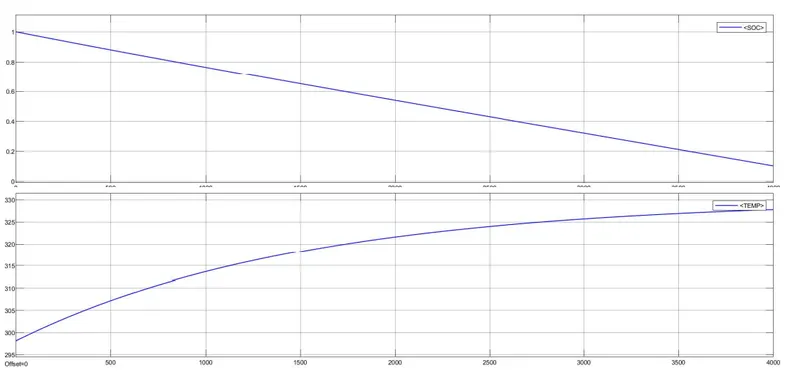
The result on 360K temperature:
Conclusion:
Here is the scope for 4000sec run time, we can see that when the temperature source is 270K the SOC will decrease and the temperature also decreases because in the battery our beginning temperature is 298.15K so it will go to 270K.
Then we give the temperature source is 300K the SOC will decrease 1 to 0.15 and the temperature will increase than the rated temperature then the battery will discharge fast and the life of the battery will decrease accordingly.