Project 2 Thermal modeling of battery pack
Aim :
For a 10 cell series lithium ion battery model, simulate the thermal effects and compare life cycle performance at various temperatures, charge & discharge rates using MATLAB.
Description:
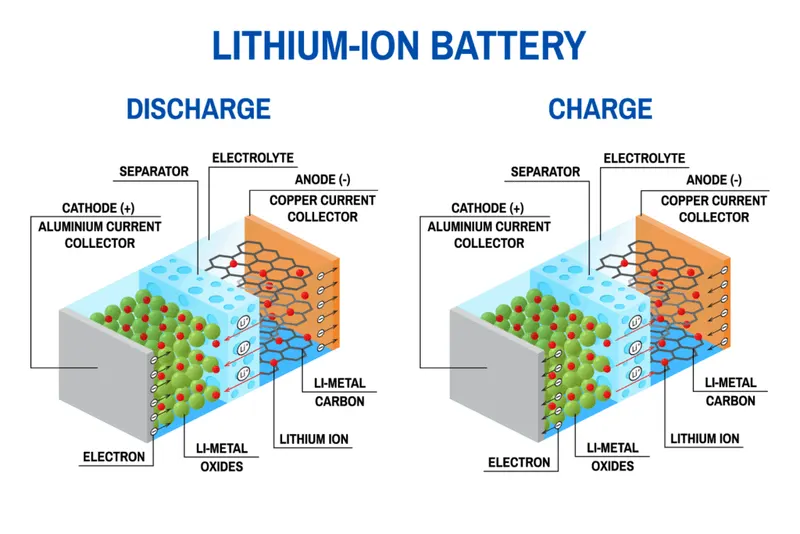
Now a days lithium ion batterys are mostly used in electric vehicles we must know its charge and discahrge rates to operate this batteries in efficient manner and with out damage when this batterys in operation this temperature of this must be kept in limit we simulate the thermal effect of the cell,by knowing the how much temperature rise take place we can provide efficient cooling to the batterys so that the life cycle of the battery increases we will see a model on the issue below and explanations as follows.
Cells connected in series and one of the cells is faulty so what will be the thermal effect.This example shows how to simulate a battery in efficient manner ans with out damage when this battery pack consisting of multiple series connected cells temperatures.For efficiency identical series connected cells are not just simply modeled by connecting cell models in series,Instead a single cell is used,and the terminal voltage scaled up by the number of cells .The fault is represented by changing the parameters for the cells 10 fault subsystem,reducing both capacity and open circuit voltage and increasing the resistance values.
Circuit Construction and working :
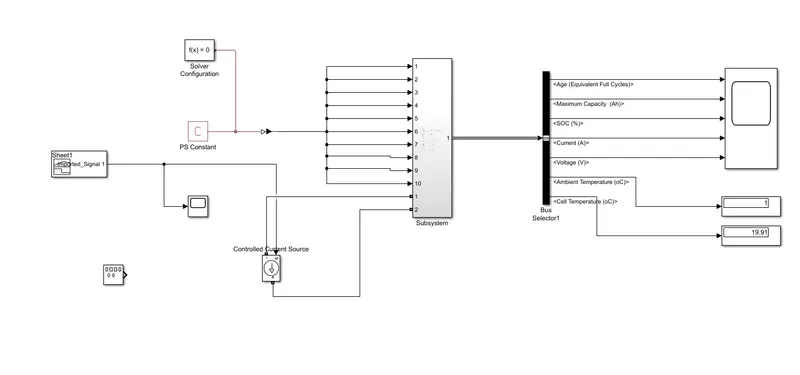
In this circuit we use Li -ion cell 1 to 10,temp sensor,Ambident temp block,SOC estimation,Scope,Charge discharge profile,solver configuration,ps constant and the signal builder
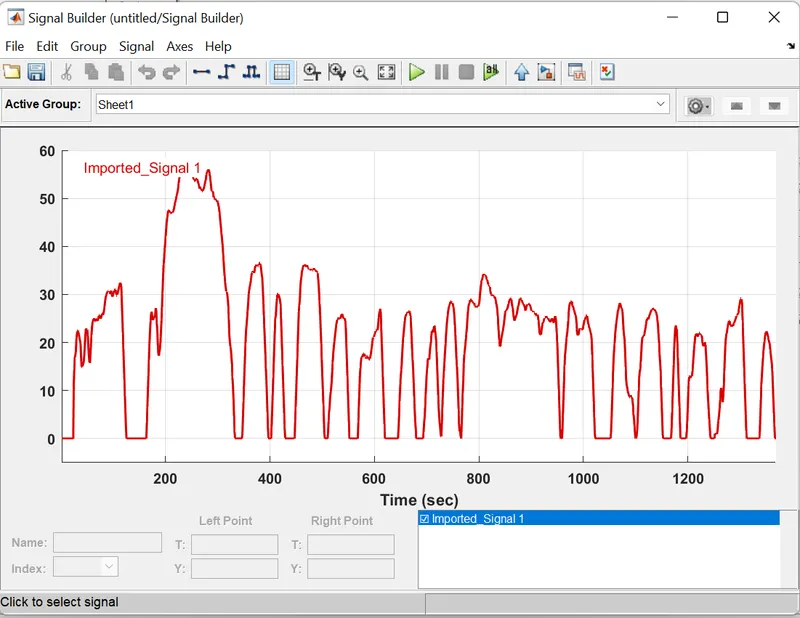
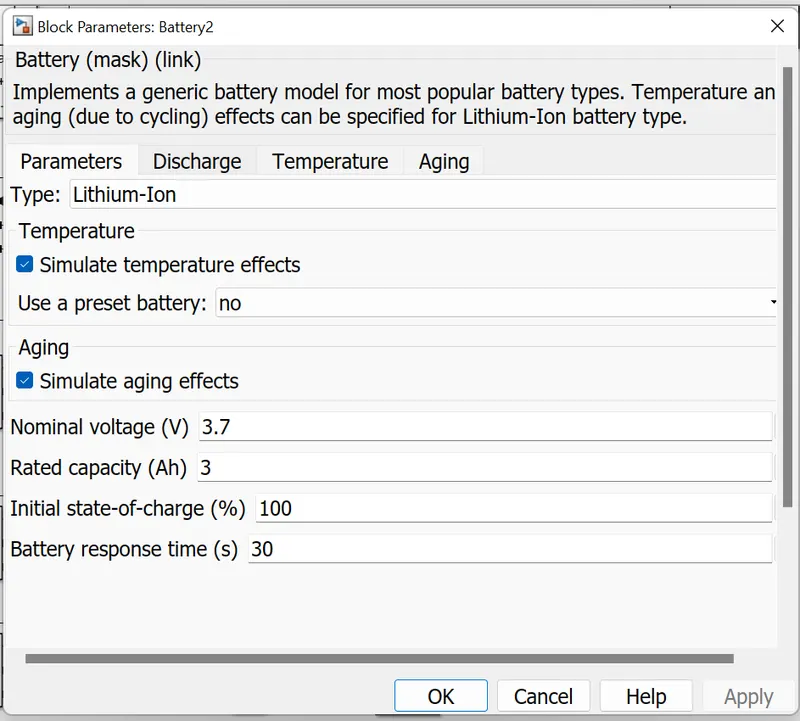
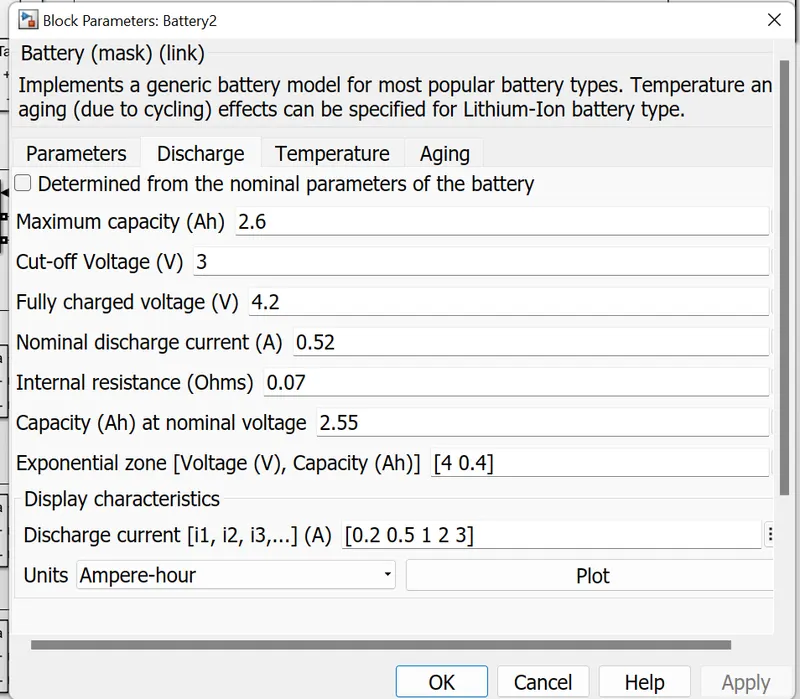
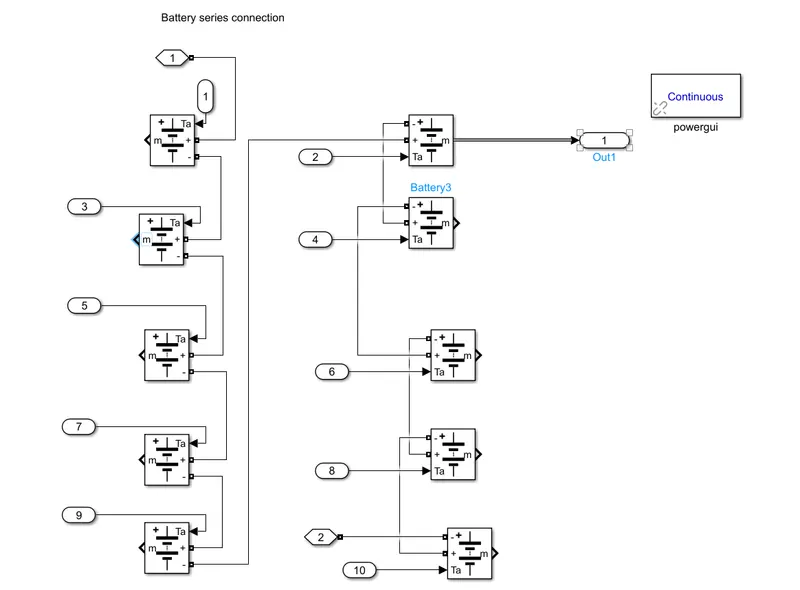
Intially the system is given input from the signal builder block by importing the file from the excel and saved in the signal builder block there after it is connected to the controlled current source and the controlled current source is connected to the input of the subsystem.The battery paramters are simulate temperature effects and aging effects. The subsystem is designed with 10 batteries in series connection and the remaining ports are connected with the connection port 1 and 2 the subystem output is connected with the bus selector block.This block consists of 7 outputs they are SOC,Current,Voltage,Maximum capacity,Age and the ambident temperature and the cell temperature the first 5 inputs are connected to the scope and the last 2 are connected to the display box.
Lithium cell IRC circuit :
The block usually consists of the capacitance value table which depends on the external physical input of the SOC and T.It is assuming that the capacitance value is varying with time and hence the equation i=C*dv/dt holds
Resistance value R table which depends on the external physical input SOC and T
Voltage Value which implements the cells main brach voltage source and determines the value of the capacity and the state of charge (SOC)
The inputs for the Li-ion battery
It is defined has the transfer of heat from one body to other from a solid to liquid is defined has convection.The rate of heat transfer is proportional to the temperature difference,surface area and heat transfer coefficient.
Thermal effects:
It is defined has the substaintial loss of heat from the object or an equipment from the intial time to the final time of the working of an object or the loss of the thermal energy.
Temperature Sensor :
This sensor represents an ideal temperature sensor that is a device determined the temperature differential measured between the 2 points without drawing any heat
Inside the subsystem:
State of charge estimation :
The coloumb counting method measures the discharging current of a battery and integrates the discharging current over time in order to estimate SOC.
This subsystem takes current has input and gives the battery SOC as output.A current sensor block is used and connected for SOC estimation.
The circuit estimates the battery SOC using coloumb counting method.It takes current has the input and SOC has the output.The initial SOC of the battery assumed has 100.
Cell Temperature :
The photovoltaic (PV) cell temperature is the temperature of the surface of the PV array. During the night, it is the same as the ambient temperature, but in full sun, the cell temperature can exceed the ambient temperature by 30°C or more.
Ambident Temperature:
It is the temperature of the air of the surrounding equipment where the equipment is stored.
Maximum Capacity:
Maximum Capacity means the quantity of air contaminants that theoretically could be emitted by a stationary source without control devices based on the design capacity or maximum production capacity of the source and 8,760 hours of operation per year
Result Explanation:
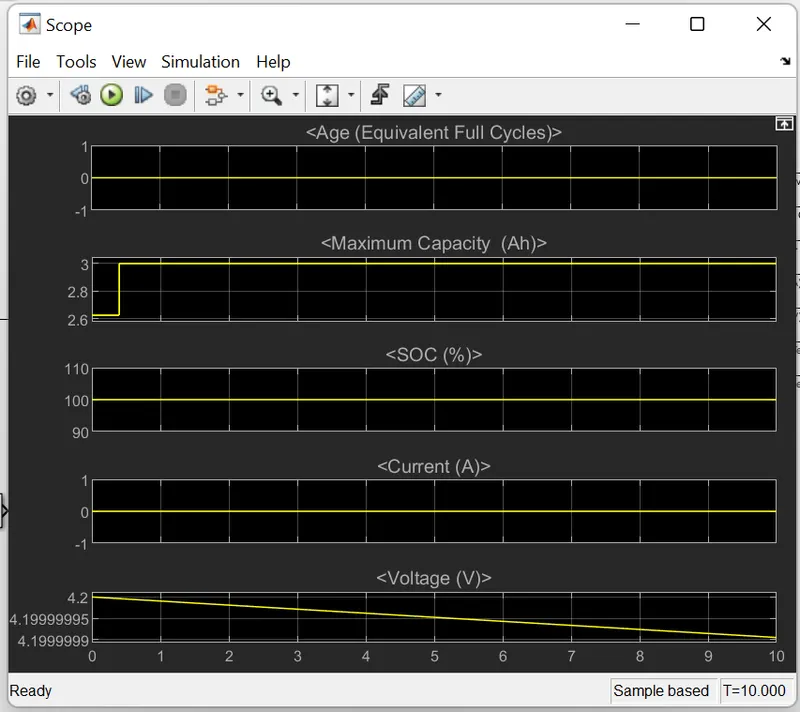
For 10 cell series Li-ion battery model we simulate the thermal effects and compare the life cycle performance at various temperature,charge and discharge using MATLAB.
1-4 cells are normal cells 5th cell is faulty 6-10 cells is normal cell has we are simulating the thermal effect on we give cyclic/Discharge profile to circuit the wave forms you can see the above results all the conditions is same but we can see the circuit on this drive cycle profile 5th cell was faulty it will show temperature rise high than any other cell and life cycle get reduceded and even the cell may gets damaged.
So as we give temp of results at 300k 1.e 26.85 C the 1-4 and 6-10 cell temp is near 314K
Here we simulated the model for 10 sec has the model is taking a lot of time to simulate for 1369sec.The out put is different for the different input but the common is the Age equivalent cycle which is common in all the given input.
Conclusion:
We simulated the thermal effect,and compared at various temperature,faulty cell temperature rise more than normal cell charge and discharge cycle given and due to temp rise it can damage the cell and reduce the performace of the battery.