Project 2 Thermal modeling of battery pack
Aim: Thermal modeling of the battery pack.
OBJECTIVE
To model and simulate 10 cells in a series lithium-ion battery pack, analyze the thermal effects and compare its life cycle performance at various temperatures, charge & discharge rates using MATLAB
INTRODUCTION
BATTERIES are a collection of one or more cells whose chemical reactions create a flow of electrons in a circuit. All batteries are made up of three basic components: an anode (the '-' side), a cathode (the '+' side), and some kind of electrolyte (a substance that chemically reacts with the anode and cathode).
.
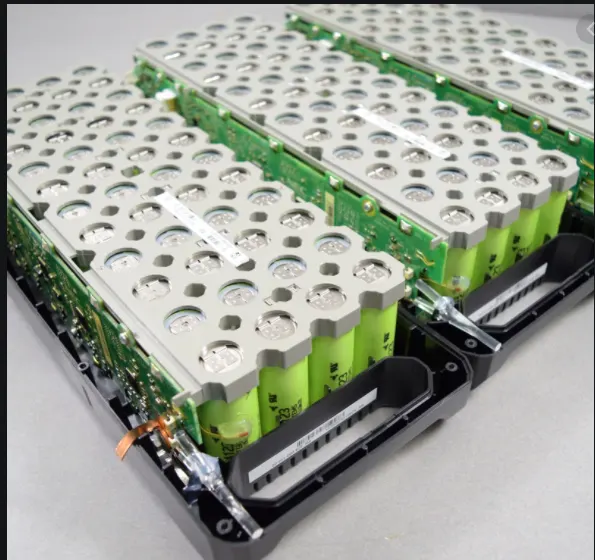
When the anode and cathode of a battery are connected to a circuit, a chemical reaction takes place between the anode and the electrolyte. This reaction causes electrons to flow through the circuit and back into the cathode where another chemical reaction takes place. When the material in the cathode or anode is consumed or no longer able to be used in the reaction, the battery is unable to produce electricity. At that point, your battery is "dead."
Batteries that must be thrown away after use are known as primary batteries. Batteries that can be recharged are called secondary batteries.
THEORY:
- A lithium-ion battery or Li-ion battery is a type of rechargeable battery. Lithium-ion batteries are commonly used for portable electronics and electric vehicles and are growing in popularity for military and aerospace applications.
- In the batteries, lithium ions move from the negative electrode through an electrolyte to the positive electrode during discharge, and back when charging. Li-ion batteries use an intercalated lithium compound as the material at the positive electrode and typically graphite at the negative electrode. The batteries have a high energy density, no memory effect (other than LFP cells), and low self-discharge. They can however be a safety hazard since they contain flammable electrolytes, and if damaged or incorrectly charged can lead to explosions and fires. Samsung was forced to recall Galaxy Note 7 handsets following lithium-ion fires, and there have been several incidents involving batteries on Boeing 787s.
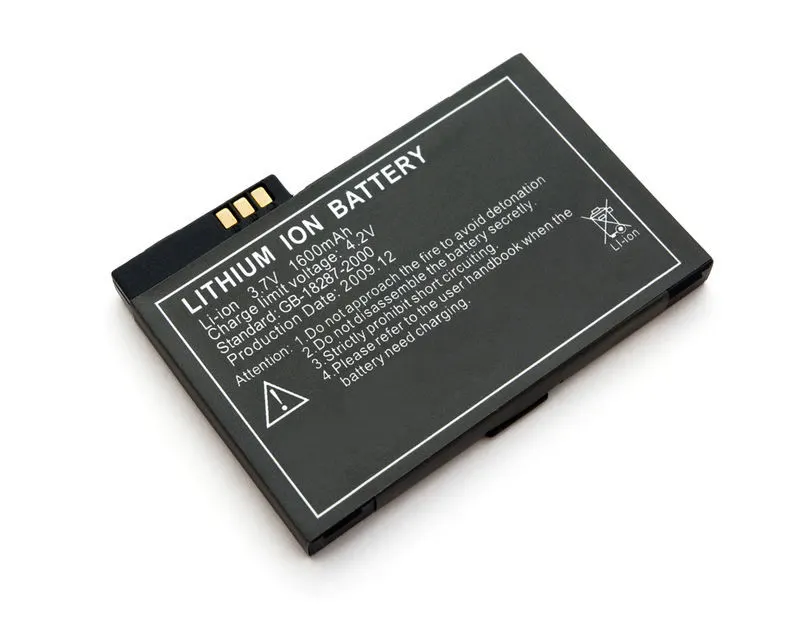
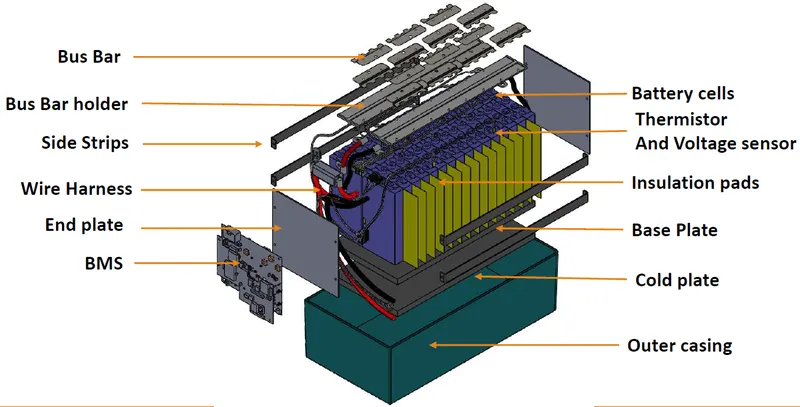
- In the batteries, lithium ions move from the negative electrode through an electrolyte to the positive electrode during discharge, and back when charging. Lithium-ion batteries use an intercalated lithium compound as the material at the positive electrode and typically graphite at the negative electrode. The batteries have a high energy density, no memory effect (other than LFP cells), and low self-discharge.
- Pioneer work with the lithium battery began in 1912 under G.N. Lewis but it was not until the early 1970s that the first non-rechargeable lithium batteries became commercially available. lithium is the lightest of all metals, has the greatest electrochemical potential, and provides the largest energy density for weight.
Lithium batteries were proposed by British chemist and co-recipient of the 2019 Nobel prize for chemistry M. Stanley Whittingham, now at Binghamton University, while working for Exxon in the 1970s.Lithium-Ion Batteries – Latest News from ISRO
- ISRO’s VSSC has successfully developed and qualified lithium-ion cells of capacities ranging from ‘1.5 Ah to 100 Ah’ for use in satellites and launch vehicles.
- According to ISRO, with the successful deployment of indigenous lithium-ion batteries in various missions, VSSC is planning to transfer this technology to the industries to establish production facilities for producing lithium-ion cells to cover the entire spectrum of the country’s power storage needs.
- The ISRO had selected ten companies in 2019 for the transfer of its Lithium-ion cell technology.
- China dominates the Li-ion battery market. Around three-quarters of battery cell manufacturing capacity is in China, and Chinese companies have unparalleled control of required domestic and foreign battery raw materials and processing facilities.
- India has been importing Li-ion batteries from China, Japan, and South Korea.
Lithium-ion Battery – Applications
- Electronic gadgets
- Tele-communication
- Aerospace
- Industrial applications
- Lithium-ion battery technology has made it the favorite power source for electric and hybrid electric vehicles.
Lithium-ion Cell technology – Benefits
- Long life cycle
- High Voltage
- High Storage Characteristics
- High Energy Density
Lithium-ion Battery – Major Issues
- Lithium-Ion batteries can be a safety hazard since they contain flammable electrolytes, and if damaged or incorrectly charged can lead to explosions and fires.
- There have been several incidents involving batteries on Boeing 787s.
- Samsung was forced to recall Galaxy Note 7 handsets following lithium-ion fires
- Requires protection circuit to maintain voltage and current within safe limits.
- Expensive to manufacture – about 40 percent higher in cost than nickel-cadmium.
- Not fully mature – metals and chemicals are changing on a continuing basis.
Environmental Impacts of Lithium-Ion Batteries
As per some studies, the following environmental impacts were noted
- Ecological Toxicity
- Global Warming
- Human Health impacts
- Resource Depletion
PROCEDURE:
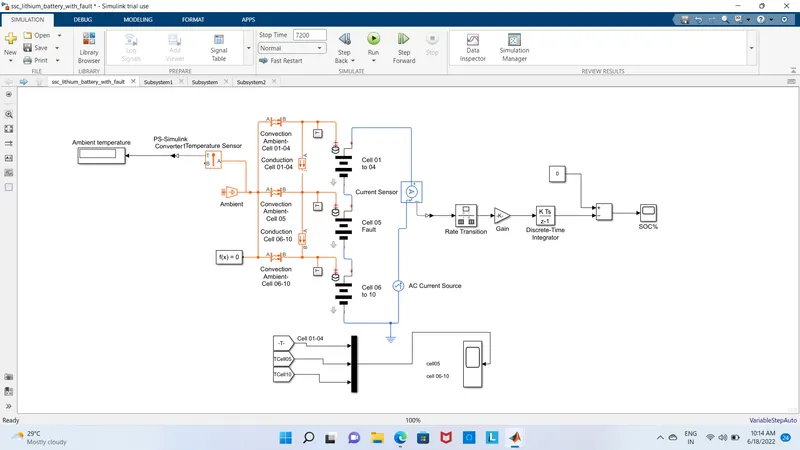
he fundamental blocks used in this model are as follows
- AC Current Source: The AC Current Source block represents an ideal current source that maintains the sinusoidal current through it, independent of the voltage across its terminals.
The output current is defined by the following equation:
I=I0⋅sin(2π⋅f⋅t+ψ)I=I0⋅sin(2π⋅f⋅t+ψ)
This block has two electrical conserving ports associated with its terminals.
- Current Sensor: The Current Sensor block represents an ideal current sensor, that is, a device that converts current measured in any electrical branch into a physical signal proportional to the current.
Connections '+' and '–' are electrical conserving ports through which the sensor is inserted into the circuit. The connection 'I' is a physical signal port that outputs the measurement result.
- Lithium Cells: The Lithium cell block represents an ideal lithium-ion cell used in a battery pack with thermal ports.
Connections '+' and '–' are electrical conserving ports through which the cells are inserted into the circuit. The Thermal port used for further thermal network connections.
Here, the Cells pack 1-4 and 6-10 are normal and healthy cells, whereas Cell 5 is the faulty cell.
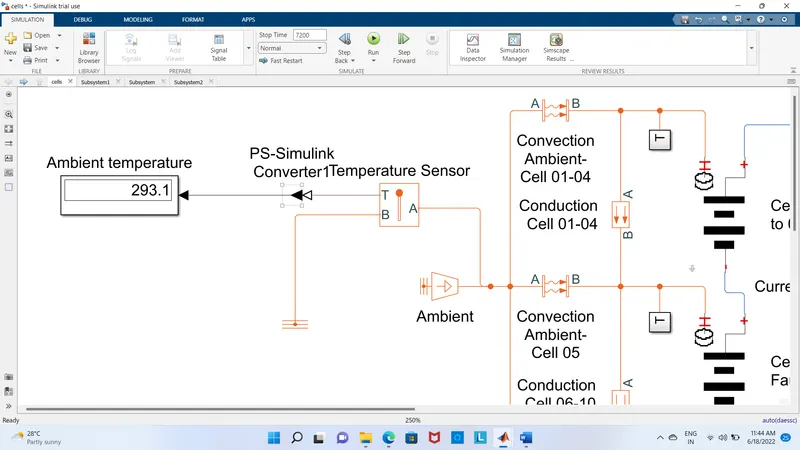
- Temperature Sensor: The Temperature Sensor block represents an ideal temperature sensor, that is, a device that determines the temperature differential measured between two points without drawing any heat. Connections 'A' and 'B' are thermal conserving ports that connect to the two points where the temperature is being monitored. Port 'T' is a physical signal port that outputs the temperature differential value.
- Conductive Heat Transfer: The Conductive heat transfer block models heat transfer in a thermal network by conduction through a layer of material. The rate of heat transfer is governed by Fourier's law and is proportional to the temperature difference, material thermal conductivity, area normal to the heat flow direction, and inversely proportional to the layer thickness.
- Convective Heat Transfer: The Convective heat transfer block models heat transfer in a thermal network by convection due to fluid motion. The rate of heat transfer is proportional to the temperature difference, heat transfer coefficient, and surface area in contact with the fluid.
- Temperature Source: The Temperature source block represents an ideal energy source in a thermal network that can maintain a constant absolute temperature at the port regardless of the heat flow rate.
- Rate Transition: Rate Transition block transfers data from the output of a block operating at one rate to the input of another block operating at a different rate. The Rate Transition block's parameters allow you to specify options that trade data integrity and deterministic transfer for faster response and/or lower memory requirements.
- Discrete-Time Integrator: The Discrete-Time Integrator block implements discrete-time integration or accumulation of the input signal. The block can integrate or accumulate using the Forward Euler, Backward Euler, and Trapezoidal methods.
- Mux: The Mux block combines inputs with the same data type and complexity into a vector output.
- Electrical Reference, Thermal Reference, Solver Configuration, Scope, Display, Gain, Constant, Add, PS-Simulink Converter, Simulink-PS Converter, Goto tag,andFrom are the miscellaneous blocks used in this model.
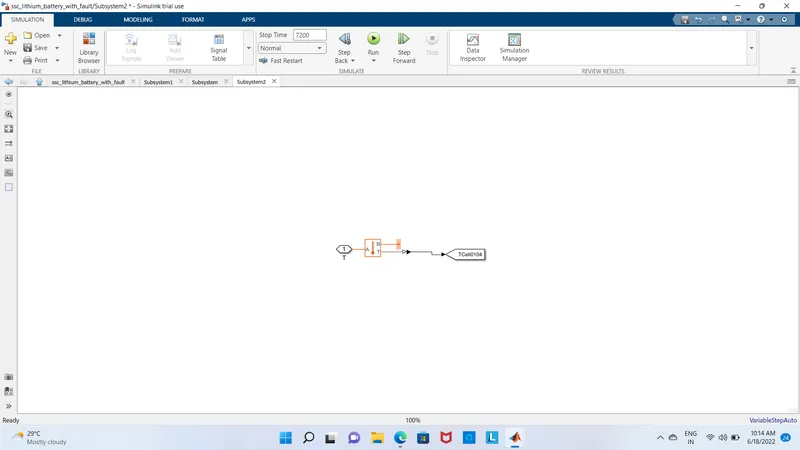
The three subsystems used in this model for the respective cells pack are as below
 \
\
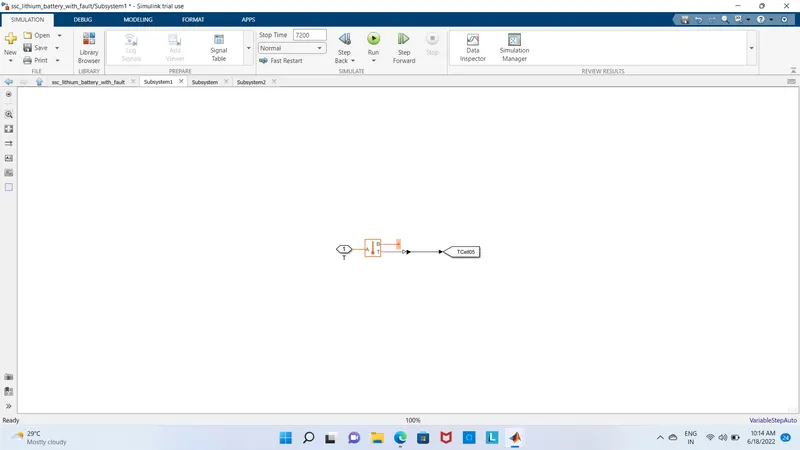
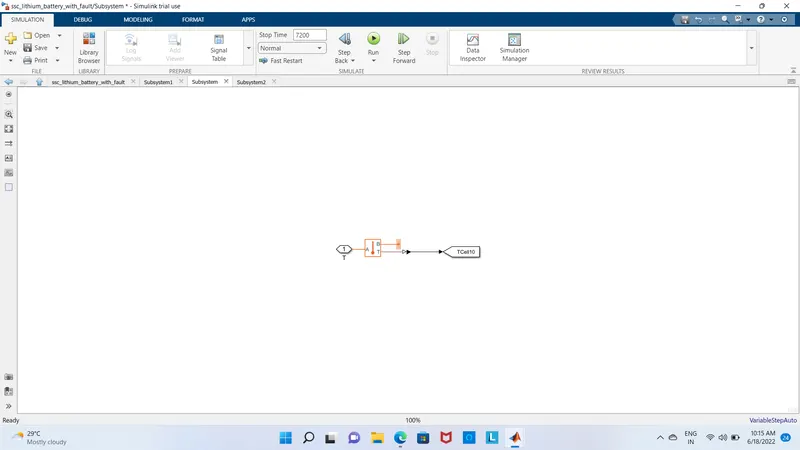
They are all named 'T' and the output of all the subsystems is given to the Goto tags which will show the temperature curves using a Scope.
LITHIUM CELLS
for cells (01-04)
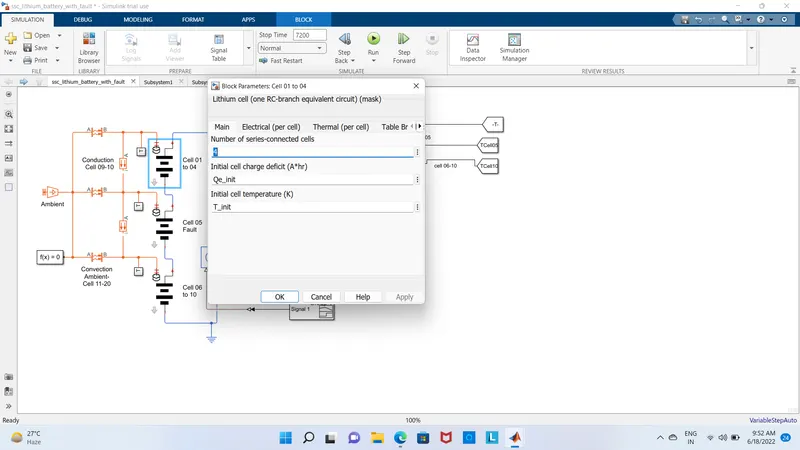
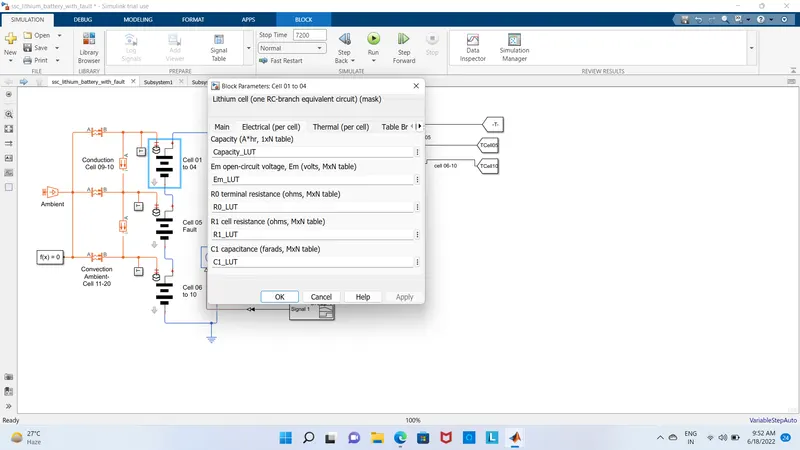
for(cell)(5)
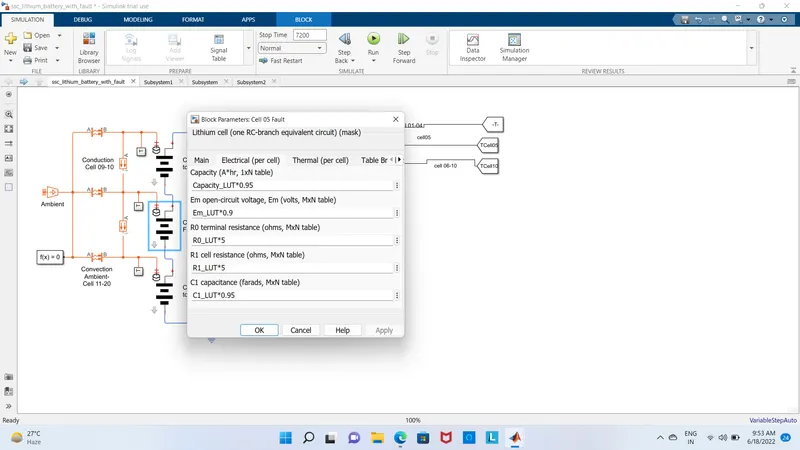
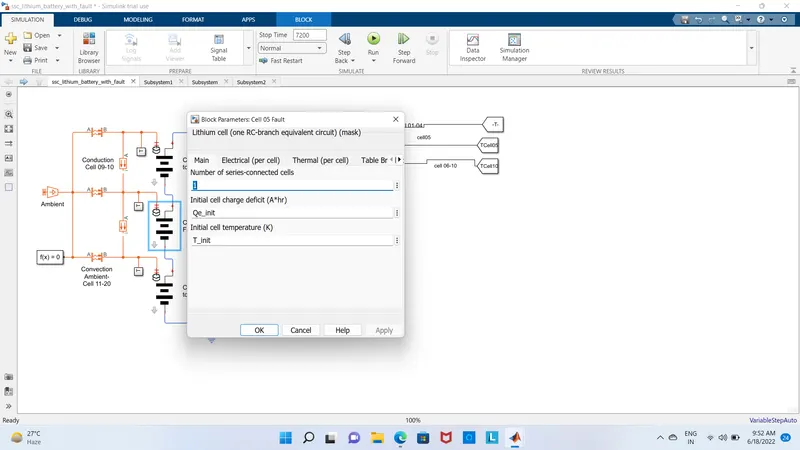
for(cell)(06-10)
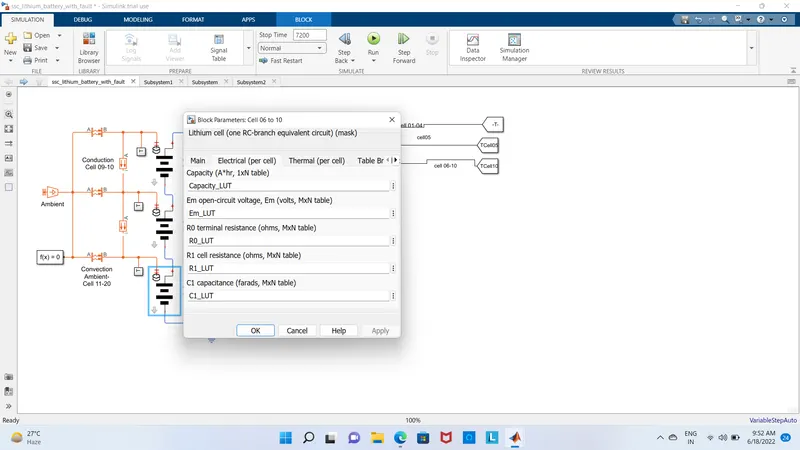
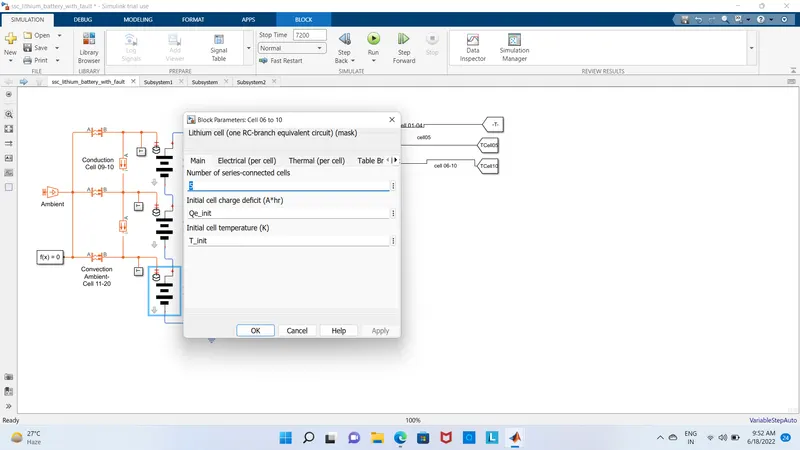
conductive heat transfer for
for cell(01-04)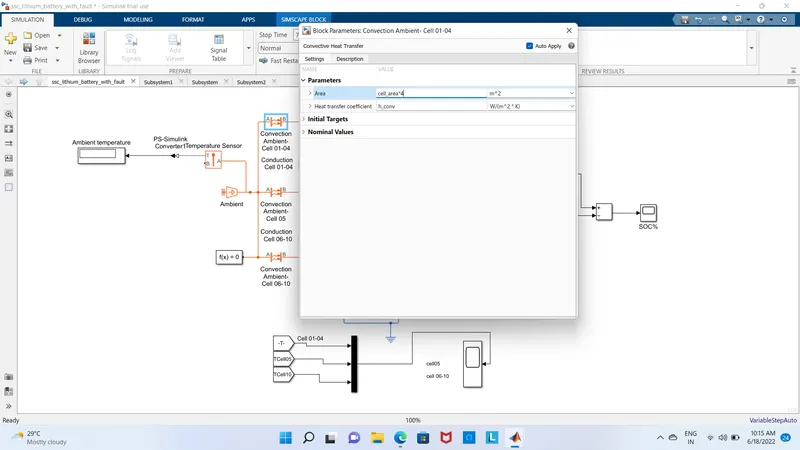
for(cell)(5)
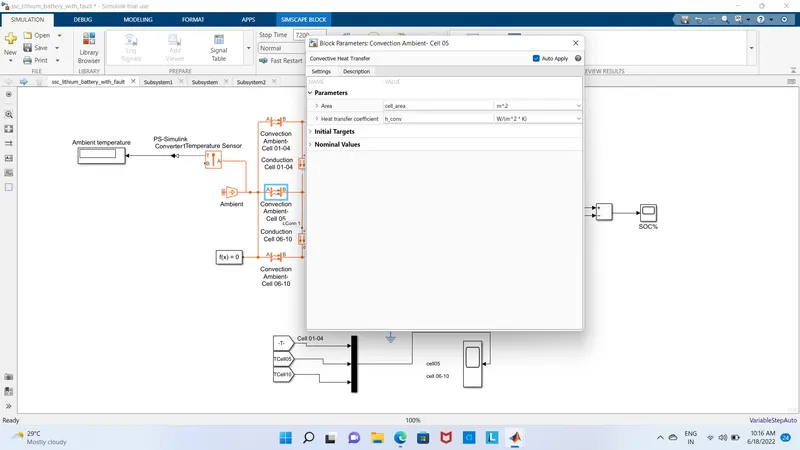
for cell(06-10)
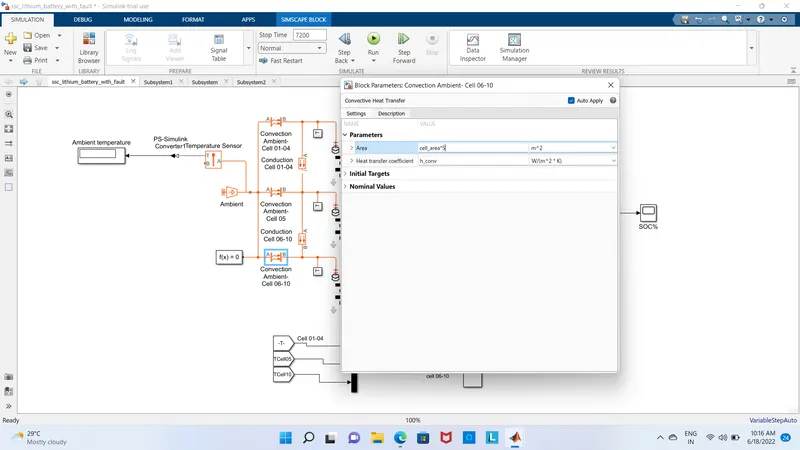
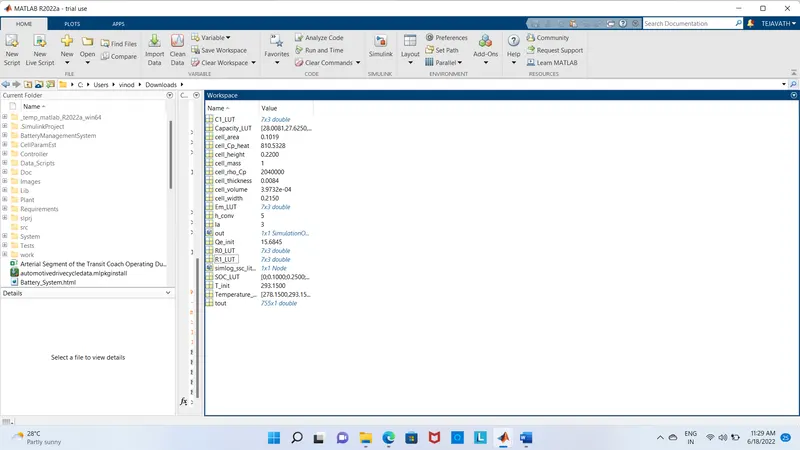
workspace parameters
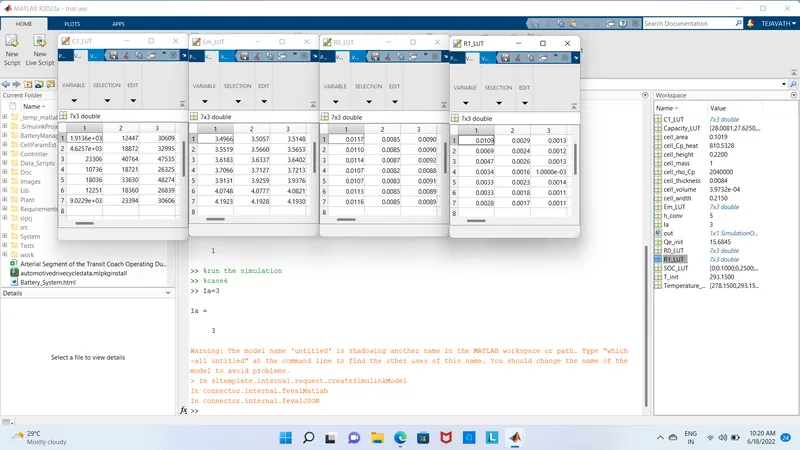
For the Temperature time cycle, refer to the following excel sheet, Temperature time data.
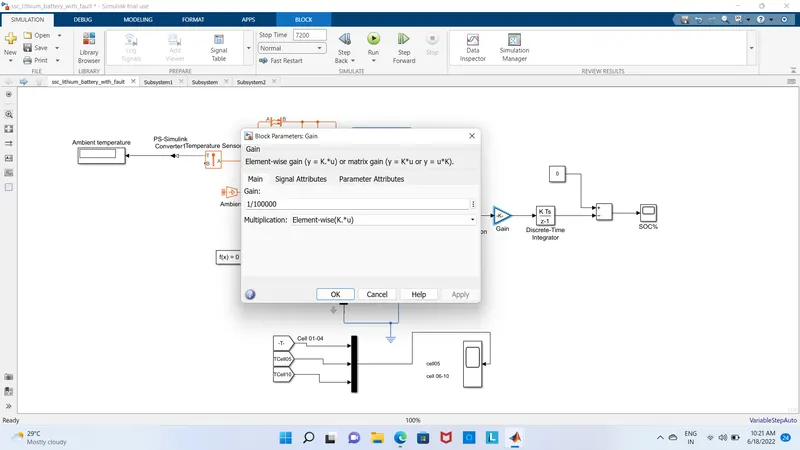
gain value
RESULTS:
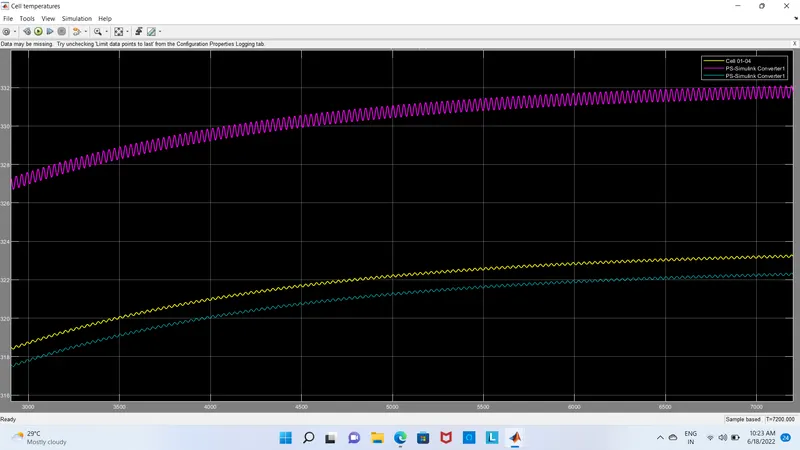
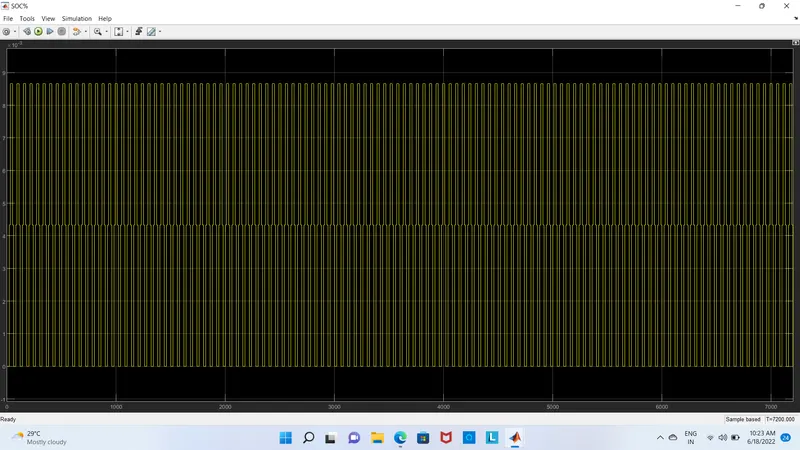
The running time for the simulation (7200)sec, and the results are,
cell temperature
SoC
Conclusion:
1. The Ambient temperature provided by the Temperature source is 293.15oK293.15oK
2. Cell pack 1-4 reaches the maximum temperature of 326oK326oK, Cell pack 5 which is the faulty cell reaches the maximum temperature of 337oK337oK, and Cell pack 6-10 reaches the maximum temperature of 325oK325oK.
3. The SOC of the model starts from 0 and goes up to 0.95 in 300 secs and again discharges to 0 in 300 secs and the cycle keeps on repeating.
4. The Life cycle of the battery pack is 6 cycles per hour.
The following figure shows the Simulink model of a 10-cell series lithium-ion battery using a Signal Builder which has a signal input using a UDDS drive cycle of the Current profile
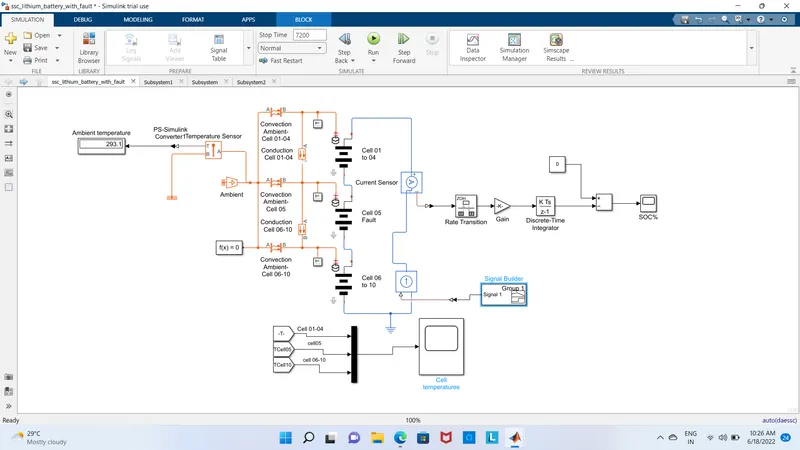
The additional fundamental blocks used in this circuit are
1. Signal builder: The Signal Builder block allows you to create interchangeable groups of piecewise linear signal sources and use them in a model.
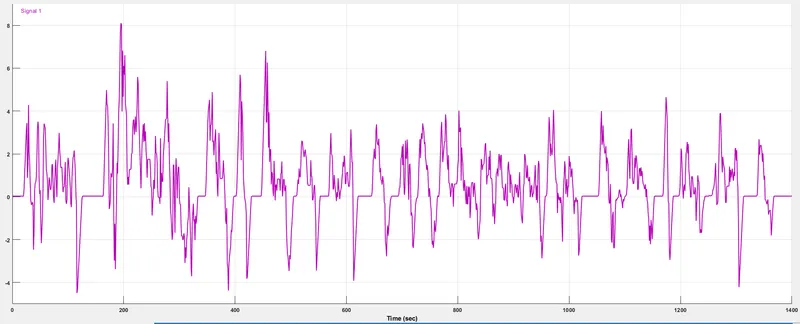
Here, we are using a signal builder block to create the drive cycle data of the UDDS cycle. The limitation of the signal builder is that it accepts data in the form of only the current profile. So, the speed v/s time data from the drive cycle should be converted to its corresponding current profile with respect to time.
2. Controlled Current Source: This block represents an ideal current source that is powerful enough to maintain the specified current through it regardless of the voltage across it. The output current is I = Is, where Is is the numerical value presented at the physical signal port.
Model parameters:
a. Signal Builder (UDDS drive cycle data with Current profile):
gain value
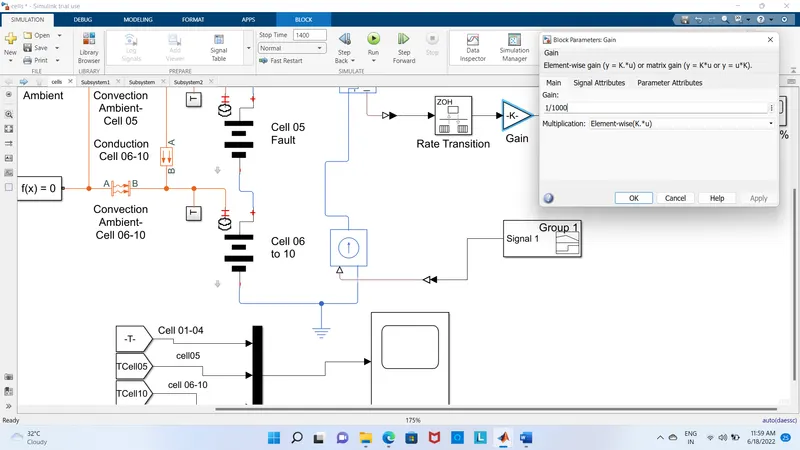
Rest all the parameters remain the same as the above model using a Cyclic AC current source.
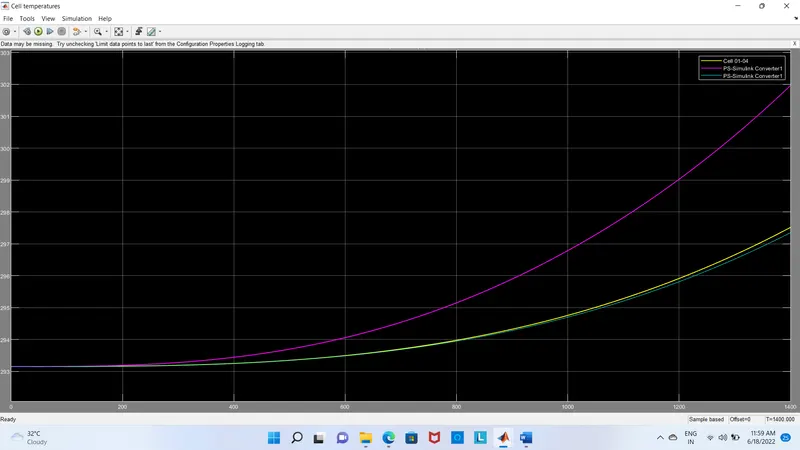
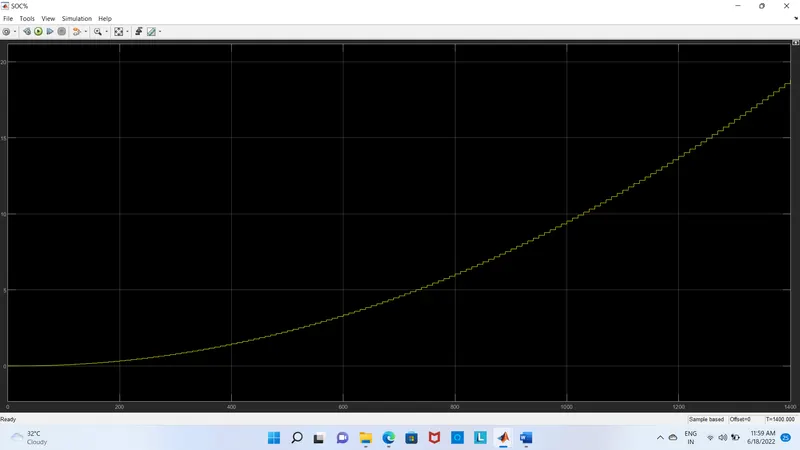
after running 1400 s the results are
cell temperature
SoC
Conclusion:
1. The Ambient temperature provided by the Temperature source is 293.15oK293.15oK
2. Cell pack 1-4 reaches the maximum temperature of 293.185oK293.185oK, Cell pack 5 which is the faulty cell reaches the maximum temperature of 293.214oK293.214oK, and Cell pack 6-10 reaches the maximum temperature of 293.184oK293.184oK.
3. The SOC of the model starts from 0 and goes up to 0.9 in 1400 secs.