Project 2 Thermal modeling of battery pack
Plotting script for example battery model ssc_lithium_battery_with_fault.
- This example shows how to model a series of lithium-ion cells
- where one of the cells develops a fault.
- The data used for each cell is the same as for the ssc_lithium_cell_1RC example model, and is based on T. Huria, M. Ceraolo, J. Gazzarri, R. Jackey. "High Fidelity Electrical Model with
Thermal Dependence for Characterization and Simulation of High Power Lithium Battery Cells.
model:
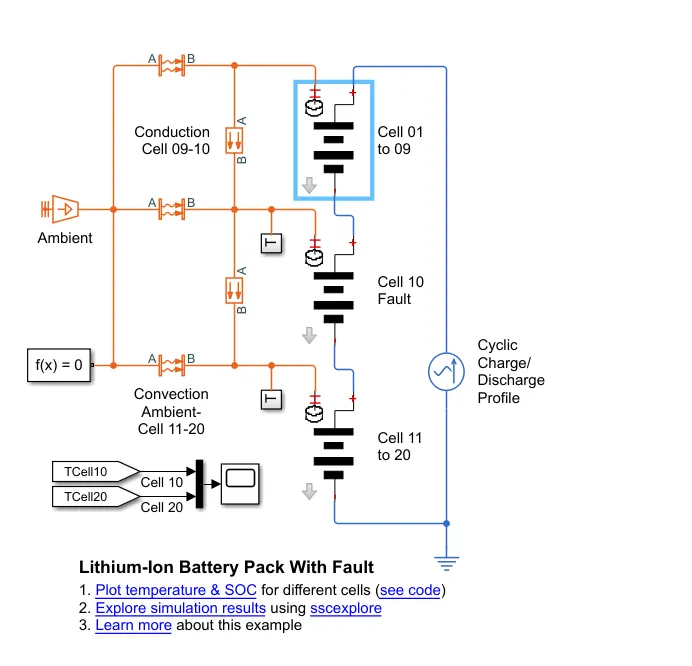
Model parameter discription:
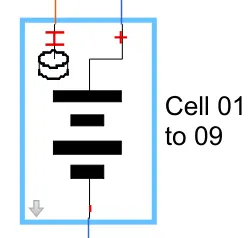
one lithium one Rc-Branch equivelant circuit : in which 9 cell connected in series.
initial cell tempreature is 293.15 k
initial cell charge = 15.6 A*hr
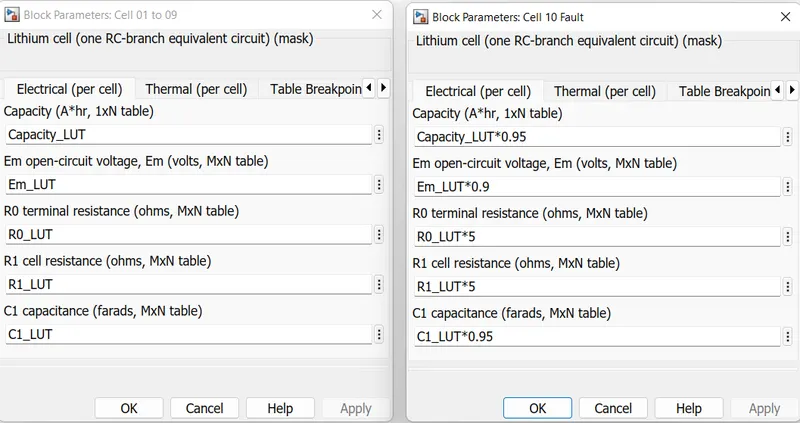
given model in Electrical paramter are diffrent and remaining same .
| cell 1 to 9 and Cell 11-20 | (faulty )cell 10 | |
| A*hr | approx 28 | approx 28*0.95 |
| open circuit voltage | 3.4 to 4.1 | 3.4 to 4.1*0.9 |
| R0 terminal resistance | 0.0117 to 0.0089 | (0.0117 to 0.0089)*5 |
2.
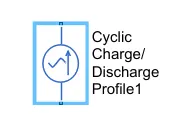
The ideal AC current source maintains the sinusoidal current through it, independent of the voltage across its terminals.
The output current is defined by I = I0 * sin(2*pi*f*t + PHI), where I0 is the peak amplitude, f is the frequency in Hz, and PHI is the phase shift in radians.
3.
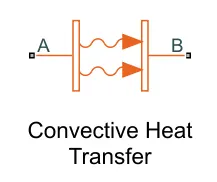
This block models heat transfer in a thermal network by convection due to fluid motion.
The rate of heat transfer is proportional to the temperature difference, heat transfer coefficient, and surface area in contact with the fluid.
above model parameter :
- for cell 1 to 9 area = 0.1019 * 9 m^2
- and Cell 11-20 area = 0.1019 * 10 m^2
- cell 10 area = 0.1019 m^2
- heat transfer cofficient = 5
we know that
- the capacity of a battery will be greater if the surface area of its plates is increased.
- With large plate areas a greater amount of acid and active materials is available, and an increase in capacity results.
4.

This block represents an ideal energy source in a thermal network that can maintain a constant absolute temperature at the port regardless of the heat flow rate.
model simulate grapgh :
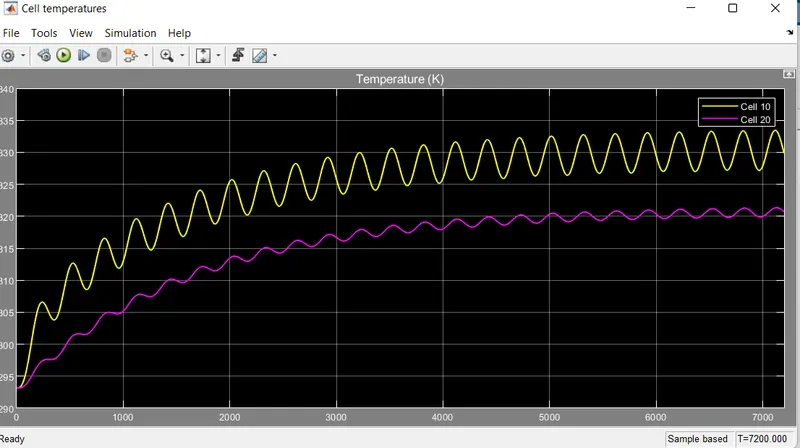
we know, all chemical reactions are affected by temperature, and a battery relies on chemical reaction to generate power.
yellow graph showing the fault cell temprature
purpal color lines showing normal cell tempreature value
cell 10 tempreature is 60 degree c
normal cell tempreature is upto 40 to 45 degree c.
optimum functioning of a battery is at room temperature.
Cell no 10 output:
tempreature is goint upto 60 degree .
voltage 0.14 in 532.24 sec.
current is showing inversly to the voltage .
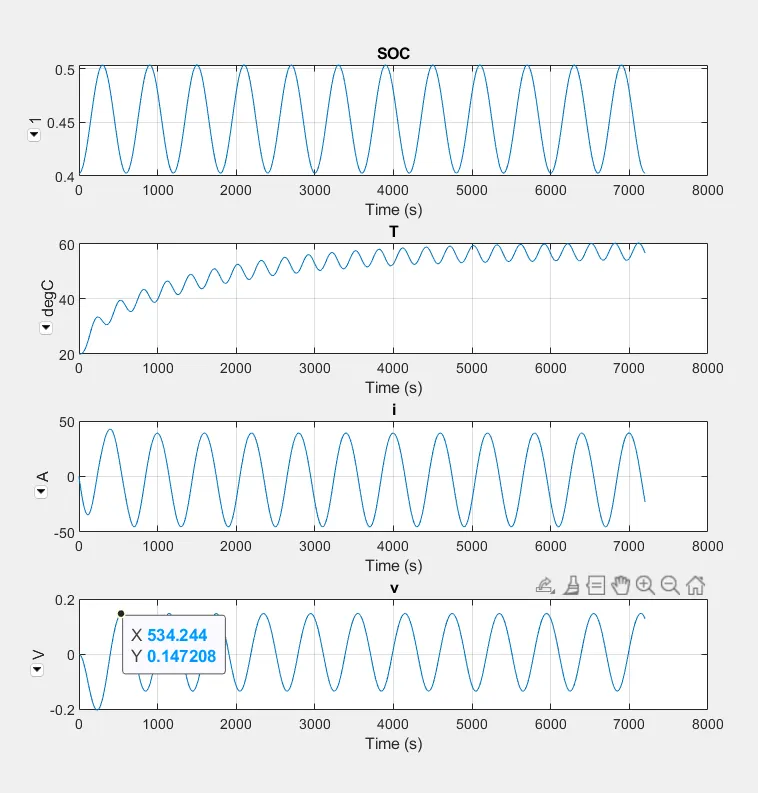
- The degradation rate of battery cells depends not only on external stress factors such as charging, discharging, time,
and temperature, but also on its current state of life.
battery’s cell no. 10 is showing the rate of which is affected by the temperature and the SoC of the battery.- in general, the more surface area the chemicals have to deposit charge onto, and take charge away from, the higher the current the battery can produce.
- The performance of all batteries drops drastically at low temperatures; however, the elevated internal resistance will cause some warming effect by efficiency loss caused by voltage drop when applying a load current.
- The driving range of an electric vehicle between charges is calculated at ambient temperature.
- This loss is not only caused by heating the cabin electrically but by the inherent slowing of the battery’s electrochemical reaction, which reduces the capacity while cold.
subsystem:
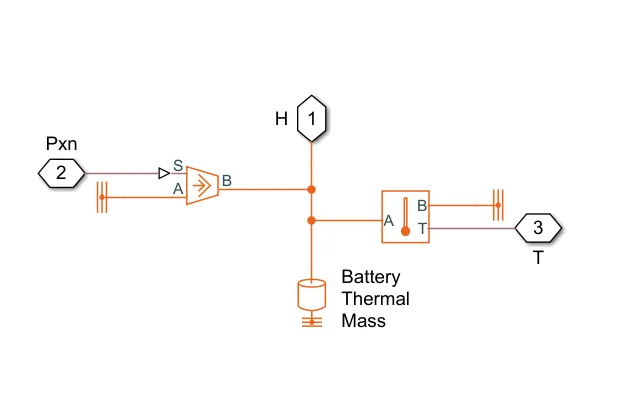
consist of thermal refrence , tempreature sensore:
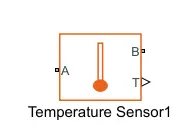
This block measures temperature in a thermal network. There is no heat flow through the sensor. T
he physical signal port T reports the temperature difference across the sensor. T
he measurement is positive when the temperature at port A is greater than the temperature at port B.
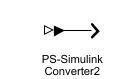
Converts the input Physical Signal to a Simulink output signal.
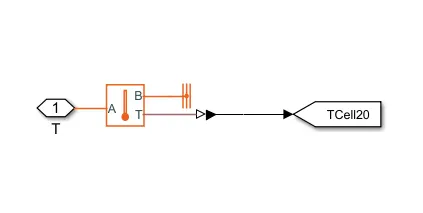
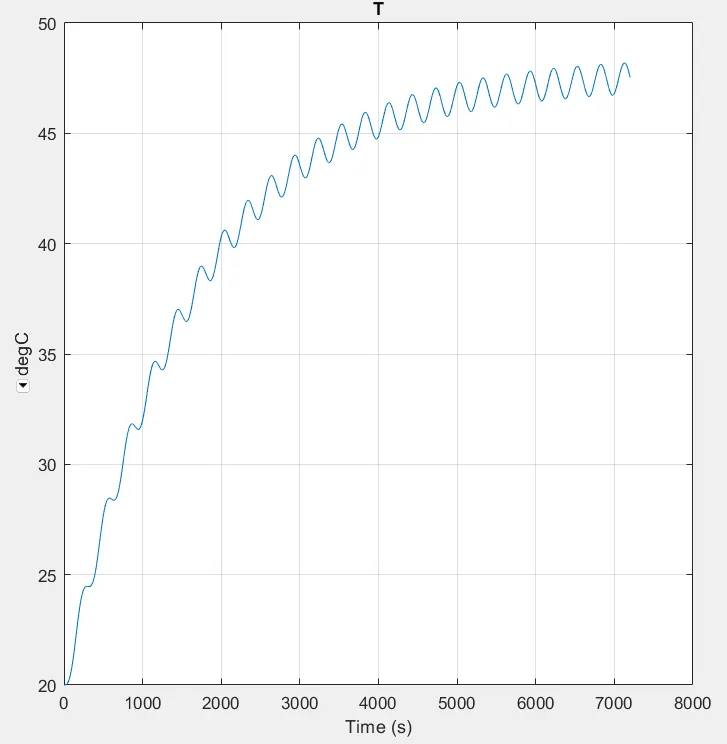
above graph is showing noemal cell tempreature .
tempreature is 45 degree C.
subsystem 1:
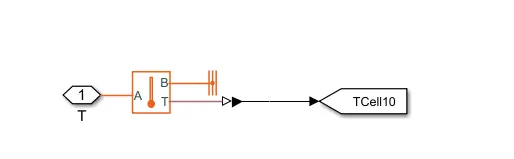
The battery generates heat during charge or discharge, increasing the battery temperature.
Once the heat cannot be dissipated in time, the battery may get into thermal runaway.
in subsystem 1 showing cell 10 (fault) condition.
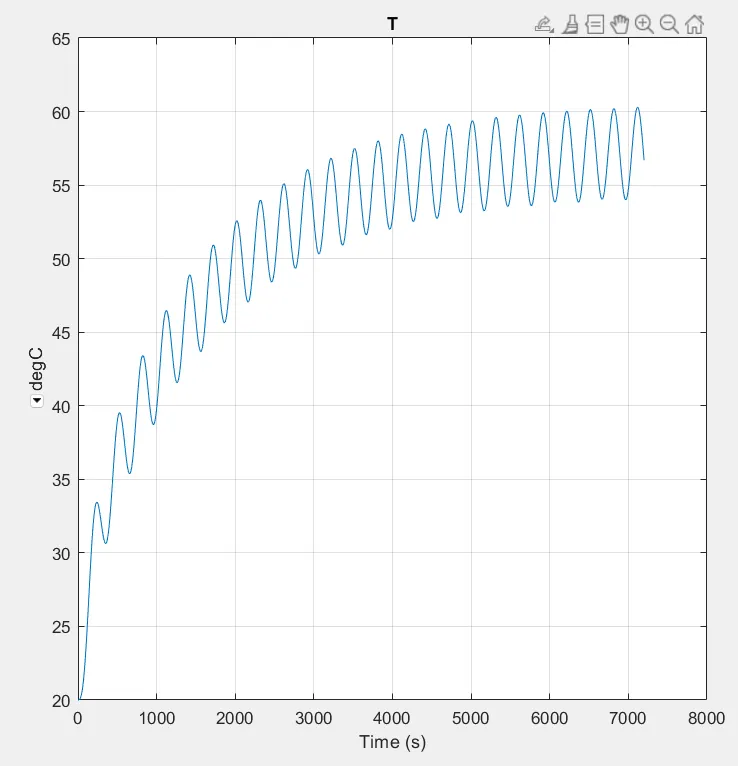
the tempreature of the cell is upto 20 to 60 degree centigrade.
in initially we can see the spike in tempreature.
we observed by obove graph If temperature is increased to 30°C for a long duration of time, service life of the battery reduces by 20 percent.
While at 45°C, the life-cycle is reduced considerably to 50 percent.
its taking 0 to 7200 sec.
the thermal effects and compare life cycle performance at various temperatures, charge & discharge rates :
- lower temperature increases internal resistance and reduces the rate of chemical metabolism, and thus results in a decrease in the capacity of the battery.
- If a battery’s capacity is 10o% at 27°C , it lowers significantly to 50 percent, once temperature is 18°C.
- At freezing point, the capacity of the battery reduces to 20 percent. At -20°C, most batteries stop functioning. that why car’s battery dies on a cold morning.
- Temperature also affects service life of a battery. Battery performs best at room temperatures.
- Matched cells with identical capacities play an important role when discharging at low temperature and under heavy load.
- the cells in a battery pack can never be perfectly matched, a negative voltage potential can occur across a weaker cell in a multi-cell pack if the discharge is allowed to continue beyond a safe cut-off point. Known as cell reversal, the weak cell gets stressed to the point of developing a permanent electrical short.
- The larger the cell-count, the greater is the likelihood of cell-reversal under load. O
- ver-discharge at a low temperature and heavy load is a large contributor to battery failure of cordless power tools.
Conclusion:
- cells are connected in series and series connection shows low current value.
- The cells connected in series produces a greater resultant voltage. The cells which are damaged can be easily identified and hence can be replaced easily as they break the circuit.
- the effects on the aging behavior of cycled LiBattery operating within the temperature range of 25 °C to 55 °C.
- The operating temperature of Li-Battery must be well controlled, as its performance, health, and safety depends on the temperature.
Refrence.
https://www.ncbi.nlm.nih.gov/pmc/articles/PMC4526891/