Project 2 Thermal modeling of battery pack
AIM:- To study Thermal modeling of the battery pack with the help of MATLAB and SIMULINK
principle of lithium battery is to circulate electrons by creating a difference in potential between two electrodes, one negative and the other positive, that are immersed in a conductive ionic liquid called the electrolyte. When the battery is powering a device, the electrons accumulated in the negative electrode are released via an external circuit to travel to the positive electrode: this is the discharging phase. Conversely, when the battery is charging, the energy supplied by the charger sends the electrons back from the positive electrode to the negative.
The differents battery type vary by ion types, electrode materials and the associated electrolytes. The 12-volt lead-acid battery that has traditionally been used to power the starter of a combustion-engine vehicle, for example, relies on an electrolyte containing lead ions and electrodes that are lead-based. As for the lithium-ion battery, it uses lithium ions (Li+): hence the name given to this technology.
A lithium-ion battery such as the one inside a car like the ZOE is designed as an assembly of individual battery units (cells), connected to each other and monitored by a dedicated electronic circuit. The number of cells, the size of each cell and the way in which they are arranged determine both the voltage delivered by the battery and its capacity, meaning the amount of electricity it is able to store. This is generally stated in watt-hours (Wh), or in kilowatt-hours (kWh) in the automotive industry.
properties of lithium ion battery :
Lithium-ion batteries can just as well be found in consumer electronics (telephones, laptops) as in electric cars. The main reason for this large-scale success essentially lies in the storage density that lithium-ion technology allows for.
This concept of density refers to the ratio between the storage capacity offered by the battery and its bulk or weight. By way of comparison, a lithium-ion battery offers a density of around 300 to 500 Wh/kg, i.e. some ten times more than a lead-acid battery.
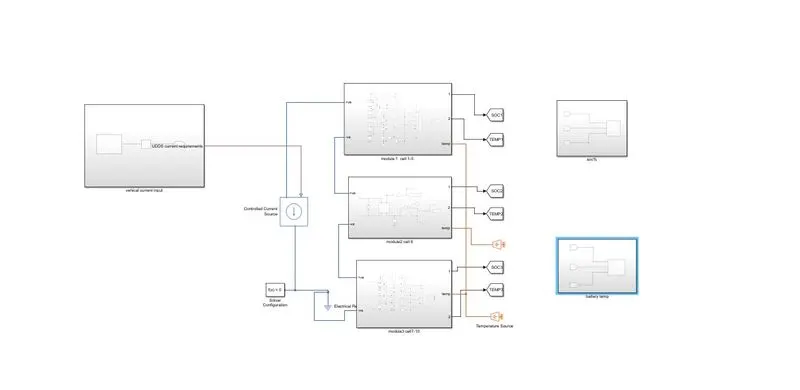
so for the 10-cell series lithium-ion battery here I used Matlab and Simulink for findings thermal effect and life cycle performances related to temperature, charge, and discharge and also conduction and convection blocks are used to show how the heat transfer takes place in battery packs.
Lithium-ion battery pack with fault is to simulate a battery pack consists of multiple cells connected in series efficiently.it also shows how a fault can be introduced into one of the cells to the impact on battery performance and cell temperatures, for efficiency the identical series-connected cells are not just simply model by connecting cell models in series. instead single cell is used, and the terminal voltage is scaled up by the number of cells. the fault is represented by changing the parameters for the cell 5 subsystem,reducing both the capacity and open-circuit voltage, and increasing the resistance values.
10 lithium-ion battery cells are connected in with the combination of three packs the 1st consistent 5 cells in series 2nd pack consist of 1 cell which set to design as fault for study purpose to observe temperature changes within battery pack and the 3rd pack contain 4 cells in series.
-the heat transfer is observed between the packs by conduction and convection block which are modes of heat transfer.
-T subsystem is attached in between every pack to plot the temperature graph of the cell of that particular battery pack with help of Go to and from block.
-also external ambient temperature source is attached and also thermal sensor is attached to the same. to indicate the value in the display.
Cell 01 to 05 subsystem:-
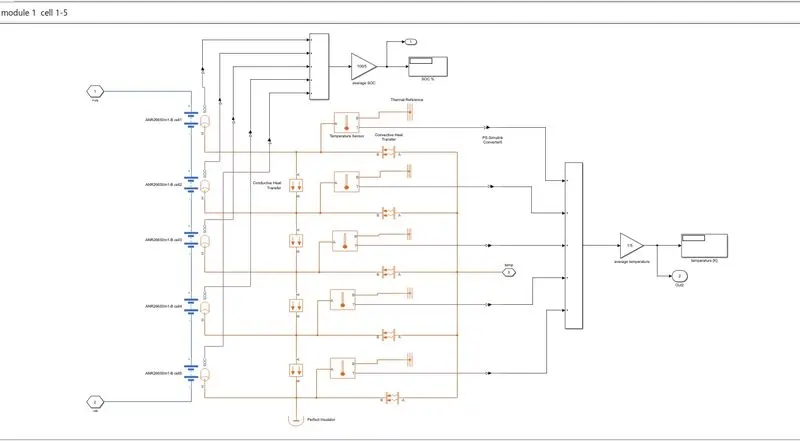
The cell subsystem basically consists of a thermal model and lithium cell which calculate the temperature and thermal effect for cells and overall calculate for the battery pack. the conduction heat transfer and convection heat transfer block is used for thermal purpose following parameters are considered in case of table based battery is arranged with thermal port . also here we used adder block to gets multiple connection as input and outputs is connected to the gain to the display to show the how much amount of soc is decrease at perticular temperture.
Number of connected in series are:-5
Initial temperature:-293.15 k
subsystem-2: cell number 6
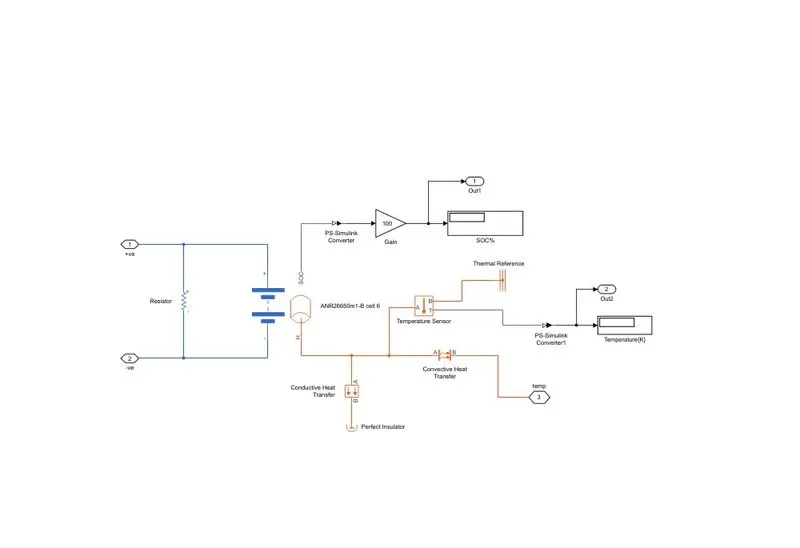
IN Above subsystem only we configure 1 cell with various thermal block like conduction &convections heat transfer ,thermal referance ,perfects insulator
In this subsystem we chnage the parameters
initials temperture of 278 k
No of cells are - 1
subsystem 3
- 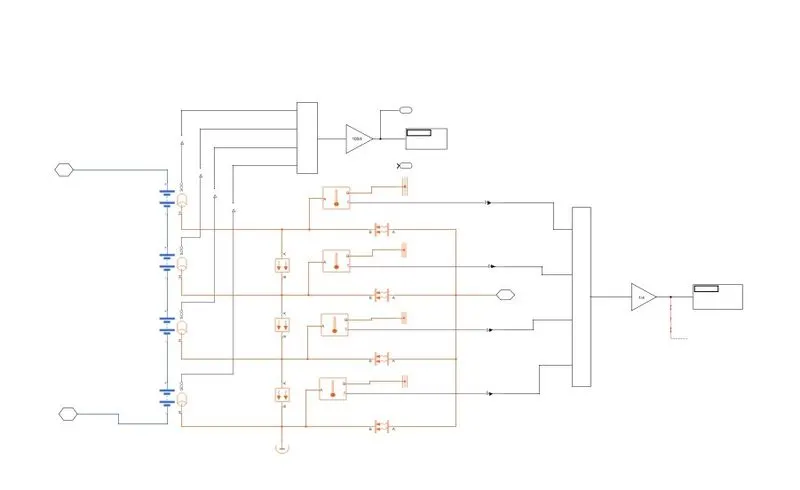
above model consist of 4 series connected cell both of 4 combined to form one module of pack. as we seen in previous subsytem various thermal block . here we take a gain value of 100/4 in case of soc and temp 1/4 here also used adder to supplied multiple outputs to the scope .
Battery (table based) :
Description
The Battery (Table-Based) block represents a high-fidelity battery model. The block calculates no-load voltage as a function of charge level and optional temperature using lookup tables and includes several modeling options:
-
Self-discharge
-
Battery fade
-
Charge dynamics
-
Calendar aging
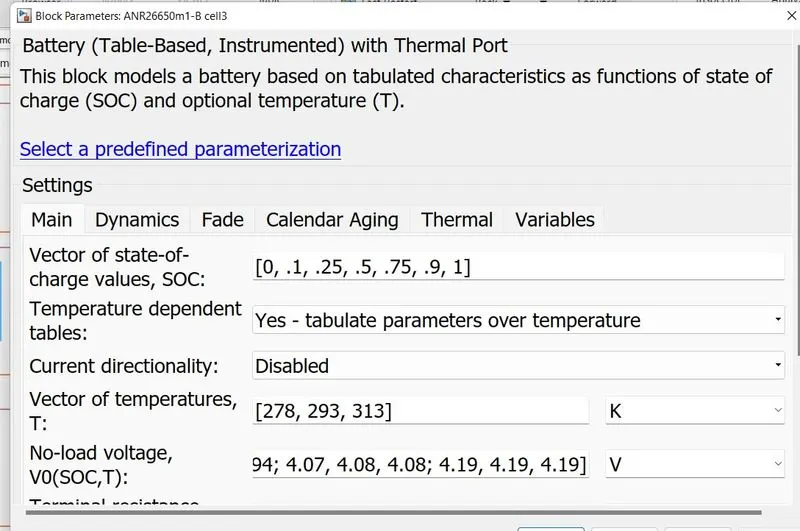
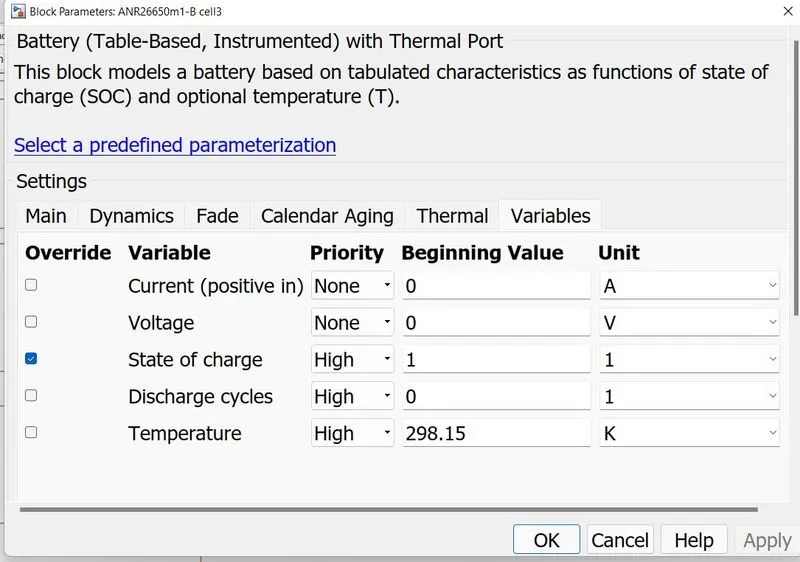
only major modifications are done in battery module 2 by cahnging the tempertaure value ,
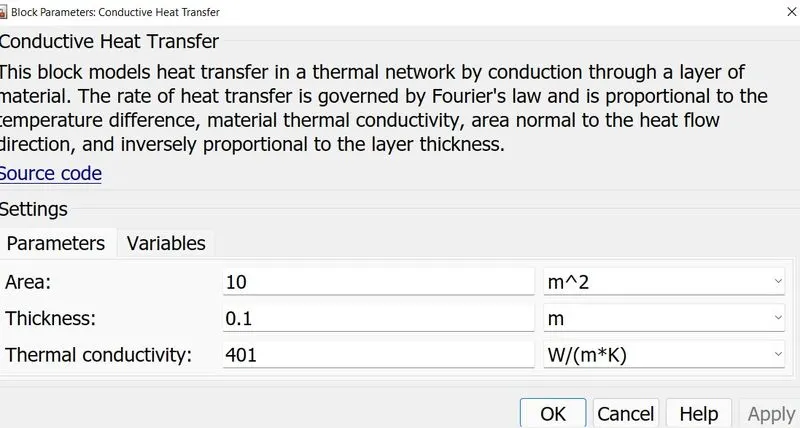
conductive heat transfer :
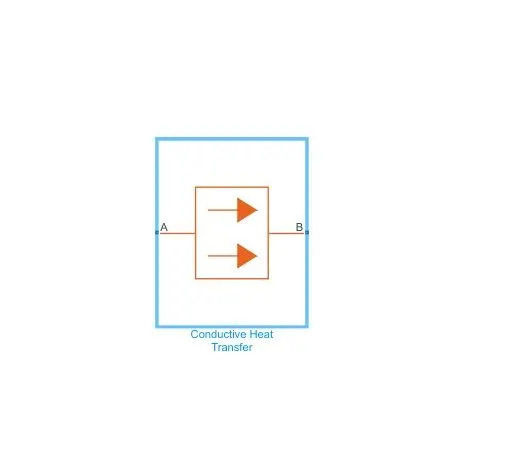
Discriptions :
The Conductive Heat Transfer block represents a heat transfer by conduction between two layers of the same material
Q=k⋅AD(TA−TB),
where:
-
Q is heat flow.
-
k is thermal conductivity of the material.
-
A is area normal to the heat flow direction.
-
D is distance between layers (that is, thickness of material).
-
TA is temperature of layer A.
-
TB is temperature of layer B.
Connections A and B are thermal conserving ports associated with material layers. The block positive direction is from port A to port B. This means that the heat flow is positive if it flows from A to B.
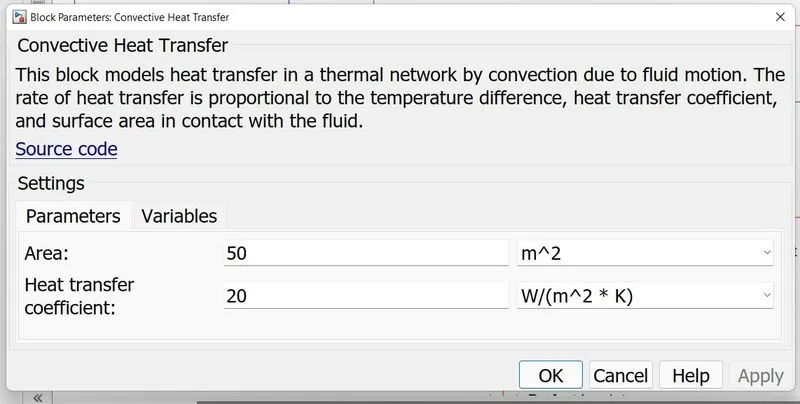
convective heat transfer
Discrptions
The Convective Heat Transfer block represents a heat transfer by convection between two bodies by means of fluid motion.
Q=k⋅A⋅(TA−TB),
-
Q is heat flow.
-
k is convection heat transfer coefficient.
-
A is surface area.
-
D is distance between layers (that is, thickness of material).
-
TA and TB are temperatures of the two bodies.
Connections A and B are thermal conserving ports associated with the points between which the heat transfer by convection takes place. The block positive direction is from port A to port B. This means that the heat flow is positive if it flows from A to B.
Thermal Referance :
Discriptions
The Thermal Reference block represents a thermal reference point, that is, a point with an absolute zero temperature, with respect to which all the temperatures in the system are determined.
Temperature sensor:
Discriptions :
The Temperature Sensor block represents an ideal temperature sensor, that is, a device that determines the temperature differential measured between two points without drawing any heat.
Connections A and B are thermal conserving ports that connect to the two points where temperature is being monitored. Port T is a physical signal port that outputs the temperature differential value.
The block positive direction is from port A to port B. The measured temperature is determined as T = TA – TB.
Temperacture source :
Discriptions :
The Temperature Source block represents an ideal source of thermal energy that is powerful enough to maintain specified temperature at its outlet regardless of the heat flow consumed by the system.
The source generates constant absolute temperature, defined by the Temperature parameter value.
controlled current source :
Discriptions :
The Controlled Current Source block represents an ideal current source that is powerful enough to maintain the specified current through it regardless of the voltage across the source.
The output current is I = Is, where Is is the numerical value presented at the physical signal port.
result :
Temperacture of the cell :
1-temperatures of cell is 325 k
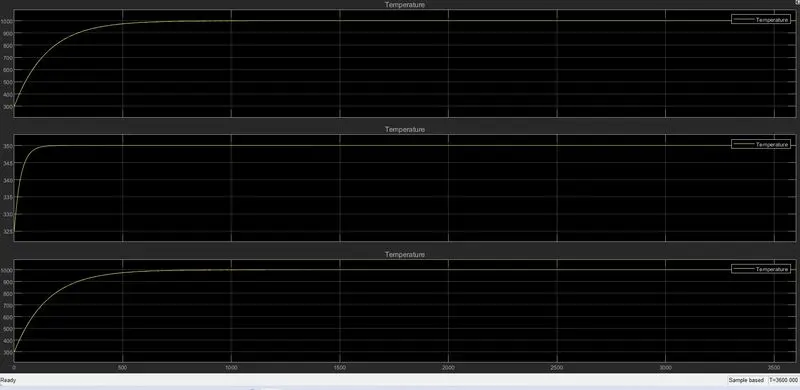
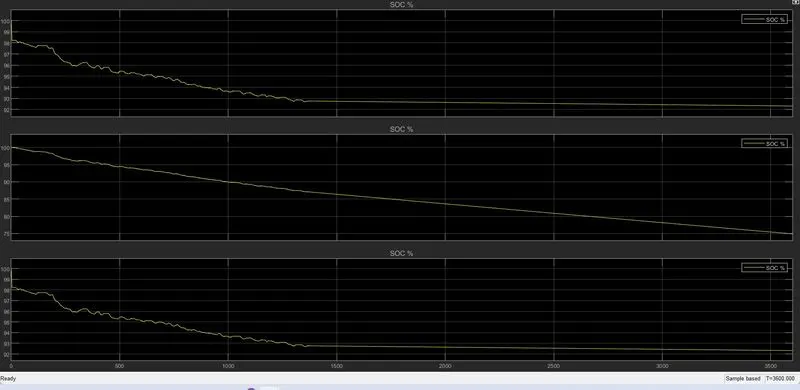
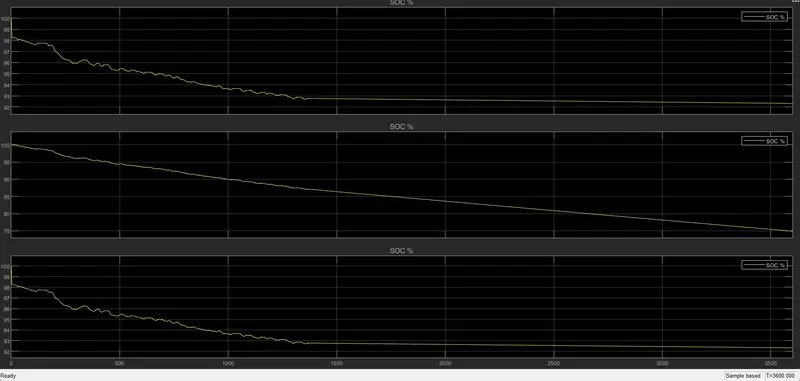
we have set temperature of the of module 2-cell temperature will be increase while observed that the value of soc of cell module will be decrease at low value as compared to both of above two we took value of temsperature source here 350 at temperature value is set as 325 results will decrease in soc at low rate 74.89 % from 100 %
below graph shows the soc value at perticular given temp .
1-temperatures of cell is 345 k
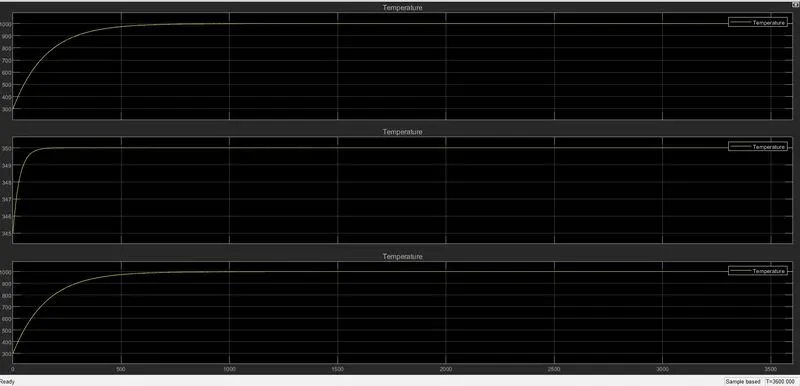
we have set temperature of the of module 2-cell temperature will be increase while observed that the value of soc of cell module will be decrease at low value .The value of temperature source here 350 at temperature value is set as 345 results will decrease in soc at low rate 73.89 % from 100 %
conclusion :
from above graph we can conclude that When temperatures increase this affects the chemical reactions that occur inside a battery. As the temperature of the battery increases the chemical reactions inside the battery also quicken. At higher temperatures one of the effects on lithium-ion batteries’ is greater performance and increased storage capacity of the battery.