Project - 2 - Meshing on the suspension Assembly
Aim: Meshing of Suspension Assembly
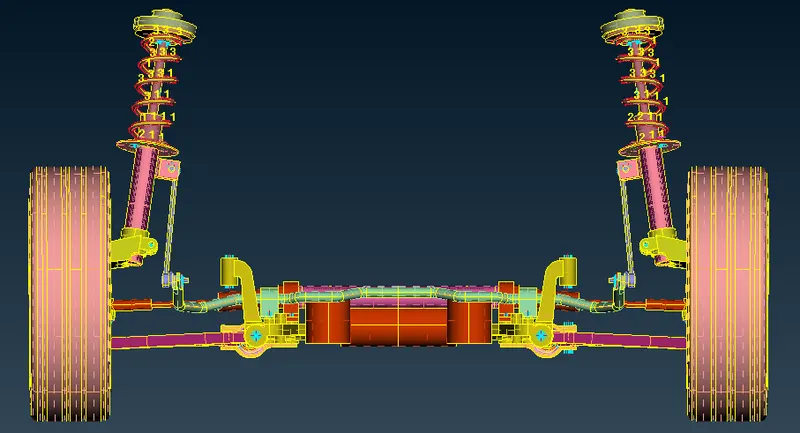
Quality Parameters:
1.
|
Component |
Mesh Type |
Quality Criterias |
|
Tyre and rim |
Tetra Mesh |
Target Length = 6.5 [5 Skewness = 45. |
|
Non-Uniform Thickness (Tria Mesh) |
Uniform Thickness (Mixed mesh) |
|||||
|
Target Length = 4 |
Target Length = 4 |
Aspect = 3 |
||||
|
|
Jacobian = .7 |
||||
|
Maximum Length = 6 |
Maximum Length = 6 |
Warpage = 15 |
||||
|
Skewness = 45 |
Skewness = 45 |
Quad Angles = [45;135;30;120] |
||||
Theory:
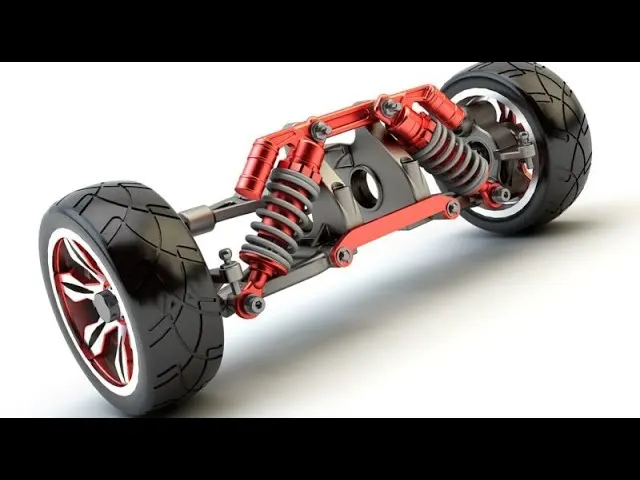
Suspension is the system of tires, tire air, springs, shock absorbers and linkages that connects a vehicle to its wheels and allows relative motion between the two.[1] Suspension systems must support both road holding/handling and ride quality, which are at odds with each other. The tuning of suspensions involves finding the right compromise. It is important for the suspension to keep the road wheel in contact with the road surface as much as possible, because all the road or ground forces acting on the vehicle do so through the contact patches of the tires. The suspension also protects the vehicle itself and any cargo or luggage from damage and wear.
Types--
Suspension systems can be broadly classified into two subgroups: dependent and independent. These terms refer to the ability of opposite wheels to move independently of each other.
Dependent Suspension: A dependent suspension normally has a beam (a simple 'cart' axle) or a (driven) live axle that holds wheels parallel to each other and perpendicular to the axle. When the camber of one wheel changes, the camber of the opposite wheel changes in the same way (by convention, on one side, this is a positive change in the camber, and on the other side, this a negative change).
Independent Suspension:Independent suspension allows wheels to rise and fall on their own without affecting the opposite wheel. Suspensions with other devices, such as sway bars that link the wheels in some way, are still classed as independent.
Procedure:
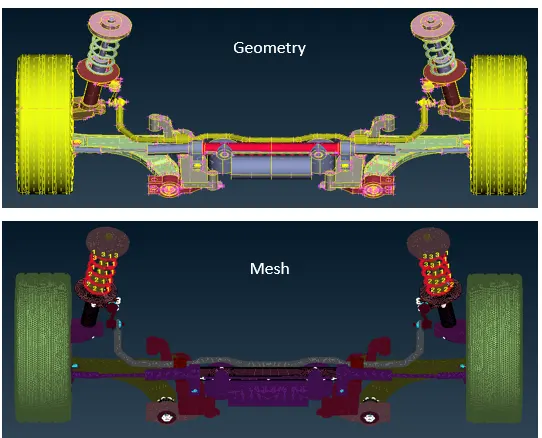
1. After Importing model, Geometry cleanup is done.
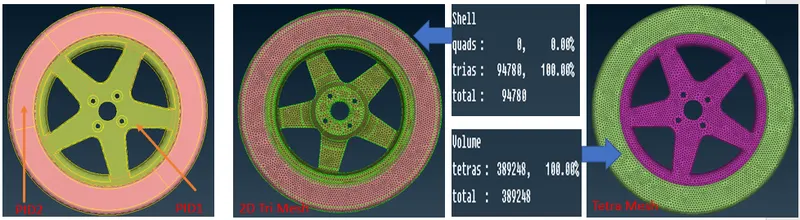
2. First Tyre and Rim are Meshed as per the the given quality criterias.
- PID's are assigned to both tyres and Rim.
- 2D mesh is performed first.
- Then Volume is generated, SOLID PID is assigned for Volume Mesh.
- Tetra Rapid Volume Mesh is performed.
- Tet collapse error are removed.
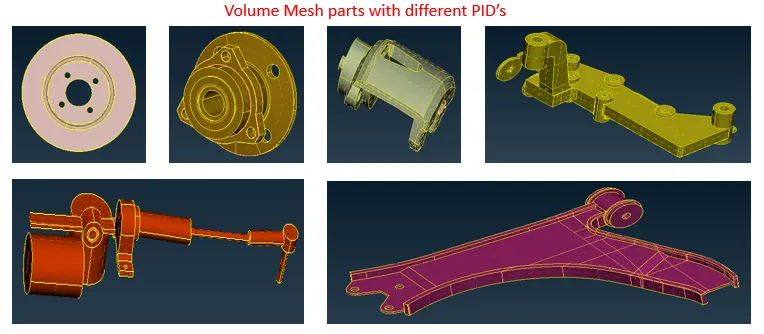
3. Parts with thickness less than 5mm are shell meshed and greater than 5mm are volume mesh.
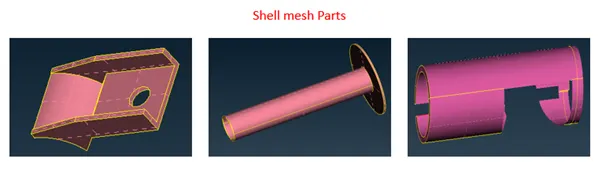
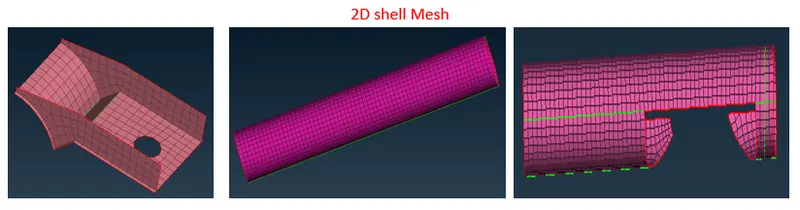
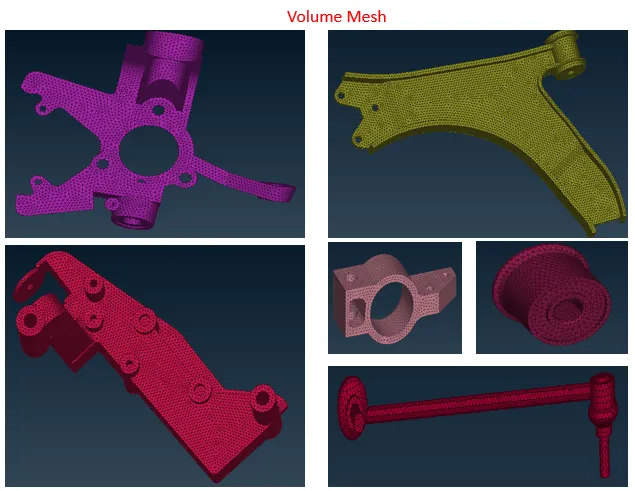
4. Shell mesh uses mixed elements while volume mesh uses tetra elements.Tet collapse error are removed from the volume mesh.
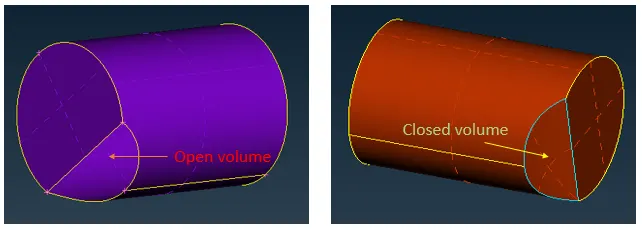
5. In case of volume mesh, volume should be closed.
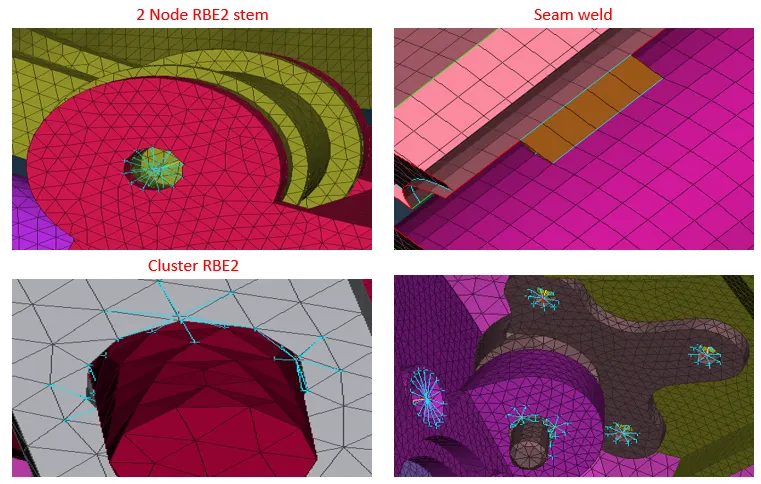
6. Proper Connections are made.
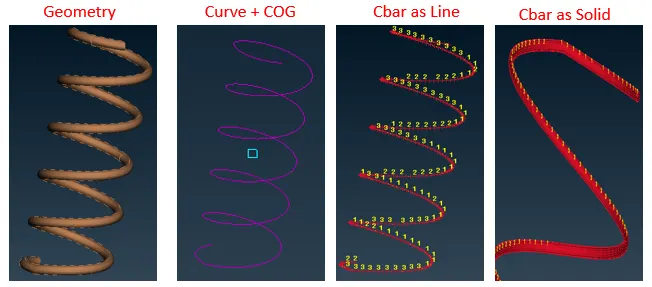
7. Springs are represented by Cbar element.
- Curve is generated from the spring geometry.
- COG is generated from the curve.
- cbar element is made using Nastran deck - cbar.
8. Now using the Transform -- Copy -- 3point plane. Other half of the suspension is obtained.
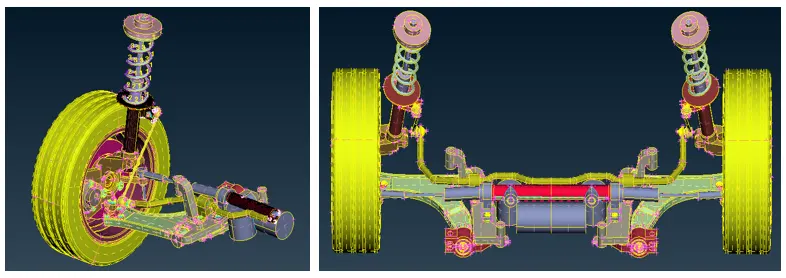
9. Complete Model
Learning Outcomes:
- Here i learn, How to manage model having multiple quality criterias.
- I learned about Solid mesh, shell mesh , making connections.
- Learned about which connection type is to used at which location like cluster RBE2, RBE2, 2 Node RBE2, SEAm Weld, Cbar Element representation etc.
Conclusion: After working on this complex model, I can model any component having different set of quality criterias, Include both shell and volume mesh, I can make appropriate connections.