Project-2-Meshing of Door Inner Panel Challenge
AIM :
To extract mid-surface, geometry clean up and create the shell (two dimensional) mesh for the given side door inner panel according to the given quality criteria by using HYPERMESH.
THEORY:
Door inner panel:
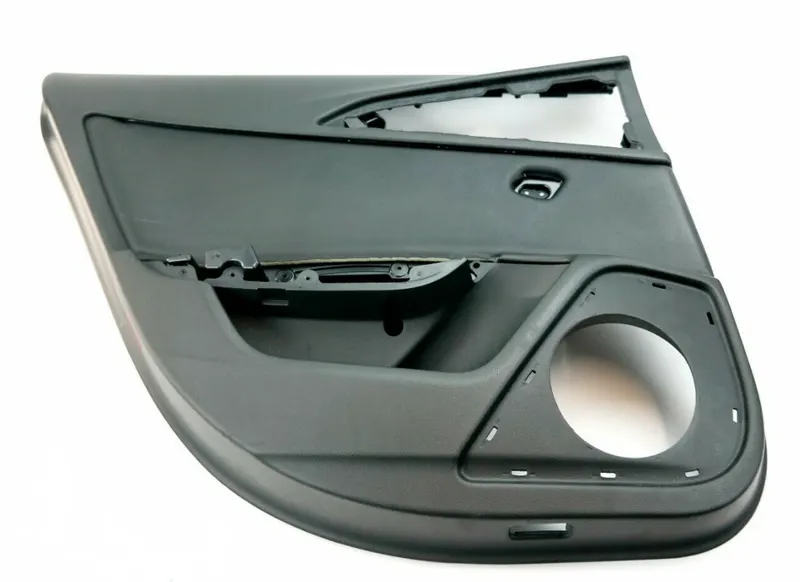
- Door panels serve as an interface between the interior of the car and the inner workings of the door, and between vehicle occupants and the door.
- They are expected to meet a variety of design specifications regarding safety, aesthetics, and functionality. In addition, they are expected to continue the material theme of the dashboard and pillars while concealing intricate electrical and mechanical components for operating locks, windows, and other features.
- The door panel has evolved from a simple two-part system of the latch and simple winding mechanism to a more sophisticated enclosure.
- Doors currently have an inner full-width panel consisting of electronic windows, a central locking system, and speakers. These panels typically consist of a foamed core covered with either textiles or plastics.
Objective
- Import and perform a geometry cleanup on the given model using Hypermesh.
- Assign thickness and generate a Proper mid-surface with the proper technique.
- Mesh the generated mid-surface and reconstruct the mesh to satisfy the following quality criteria.
- Model Checks
Quality Criteria
Target Element Length = 4 Units
| S.N | Quality Criteria | Value |
| 1 | Aspect Ratio | 5 |
| 2 | Skewness | 45 |
| 3 | Warping | 15 |
| 4 | Taper | 0.5 |
| 5 | Min. Length | 2 Units |
| 6 | Max. Length | 6 Units |
| 7 | Min angle Quad | 45 |
| 8 | Max angle Quad | 135 |
| 9 | Min angle Tria | 20 |
| 10 | Max angle Tria | 120 |
| 10 | Tria % | 10 |
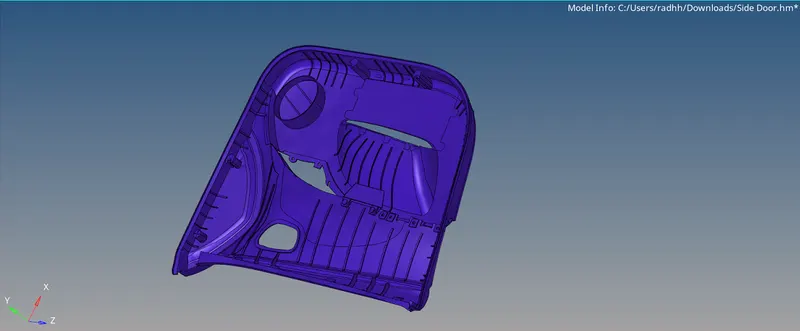
Fig 01: Isometric View Of Model.
3. Procedure
Step 1: Importing the File
- First We have to import the file to hyper mesh. Here, the file is in IGES and STP format.
Step 2: Geometric Cleanup and Extracting Midsurface.
- We can see that thickness is not constant throughout the geometry by taking thickness measurements. So given geometry is a plastic model. After the geometry cleanup, try the Manual mid-surface option to extract the mid-surface.
- The extracted mid-surface has issues like missing surfaces, orientation, and mismatching surfaces.
- These issues are addressed by commands like 'Split Surf Line, Toggle Edge, Filler Surfs, Delete Surfs, Extend Surf, Offset, Ruled, Project, etc. After that, the mid-surface is generated and it is ready for meshing.
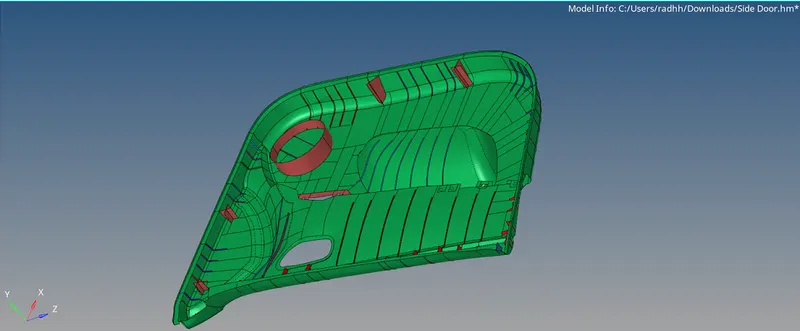
Fig 02: Mid Surface Extraction
Step 3: Property, Material, Measuring Parameters and Quality Criteria
- This is a plastic model, which means that there are components with different thicknesses.
- So organise those components separately and assign properties based on thickness. Create material, and add Quality Criteria and Measuring Parameters.
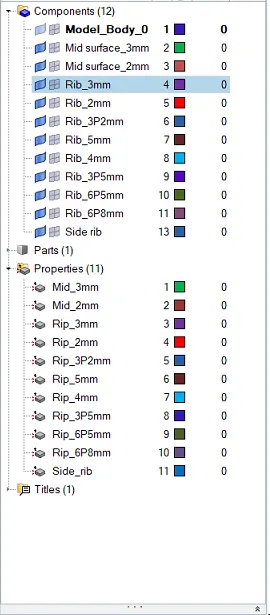
Fig 03: Property and Material
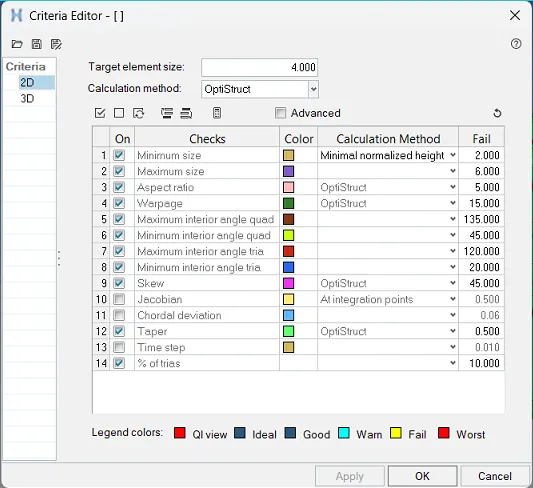
Fig 04: Quality Criteria
Step 4: Meshing the Surface
- The meshing is carried out the surface to surface. Also, adjusting the number of nodes for good mesh flow.
- 2D >> Automesh >> Select Surface >> Ok.
- The mesh flow should be improved especially in feature areas. For that, we can use these functions,
- 2D >> Rebuilt >> Select the mesh elements which to be reconstructed.
- 2D >> Edit element >> Create/Combine/Split
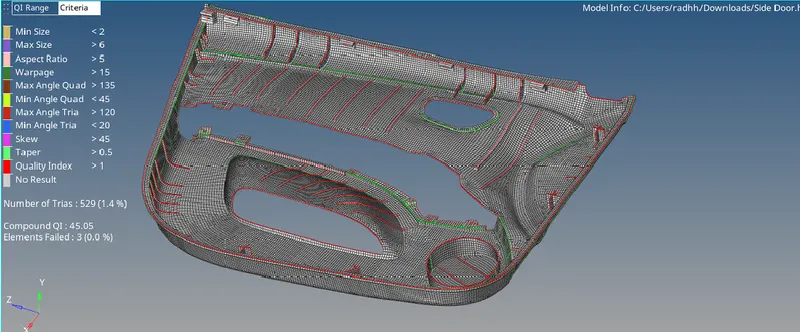
Fig 05: Generated Mesh
- After correcting the mesh flow, the element quality should be checked.
- 2D >> Quality Index >> Cleanup Tools
- Using the following tools, Place nodes/Smooth/Modify holes and washers/Split and Collapse Edge/Swap edge/Drag tria element/node optimise/element optimise/split quad element/combine tria element, we can simply modify elements to obey element criteria.
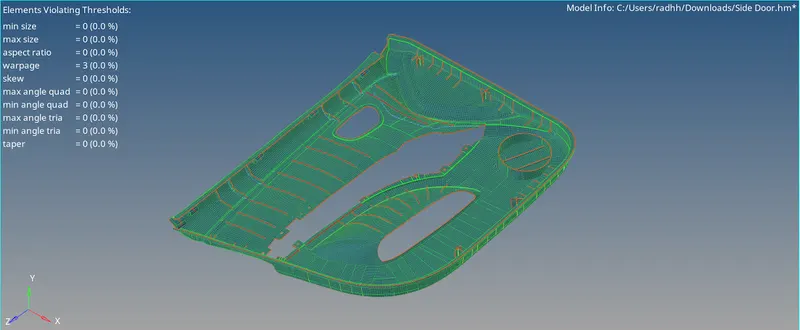
Fig 06: Quality Index
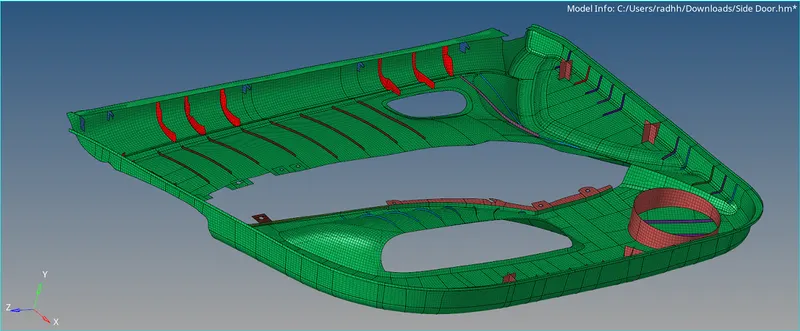
Fig 07: Final Mesh
Step 5: Model Checks
- Check For Free Edges And Equivalence
- Tools >> Edges >> Select Elements >> Adjust The Tolerance Value (~0.10) >> Find edges. >> Delete Edges >> Preview Equivalence >> Equivalence.
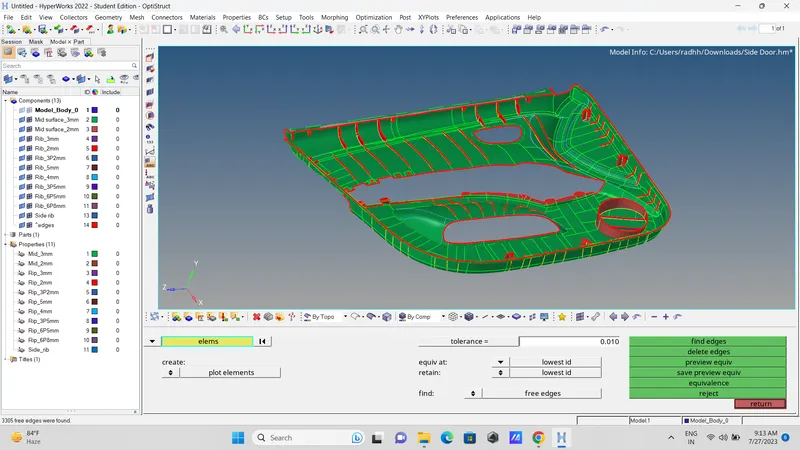
Fig 08: Model checks
Check For Connectivity and Duplicates
For Connectivity
- Tools >> Check Elements >> 2D >> Connectivity.
For finding duplicates,
- Tools >> Check Elements >> 2D >> Duplicates.
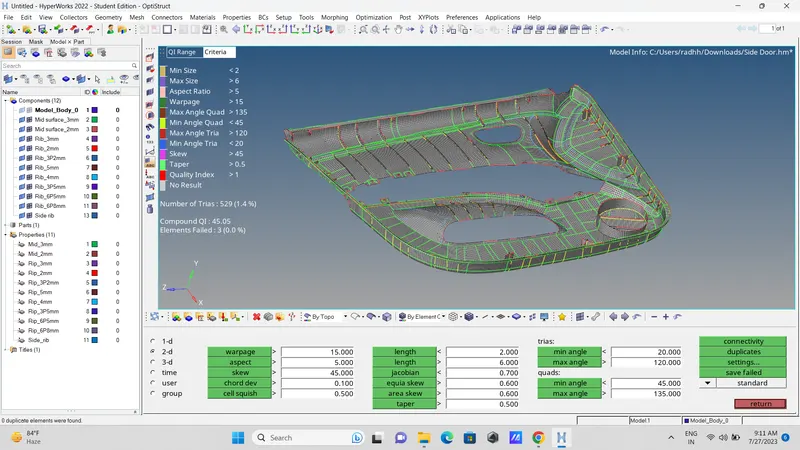
Fig 09: Connectivity and Duplicates
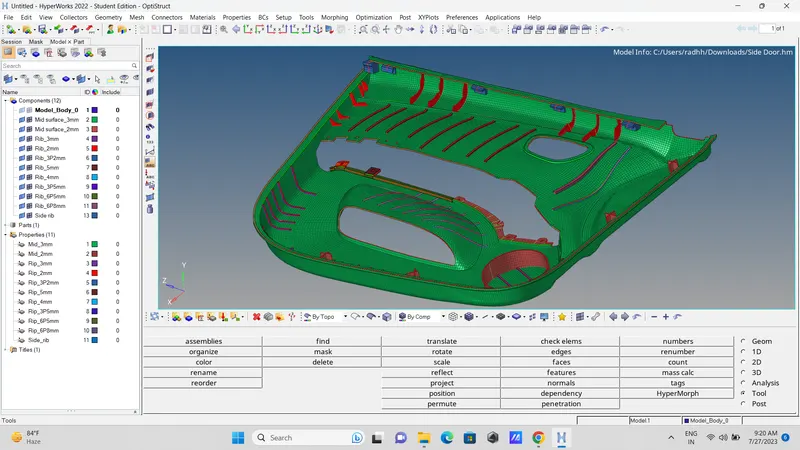
Fig 10: Final Result
4. Conclusion
- The mid surface of the given Door inner panel model is generated, assigned properties based on thicknesses, and materials and adds quality criteria and target element lengths for every one of the components.
- The meshing and reconstruction of a generated mesh of each component are completed.
- Model checking is finished.
5. Results
- For the given Door inner panel model, the mid-surface is extracted and mesh generated. The generated mesh satisfies the following quality criteria and the model checks are completed.