Project 2 - Measuring the distance of an object using ultrasonic sensor and also smoothen the sensor data using moving average filter
Ans)
Measuring distance with ultrasonic sensor :
COMPONENTS AND SUPPLIES :
1. Ultrasonic Sensor HC - SR04 - 1
2. Juper wires - 3
3. Ardiuno UNO - 1
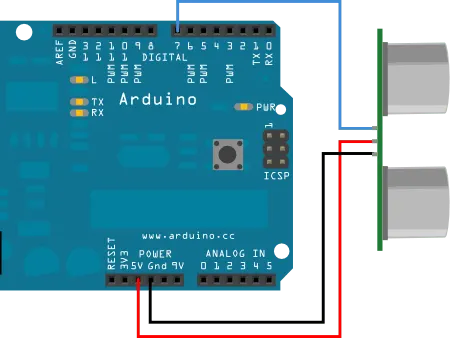
This is the code for the project Ardiuno :
CODE :
1.  /*
2.  Ping))) Sensor
3.
4.  This sketch reads a PING))) ultrasonic rangefinder and returns the distance
5.  to the closest object in range. To do this, it sends a pulse to the sensor to
6.  initiate a reading, then listens for a pulse to return. The length of the
7.  returning pulse is proportional to the distance of the object from the sensor.

8.  The circuit:
9.	- +V connection of the PING))) attached to +5V
10.	- GND connection of the PING))) attached to ground
11.	- SIG connection of the PING))) attached to digital pin 7
12.
13.  created 3 Nov 2008
14.  by David A. Mellis
15.  modified 30 Aug 2011
16.  by Tom Igoe
17.
18.  This example code is in the public domain.
19.
20.  http://www.arduino.cc/en/Tutorial/Ping
21.  */
22.
23.  // this constant won't change. It's the pin number of the sensor's output:
24.  const int pingPin = 7;
25.
26.  void setup() {
27.  // initialize serial communication:
28.  Serial.begin(9600);
29.  }
30.
31.  void loop() {
32.  // establish variables for duration of the ping, and the distance result
33.  // in inches and centimeters:
34.  long duration, inches, cm;
35.
36.  // The PING))) is triggered by a HIGH pulse of 2 or more microseconds.
37.  // Give a short LOW pulse beforehand to ensure a clean HIGH pulse:
38.  pinMode(pingPin, OUTPUT);
39.  digitalWrite(pingPin, LOW);
40.  delayMicroseconds(2);
41.  digitalWrite(pingPin, HIGH);
42.  delayMicroseconds(5);
43.  digitalWrite(pingPin, LOW);
44.
45.  // The same pin is used to read the signal from the PING))): a HIGH pulse
46.  // whose duration is the time (in microseconds) from the sending of the ping
47.  // to the reception of its echo off of an object.
48.  pinMode(pingPin, INPUT);
49.  duration = pulseIn(pingPin, HIGH);
50.
51.  // convert the time into a distance
52.  inches = microsecondsToInches(duration);
53.  cm = microsecondsToCentimeters(duration);
54.
55.  Serial.print(inches);
56.  Serial.print("in, ");
57.  Serial.print(cm);
58.  Serial.print("cm");
59.  Serial.println();
60.
61.  delay(100);
62.  }
63.
64. long microsecondsToInches(long microseconds) {
65. // According to Parallax's datasheet for the PING))), there are 73.746
66. // microseconds per inch (i.e. sound travels at 1130 feet per second).
67.  // This gives the distance travelled by the ping, outbound and return,
68.  // so we divide by 2 to get the distance of the obstacle.
69.  // See: http://www.parallax.com/dl/docs/prod/acc/28015-PING-v1.3.pdf
70.  return microseconds / 74 / 2;
71.  }
72.
73. long microsecondsToCentimeters(long microseconds) {
74.  // The speed of sound is 340 m/s or 29 microseconds per centimeter.
75.  // The ping travels out and back, so to find the distance of the object we
76.  // take half of the distance travelled.
77.  return microseconds / 29 / 2;
78. }