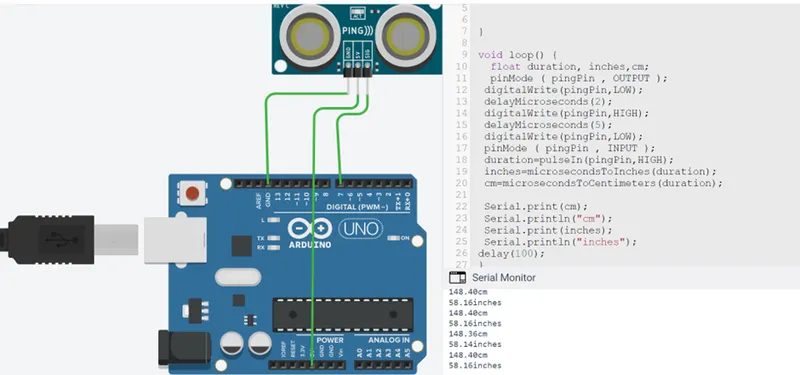
Project 2 - Measuring the distance of an object using ultrasonic sensor and also smoothen the sensor data using moving average filter
code
// this constant won't change. It's the pin number of the sensor's output:
const int pingPin = 7;

void setup() {
  // initialize serial communication:
  Serial.begin(9600);
}

void loop() {
  // establish variables for duration of the ping, and the distance result
  // in inches and centimeters:
  long duration, inches, cm;

  // The PING))) is triggered by a HIGH pulse of 2 or more microseconds.
  // Give a short LOW pulse beforehand to ensure a clean HIGH pulse:
  pinMode(pingPin, OUTPUT);
  digitalWrite(pingPin, LOW);
  delayMicroseconds(2);
  digitalWrite(pingPin, HIGH);
  delayMicroseconds(5);
  digitalWrite(pingPin, LOW);

  // The same pin is used to read the signal from the PING))): a HIGH pulse
  // whose duration is the time (in microseconds) from the sending of the ping
  // to the reception of its echo off of an object.
  pinMode(pingPin, INPUT);
  duration = pulseIn(pingPin, HIGH);

  // convert the time into a distance
  inches = microsecondsToInches(duration);
  cm = microsecondsToCentimeters(duration);

  Serial.print(inches); //print distance in inches
  Serial.println("in, ");
  Serial.print(cm);    //print distance in cm
  Serial.println("cm");
  Serial.println();

  delay(100);
}

long microsecondsToInches(long microseconds) {
  // According to Parallax's datasheet for the PING))), there are 73.746
  // microseconds per inch (i.e. sound travels at 1130 feet per second).
  // This gives the distance travelled by the ping, outbound and return,
  // so we divide by 2 to get the distance of the obstacle.

  return microseconds / 74 / 2;
}

long microsecondsToCentimeters(long microseconds) {
  // The speed of sound is 340 m/s or 29 microseconds per centimeter.
  // The ping travels out and back, so to find the distance of the object we
  // take half of the distance travelled.
  return microseconds / 29 / 2;
}
void loop{
}
establish variables for duration of the ping, and the distance result in inches and centimeters:
The PING))) is triggered by a HIGH pulse of 2 or more microseconds.Give a short LOW pulse beforehand to ensure a clean HIGH pulse.
The same pin is used to read the signal from the PING. a HIGH pulse whose duration is the time (in microseconds) from the sending of the ping
to the reception of its echo off of an object.
convert the time into a distance
long microsecondsToInches(long microseconds) {
}
According to Parallax's datasheet for the PING))), there are 73.746 microseconds per inch (i.e. sound travels at 1130 feet per second). This gives the distance travelled by the ping, outbound and return,
so we divide by 2 to get the distance of the obstacle.
long microsecondsToCentimeters(long microseconds) {
}
The speed of sound is 340 m/s or 29 microseconds per centimeter.The ping travels out and back, so to find the distance of the object we
take half of the distance travelled.
circuite
ping altrasonic sensor used to communicates only one pin that means there is no trig and echo pins.
the connections are ,
gnd conected to gnd and vcc connected to 5v pin of the arduino and SIG pin connected to Pin7 of the arduino.
that sends and receive signal by using only one wire or pin7