Project 2 - Electric Scooter
Task1-
Market analysis for electric scooter
|
Report Attribute |
Details |
|
The market size value in 2022 |
USD 22.28 billion |
|
The revenue forecast in 2030 |
USD 40.6 billion |
|
Growth rate |
CAGR of 7.8% from 2022 to 2030 |
|
Quantitative units |
Revenue in USD million and CAGR from 2022 to 2030 |
|
Regional scope |
North America; Europe; Asia Pacific; Latin America; MEA |
|
Country |
U.S.; Canada; U.K.; Germany; France; China; Japan; India; Mexico; Brazil |
|
Key companies profiled |
Yadea Technology Group Co., Ltd.; Jiangsu Xinri E-vehicle Co. Ltd.; Hero Electric; Gogoro Inc.; Vmoto Limited; BMW Motorrad International; Mahindra GenZe; Terra Motors Corporation |
Source-https://www.grandviewresearch.com/industry-analysis/electric-scooters-market
State-of-the-art products-
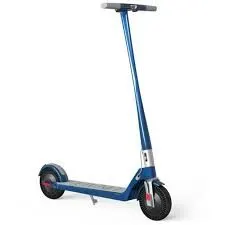
- Unagi Model1
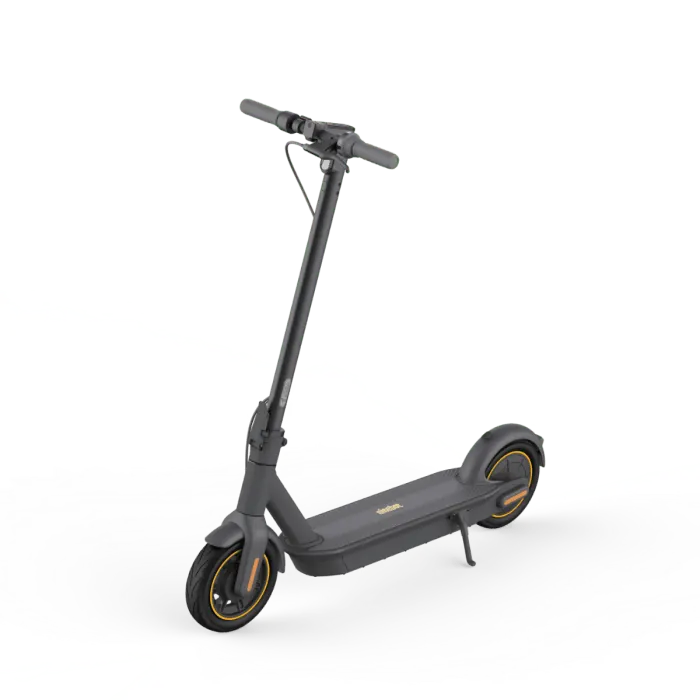
- Segway Ninebot Kickscooter Max
- GoTrax GLX V2
- Apollo City
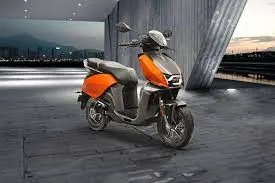
- Hero Vida V1
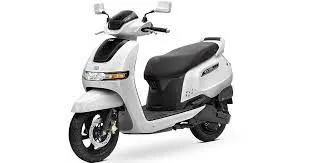
- TVS iQube electric
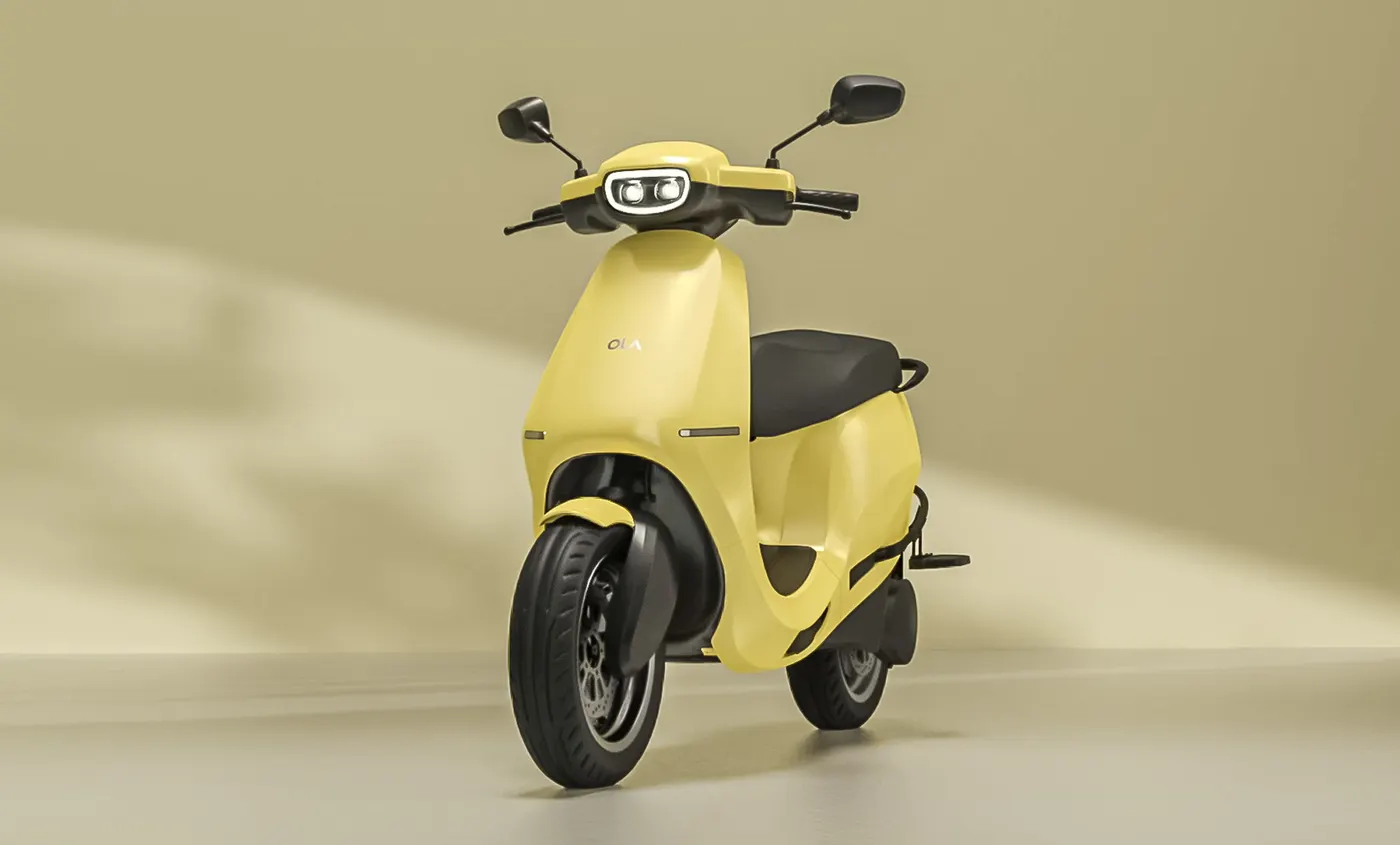
- Ola S1(India)
Key players in the market-
- Yadea Technology Group Co., Ltd.
- Jiangsu Xinri E-vehicle Co. Ltd.
- Hero Electric
- Gogoro Inc.
- Vmoto Limited
- BMW Motorrad International
- Mahindra GenZe
- Terra Motors Corporation
Industry trends of electric scooters
- Sleek design
- Clear display
- Dual motors which is good for hills
- Very affordable
- Light system availability
- Strong braking
- Comfortable ride
- Turn signals added
- Apps let the user customize the performance of the scooter
- Portable
- Great KM range
Task 2
Product Development Roadmap
|
Q1 1980-2000 |
Q2 2009 |
Q3 2012 |
Q4 2022 |
|
|
Body |
Variable reluctance electric motor scooter Bike body used for racing |
Battery operated scooter Skateboard cycle type design |
Electric scooter with charging capability |
Solar-efficient electric scooter Charging electric scooter Portable scooter with inbuilt navigation system |
|
Battery |
Nickel-cadmium battery Lead acid battery |
A123 systems Li-ion nano phosphate cells |
Li-ion battery |
|
|
Wheel electric motor |
Brushed DC motor |
Brushless DC motor |
||
|
Handlebar system |
Brakes Accelerator |
Brakes Accelerator Speed setting |
Brakes Accelerator Speed setting Turn signal |
Brakes Accelerator Speed setting Turn signal Navigation system |
Resource requirements
|
# |
Requirements |
|
Customer Requirements |
|
|
Functional Requirements |
|
|
Performance Requirements |
|
|
Design Requirements |
|
Mission statements-
|
Mission Statement |
|
|
Product Description |
|
|
Benefits Statement |
|
|
Business Objectives |
To obtain stellar products and services within a tight timeframe Obtain these services at a reasonable cost which represents the best possible value to their customers and shareholders |
|
Core Market |
|
|
Stakeholders |
● Manufacturing and supply chain partners ● Retailers and stores ● Existing and new customers |
Task 3
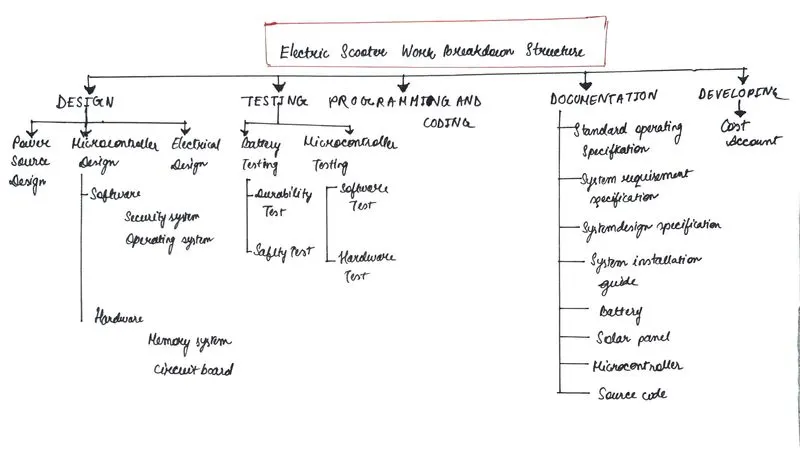
Work breakdown structure of the electric scooter
The integrated architecture of electric scooter
- The architecture used in the electric scooter design is integrated
- The electrical scooter has a seamless integration of the various futuristic technologies
- It has an electric motor and a battery instead of a fuel tank and combustion engine
- The motor is self-started and can easily control by the about current
- It has the following integrated architecture of the electrical vehicles
- Plug-in electrical vehicle
- Hybrid electrical vehicle
- Battery electrical vehicle
- Powertrains integrated with the Electrical scooter is
- Electric motor
- Battery pack
- Invertor
- DC-DC converter
- On-board charger
- It has an integrated power module
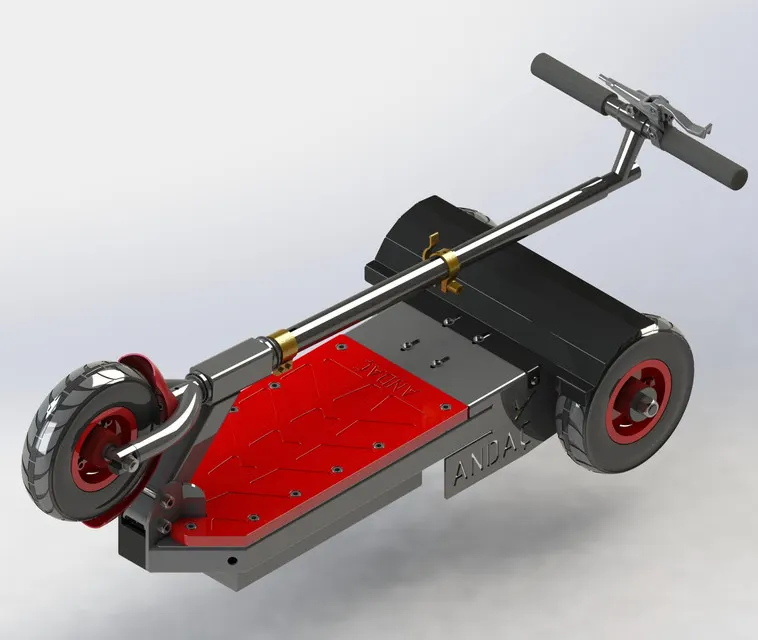
The solidworks file chosen for designing the electric scooter is attached
A 3D rendering of the electric scooter
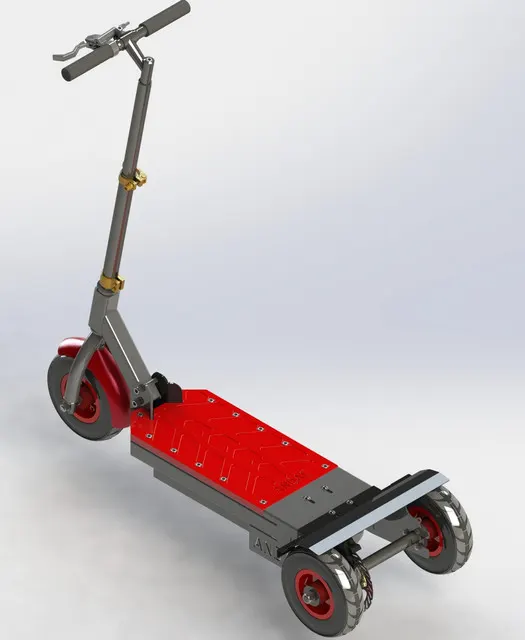
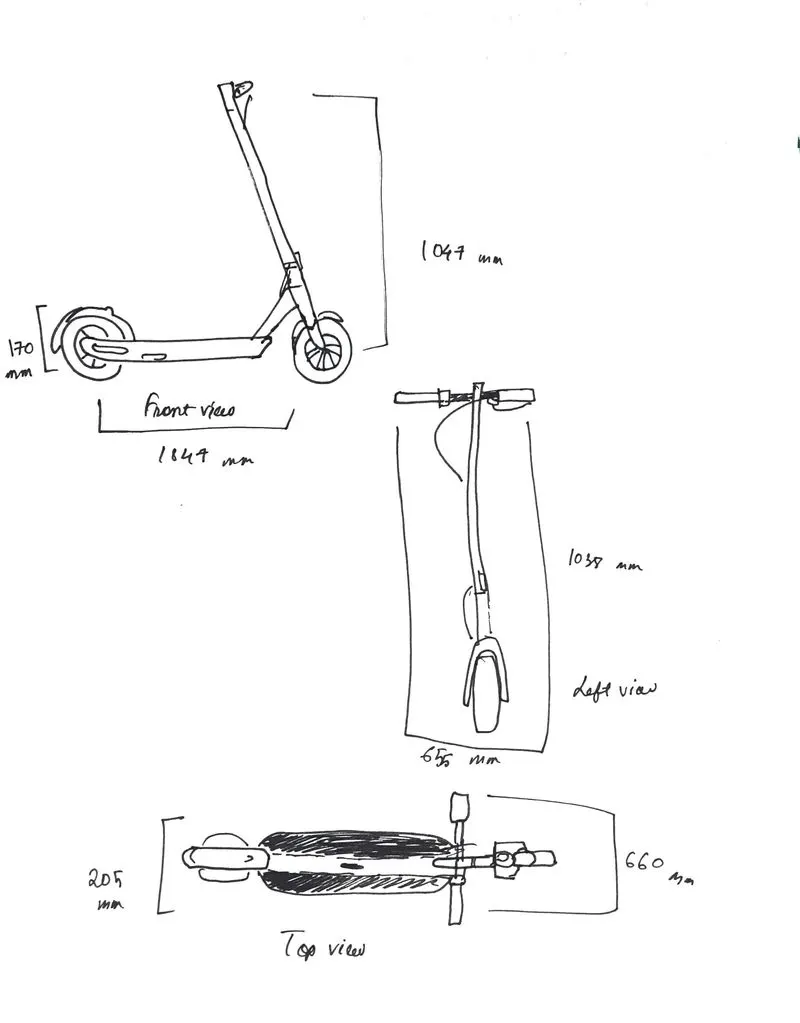
2D engineering drawings of the electric scooter
Task4
(A)
Failure Mode Effect analysis (FMEA) of the electric scooter
|
Component |
Failure mode |
Failure effect |
SEV |
Potential cause |
OCC |
Existing detection method |
DET |
RPN |
|
Electric hub |
Fails to rotate Motor overheat |
Scooter fails to operate using electric hub |
7- Major Scooter performance severely affected |
Short circuit |
3-Low occurance of failure |
Present of smoke |
3-High probability of detection |
63 |
|
Battery |
Not enough power supply |
System fails to operate |
5- Moderate Effect on the product performance |
Exceed lifespan on a single charge |
4- relatively low occurance rate |
Motor not running |
2-low chance of detection |
40 |
|
Chasis |
Breaking |
Chasis system fails to operate Fail to hold the other part |
4-Low Moderate Effect on the product performance |
Fracture |
2- Remote occurance |
Crack in the frame |
8-Remote chance of detection |
64 |
|
Handle |
Fails to steer properly |
Shock the absorber |
5-Moderate Effect in the product performance hence the product requires repair |
Wrong installation |
5-Moderate probability of failure |
Steer to wrong direction |
1-Almost certain detection |
25 |
|
Brake |
Fail to decelerate the scooter |
The scooter fails to stop |
8-Extreme Accident might occur |
Wear brake pads |
3-Low occurrence probability |
Scooter takes time to stop |
3-High probability of detection |
78 |
|
Wheel/Tire |
Fail to move fluently Rim punctured |
Scooter cannot move |
5- Moderate The product requires repair |
Punctured |
6- Moderately high due to unavoidable obstacle |
Need a lot of energy to move |
2-high chance of detection |
60 |
(B)
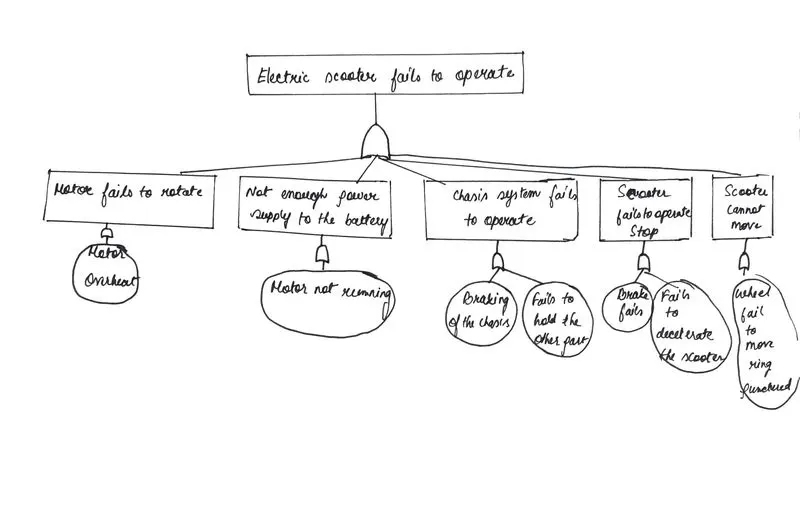
Fault Tree Analysis
Task 5
(A)DFMA
Ten areas of the potential design improvements that are compliant with design for manufacture and assembly would be-
- Minimize the total number of parts
- Weld the bracket with the chassis
- Use the fillet to avoid the sharp corner
- Avoid the excessively tight tolerances
- To absorb vibration from main body
- Support the weight of the car
- To utilize the characteristics of the process
- Reduce the number of process stages
- Designing of the process
- Improve battery efficiency
DFMA key elements
- Process selection
|
Parts |
Process |
|
Main frame |
Cutting and welding |
|
Front fork |
Cutting and welding |
|
Absorber |
|
|
Swing arm |
Cutting,drilling and welding |
|
Tyre shaft |
Cutting |
|
Handle bar |
Cutting and bending |
- To reduce the number of process stages
- Elimination of finishing process of some parts
- Welding the rocker will reduce the weight of the scooter
- Eliminate unnecessary process
- Design of the process
- Use standard spring coil for machining
- Design for robust
- Handlebar and front fork connection
- Design to hold the front frame
- Connection of the seat and main frame
- Connections parts by parts
- Material of parts
Costing of components
Bill of materials of mechanical parts and component
|
No. |
Name of parts |
Quantity |
Types of material |
Cost(INR) |
|
1. |
Swing arm |
1 |
Mild steel |
876 |
|
2. |
Handle bar |
1 |
Mild steel |
525 |
|
3. |
Floor deck |
1 |
Mild steel |
350 |
|
4. |
Seat |
1 |
Fabric |
876 |
|
5. |
Front shock absorber |
1 |
Mild steel |
900 |
|
6. |
Real shock absorber |
1 |
Mild steel |
900 |
|
7. |
Rim |
1 |
Aluminium |
340 |
|
8. |
Brakes lever |
1 |
Plastic |
525 |
|
9. |
Bearing swing arm |
1 |
Mild steel |
87 |
|
10. |
Bolts |
26 |
Mild steel |
80 |
|
11. |
Nuts |
26 |
Mild steel |
80 |
|
12. |
Washer |
1 |
Mild steel |
87 |
|
13. |
Handle bar |
1 |
Steel |
80 |
|
14. |
Tyre bearing |
1 |
Mild steel |
550 |
|
Total cost on mechanical components |
6526 ₹ |
|||
Bill of materials of electrical parts and component
|
No. |
Name of parts |
Quantity |
Type of materials |
Cost(INR) |
|
1. |
Speed Controller |
1 |
Electrical parts |
1400 |
|
2 |
Battery |
4 |
Electrical parts |
5000 |
|
3 |
Battery Charge port |
1 |
Electrical parts |
660 |
|
4 |
Horn |
1 |
Electrical parts |
200 |
|
5 |
Front light and signal |
1 |
Electrical parts |
350 |
|
6 |
Wire |
1 |
Electrical parts |
300 |
|
7 |
Power switch |
1 |
Electrical parts |
500 |
|
8 |
Throttle set |
1 |
Electrical parts |
613 |
|
9 |
Charger |
1 |
Electrical parts |
800 |
|
10 |
Connector |
1 |
Electrical parts |
250 |
|
The total cost of the electrical components |
10,073₹ |
|||
The outcome of DFA
- It reduces the assembly time
- Simplifies the assembly process
- Shorten the product design time
- Reduces the total material costs
- Reduces the labor content
- Improves the quality by reducing the defects
(B)
Environmental impact
- Natural resource degradation
- Emission and waste generation
- Reduced amount of biodiversity due to the deforestation
- Air pollution from factory emissions affects the environment
- Waste generation during the production of the electric scooter
- Air pollution due to transportation emissions by the transport vehicles
- Maintenance and cleaning materials
- Electricity consumed during operating the electric scooter
- Waste generation during the recovery process
- Incineration basically generates air pollution and toxic Ash
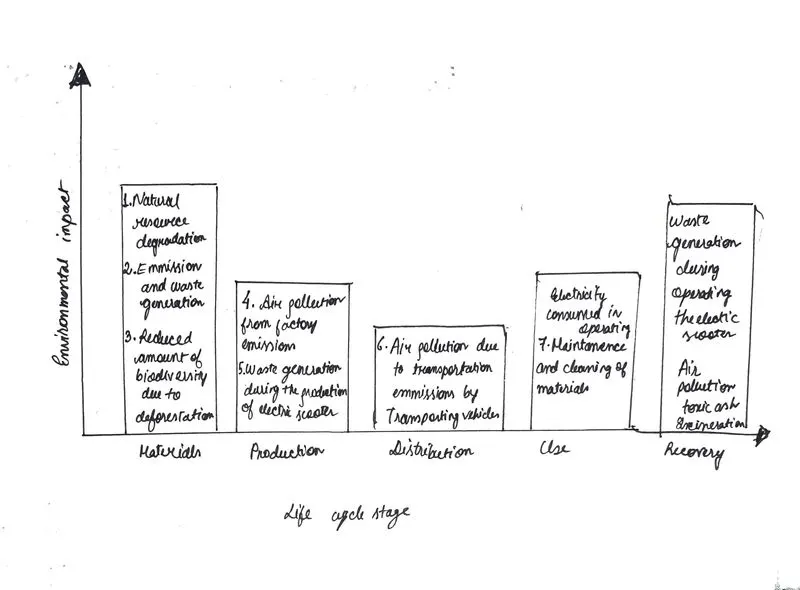
Materials
- It has the highest environmental impact due to the large variety of materials which is needed to build the electric scooters
Production
- The production of materials causes pollution of the air, water, and land
- Factory emissions, water discharge, and waste generation are the main cause of it
Distribution
- Transportation needed to transfer the materials from one place to another causes huge air pollution
- The packaging creates lots of waste which is harmful to the environment such as plastic waste
Use
- The use is very High
- The amount of electricity needed to operate the electric scooter is 250 watts
- Example
Recovery
- The recovery is very high due to the large amount of waste which will be slow to degrade and might leak toxins into the soil or air
- Example
- Large plastic enclosures
- The circuit boards containing beryllium
- Electricity too causes pollution
- Coal-fired electricity plants
- Example
DFES guidelines for the electric scooter
|
Life Cycle Stage |
Design for environment and sustainability guidelines |
|
|
Materials |
● Sustainability of resources ● Healthy inputs and outputs |
● Specify renewable/recyclable/recycled material ● Specify renewable forms of energy ● Specify non-hazardous materials ● For safe handling of toxic material, including labels and instructions |
|
Production |
● Minimal use of resources in production |
● Employ as few manufacturing steps as possible ● Specify materials that do not require surface treatment or coating ● Minimize the number of components and raw material consumption |
|
Distribution |
● Minimal use of resources in the distribution |
● Use folding, nesting,and disassembly to minimize packaging ● Use recyclable/reusable/lightweight material in packaging |
|
Use |
● Efficiency of resources during use ● Appropriate durability |
● Implement default power off for systems that are not in use ● Implement feedback or controls for how many Resources are used ● Design to ensure long product life, facilitate repair and upgrades |
|
Recovery |
● Disassembly, separation, and purification |
● To ensure joints and fasteners/incompatible materials are easily accessible ● Specify the joints and fasteners that can be separated by hand or common tools |
Ways to reduce the environmental impact caused by the electric scooter in each life cycle stage-
|
Materials |
|
|
Production |
|
|
Distribution |
|
|
Use |
|
|
Recovery |
|
(C)
Prototype technologies used in manufacturing electric scooters -
Subtractive prototyping technologies
CNC machining
- Types of CNC machining used are
- Laser Cutter
- Plasma cutter
- Electric discharge machines(EDM)
- CNC Cutting
- CNC turning
- Machining materials
- Alluminium alloys
- Brass alloys
- Bronze alloys
- Copper
- Stainless steel
- Mild low-carbon steel
- Titanium alloys
- Zinc alloys
- Plastic
- ABS
- Polycarbonate
- Garolite G10
Sheet metal fabrication
- Laser cutting
- High-power laser beam to cut the materials
- High precision and repeatability
- Quick production turnaround
- Plasma cutting
- An accelerated jet of hot plasma cut through electrically conductive materials
- All-around sheet metal fabrication tool
- Easy to operate and high-speed cutting
Additive prototyping technologies
3D printing
- A manufacturing process where the materials are joined together via later by layer process
- Types of 3D printing
- FDM
- Polyjet
- SLS, DMLS
- Material Extrusion
- Material Jetting
- Powder Bed Fusion
- Vat Photopolymerisation
The 3D printing used by most manufacturing companies is-
- Selective Laser Sintering(SLS)
- A powder bed fusion 3D printing process using a high power laser to fuse small particles of plastic powders into a mass that has desired 3D shape
- Benefits
- Parts can be made by various materials including plastic, metal,ceramic, or glass powder
- Does not require a support structure
- Direct Metal Laser Sintering (DMLS)
- Allow multiple parts to be combined during the printing process
- Can create complex and strong metal parts
- Small build size and expensive process
The reason why the Manufacturing company uses 3D printing technologies such as SLS and DMLS instead of conventional manufacturing technologies to produce electric scooter parts
- The SLS and DMLS operate by adding layers of material altogether to make an object while traditional manufacturing technologies are subtractive removing parts of a block of material in to create the desired shape of the product
- Creating complex geometries is easier with the DMLS technology but it is difficult with the traditional method to create highly complex parts which would cost much more
- Functional difference of the SLS and DMLS includes the possibility to print full moving assemblies but for the conventional firm, each part must be manufactured for the assembly separately and then they can be assembled later on
- Equipment required in SLS and DMLS is more and it is the mostly automated manner where less labor is required but for conventional Technology different skilled laborers are required to operate each individual machine that is being used
- Business applications customization by creating many more personalized products is possible with the DMLS technology compared to the conventional Technology
Why 3D printing is superior compared to other technologies-
- Advantages
- Enables manufacturing agility
- A wide range of products can be produced using 3D printing
- Even if the market shift the manufacturer can modify their design quickly with no retooling time
- Multiple SKU's can be produced in a single 3D printing machine
- Reduced costs and risks
- It eliminates tooling cost making it economical for low volume production runs
- Greater flexibility
- A single factory can support more amount of customers
- Greater control over the quality
- In 3D printing, automation quality can be controlled directly
- Reduce tariff risk
- The manufacturing companies can tax optimize by opening the manufacturing sites in the same region because multiple 3d printing machines will help to open more side stations
- Faster customer response
- With 3-D printing less time is required to produce the product hence faster customer response initiated in a few moments of time
- Enables manufacturing agility
(D)
I have chosen the following factors to make it harder for people to do reverse engineering of my designed electric scooter -
Patent
- It is an exclusive right that is granted to an invention
- This intellectual property will give me the legal right to exclude others from making selling or using the invention for a limited period of time in exchange for enabling disclosure of the invention
- Using patent protection I can prevent from doing reverse engineering
Trademark
- It will help my customers to recognize my products in the marketplace and distinguish my product from the competitors
- If my product will be protected by the trademark the other person cannot reverse engineer it simply by duplicating the product
Source-
https://www.grandviewresearch.com/industry-analysis/electric-scooters-market
https://www.tomsguide.com/best-picks/best-electric-scooters
https://www.embitel.com/wp-content/uploads/Single-ECU-Architecture.jpg
https://www.iezway.com/design-and-development-of-electric-scooter/
https://e-vehicleinfo.com/electric-vehicle-architecture-ev-powertrain-components/
https://www.productplan.com/glossary/product-architecture/
https://www.sciencedirect.com/science/article/abs/pii/S0957417417300714
http://inside.mines.edu/fs_home/cskokan/courses/failure/analysis.html
https://www.smartdraw.com/fault-tree/
https://iopscience.iop.org/article/10.1088/1748-9326/ab2da8
https://futurist.law.umich.edu/the-environmental-impacts-of-e-scooters/
https://hackaday.com/2021/09/15/3d-printed-scooter-zips-around/