Project 2 - Clinical Investigation Plan
Clinical Investigation
- Clinical investigation is the investigation of medical device after the approval obtained from the ethics committee registered under the rule 122 DD of the drugs and cosmetics rule of 1945 and the permission of it is granted by the Central Licensing authority
- It should be initiated at the respective sites only after getting such approval from the Ethics committee for that site
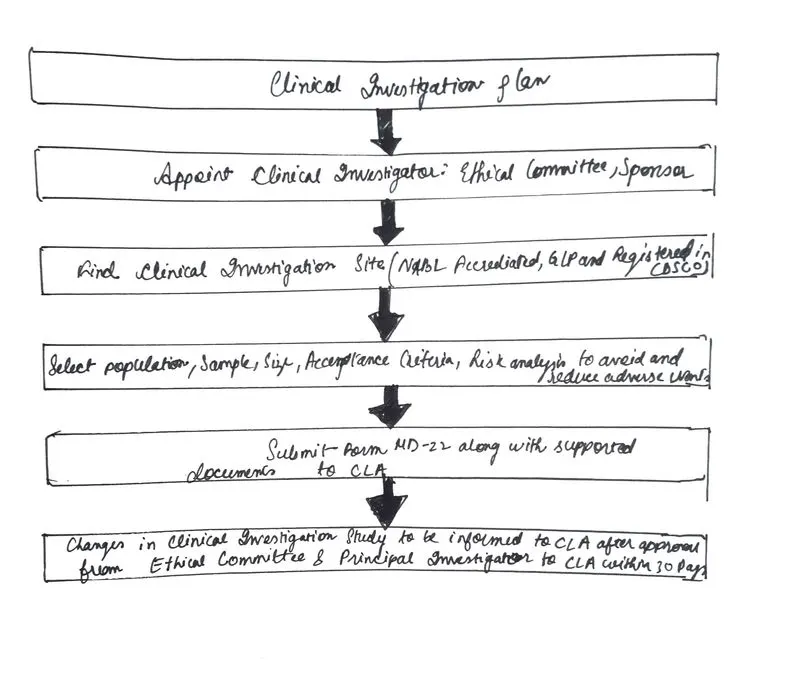
Clinical investigation plan -
- Appoint Clinical Investigator, Ethical Committee, Sponsor
- Find Clinical Investigation Site (NABL Accredited, GLP and/or Registered in CDSCO)
- Select Population, Sample Size, Acceptance Criteria, Risk Analysis to avoid or reduce adverse events
- Submit Form MD-22 along with supported documents to CLA
- Changes in Clinical Investigation Study to be informed to CLA after approval from Ethical Committee & Principal Investigator to CLA within 30 Days
Application for permission
- (1) An application in Form MD-22 shall be made to the Central Licensing Authority along with the following data in accordance with tables namely
- (I) Design analysis data as per Table 1
- Design process control diagram
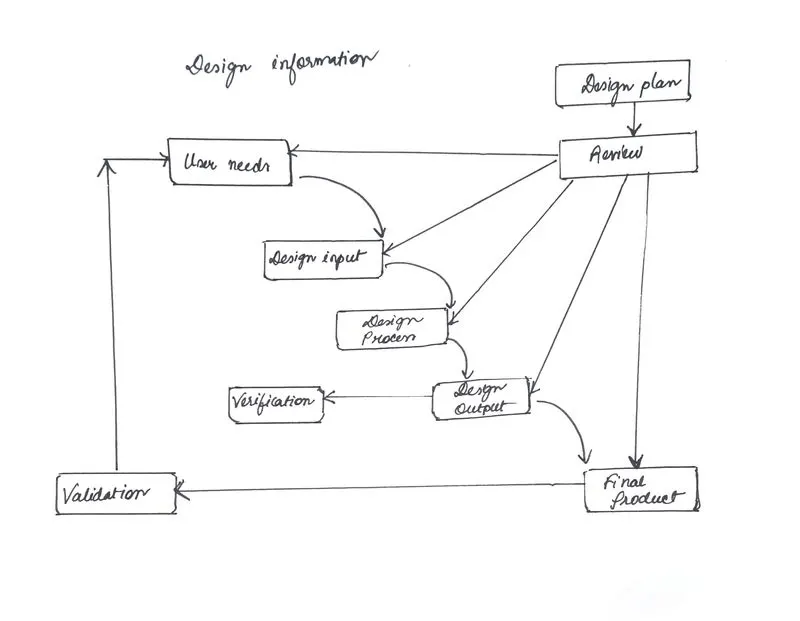
- Application for Grant of permission to conduct clinical investigation of an investigational medical device IVD
- (ii)Biocompatibility study-
- By definition, a measurement of how compatible a device or material is with a biological system.
- “Ability of a medical device or a material to perform with an appropriate host response in a specific application”.
- (iii) Information specified in table 3 shall be submitted along with investigator's brochure as prescribed in table 4, clinical investigational plan as prescribed in table 5, case report form as prescribed in table 6, serious adverse event reported, if any, as prescribed in table 7, informed consent form as prescribed in table 8, investigator's undertaking as prescribed in table 9, of this schedule and ethics committee approval, if available, as prescribed in appendix VIII of schedule Y of the drugs and cosmetics rules, 945.
- (iv) Regulatory status in other countries, if any, on use of investigational medical device in other countries,
- Prescription based device
- Exclusion of certain age groups
- Warning about adverse device effect
- Information on withdrawn in any country by the manufacturer or by regulatory authority, such information shall also be furnished along with reasons
- Sponsor should submit the above information to the Central Licensing Authority during the entire duration of marketing of the said medical device in the Country.
- (v) Proposed Instruction for use or direction for use and labels to be submitted along with application. Provided that after submission and approval by the central licensing authority, no change in the instructions for use shall be effected without such changes having been approved by the central licensing authority
- (vi) Report of clinical investigation should be in consonance with the format as prescribed in table 10, such reports shall be certified by principal investigator.
(1)Approval for clinical investigation
(i) Clinical investigation on an investigational medical device either at one site or multiple sites shall be initiated only after approval has been obtained from the ethics committee and permission granted by central licensing authority.
(ii) Investigators should have appropriate qualification, training and experience and treatment facilities as are relevant to the proposed clinical investigation. A qualified physician (or dentist, when apprchariate), who is an investigator or a sub-investigator for the investigation, shall be responsible for all investigation related decisions concerning medical or dental issues. Investigation site or laboratories should be compliant with good laboratory practices or should have accreditation certificate issued by national accreditation board for testing and calibration laboratories. Provide complete information about investigation site / laboratories.
(iii) No deviations from or changes to clinical investigational plan shall be implemented without prior written approval of the ethics committee and the central licensing authority except when it is necessary to eliminate immediate hazards to the study subject or when changes involve only logistic or administrative aspects of investigation. All such exceptions shall be immediately notified to the ethics committee as well as to the central licensing authority within 30 days.
(2)Roles and Responsibilities of Sponsor or manufacturer
- "Sponsor” includes a person, an investigator, a company or an institution or an organisation responsible for the initiation and management of a clinical investigation or clinical performance evaluation in India.
- (i) The sponsor is responsible for implementing and maintaining quality assurance system to ensure that the clinical investigation is designed, conducted, monitored, and that data is generated, documented, recorded and reported in compliance with clinical investigational plan and Good Clinical Practices (GCP) guidelines issued Aby the CDSCO, directorate general of health services, Govt. of India and applicable rules.
- (ii) The Sponsor is required to submit a status report on Clinical Investigation to the Central Licensing Authority.
- (iii) Report of any serious adverse event occurring during clinical investigation to the Chairman of the Ethics Committee, Central Licensing Authority, and the Head of institution where the clinical investigation has been conducted within 14 calendar days.
- (iv) In case of injury or death occurring to the clinical investigation subject, Sponsor will make payment for medical management to the subject and also provide financial compensation for clinical investigation as specified in the Drugs and Cosmetics Rules, 1945.
- (v) The sponsor shall submit details of compensation paid for clinical investigation related injury or death to the Central Licensing Authority within thirty days (30 Days) of the receipt of the order from the Central Licensing Authority.
- (vi) The sponsor will submit Clinical Investigation Report, whether for a completed or prematurely terminated clinical investigation, to the Ethics Committee, participating investigators and to the Central Licensing Authority.
- (vii) In case, an investigation need to be discontinued prematurely for any reason including lack of commercial interest, the sponsor shall need to inform to the Central Licensing Authority and also submit complete summary report within a period of ninety days.
(3)Roles and Responsibilities of Investigator
- Principal Investigator - The investigator must be qualified by education, training, and experience to assume responsibility for the proper conduct of the trial, should meet all the qualifications specified by the applicable regulatory requirement.
- (i) The investigator shall be responsible for the conduct of the investigation according to clinical investigation plan, GCP guidelines and also for compliance as per the undertaking by the investigator as given in Table 9.
- Investigator Responsibilities are,
- Prepare and maintain SOP require for clinical investigation
- Adequate medical care to avoid adverse events for the subjects
- Report all serious adverse events to the central licensing authority, sponsor and the ethics committee within forty eight hours (2 Days).
- In case the Investigator fails to report any serious adverse event within the stipulated period, he shall have to furnish the reason for the delay, after due analysis, to chairman of the Ethics Committee, Central Licensing Authority and the head of the Institution where investigation has been conducted within fourteen calendar days.
- The Investigator shall provide information to the clinical investigation subject through informed consent process as provided in table 8 about the essential elements of the clinical investigathon and the subject's right to claim compensation in case of investigation related injury or death.
(4)Roles and Responsibilities of Ethics Committee
- (i) It is the responsibility of the ethics committee that reviews and accords its approval to a clinical investigation plan to safeguard the rights, safety and well-being of all study subjects. The ethics committee should exercise particular care to protect the rights, safety and well-being of all vulnerable subjects participating in the study.
- Explanation - The vulnerable subject means the members of a group with hierarchical structure (e.g. prisoners, armed forces personnel, staff and students of medical, nursing and pharmacy institutions), patients with incurable diseases, unemployed or impoverished persons, patients in emergency situation, ethnic minority groups, homeless persons, nomads, refugees, minors or others incapable of personally giving consent. Ethics committee(s) get documented 'standard operating procedures' and should maintain a record of its proceedings.
- (ii) Ethics committee shall review the clinical investigation on periodic study progress reports furnished by investigators or monitoring and internal audit reports furnished by the Sponsor.
- (iii) Ethics committee can revoke sites approval accorded to a clinical investigation plan with proper reason and communicate such a decision to the investigator as well as to the central licensing authority.
- (iv) Ethics committee will report of any adverse events occurred during clinical investigation to CLA and head of the investigation site within 14 days.
(5)Informed consent
(i) In all investigations, a freely given, informed, written consent using an Informed Consent Form' is required to be obtained from each study subject. The investigator shall provide information about the study verbally and through patient information sheet. The patient information sheet & the informed consent form shall be approved by the ethics committee and furnished to the central licensing authority.
Any change in the informed consent documents should be approved by the Ethics Committee and submitted to the central licensing authority before such changes are implemented.
(ii) Where a subject is not able to give informed consent (e.g. an unconscious person or a minor or those who are suffering from severe mental illness or disability), the same may be obtained from a legally acceptable representative.
(iii) If the subject or his legally acceptable representative is unable to read or write, an impartial witness should be present during the entire informed consent process who must append his signatures to the consent form. Explanation - A legally acceptable representative means a person who is able to give consent or authorise an intervention in the patient as provided by the law in India.
(iii) A checklist of essential elements to be included in the format for the Informed Consent Form.
(iv) The informed consent process, in case of vulnerable subjects in clinical investigations of an innovative medical device which is not approved anywhere in the world, shall be audio-video recorded.
- The vulnerable subject means the members of a group with hierarchical structure (e.g. prisoners, armed forces personnel, staff and students of medical, nursing and pharmacy institutions), patients with incurable diseases, unemployed or impoverished persons, patients in emergency situation, ethnic minority groups, homeless persons, nomads, refugees, minors or others incapable of personally giving consent. Ethics committee(s) get documented 'standard operating procedures' and should maintain a record of its proceedings.
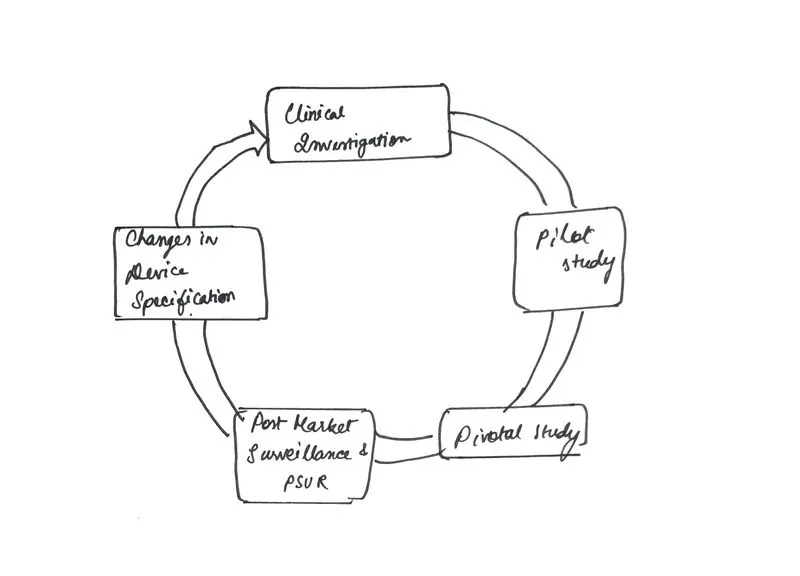
(6)Pilot Clinical Investigation Study
- (i) Pilot clinical investigation is exploratory study which may be conducted in a few numbers of patients with the disease or condition being studied before moving to large population which are used to acquire specific essential information about a device before beginning the pivotal clinical investigation.
- (ii) The objectives of a pilot clinical investigation typically include assessing, Feasibility (e.g, preliminary device performance).
- Eligibility criteria and their practical application for pivotal controlled investigation.
- Ascertaining potential harm (preliminary safety evaluations). Validating a method for determining an outcome measure.
- Evaluating the logistics of pivotal investigation for performance.
- (iii) If the application is for conduct of clinical investigation as a part of multinational clinical development of medical device, the number of sites and the patients as well as justification to conduct such clinical investigation in India shall be provided to the Central Licensing Authority.
(7)Pivotal Clinical Investigation Study
(i) The pivotal clinical investigation is a definitive study in which evidence is gathered to support the safety and effectiveness evaluation of the medical device for its intended use.
- Pivotal clinical investigation is a confirmatory study that may be conducted in large number of patients with disease or condition being studied and scope to provide the effectiveness and adverse effects.
(ii) For investigational medical device which does not have a predicate medical device but has been approved for sale or distribution in any country other than India, pivotal studies need to be carried out in Indian patients except in cases of investigational medical device classified under class A which shall be governed as per permission of pilot study above if approved by CLA based on the clinical data generated from other countries.
(iiI) For class B, C, D, prior to conduct of pivotal clinical investigation in Indian subjects, the Central Licensing Authority may require making the pilot study data available to assess whether the pilot data is in conformity to the data already generated outside the country. (iii) If the application is for conduct of clinical investigation as a part of global clinical investigation of medical device, the number of sites and patients as well as justification for undertaking such clinical investigation in India shall be provided to the central licensing authority.
(8)Post Marketing Clinical Investigation
- Post Marketing Clinical Investigation is the subsequent approval of an Investigational medical device, which shall be closely monitored for their clinical safety once they are marketed. This investigation may not be considered necessary at the time of medical device approval but may be required by the Central Licensing Authority for optimizing the intended use of the medical device. Post marketing clinical investigation is the study other than surveillance performed after marketing approval, it includes additional drug device interaction, safety studies, investigation designed to support use under the approved indication (e.g. mortality or morbidity studies, etc.)
(9)Special Population
- The clinical investigation data of the medical device is required to be submitted to support the claim sought to be made for use of medical device in children, pregnant women, nursing women, elderly patients with renal or other organ system failure as given below:
- (i) Geriatrics Geriatrics patients can be included in pivotal study (and in pilot study at the sponsor's option) in meaningful numbers, if,
- (a) the disease intended to be treated is characteristically a disease of aging.
- b) The population to be treated is known to be included in substantial numbers of geriatric patients; or
- et that conditions
- (c) There is specific reason to expect that conditions common in the elderly are likely to be encountered; or
- (d) The investigational medical device is likely to alter the geriatric patient's response in regard to safety or performance compared with that of non-geriatric patient.
- (ii) Paediatrics
- (a) The timing of pediatric studies in the medical device development program shall depend on the device, the type of disease being treated, safety consideration, and the safety and effectiveness of available treatment.
- (b) The medical device expected to be used in children, the performance and safety shall be made in the appropriate age group. It is usually appropriate to begin with older children before extending the investigation to younger children and then infants.
- (c )If the medical device is predominantly or exclusively used in paediatric patients, clinical investigation data should be generated in paediatric population except for initial safety and performance data, which will usually be obtained in adults unless such initial safety studies in adults would yield little useful information or expose them to inappropriate risk.
- (d) If the medical device is intended to treat serious or life-threatening diseases, occurring in both adults and paediatric patients, for which there are currently no or limited therapeutic options, the paediatric population may be included in the clinical investigation early, following assessment of initial safety data and reasonable evidence of potential benefit. In circumstances where this is not possible, lack of data has to be justified.
- (e) If the medical device has a potential for use in paediatric patient, paediatric studies may be conducted. These studies may be initiated at various stages of clinical development or after post-marketing surveillance in adults, if a safety concern exists. In cases where there is limited paediatric data at the time of submission of application, more data in paediatric patients would be expected after marketing authorization for use in children is granted.
- (f) Parents or legal guardian will provide written informed consent form on behalf of child for their participation in clinical investigation. Mature minors and adolescents should personally sign and date a separately designed written consent form. Although a participant's wish to withdraw from a study shall be respected, there may be circumstances in therapeutic studies for serious or life-threatening diseases in which, in the opinion of the investigator and parent or legal guardian
- (g) For clinical investigations conducted in paediatric population, the reviewing Ethics Committee shall include members who are knowledgeable about pediatric, ethical, clinical and psychosocial issues.
- (iii) Pregnant or nursing women
- (a) Pregnant or nursing women shall be included in clinical investigation only when the medical device is intended for use.
- b) For medical device intended for use during pregnancy, follow-up data pertaining to a period appropriate for that medical device on the pregnancy, foetus and child will be required.
Post Marketing Surveillance
(i) Subsequent to approval of an Investigational redical device, it shall be closely monitored for their clinical safety once they are marketed. The applicants shall furnish Periodic Safety Update Reports (PSURs) in order to
- (a) Report all the relevant new information from appropriate sources
- (b) Relate these data to patient exposure
- (c) Summarise the market authorisation status in different countries and any significant variations related to safety
- (d) Indicate whether changes will be made to product information in order to optimize the use of the product
(ii) One medical device should be covered in one PSUR. Within the single PSUR separate presentation of data for different indications or separate population need to be given.
(iii) All relevant clinical and non-clinical safety data will cover only the al safety data period of the report (interval data). The PSURS shall be submitted every six months for the first two years after marketing approval of the medical device. For subsequent two years, the PSURS need to be submitted annually. PSURS due for a period must be submitted within thirty calendar days of the last day of the reporting period.However, all cases involving suspected unexpected serious adverse event shall be reported to the licensing authority within fifteen days of initial receipt of information by the applicant.
(iv) New studies specifically planned or conducted to examine a safety issue should be described in the PSURs.
(v) A PSUR should be structured as follows W
(a) Title Page
- Name of the Medical device
- Approved indication of Medical devices
- Date of approval of the medical device
- Date of marketing of medical device
- Licensee name and address.
(b) Introduction
- Reporting interval medical device intended use
- Mode of action or principle of operation,
- Risk class and a brief description of the approved indication and population.
(c) Current worldwide marketing authorization status
- Details of approval in different countries with date of first approval, date of marketing and Information about the product withdrawn status in any of the countries with reasons.
- d) Actions taken in reporting interval for safety reasons
- Description of significant actions related to safety, taken with in the reporting interval, related to either investigational uses or marketing experience by the licence holder, sponsor of a clinical investigation, regulatory authorities, data monitoring committee, or ethics committee.
(e) Changes to reference safety information
Details of any significant changes within the reporting interval, relating to contraindications, warnings, precautions, adverse events, and important findings from ongoing and completed clinical investigations and significant non-clinical findings.
(f) Estimated patient exposure
- Details of estimates of the size and nature of the population exposed to the medical device. Brief descriptions of the method used to estimate
- (i) Cumulative and interval subject exposure in Clinical investigation.
- (ii) Cumulative and interval patient exposure from Marketing Experience in Indiaand r est of the world
(g) Presentation of individual case histories Details of the individual case information and provide brief case narrative, medical history indication treated with suspect medical device, causality assessment and provide following information
- (i) Reference prescribing information
- (ii) Individual cases received from India and from rest of the world
- (iii) Cumulative and interval summary tabulations of serious adverse events and post-marketing data sources
(h) Studies - Details of the brief summary of clinically important emerging efficacy or effectiveness and safety findings.
- (i) Summaries of Significant Safety Findings from Clinical investigation
- (ii) Findings from Non-interventional Studies, Non-Clinical Studies and Literature
(i) Other information
Details about signals and Risk Management Plan.
- (a) Signal and risk evaluation: details of signal and risk identified and evaluation of signals identified during the reporting period.
- (b) Risk Management Plan: brief details of safety concerns and necessary action taken by him to mitigate such safety concerns.
(j) Overall Safety Evaluation
Details of overall safety evaluation of medical device based on its risk benefit evaluation for approved indication.
- (i) Summary of Safety Concerns
- (ii) Benefit Evaluation
- (iii) Benefit Risk Analysis Evaluation
(k) Conclusion
- Details on the safety profile of medical device and necessary action taken in this regards.
(l) Appendix
- The appendix includes the copy of marketing authorization in India, copy ofprescribing information, line listings with narrative of Individual Case Safety Reports (ICSR).
Timelines for report about clinical investigation process
Table 1- Design Analysis Data
Design Analysis Data for a medical device shall include the following:
(i) Physical and Metrological Standardization.
(ii) Design control documents as per MDR 2017 and a predefined procedure of the medical device at the time of manufacturing . A comprehensive report of design analysis including
- The basic design features of the device drawings.
- Tests adapted for design analysis (with specifications).
- Rationale for selecting those tests.
Table 2 - Biocompatibility and Animal Performance Study for investigational medical device
- Depending on the nature and intended use, device performance for its actions (including mechanical, electrical, thermal, radiation and any other of this type) and safety shall be assessed in healthy or diseased animal model (intended to be treated by such medical device)
- Demonstrating reaction to active and basic parts of the devices on absolute tissue, local tissue as well as whole organ
- Clearly recording local, general and systemic adverse reactions
- Risks or potential risks and performance of device
Table 3 - Information to be submitted along with the application
1.Design Analysis data including, (whichever applicable)
- (a) Design input and design output documents
- (b) Mechanical and electrical tests
- (c) Reliability tests
- (d) Validation of software relating to the function of the device
- (e) Any performance tests
- (f) ex vivo tests.
- The agreement between the Sponsor and Principal and coordinating investigator(s). 3. Appropriate insurance certificate, if any.
- Forms for reporting any adverse event and serious adverse event.
- Report of biocompatibility tests along with rationale for selecting these tests including a summary report and conclusion of the study.
- Results of the risk analysis.
- Animal Performance study data
- Clinical Investigational Plan, Investigator's Brochure as per Table 4, Case Report Form as per Table 6, Informed Consent Form as per Table 8, investigator's undertaking and Ethics Committee clearance.
- Pilot and Pivotal Clinical Investigation data including that, if any, carried out in other countries.
- Regulatory status and Restriction on use in other countries, if any, where marketed or approved.
- Proposed Instructions for use and labels.
Table 4 - Investigator's Brochure (IB)
I.General
1.1 Introduction
1.2 Identification of the IB
- (a) Name of the investigational medical device.
- (b) Document reference number, Date & Version of the IB.
- (d) Confidentiality statement, if appropriate.
- (e) Summary of the revision history in case of amendments, if appropriate.
1.3 Sponsor or manufacturer
Name and address of the sponsor or manufacturer of the investigational medical device.
- Investigational medical device information
- (a) Summary of literature and evaluation of investigational medical device.
- (b) Statement concerning regulatory classification of medical device.
- (c) General description of the medical device and its components.
- (d) Summary of manufacturing processes and validation processes.
- (e) Description of the mechanism of action, along with supporting scientific literature.
- (f) User Manual - Information on Sterilization, reuse, safety measurements, etc.
- (g) Description of the intended clinical performance.
- Preclinical testing
The summary shall include or, where applicable, refer to the results of:
- (a) Design input and design output documents,
- (b) In vitro tests,
- (c) Mechanical and electrical tests,
- (d) Reliability tests,
- (e) Validation of software relating to the function of the device,
- (f) Any performance tests,
- (g) Ex vivo tests, and
- (h) Biological safety evaluation.
- Existing clinical data and Adverse events history
- Risk management Report as per ISO 14971
- Regulatory and other references
- (a) List of International Standards, if any, complied with in full or in part.
- (b) Statement of conformity with national regulations, where appropriate.
- (c) List of references, if relevant.
Table 5 - Clinical Investigation Plan
I.I
1.1.1 Introduction - Describe Clinical investigation study plan
1.1.2 Identification of the clinical investigation plan
(a) Title of the clinical investigation.
(b) Reference number identifying the specific clinical investigation, if any.
(c) Version or date of the CIP.
1.1.3 Sponsor Details
- Name, address and contact details.
- Email id, phone number, etc. of the sponsor
1.1.4 Principal investigator, coordinating investigator and investigation site
(a) Name, address, and professional position of
- (i) Principal Investigator.
- (ii) Coordinating investigator, if appointed.
(b) Name and address of the investigation site
1.1.5 Overall synopsis of the clinical investigation
- CIP Synopsis
- Inclusion or exclusion criteria
- Number of subjects
- Product description, intended use
- Investigator, Sponsor and investigation site details
1.2 Identification and description of the investigational medical device
- (a) Device description and its intended purpose.
- (b) Manufacturer details
- (c) Name or number of the model or type, including software version and accessories, if any.
- (d) Product Lot no. or serial no.
- (e) The populations and Indication for use
- (f) Description of investigational medical device including any materials that will be in contact with tissues or body fluids. (This shall include details of any medicinal products, human or animal tissues or their derivatives, or other biologically active substances.)
- (g) Personnel training and experience requirements.
- (h) Description of the specific medical or surgical procedures if any
1.3 Justification for the design of the clinical investigation Justification for the design of clinical investigation, which shall be based on conclusions of the evaluation,
(a) An evaluation of the results of the relevant preclinical testing or of the relevant pr assessment carried out to justify the use of investigational medical device in human subjects.
(b) An evaluation of clinical data that are relevant to the proposed clinical investigation.
1.4 Risks and benefits of the investigational medical device and clinical investigation
- Risk-to-benefit rationale
- Control or mitigation of the risks
- Risks associated with the clinical investigation
- Residual risks
- Anticipated adverse device effects
- Anticipated Risk
1.5 Objectives and hypotheses of the clinical investigation
- (a) Objectives, primary and secondary.
- (b) Hypotheses, primary and secondary, to be accepted or rejected by statistical data from the clinical investigation.
1.6 Design of the clinical investigation
1.6.1 General
- Description of the type of clinical investigation to be performed (e.g.double-blind, parallel design, with or without a comparator group).
- Description of the measures to be taken to minimize or avoid bias.
- Equipment requirements
1.6.2 Investigational medical device and comparator STANDARD (a) Description of the comparator,
(b) Justification of the choice of comparator.
(c) List of any other medical device or medication if used in the study 1.6.3 Subjects
(a) Inclusion criteria for subject selection. (b) Exclusion criteria for subject selection. (c) Criteria and procedures for subject withdrawal (d) Total expected duration of the clinical investigation. (e) Number of subjects required to be included in clinical investigation.
1.6.4 Procedures
(a) Description of all the clinical investigation related procedures (b) Description of those activities performed by sponsor representatives (excluding monitoring) (c) Any known or foreseeable factors that may compromise the outcome
of clinical investigation or interpretation of results 1.6.5 Monitoring plan
General outline of the monitoring plan to be followed, including access to source data and the extent of source data verification planned.
1.7 Statistical considerations With reference to 1.5 and 1.6, the description of and justification for
(a) Statistical design, method and analytical procedures.
(b) Sample size.
(c) The level of significance and the power of the clinical investigation.
(d) Expected drop-out rates.
(e) Pass or fail criteria to be applied to the results of the clinical investigation.
1.8 Data management
- (a) Procedures used for data review, database cleaning, and issuing and resolving data queries.
- (b) Procedures for verification, validation and securing of electronic clinical data systems, if applicable.
- (c) Procedures for data retention.
- (d) Specified retention period.
- (e) Other aspects of clinical quality assurance, as appropriate.
1.9 Amendments to the Clinical investigation plano
Description of the procedures to amend the Clinical investigation plan.
1.10 Deviations from clinical investigation plan
- (a) Statement specifying that the investigator is not allowed to deviate from the Clinical investigation plan, except without appropriate notifications or approvals from Ethics Committee and Central Licensing authority, as the case may be.
- (b) Procedures for recording, reporting and analyzing Clinical investigation plan deviations.
- Description of the procedures to amend the Clinical investigation plan.
- (c) Notification requirements and time frames
- (d) Corrective and preventive actions and principal investigator disqualification criteria.
1.11Device accountability.
Description of the procedures for the accountability of investigational medical devices should be maintained.
1.12 Statements of compliance.
- (a) The clinical investigation shall be conducted in accordance with the ethical principles as prescribed in good clinical practice.
- (b) The clinical investigation shall not begin until get approval from the ethics committee.
1.13 Informed consent process.
- Description of the general process for obtaining informed consent, including the process for providing subjects with new information, as needed.
- Description of the informed consent process in circumstances where the subject is unable to give it, in the case of emergency treatment, process should be clearly specified.
1.14 Adverse events, adverse device effects and device deficiencies.
- (a) Definitions of adverse events and adverse device effects.
- (b) Definition of device deficiencies.
- (c) Definitions of serious adverse events and serious adverse device effects and, where appropriate, unanticipated serious adverse device effects.
- (d) Time period in which the principal investigator shall report all adverse events and device deficiencies to the sponsor and, where appropriate, to Ethics Committee and the regulatory authority.
- (e) Details of the process for reporting adverse events (date of the adverse event, treatment, resolution, assessment of both the seriousness and the relationship to the investigational medical device).
- (f) Details of the process for reporting device deficiencies.
- (g) List of foreseeable adverse events and anticipated adverse device effects, together with their likely incidence, mitigation or treatment.
- (h) Emergency contact details for reporting serious adverse events and serious adverse device
1.15 Vulnerable population.
(a)Description of the vulnerable population.
(b)Description of the specific informed consent process, Ethics Committee specific responsibility and procedure for medical care, if any, will be provided for subjects after the clinical investigation has been completed.
1.16 Suspension or premature termination of the clinical investigation.
(a) Criteria and arrangements for suspension or premature termination of the whole clinical investigation or of the clinical investigation in one or more investigation sites.
(b) Criteria for access to and breaking the blinding or masking code in case of suspension or premature termination of the clinical investigation, if the clinical investigation involves a blinding or masking technique.
1.17 Publication policy.
(a) Statement indicating whether the results of the clinical investigation will be submitted for publication.
(b) Statement indicating the conditions under which the results of the clinical investigation will be offered for publication.
Table 6 - Case Report Form (CRF)
- General
(i) Case Report Forms are established to implement the clinical investigation plan, to facilitate subject observation and to record subject and medical device data during the clinical investigation.
- Content and format
2.1 Overall considerations
- (i) The Case Report Forms can be organized such that they reflect all the data from a single procedure or a single visit or other grouping that makes clinical or chronological sense.
- (ii) The format of Case Report Forms shall be such as to minimize errors that can be made by those who enter data and those who transcribe the data into other systems.
- Content and format
2.2 Cover page or login screen
(a) Name of sponsor or sponsor logo.
(b) Clinical investigation plan version and date (if required).
(c) Version number of Case Report Forms.
(d) Name of clinical investigation or reference number (if applicable).
2.3 Header or footer or Case Report Form identifier
(a) Name of the clinical investigation or reference number.
(b) Investigation site/principal investigator identification number.
(c) Subject identification number and additional identification such as date of birth or initials, if allowed by national regulations.
(d) Page/screen number (e.g. "page x of xx”).
- Content and format
2.4 Types of Case Report Forms
The following is a suggested list of CRFs that may be developed to support a clinical investigation.
- (a) Screening
- (b) Documentation of subject's informed consent.
- (c) Inclusion/exclusion.
- (d) Baseline visit
- (1) Demographics.
- (2) Medical diagnosis.
- (3) Relevant previous medications or procedures.
- (4) date of enrolment.
- (5) other characteristics.
- (e) Intervention(s) or treatment(s).
- (f) Follow-up visit(s).
- (g) Clinical investigation procedure(s).
- (h) Adverse event(s).
- (i) Device deficiencies.
- (j) Concomitant illness(es)/medication(s)
- (k) Unscheduled visit(s).
Table 7 - Data elements for reporting serious adverse events occurring in a clinical investigation
- Patient details
(a) Initials and other relevant identifier (hospital/outpatient department's record number etc.)
(b) Gender. 1 (c) Age and date of birth.
(d) Weight (e) Height.
- Suspected device(s)
(a) Name of the Device. (b) Indication(s) for which suspect device was prescribed. (c) Device details including model number/size/lot number, if applicable. (d) Starting date and time of day. (e) Stopping date and time, or duration of treatment.
- Other treatment(s)
Provide the same information for concomitant treatment.
- Details of suspected adverse device reaction(s)
(a) Full description of reaction(s) including body site and severity, as well as the criteria for regarding the report as serious. In addition to a description of the reported signs and symptoms, describe a specific diagnosis for the reaction.
(b) Start date (and time) of onset of reaction.
(c) Stop date (and time) or duration of reaction.
(d) Setting (e.g., hospital, outpatient clinic, home, nursing home).
- Outcome
(a) Information on recovery and any sequel.
(b) For a fatal outcome, cause of death and a comment on its possible relationship to the suspected reaction, any post-mortem findings.
(c) Other information: anything relevant to facilitate assessment of the case, such as medical history from special investigations etc.
- Details about the Investigator
(a) Name
(b) Address
(c) Telephone number
(d) Profession (specialty)
(e) Date of reporting the event to central licensing authority
(f) Date of reporting the event to ethics committee overseeing the site (g) Signature of the investigator.
Table 8 - Informed Consent Form
Checklist for for clinical investigation Subject's informed consent documents
1.1 Essential elements:
- Statement and explanation of the purpose of the research
- Expected duration of the Subject's participation
- Description of the procedures including all invasive procedures
- Description of any reasonably foreseeable risks or discomforts to the Subject
- Description of any benefits to the Subject or others reasonabiy expected from research. If no benefit is expected, subject should be made aware of this.
- Specific appropriate procedures or therapies available to the Subject.
- confidentiality statement for maintenance of subject information and who will have access to Subject's medical records
- Statement that there is a possibility of failure of investigational medical device to provide intended therapeutic effect.
- Any other pertinent information.
1.2 Additional elements, which may be required
(a) Statement of foreseeable circumstances under which the subject's participation may be terminated by the Investigator without the subject's consent.
(b) Additional costs to the subject that may result from participation in the clinical investigation.
(C) The consequences of a Subject's decision to withdraw from the investigation and procedures for orderly termination of pafticipation by Subject.
(d) Statement that the Subject or Subject's representative will be notified in a timely manner if significant new findings are developed during the course of the investigation. (e). A statement that the particular treatment or procedure may involve risks to the Subject, which are currently unforeseeable
(f) Approximate number of Subjects enrolled in the clinical investigation
Table 9 - Undertaking by the Investigator
- Full name, address and title of the Principal Investigator (or Investigator(s) when there is no Principal Investigator)
- Name and address of the medical college, hospital or other facility
where the clinical investigation will be conducted - Education, training & experience that qualify the Investigator
- Name and address of all clinical facilities to be used in the clinical
- Name and address of the Ethics Committee that is responsible for approval and continuing review of the clinical investigation.
- Names of the other members of the research team (co-investigators) 6. Clinical Investigation Plan, Title and Clinical investigation number
- Commitments
- (i) I have reviewed the clinical investigation plan and agree that it contains all the necessary information to conduct the investigation. I will not begin the clinical investigation until all necessary ethics committee and regulatory approvals have been obtained.
- (ii) I agree to conduct the investigation in accordance with current clinical investigation plan.I will not implement any deviation from changes of the investigation plan without agreement by the sponsor and review and documented approval opinion from ethics committee of the amendment, where necessary to eliminate an hazard(s) to the clinical investigation participant change(s) involved are only logistical or administrative in nature
- (iii) I agree to personally conduct and/or supervise the clinical investigation at my site.
- (iv) I agree to inform all Subjects that the medical devices are being used ects that the medical for investigational purposes and I will ensure that the requirements relating to obtaining informed consent and Ethics Committee review and approval specified in this Schedule are met.
- (v) I agree to report to the Sponsor all adverse experiences that occur in the course of the investigation(s) in accordance with the regulatory and Good Clinical practice guidelines.
- (vi) I have read and understood the information in the Investigator's brochure, including the potential risks and side effects of the medical device.
- (vii) I agree to ensure that all associates, colleagues and employees assisting in the conduct of the clinical investigation are suitably qualified and experienced and they have been informed about their obligations in meeting their commitments in the clinical investigation.
- (viii) I agree to maintain adequate and accurate records and to make those records available for audit / inspection by the Sponsor, Ethics Committee, Licensing Authority or their authorized representatives, in accordance with regulatory and provisions of these rule will fully cooperate with any clinical investigation related audit conducted by regulatory officials or authorized representatives of the Sponsor.
- (ix) I agree to promptly report to the Ethics Committee all changes in the CIP activities and all unanticipated problems involving risks to human Subjects or others.
- (x) I agree to inform all serious adverse events to the Sponsor, Central Licensing Authority as well as the Ethics Committee within forty eight hours of their occurrence. In case of failure, I will submit the justification to the satisfaction of the Central Licensing Authority. I also agree to report the serious adverse events, after due analysis, to the Central Licensing Authority, Chairman of the Ethics Committee and head of the institution where the investigation has been conducted within fourteen days of the occurrence of serious adverse events.
- (xi) I will maintain confidentiality of the identification of all participating clinical investigation patients and assure security confidentiality of clinical investigation data
- (xii) | agree to comply with all other requirements, guidelines and statutory obligations as applicable to clinical Investigators participating in clinical Investigations
Table 10 - Clinical Investigation Report
1.General
This table specifies the contents of the clinical investigation report that describes the design, execution, statistical analysis and results of a clinical investigation.
- Cover page
The page shall be contain the following information
- (a) Title of the clinical investigation
- (b) Identification of the investigational medical devices, including names,models, etc.
- (c) A single sentence describing the design, comparison, period, usage method, and subject population
- (d) Name and contact details of sponsor or sponsor's representative
- (e) CIP identification/protocol code
- (f) Name and department of investigator and names of other relevant parties, e.g. experts, biostatistician, laboratory Personnel
- (g) Statement indicating whether the clinical investigation was performed in accordance with declaration of Helsinki, good clinical practice guidelines and applicable regulations (h) Brief description of investigation design
- (i) Start and end date of patient accrual
- (j) Author(s) of report.
- Table of contents
- Summary The summary may contain the following items
- (a) The title of the clinical investigation
- (b) An introduction
- (c) The purpose of the clinical investigation
- (d) Description of the clinical investigation population
- (e) The clinical investigation method used
- (f) The results of the clinical investigation
- (g) The conclusion
- (h) The date of the clinical investigation initiation and completion or if the clinical investigation is discontinued, the date of premature termination.
- Introduction
- Brief Introduction of Medical Device and Clinical Investigation Plan
- Investigational medical device and methods
6.1 Investigational medical device description
- The description of the investigational medical device should contain the following points:
- A description of the investigational medical device;
- The intended use of the investigational medical device(s);
- Previous intended uses or indications for use,
- if relevant;any changes to the investigational medical device during the clinical investigation or any changes from the IB
6.2 Clinical investigation plan (CIP)
- A summary of the CIP, including any subsequent amendment(s) with a rational for each amendment, should be provided.
- The summary will include a brief description of the following points
(a) the clinical investigation objectives;
(b) the clinical investigation design including,
- (i) The type of clinical investigation
- (ii) The clinical investigation endpoints
- (iii) The ethical considerations
- (iv) The data quality assurance
- (v) the subject population for the clinical investigation, with the
- (a) Inclusion or exclusion criterial
- (b) Sample size;
- (vi) The treatment and treatment allocation schedule; (vii) Any concomitant medications/treatments;
- (viii) The duration of follow-up;
- (ix) the statistical analysis including
- (a) The clinical investigation hypothesis or pass or fail criteria
- (b) A sample size calculation and
- (c) Statistical analysis methods.
6.4 Clinical investigation team
- Briefly describe the administrative structure of the clinical investigation (Investigators, site staff, Sponsor/ designates, Central laboratory etc.). estigators, site staff
- Results
- The results should include the following points:
- (a) The clinical investigation initiation date
- (b) The clinical investigation completion/suspension date
- (c) The disposal of subjects and investigational medical devices
- (d) The subject demographics
- (e)The results should include the following points 55 (f)Clinical investigation plan compliance; an analysis, which includes,
- (i) a performance analysis as provided in the clinical investigation plan;
- (ii) a summary of all adverse events and adverse device effects, including a discussion of the severity, treatment needed, resolution and relevant principal
- (iii) a table compiling all observed device deficiencies that could have led to a serious adverse effect, and any corrective actions details
- (f)Clinical investigation plan compliance an analysis which includes-
- (iv) any needed subgroup analysis for special populations (i.e. gender,
- racial/cultural/ethnic subgroups),
- (v) an accountability of all subjects with a description of how missing data or deviation(s) were dealt within the analysis, including subjects
- (A) Not passing screening tests.
- (B) Lost to follow-up.
- (C) Withdrawn or discontinued from the clinical investigation and the reason.
- Discussion and overall conclusions
The conclusions may include the following points:
(a) The safety and performance results and any other endpoints
(b) An assessment of risks and benefits
(c) A discussion of the clinical relevance and bnportance of the results in the light of other existing data
(d) Any specific benefits or special precautions required for individual subjects or groups considered to be at risk
(e) Any implications for the conduct of future clinical investigations
(f) Any limitations of the clinical investigation
- Abbreviated terms and definitions
- A list of abbreviated terms and definitions of specialized or unusual terms should be provided.
- List of appendices to the clinical investigation report
- (a) Protocols and amendments
- (b) Specimen of Case Record Form
- (c) Investigators' name(s) with contact addresses, phone, e-mail etc
- (d) Patient data listings
- (e) List of participants treated with investigational product
- (f) Discontinued participants
- (g) Protocol deviations.
- (h) CRFs of cases involving death and life threatening adverse event cases.
- (i) Publications from the investigation. a the clea
- (k) Important publications referenced in the clinical investigation
- (l) Audit certificate.
- (m) List of other parties(e.g. core labs, Contract Research Organizations (CROs), experts, etc.)
- (n) List of monitors involved
- (0) Investigator's certificate that he or she has head the report and that the report accurately describes the conduct and results of the clinical investigation.
Exemptions
Suspension or premature termination of the clinical investigation and publication policy on the case reports.-
|
S No. |
Class of Medical Devices |
Extent and conditions of exemptions |
|
1 |
Custom made device |
All provisions of Chapter IV and Chapter V of these rules, subject to the condition that the device is being specifically made in accordance with a duly qualified medical practitioner's written prescription under his responsibility, in accordance with specific design, characteristics and the same is intended for the sole use of a particular patient and the label contains the words 'custom made device'. Explanation - Mass produced devices, which only need adoption to meet the specific requirement of a medical practitioner or any other professional user, shall not be considered as custom made device. |
|
2 |
Medicated dressings and bandages for first aid |
The provisions of Chapter XI of these rules which require them to be covered by a sale licence, subject to condition that such products have been manufactured by licensed manufacturers. |
|
3 |
Medical devices supplied by a registered medical practitioner to his own patient or any medical device supplied by a registered medical practitioner at the request of another such practitioner uf it is specially prepared with reference to the condition and for the use of an individual patient provided the registered medical practitioner is not a keeping an open shop or (b) Selling across the counter,for distribution or sale of medical devices in India to a degree which render him liable to the provisions of Chapter IV of the Act and the rules made there under |
All provisions of Chapter XI of these rules which require them to be covered by a sale licence subject to the following conditions:(a) The medical devices shall be purchased only from a licenced manufacturer or licenced wholesaler or retailer under these rules and records of such purchases showing the name and quantities of such medical devices, together with their batch numbers and names and addresses of the manufacturers shall be maintained. Such records shall be open to inspection by medical device officer appointed under this Ast, who may, if necessary make enquiries about purchase of medical device and may also take samples for test. (b) Medical device shall be stored under proper storage conditions as specified in the label ( C) No medical device shall be sold or supplied or dispersed after the date of expiration recorded on its label or in violation of any statement or direction recorded on such label |
|
4 |
Medical devices supplied by hospital or dispensary maintained or supported by government or local body |
All provisions of Chapter XI of these rules which requires them to be covered by a sale license subject to the following conditions ● The dispensing and supply of medical devices shall be carried out by or under the supervision of qualified person; ● The premises where medical devices are supplied or stocked shall be open to inspection by a medical device officer appointed under this Act who can,if necessary take samples for test ● The medical devices shall be stored under proper storage conditions ● The medical devices shall be purchased from a manufacturer or a wholesaler or retailer licensed under these rules or received as transferred stocks from hospital stores for distribution. Records of such purchased or receipt shall be maintained ● No medical device shall be sold or supplied or dispensed after the date of expiration recorded on its label or in violation of any statement or direction recorded on such label |
|
5 |
Mechanical contraceptives |
The provisions of Chapter XI of these rules which require them to be covered by a sale licence subject to the condition that the provisions of condition that no medical device shall be sold or supplied or dispensed after the date of expiration recorded on its label or in violation of any statement or direction recorded on such label. |
|
6 |
Import of small quantity medical devices donated to a charitable hospital for treatment of patients free of cost by that hospital |
The provisions of Chapter V of these rules which require them to be covered by a licence for import provided that the Central Licensing Authority shallWissue a No Objection Certificate for such purpose to the applicant. |