Project 2
Aim: To calculate the SoC% and maximum heat generated by the battery according to the given drive cycle and considering the given specifications using MATLAB/Simulink.
Theory:
Lithium Ion Batteries are new era of energy storage applications, Although it has its own flaws, due to its high energy density it is very popular now a days. Lithium Ion batteries have many chemistries, one of them is LiFePo4 which most commonly used.
The Li ion battery exhibits the heat whenever charging and discharging So, To calculate the heat generated in the battery we use the following formula
`"Heat generated in the battery"= "Joule heat “+”entropic heat"`
these two types of heats are generated in the battery
The Joule heat is also known as ohmic heat because it is generated depend upon the current resistance of the battery with respect to time
Joule heat is given by
`H=I^2RtJ`
The entropic heat is commonly taken as entropic factor of 2
which means
`"entropic heat"="2(Joule heat)"`
By these two heats calculated we can calculate the heat generated in the battery
The Maximum Heat generated by the battery is given by
`"Max. Heat generated"="Max.Joule heat"+"Max.Entropic heat"`
`=>"Max. Heat generated"= "Max. Joule heat"+ "2(Max. Joule heat)`
here Maximum Joule heat is given by
`H_(max)=I_(max)^2xxR_("battery")xxt`
where
`H_(max)`is maximum Joule heat
`I_(max)`is maximum current
`R_("battery")`is internal resistance of the battery
t is the time were maximum current occurred
Now coming to State of charge of the battery which is so important in which state of charge is given by
`SoC=("Total Charge Input")/("Maximum Battery Capacity")`
`SoC%=("Total Charge Input")/("Maximum Battery Capacity")xx100`
but if we are having the current state of charge we have to use the Coulomb count method
The Coulomb Count Method is given by
`Z(t)=Z(0)-1/C_nint_0^tn_ii(t)dt`
were
`C_n`is battery nominal capacity
Z(t) is state of charge
i(t) is instantaneous current
t is time
`n_i`is Coulomb efficiency
by this we can calculate the state of charge of the battery
Now let us design the battery model in Simulink to calculate the SoC% and maximum heat generated in the battery
Parameters:
To design the Battery model the following parameters are considered
given parameters
battery internal resister is 0.0005ohms
entropic factor is 2
which means
entropic heat = 2(Joule Heat)
To calculate the SoC% I am considering the lithium ion cell with
Nominal voltage 3.3V
Capacity 2.3Ah
chemistry LiFePo4
The given currents with respect to the time is
|
Time |
Time Step |
Battery Current |
|
00:00.4 |
0.1 |
-0.9632 |
|
00:00.5 |
0.2 |
-0.952 |
|
00:00.6 |
0.3 |
-0.9072 |
|
00:00.7 |
0.4 |
-0.9632 |
|
00:00.8 |
0.5 |
-1.0304 |
|
00:00.9 |
0.6 |
-0.9632 |
|
00:01.0 |
0.7 |
-1.0304 |
|
00:01.1 |
0.8 |
-1.008 |
|
00:01.2 |
0.9 |
-0.9856 |
|
00:01.3 |
1 |
-0.9632 |
|
00:01.4 |
1.1 |
-0.9184 |
|
00:01.5 |
1.2 |
-0.9296 |
|
00:01.6 |
1.3 |
-0.9296 |
|
00:01.7 |
1.4 |
-0.9296 |
|
00:01.8 |
1.5 |
-0.9184 |
|
00:01.9 |
1.6 |
-0.9408 |
|
00:02.0 |
1.7 |
-0.896 |
|
00:02.1 |
1.8 |
-0.9072 |
|
00:02.2 |
1.9 |
-0.9072 |
|
00:02.3 |
2 |
-0.9408 |
|
00:02.4 |
2.1 |
-0.9296 |
|
00:02.5 |
2.2 |
-0.9296 |
|
00:02.6 |
2.3 |
-0.9968 |
|
00:02.7 |
2.4 |
-0.9968 |
|
00:02.8 |
2.5 |
-0.9408 |
|
00:02.9 |
2.6 |
-0.9408 |
This data is loaded to the Signal Builder Block to create reference current for the controlled current source block
Components needed:
- Generic Battery (simscape/Electrical/special Power systems/Sources)
- Controlled current source(simscape/Electrical/special Power systems/Sources)
- Bus Selector(fundamental)
- scope(sinks)
- Powergui(SpecialPowerSystems)
- Math Function(Math Operators)
- Gain(fundamental)
- Add(fundamental)
- product(math operators)
- display(sinks)
System level Configuration:
Generic battery
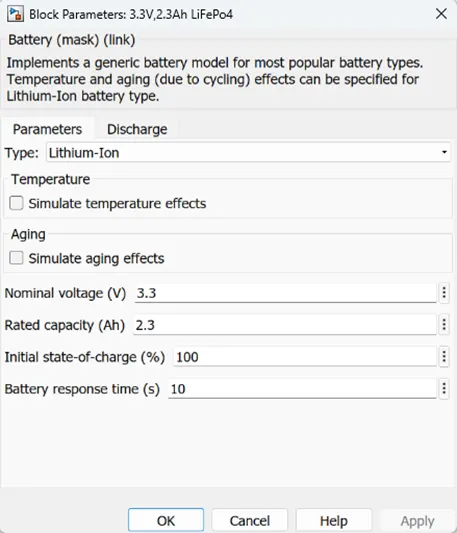
we can observe the nominal voltage is 3.3V and nominal capacity is 2.3Ah
Signal Builder
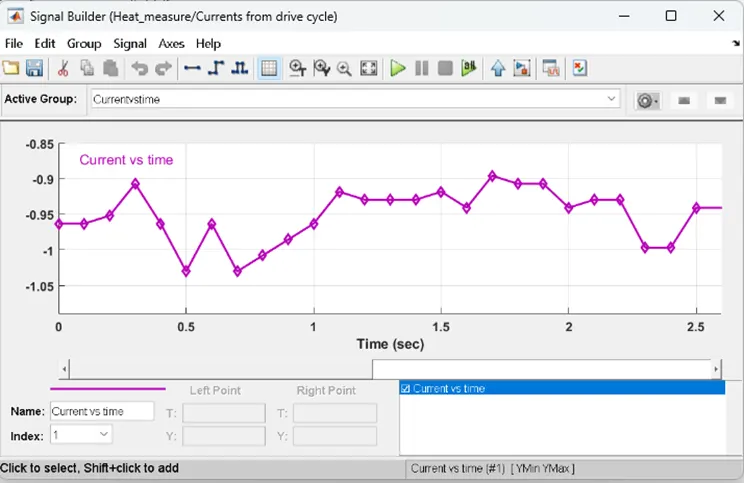
The given drive cycle data is loaded to the signal builder block as below
Simulation Diagram:
SoC% Calculation for 208 seconds
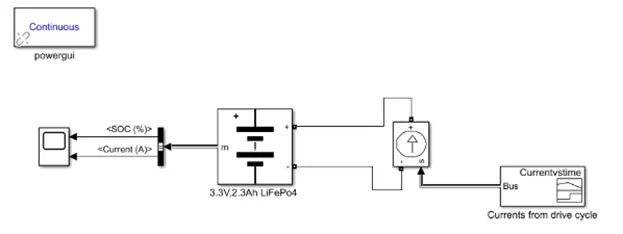
The generic battery with 3.3V, 2.3Ah is connected to a Controlled current source with the current reference from the signal builder block in which the signal builder block is loaded with the currents with respect to time values from the given table. The simulation run time is set to 208 seconds.
Maximum Heat Generated Calculation
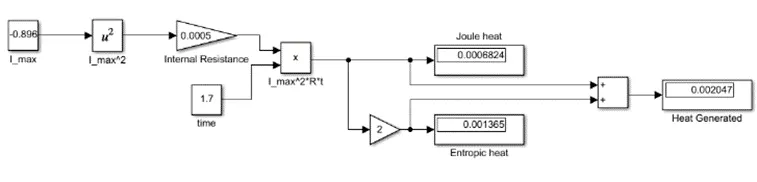
We can observe that the maximum current is taken from the given table the maximum joule heat is calculated first and maximum entropic heat next. The maximum heat generated is calculated using the Simulink fundamental and basic blocks
Results:
Let us see the SoC% and Currents for the given battery currents and simulation run time
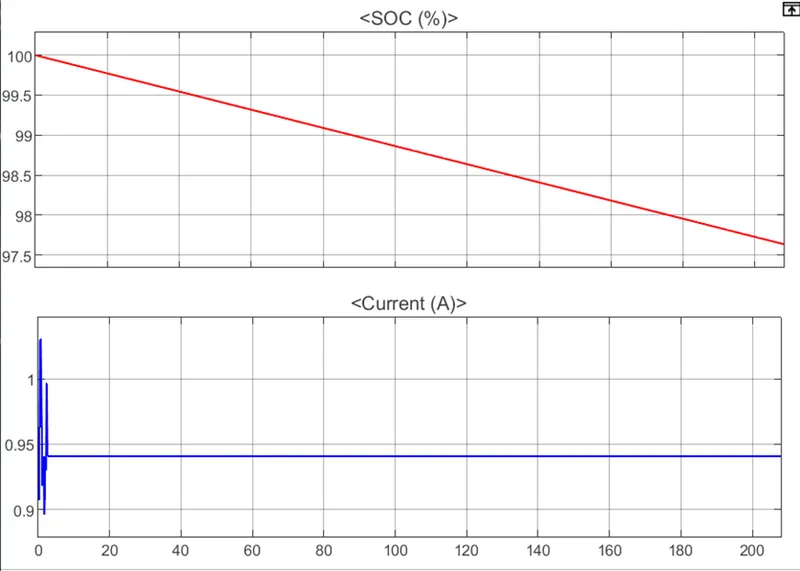
We can observe the SoC% decrease over the discharge for 208 seconds as we are only giving the Reference current for only 2.6 seconds, if we observe the current wave from up to 2.6 seconds the current discharged from the battery is with respect to the reference currents that are loaded in the signal builder block after 2.6 seconds the Simulink automatically averaged the currents that are given as the reference and discharged for the remaining 205.4 seconds this is the reason the SoC% is gradually decreasing over the 208 seconds even though the reference current is only for 2.6 seconds
Now we will go for results of Maximum Heat generated in the battery
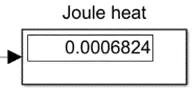
The maxim current in the given reference currents is -0.896A at 1.7seconds by this we calculated the maximum Joule heat which is
And given the entropic ratio is 2 so,
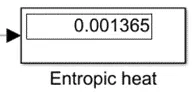
The maximum Entropic ratio is
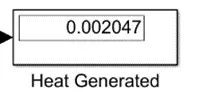
Now the Maximum Heat generated in the battery is
By observing the above results we can say that
The SoC% of the battery at 2*104s=208s is 97.7%
The Maximum Joule heat is 0.0006827J
The Maximum entropic heat is 0.001365J
The maximum Heat generated in the battery is 0.002047J
Conclusion:
A Battery model is designed in the Simulink with the given currents data and given specifications, Calculated SoC% for 208seconds of simulation run time, and also Calculated Maximum heat generated in the battery.