Project 2
AIM:
Calculate the water current forces ,centrifugal forces, wave forces, snow loads, temperature loads, Barge Impact load for the bridge structure.
GIVEN:
- The maximum crest elevation for the wave is 3 m.
- I Girder is 1.6 m height with a top and bottom flange width of 2m.
- The thickness of flange and web is 0.3m.
- Assume constant r as 5.
- Assume Cva as 3.
- The Storm elevation is 8.5m. Take Cr as 0.4
- The high flood level is 4 m above the Bottom of foundation level.
- The span of the bridge is 10 m.
- The mean velocity of the river is 2.5 m/s.
- Width of carriage way is 9 m.
- bridge is subjected to a live load of Class 70R tracked vehicle and radius of curvature in the bridge is 2 m.
- The design speed of the vehicles is 50 km/hr.
- The size of the Pier is 1.2 x 1.2 m.
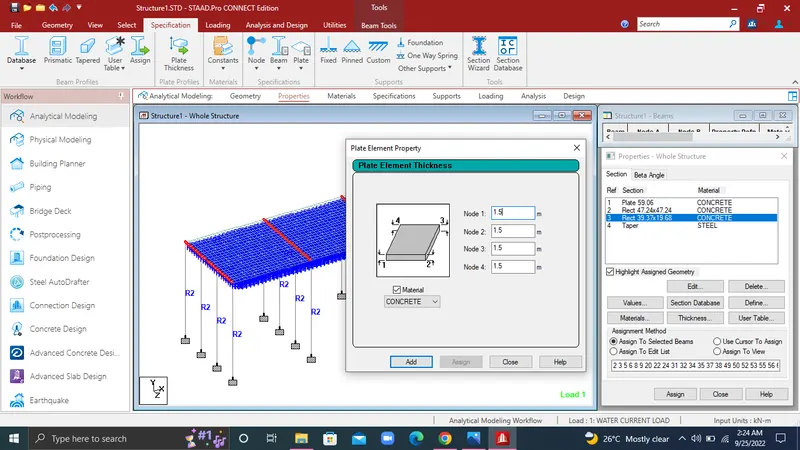
- The width of deck slab is 10.5m and the thickness of deck slab is 1.5 m.
- The deck of bridge is flat with B <30 degree. The depth of accumulation of snow is 1250 mm.
- The Dead weight tonnage of Panamax vessel is 25000 DWT.
- The Ship can accommodate maximum of 1500 containers. Each container is of standard 6.1 TEU.
PROCEDURE:
1.First creat a node
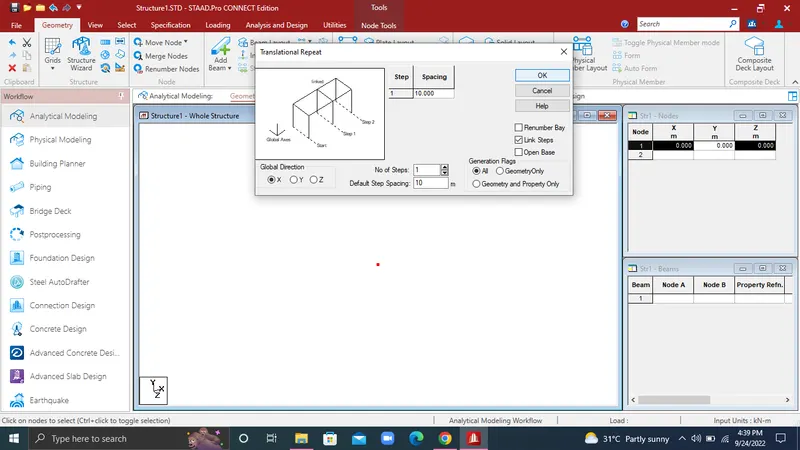
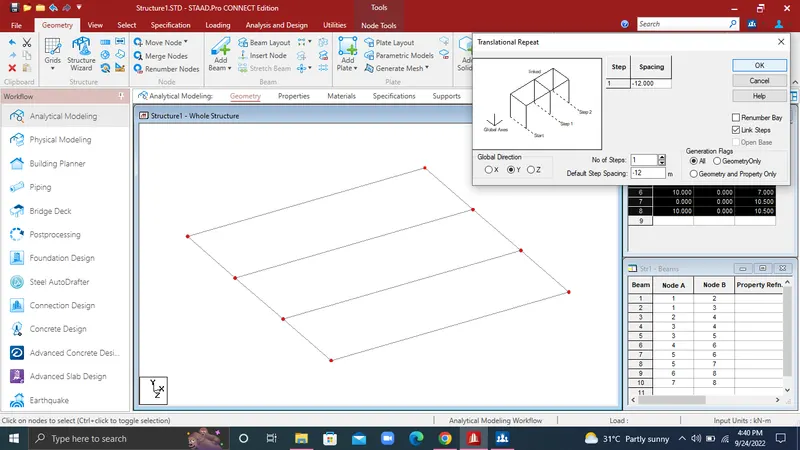
2. Then creat beams in this structure and selecte the corner nodes use reputing command Y direction 12m
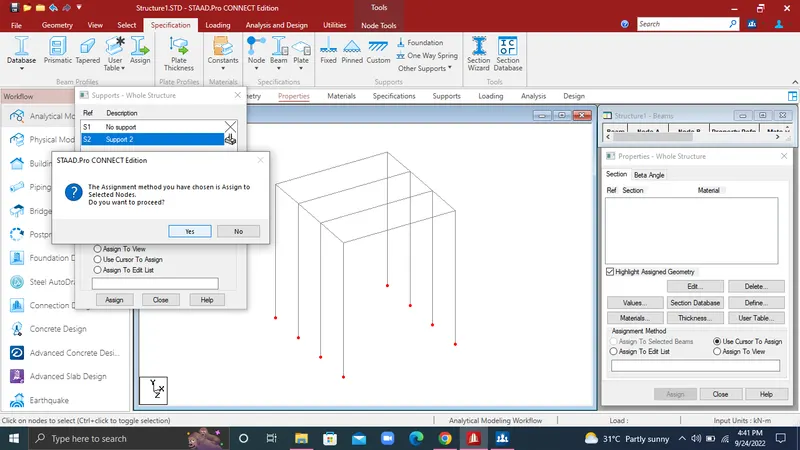
3.This design is fixed supports
4.Use reputing command X direction 3 steps, 10m spacing
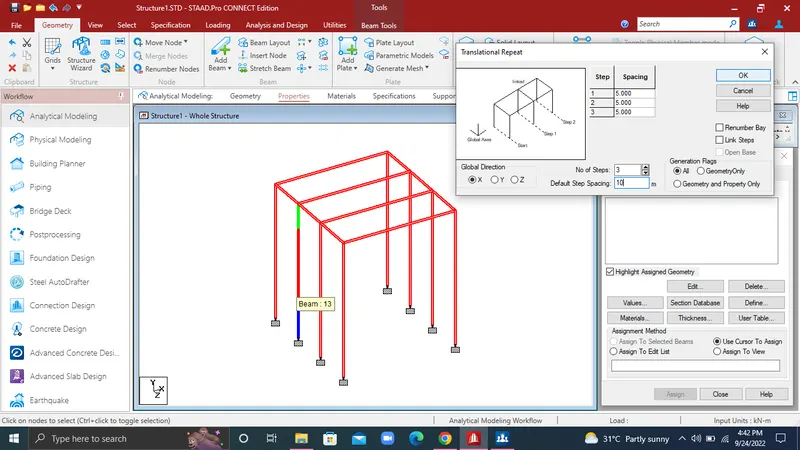
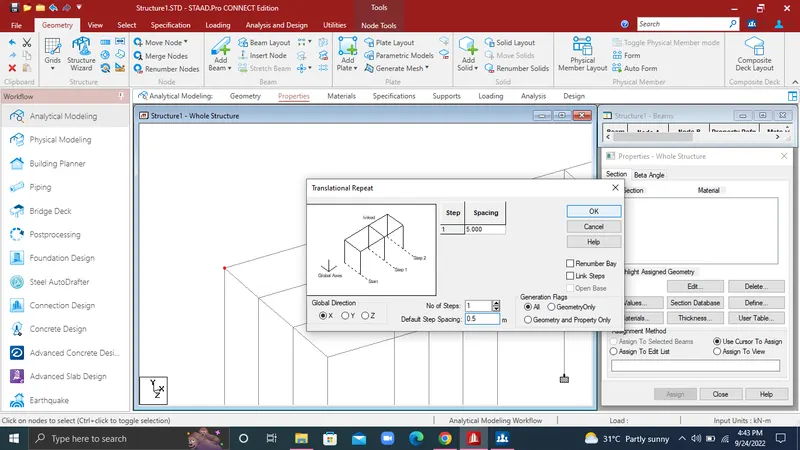
5.Creat a plate in 0.5m spacing and apply in deck slab fully
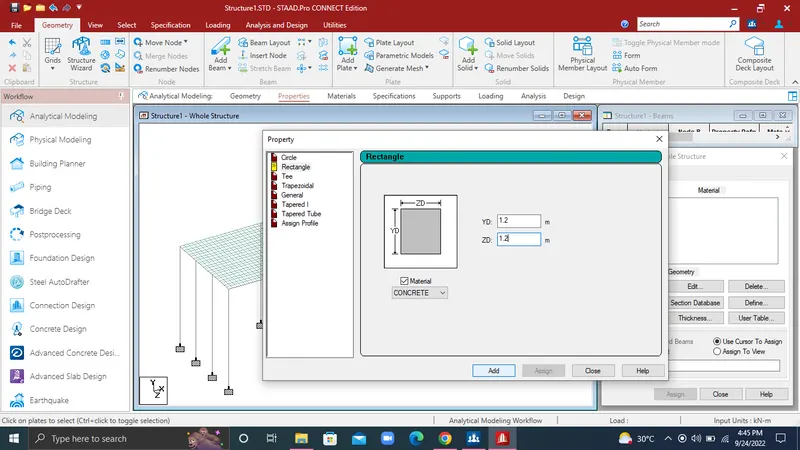
6.Piers size is 1.2m X 1.2m
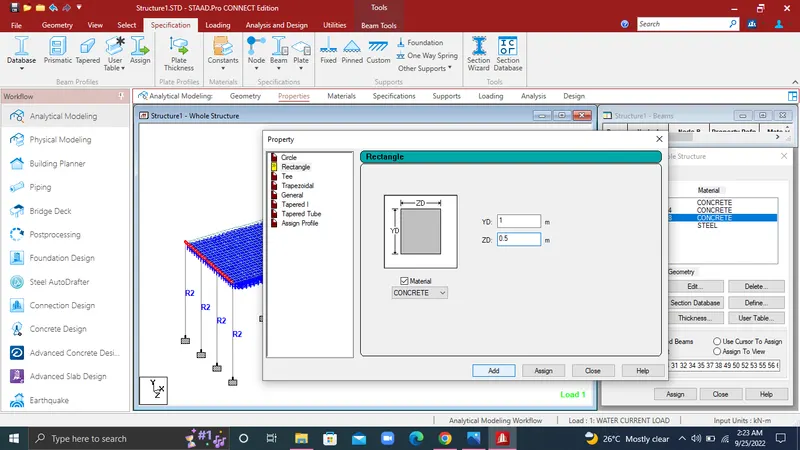
cross beams 1m X 0.5m
X Direction beams are I girder
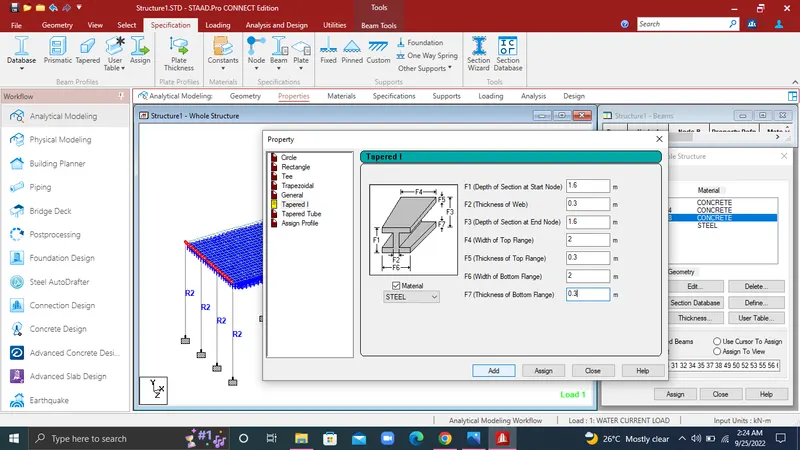
The plates thickness is 1.5m
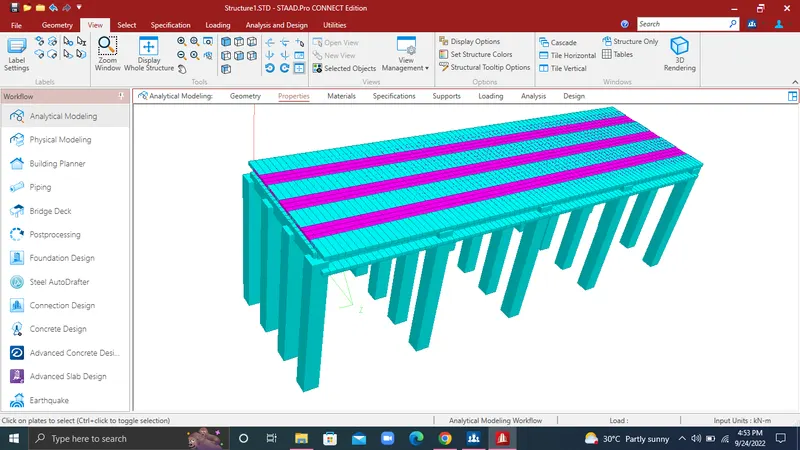
7.3D view
1.WATER CURRENT LOAD
Maximum velocity V = square root of 2 X Vmean
= square root of 2 X 2.5 m/s
Vmax = 3.535 m/s
Water current, P = 52 X K X V^2
= 52 X 1.5 X ( 3.535 )^2 ( Square ended peirs 1.5 )
P = 974.7055 kN/m2
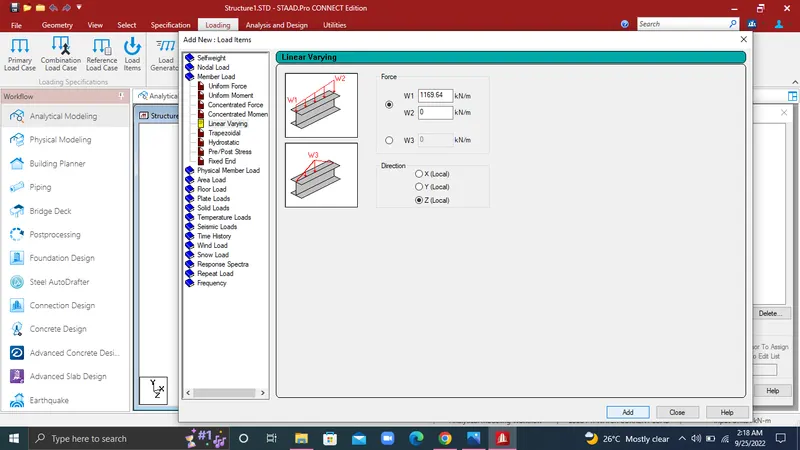
P is area load, 974.7055 x 1.2 m pier = 1169.64 kN/m
8.Go to load cases detailes > add > WATER CURRENT LOAD > add
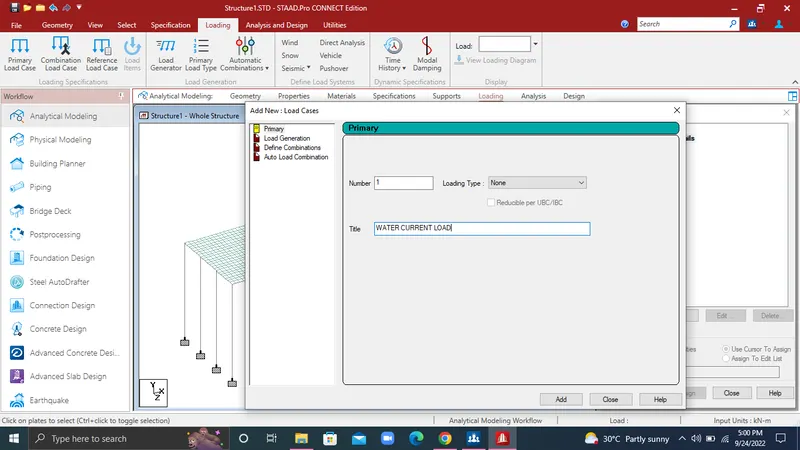
9.WATER CURRENT LOAD > add > member load > linear varying > w1 974.7055 > Z local
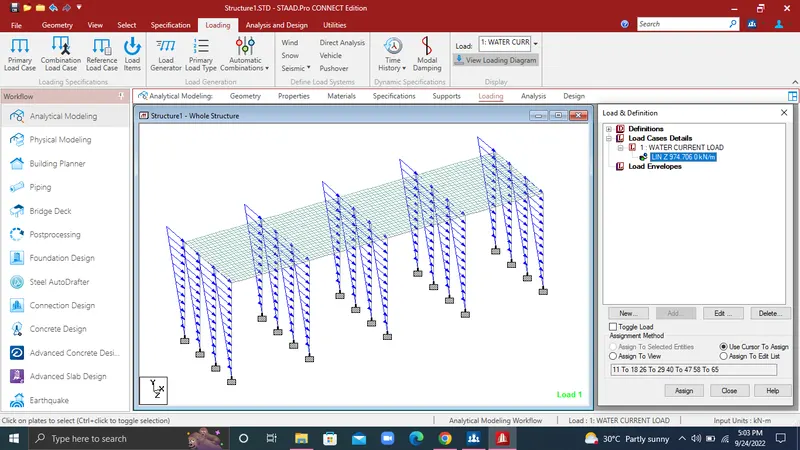
10.All the piers to be asign the load
2.CENTRIFUGAL LOAD
C = WV^2/127R
= 70 X 50 X 50 / 127X 2
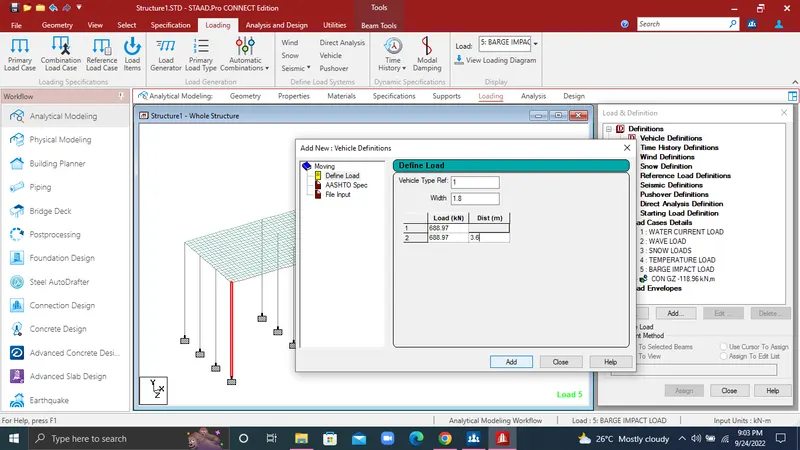
C = 688.97kN
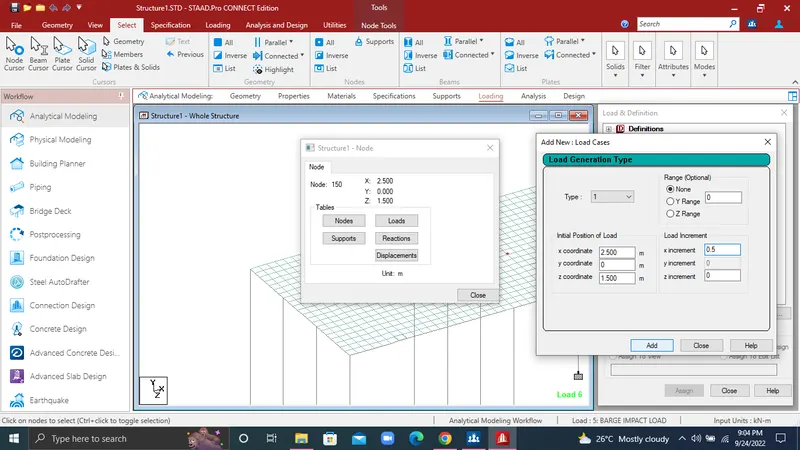
11.Definition > vehicle definition > load 688.97, dist 3.6 > width 1.8m
12.Load cases detailes > add > load generaion > 50 loads > add
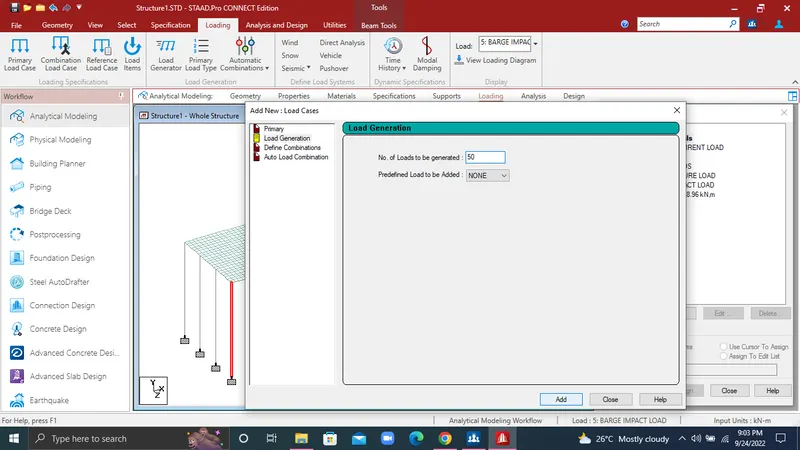
13.Generating loads > add > x=2.5,y=0,z=1.5 and increment is 0.5m
3.WAVE LOAD
Fv* = gama * Zv * Av
Fv* = 10 x 8.5 x (9 x 10)
= 7650 kN
Fh* = gama * Zh * Ah
Fh* = 10 x (8.5 + (1.5+1.6)/2) x (3.1 x 10)
= 3115.5 kN
Fvmax = Cva-v * Fv*
Fvmax = 3 x 7650
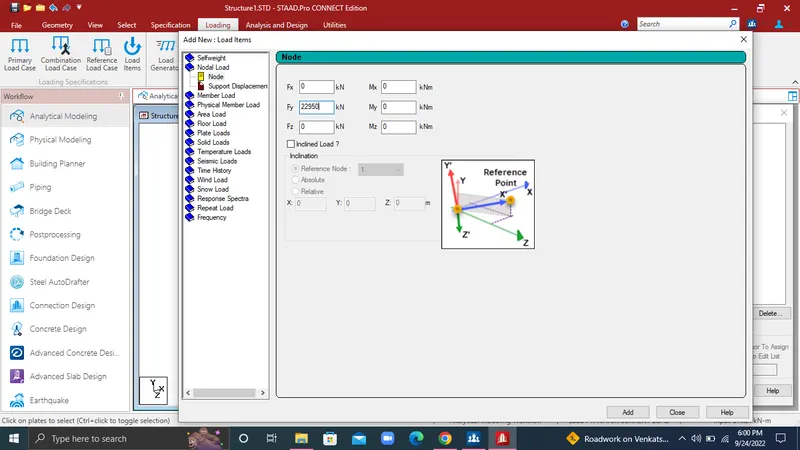
= 22950 kN
Fhmax = (1+ Cr (N-1)) * Cva-h * Fh*
Fhmax = (1+0.4 x (4-1)) x 3 x 3115.5
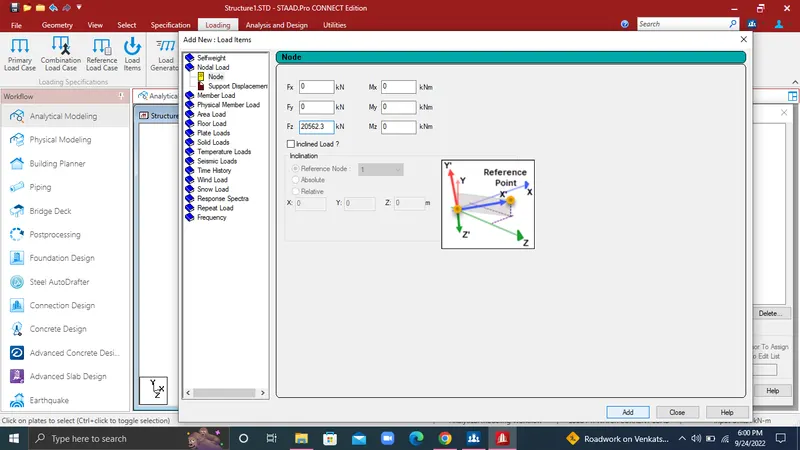
= 20562.3 kN
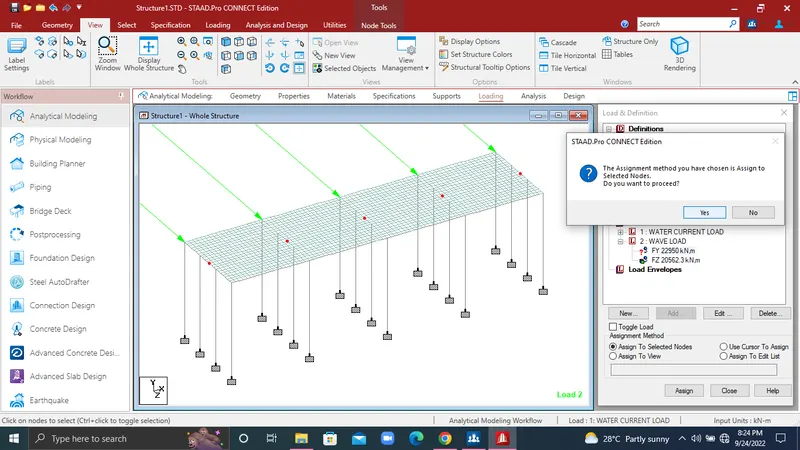
14.Load case detailes > wave loads > add > nodal load > node > Fy = 22950
15.Load case detailes > wave loads > add > nodal load > node > Fz = 20562.3
16.Select the Fz load and asign the selected nodes in Z direction
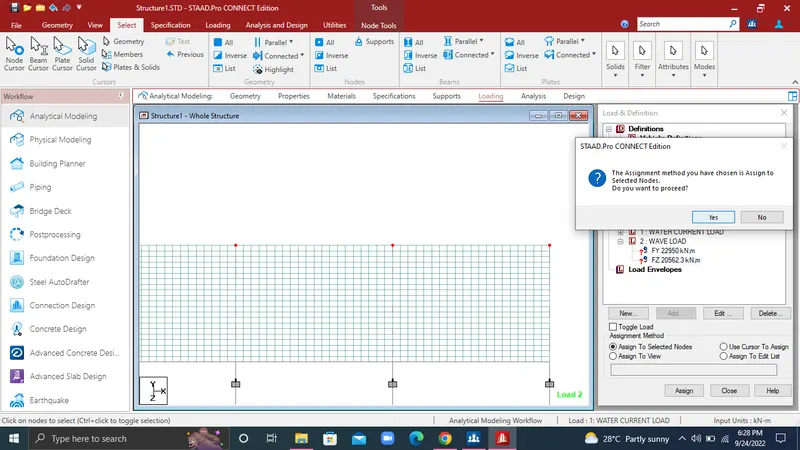
17.Select the Fy load and asign the selected nodes Y direction
4.SNOW LOAD
Density of settled snow = 2 to 3 kN/m3
Let us assume the density of settled snow = 3kN/m3
Snow load, S0 = 3 x 1.25 x 10
SnowLoad, S0 = 37.5 kN/m
For β">β< 30 deg, μ">μ=0.8
S = μ">μ S0
S = 0.8 x 37.5 = 30kN/m
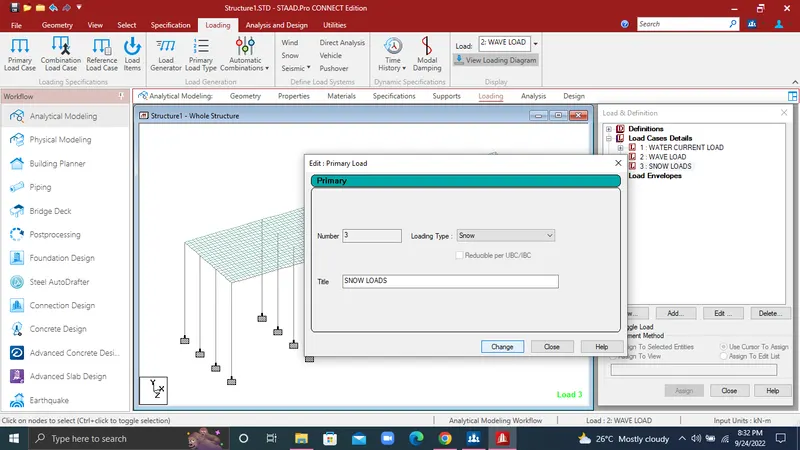
18.Load case details > snow load > add
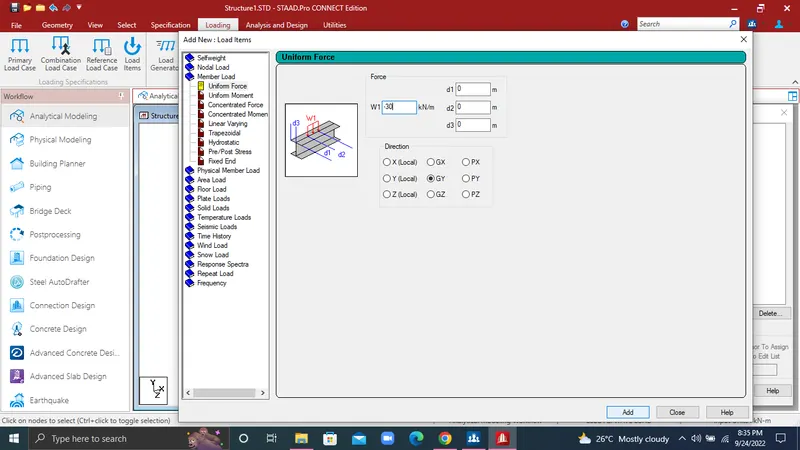
19.Snow load > add > member load > uniform force > W1 = -30 > GY
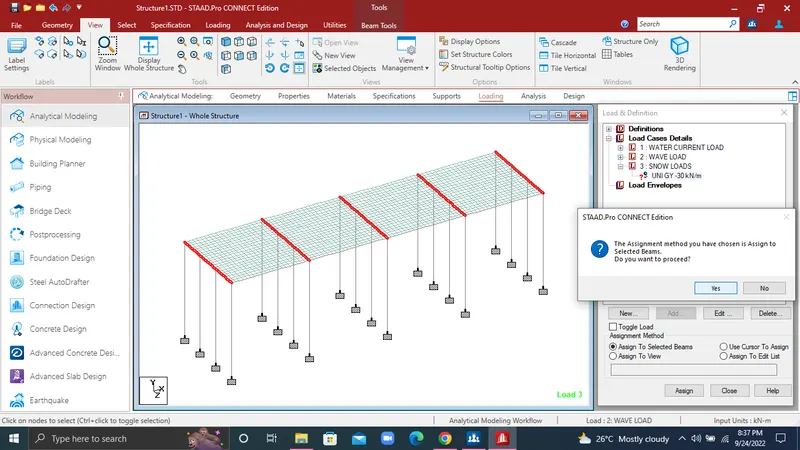
20.The load asign in cross beams
5.TEMPERATURE LOAD
Effective temperature difference = (47.5-0)/2+10 = 33.75 degree celcius
Stress due to temperature = α">αδ">δT E = 11.27 x 10-6 x 47.5 x 5000 x squre root of(40) = 16.92 kN/m2
Maximum permissible stress = 2/3 x 0.7 x squre root of (fck) = 2/3 x 0.7 x squre root of (40) = 2.95 kN/m2
Hence stresses are restricted to 3kN/m2
Positive temperature difference : (Delhi)
Temp at top = 47.5 degree celcius
Temp at bottom = 2.1/17.8 x 47.5 = 5.603 degree
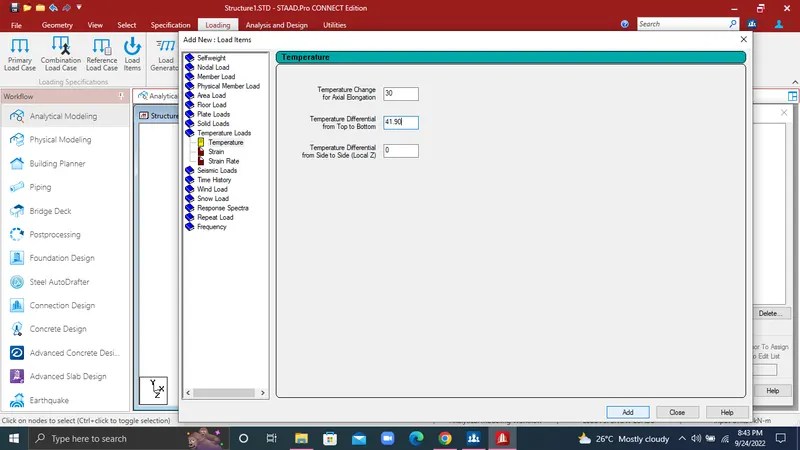
21.Load case detailes > add > temperature load > add
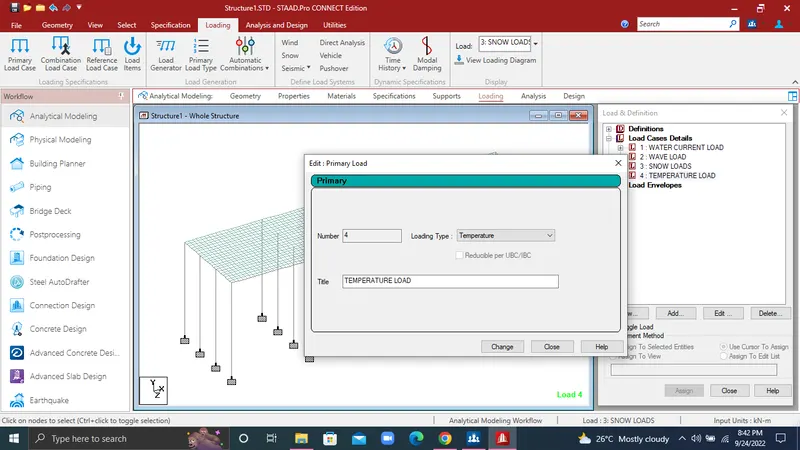
22.Temperature load > temperature load > axial elongation 30, top to bottom 41.90
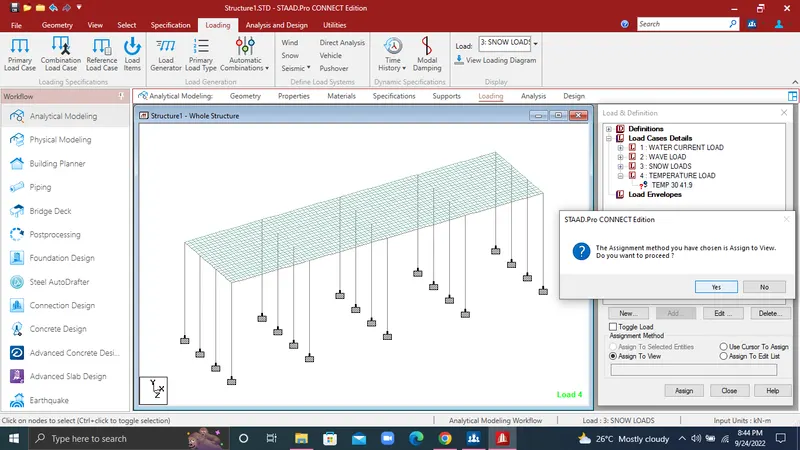
23.Select a load > asign to view
6.BARGE IMPACT LOAD
Barge Collision energy KE = 500 CH W V^2
KE = Barge collision energy Nm
W = Barge displacement tonnage T
V = Barge impact speed m/s
CH = Hydrodunamic coefficient
CH = 1.05 to 1.25 for barges depending on under keel clearance available
CH = 1.05 if under keel clearance > 0.5 x draft
CH = 1.25 if under keel clearance < 0.1 x draft
KE = 500 x 1.24 x 25000 x (60 x 1000/ 60 x 60)^2 = 4.34 x 10^9 Nm
Barge damage depth aB = 3100 ((1+1.3 x 10^-7 KE )^0.5 -1) in mm
Barge damage depth aB = 3100 ((1+1.3 x 10^-7 x 4.34 x 10^9 )^0.5 -1) = 70.6 x 10^3 mm
Barge collision impact force PB shall be determined based on the following equations
For aB < 100 mm, PB = 6 x 10^4 aB in N
For aB >= 100 mm, PB = 6 x 10^6 +1600 aB in N
Here since aB>= 100mm,
Barge collision impact force PB= 6 x 10^6 + 1600 x (70.6 x 10^3) = 118.96 x 10^6 N
24.Load case detailes > Barge impact load > add > member load > concentrated force > p=-118.96, d1=6 > GZ
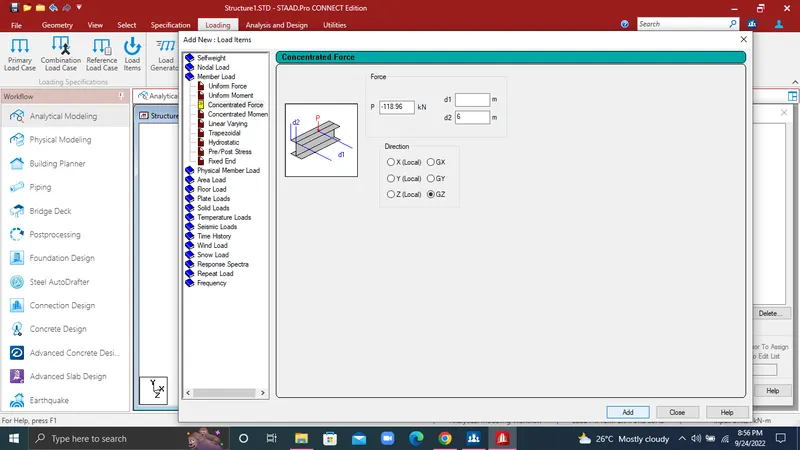
25. Asign to the load in first pier
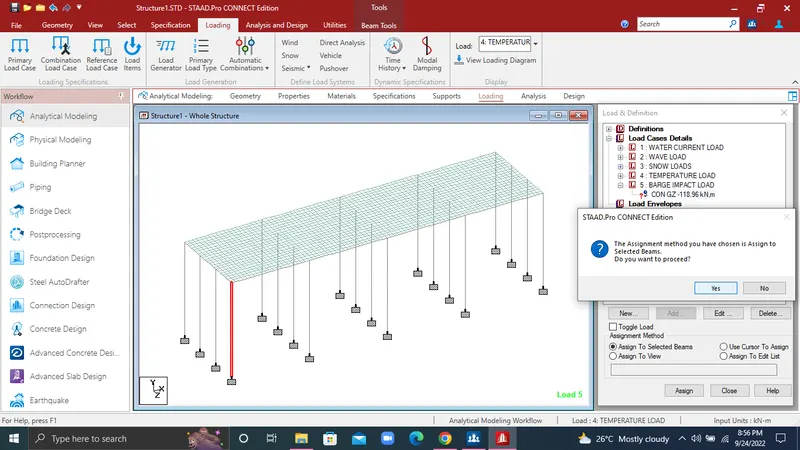
26.Go to analysis and run analysis
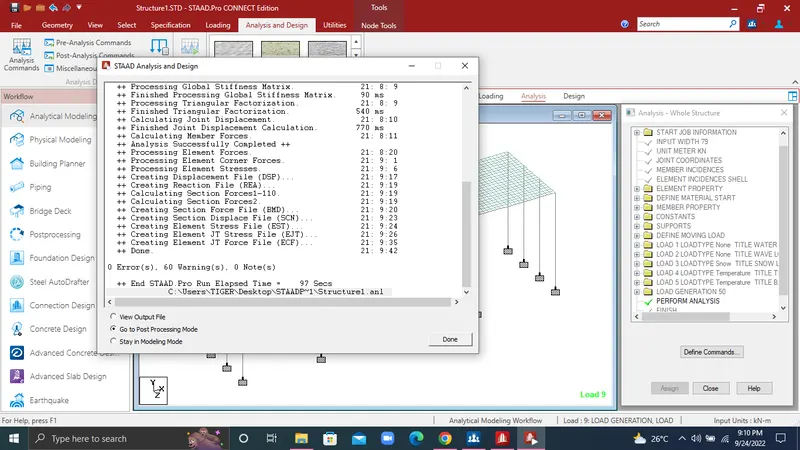
RESULTS:
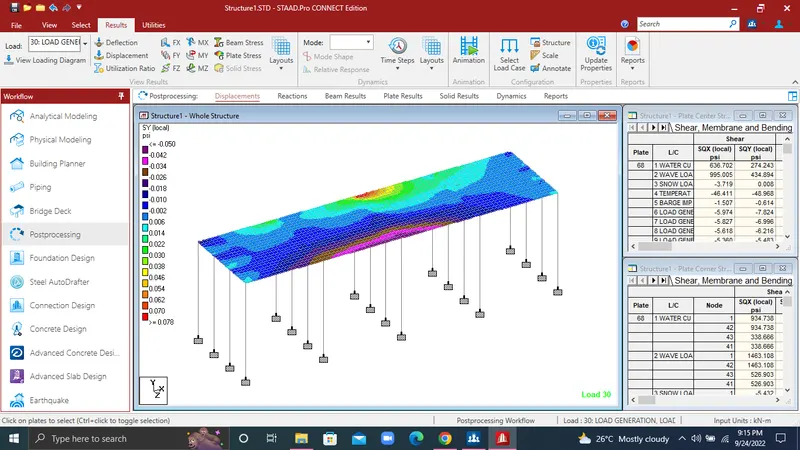
27.Deflaction
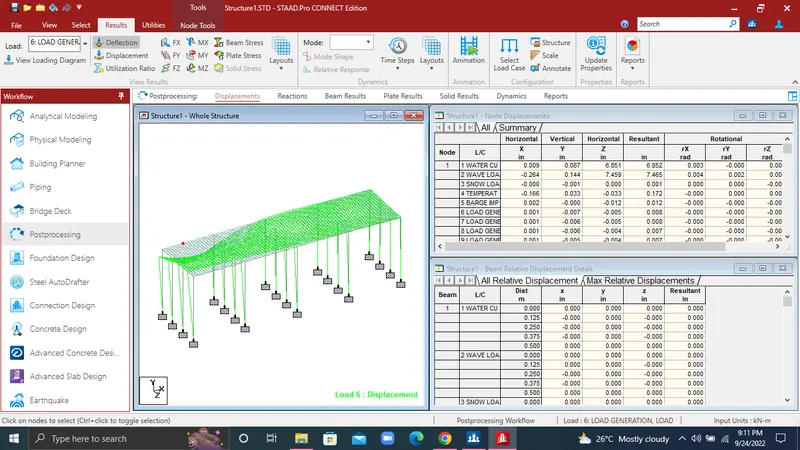
28.Displacement
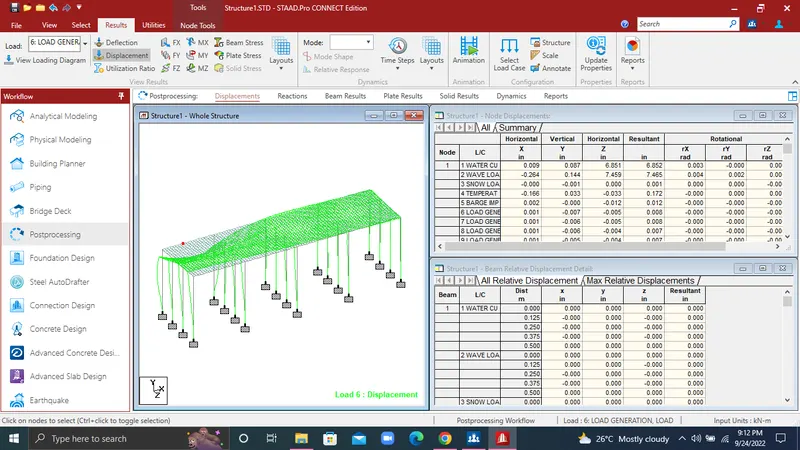
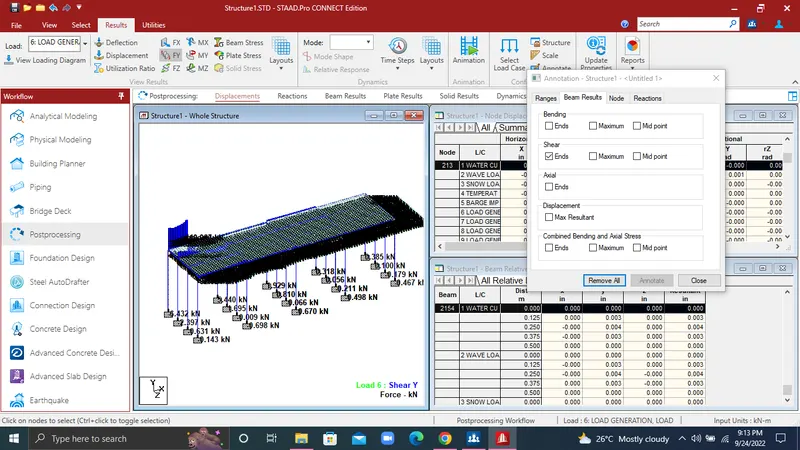
29.Shear FY
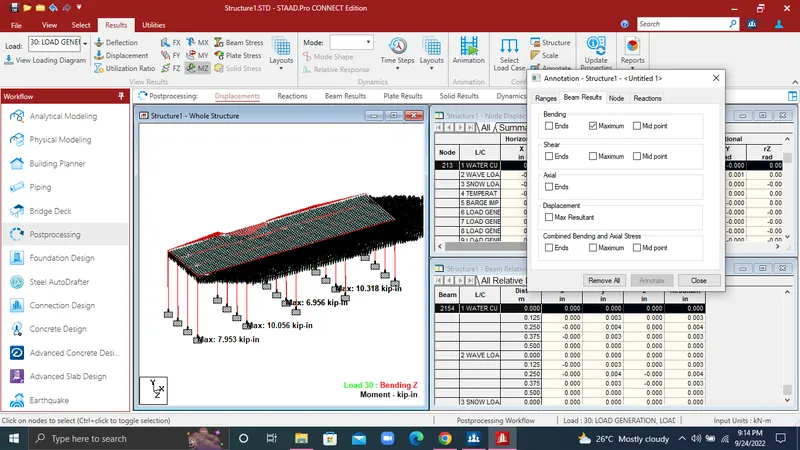
30.Bending moment MZ
31.MY local
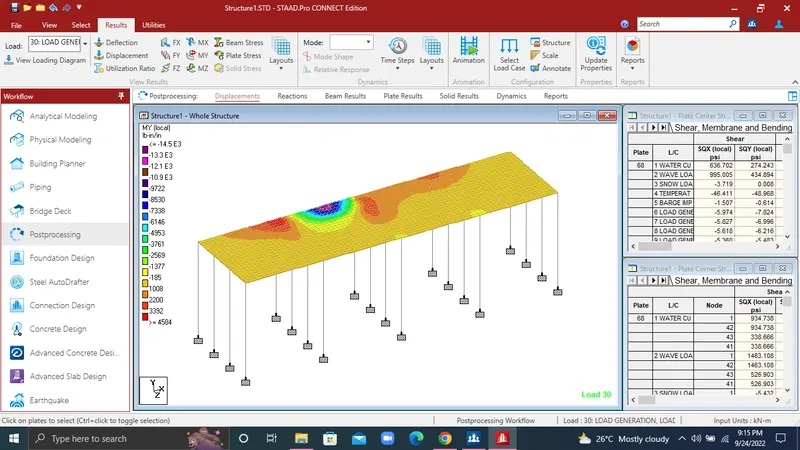
32.SY local