Project - 2
Additive Manufacturing of Customized Orthopedic Implants
Introduction
Orthopedic implants have revolutionized the field of orthopedic surgery, offering innovative solutions to restore mobility, alleviate pain, and improve the quality of life for millions of individuals worldwide. These implants play a vital role in treating conditions such as fractures, joint degeneration, and musculoskeletal disorders.
In recent years, Additive Manufacturing (AM), also known as 3D printing, has emerged as a groundbreaking technology in the production of orthopedic implants. Unlike traditional manufacturing methods, which often involve subtractive processes like cutting and milling, AM builds components layer by layer, enabling the creation of complex geometries with enhanced precision and customization.
Integrating AM into the fabrication of orthopedic implants offers several advantages. Firstly, it allows for the production of patient-specific implants tailored to individual anatomies, optimizing fit and function. Additionally, AM facilitates the incorporation of advanced materials, such as titanium alloys and biocompatible polymers, known for their strength, durability, and biocompatibility.
Moreover, the design flexibility afforded by AM enables the development of implants with intricate lattice structures, mimicking the mechanical properties of natural bone and promoting osseointegration—the process by which the implant fuses with the surrounding bone tissue.
In this project, the focus is on harnessing the capabilities of Additive Manufacturing to design and manufacture an orthopedic implant. By leveraging the advantages of AM technology, we aim to create a customized implant that not only meets the specific needs of the patient but also enhances surgical outcomes and long-term implant performance.
Through meticulous design, precise fabrication, and rigorous testing, the advancement of orthopedic care, ultimately improving the quality of life for individuals in need of orthopedic interventions.Top of Form
Literature Survey
Additive manufacturing for orthopedic implants: morphological and material characterization of SLM thin Ti6Al4V samples
|
https://www.sciencedirect.com/science/article/pii/S2452321624001884
|
Functionally graded additive manufacturing for orthopedic applications
|
https://www.sciencedirect.com/science/article/abs/pii/S0972978X22001490
|
3D printing metal implants in orthopedic surgery: Methods, applications and future prospects
|
https://www.sciencedirect.com/science/article/pii/S2214031X2300058X
|
Recent advances of additive manufacturing in implant fabrication – A review
|
https://www.sciencedirect.com/science/article/pii/S266652392300096X
|
An overview of 3D printed metal implants in orthopedic applications: Present and future perspectives
|
https://www.sciencedirect.com/science/article/pii/S2405844023049265
|
Resource planning for direct fabrication of customized orthopedic implants using EBM technology |
https://www.sciencedirect.com/science/article/abs/pii/S0278612521001400
|
Additive Manufacturing for orthopedic applications: Case study on market impact |
https://www.sciencedirect.com/science/article/pii/S1877050922023481
|
Research progress on nanocellulose and its composite materials as orthopedic implant biomaterials |
https://www.sciencedirect.com/science/article/pii/S1110016824000036
|
Mechanical interaction between additive-manufactured metal lattice structures and bone in compression: implications for stress shielding of orthopaedic implants |
https://www.sciencedirect.com/science/article/abs/pii/S1751616121002897
|
Scope of the Project Work:
The scope of the present work encompasses the following key aspects:
1. Understanding Additive Manufacturing Steps
Explore various types of orthopedic implants, such as hip, knee, and spine implants, and their applications.
Select a specific orthopedic implant model that is crucial for the patient's condition and age group.
Determine the most suitable AM method (e.g., Selective Laser Melting, Fused Deposition Modeling) and material (e.g., Titanium Alloy, Cobalt-Chromium) for manufacturing the chosen orthopedic implant.
2. Powder/Wire Testing
Proposed Tests on 3D AM Implant:
Mechanical Testing (Tensile Strength, Compression Strength)
Biocompatibility Testing (Cytotoxicity, Hemocompatibility)
Dimensional Accuracy and Surface Finish Evaluation
3. Creating a 3D Model and Converting it into STL File
Develop a detailed 3D model of the selected orthopedic implant using Computer-Aided Design (CAD) software.
Convert the 3D CAD model into an STL (Stereolithography) file format, which is compatible with AM processes.
3d Orthopedic implants:
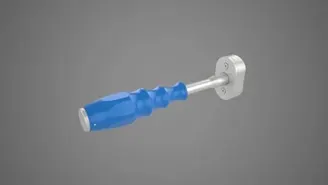
Types of orthopedic implants
Orthopedic implants encompass a wide range of devices designed to address various musculoskeletal conditions and injuries. These implants can be classified based on their function, anatomical location, and materials used. Here are some common types of orthopedic implants:
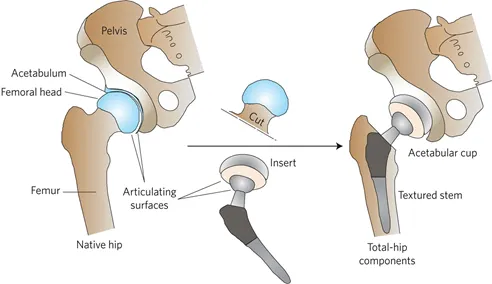
Joint Implants:
· Total hip replacement implants
· Total knee replacement implants
· Total shoulder replacement implants
· Total elbow replacement implants
· Total ankle replacement implants
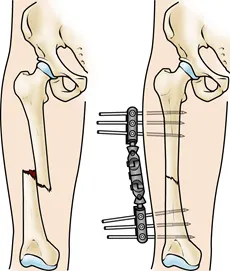
Fracture Fixation Implants:
· Plates and screws: Used to stabilize fractures and facilitate bone healing.
· Intramedullary nails: Inserted into the medullary canal of long bones to provide stability and support during fracture healing.
· External fixation devices: Utilized in complex fractures or cases where internal fixation is not feasible.
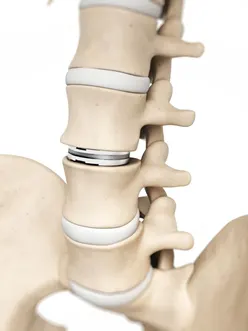
Spinal Implants:
· Pedicle screws: Used in spinal fusion procedures to stabilize the spine and promote fusion.
· Interbody cages: Placed between vertebrae to restore disc height and stability in spinal fusion surgery.
· Artificial discs: Designed to replace damaged intervertebral discs and preserve spinal motion.
Orthobiologics:
· Bone grafts: Used to promote bone healing and regeneration in fractures, non-unions, and spinal fusion.
· Growth factors: Biological substances that stimulate bone formation and enhance the healing process.
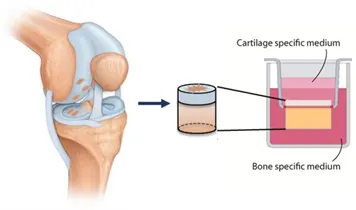
· Cartilage implants: Used in procedures such as cartilage repair and joint reconstruction to restore damaged cartilage.
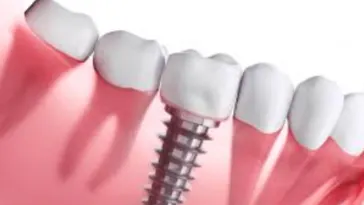
Dental Implants:
Dental implants replace missing teeth by integrating with the jawbone and supporting artificial teeth or dental prostheses.
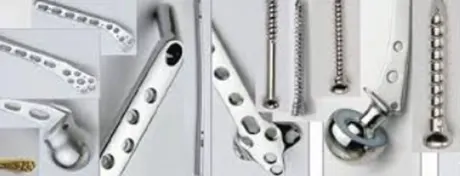
Trauma Implants:
· Intramedullary rods
· External fixation devices
· Bone plates and screws
Sports Medicine Implants:
· Ligament reconstruction devices
· Meniscal implants
· Tendon repair devices
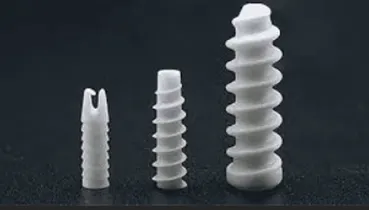
Osteosynthesis Implants:
Fixation devices used to stabilize bone fragments and facilitate fracture healing.
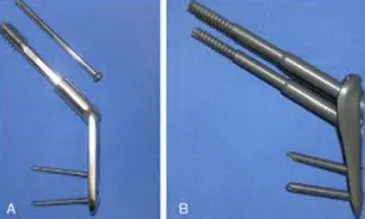
These are just a few examples of orthopedic implants, and the field continues to evolve with advancements in materials, design, and surgical techniques. Each type of implant serves a specific purpose in orthopedic surgery, aiming to restore function, relieve pain, and improve the quality of life for patients with musculoskeletal conditions and injuries.
Description of Manufacturing Process:
· The manufacturing process involves the following steps:
- · Preparation: Preparing the AM machine and the selected material in powder or wire form.
- · 3D Printing: Utilizing the chosen AM method to print the orthopedic implant layer by layer, based on the STL file.
- · Post-Processing: Removing support structures, cleaning, and surface finishing to achieve the desired implant specifications.
- · Testing: Conducting the proposed tests on the 3D printed implant to ensure quality, safety, and performance.
Conclusions
This report provides a comprehensive methodology for designing and manufacturing customized orthopedic implants using AM techniques. The integration of advanced AM technologies with personalized healthcare solutions offers promising opportunities for improving patient outcomes and quality of life.
Suggestions for Improvement
· Optimization of AM Parameters: Further research on optimizing AM parameters to enhance the mechanical properties and biocompatibility of the implants.
· Material Development: Exploring new materials with improved properties for AM-based orthopedic implants.
· Advanced Testing Methods: Incorporating advanced testing methods for comprehensive evaluation of AM-made orthopedic implants.
The systematic approach outlined in this report serves as a foundation for developing customized orthopedic implants using Additive Manufacturing methods. Continuous research, innovation, and collaboration across disciplines are essential for advancing the field of personalized medicine and improving patient care.