Project - 2
Additive manufactured in Human Orthopedic Implants-
Introduction-
- The technique of combining materials to produce products from three-dimensional model data, usually layer upon layer, as opposed to subtractive fabrication manufacturing procedures such as ordinary milling and machining, has been termed as additive manufacturing (AM).
-
Additive manufacturing (AM), also known as 3D printing, has been increasingly used in the manufacturing of orthopedic implants due to its ability to create complex geometries that cannot be produced using traditional manufacturing techniques.
-
As of my knowledge cut-off in 2021, the global market for AM in orthopedic implants was estimated to be around $450 million and is expected to grow at a compound annual growth rate (CAGR) of around 20% from 2021 to 2028, according to a report by Grand View Research. The report cites factors such as the increasing prevalence of orthopedic disorders, rising demand for minimally invasive surgeries, and advancements in AM technology as the main drivers of this growth.
Common processes and principles of additive manufacturing.-
Table I
ASTM standard terminology for additive manufacturing technologies
| Term | Description |
|---|---|
| Binder jetting | Layers of powder are joined by deposited liquid bonding agents |
| Direct energy deposition | Laser is used to fuse materials by melting as they are being laid down |
| Material extrusion | Material is dispensed through a nozzle to form an object |
| Material jetting | Droplets of build material are laid down |
| Powder bed fusion | Thermal energy (e.g. laser) selectively fuses regions of powder bed |
| Sheet lamination | Sheets of material are cut and bonded to form an object |
| Vat photo-polymerization | Liquid photopolymer is selectively cured by light activated polymerization |
Literature Survey-
| Author(s) | Year | Study Aim | Methods | Key Findings |
|---|---|---|---|---|
| Liu et al. | 2020 | To evaluate the biomechanical performance of 3D printed titanium acetabular cups | Finite element analysis | The 3D printed titanium cups showed similar biomechanical performance as traditional cups, with the potential for improved osseointegration |
| Cai et al. | 2020 | To investigate the mechanical properties and biocompatibility of 3D printed PEEK spinal cages | Mechanical testing and in vitro studies | The 3D printed PEEK cages exhibited favorable mechanical properties and biocompatibility, suggesting their potential as a viable alternative to traditional cages |
| Zhang et al. | 2019 | To evaluate the clinical outcomes of 3D printed titanium humeral stems in patients with osteonecrosis of the femoral head | Retrospective clinical study | The 3D printed titanium stems resulted in significant improvements in pain and function, with no implant failures or complications reported |
| Li et al. | 2018 | To compare the clinical outcomes of 3D printed titanium mandibular reconstruction plates to traditional plates | Retrospective clinical study | The 3D printed titanium plates showed similar clinical outcomes to traditional plates, with a lower rate of postoperative complications and shorter operating time |
| Wang et al. | 2017 | To investigate the feasibility of 3D printing customized tibial prosthesis | Case report | The 3D printed tibial prosthesis resulted in good functional outcomes and patient satisfaction, with a shorter operation time and lower blood loss compared to traditional prosthesis |
Scope of the Project Work -
Steps in Additive Manufacturing -
1. Design:
- CAD software is used to create a 3D model of the object to be printed in additive manufacturing.
- The design must consider the application, material properties, and 3D printing limitations.
2.Preprocessing:
- After designing, 3D printing requires preprocessing.
- The 3D model is sliced into thin horizontal layers and printed one on top of the other.
- The 3D printer uses code from the slicing software.
3.Printing:
- The 3D printer reads the code and layers the object.
- A nozzle or laser selectively fuses thermoplastic material extruded by the printer.
- The printer repeats until the object is finished.
4.Post-processing:
- After printing, the object may need to be sanded, finished, or removed support structures.
5.Testing:
- Finally, test the printed object to ensure it meets specifications and performance criteria.
- Tensile, compressive, fatigue, and dimensional accuracy tests are possible.
Types of orthopedic implants-
Orthopedic implants serve different purposes. Common orthopaedic implants are:
- Bone plates support and stabilise broken bones during healing. Metal screws attach them to the bone.
- Screws fix bones and other structures. They are used with bone plates and other implants in various sizes and shapes.
- Rods stabilise the spine and other long bones. Metal bone marrow canal implants are common.
- Joints-Hip, knee, and shoulder implants replace damaged or diseased joints. Metal, plastic, or ceramic implants can be secured with bone cement or by allowing bone to grow into them.
- Cages - Spinal fusion surgery uses cages to stabilise and grow bone. They contain titanium and bone graft.
- Prostheses replace missing or damaged body parts. They can be made of metal, plastic, or silicone to fit a patient's anatomy.
Numerous orthopaedic implants treat a variety of conditions and injuries. The surgeon's diagnosis and the patient's needs determine the implant.
Orthopedic implant chosen for this project is a Hip implant-
- This project work shows how to make a custom hip implant from Ti-6Al-4V powder using patient computed tomography data.
- By partially decomposing the martensitic phase, different heat treatments improved tensile strength and elongation. Postoperative supervision showed good results, and the patient can move with the implant.
- An AM-produced custom hip implant is discussed in this project work.
- AM made custom hip implants quickly, reducing operation time and infection risk.
- We can see how to use AM and CT data from the patient's bone configuration to create individual acetabular revision systems for a revised endoprosthesis replacement of a Ti-6Al-4V alloy hip implant.
- CT data is used to 3D print a polymer model of the patient's deformed bone, resulting in a prototype implant for modelling the surgery process.
- The final model of the part can be used in production.
Scope of the orthopedic hip implant-
- A hip implant is intended to provide pain relief and improved mobility to patients suffering from hip joint degeneration or damage. A hip implant is a surgically implanted medical device that replaces a damaged hip joint. Hip implants are classified into three types: total hip replacement (THR), partial hip replacement (PHR), and hip resurfacing.
- The primary goal of a hip implant is to restore normal hip joint function, relieve pain, and improve the patient's quality of life. Metal, ceramic, and plastic, as well as a combination of these materials, can be used to make the hip implant.
- The best hip implant for a patient is determined by several factors, including the patient's age, weight, activity level, and degree of hip joint damage. To ensure the implant's longevity and success, surgeons must consider its biomechanical properties, such as stability, range of motion, and wear resistance.
- Furthermore, advances in additive manufacturing technology have enabled the development of customised hip implants that are tailored to a patient's specific anatomy. It is possible to create implants with intricate shapes and geometries that are not possible with traditional manufacturing methods by using additive manufacturing techniques. This method may result in a better fit and better implant performance.
- The overall goal is to improve the quality of life of patients suffering from hip joint dama.
Materials and Methods-
- A 3D Systems Sinterstation HiQ+HS machine used Selective Laser Sintering (SLS) to make a physical model of the patient's hip bone from DICOM file-formatted CT data.
- CAD-software designed the implant configuration after making a polyamide model of the patient's bone.
- Due to severe hip bone deformations, the implant's polymer clay model was based on the patient's anatomy. A Faro Platinum Arm scanner 3D-scanned the implant to create a CAD file.
Software-
- CAD software was used to partially texturize the implant surface.
Powdered or wired testing-
Powdered/wired testing methods of Ti 6AI 4V hip implant additive manufacturing typically include a range of quality control measures to ensure that the final product is safe and effective.
These methods may involve mechanical and metallurgical testing to evaluate the material's strength, ductility, and other properties.
Imaging and inspection techniques such as CT scanning and microscopy may also be used to identify any defects or irregularities in the final product.
Other testing methods may include fatigue testing, corrosion testing, and wear testing to evaluate the implant's durability and resistance to degradation over time. Ultimately, these testing methods are critical for ensuring the quality and safety of Ti 6AI 4V hip implants made using additive manufacturing.
- Plasma atomization produced the metal implant from Ti-6Al-4V Grade 5 powder. d10 = 27 μm; d50 = 47 μm; d90 = 76 μm. The particles are spherical without satellites
- The metal implant can be made using SLM Solutions SLM 280HL machine with parameters set to 99.9% relative density
- Manufactured implants are 200 μm accurate.
- In the figure we can see an AM titanium hip implant production sequence.
Microstructure analysis-
- Leica DMI 5000 light microscopes examined microstructure.
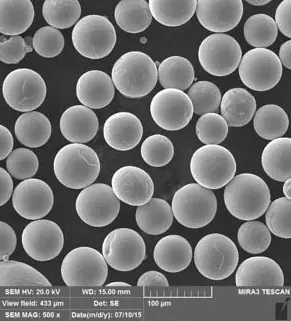
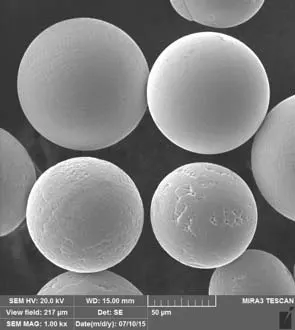
a) b)
Figure 1. a)X200 and b) X1000 SEM images of plasma-atomized Ti-6Al-4V powder particles.
- SLM standard samples were machined to ASTM E8/E8M size and tested on Zwick/Roell – Z100 machine.
- Each test point used three specimens.
- ALD MonoTherm vacuum furnaces were used to anneal at 10−3–10−4 mbar.
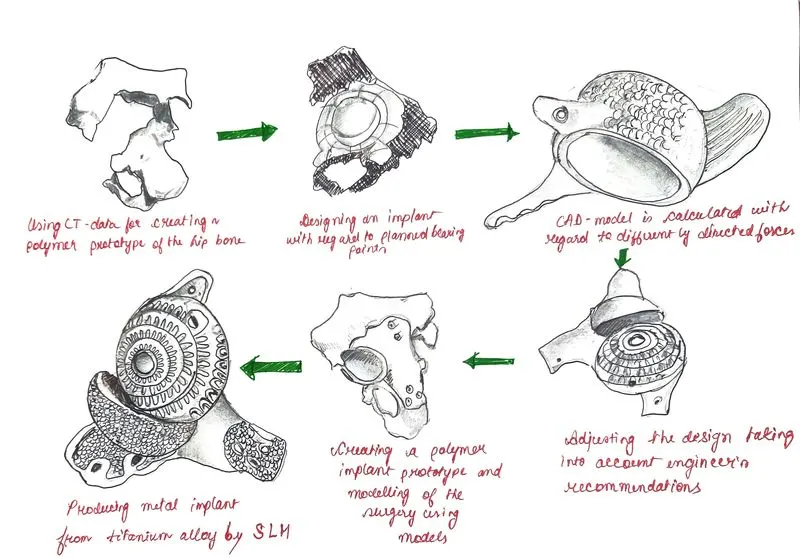
Fig :Sequence of operations used to produce an implant via additive manufacturing.
Results and Discussion of the project work
- By matching the patient's bone size and shape, a 3D hip bone model was created using CT data. SLS 3D-printed the polyamide hip bone model.
- After SLM, Ti-6Al-4V was heat-treated twice. Vacuum annealing parameters such as 950 °C for 1.5 hours and 800 °C for 4 hours; furnace cooling.
- Materialise Magics software can be used to position the implant's CAD model relative to the SLM machine's building plate.
- Support structures were also created to preserve the implant geometry.
- The implant orientation minimised thermal stresses and supports during SLM. Supports were placed on surfaces without special patterns to simplify removal and prevent support residue on the implant.
- Table 1 shows that the material meets the requirements of ASTM F2924–14 (Standard Specification for Additive Manufacturing Titanium-6 Aluminum-4 Vanadium with Powder Bed Fusion) and ISO 5832-3 in terms of its mechanical properties as a whole (Implants for surgery – Metallic materials –Wrought titanium 6-aluminium 4-vanadium alloy).
Conclusion-
- The ability of additive manufacturing technologies to successfully produce a custom-made component of a hip implant endoprosthesis from Ti-6Al-4V alloy was demonstrated.
Because the implant's configuration matches the anatomical features of the patient, the risk of early instability development is reduced, as is the surgery time, blood loss, and the risk of infectious complication development. The ability of SLM technology to create a texturized surface of the implant allows for the potential improvement of the osseointegration process by creating areas with high specific surface. - After annealing, martensitic α′-phase microstructures are partially decomposed into α- and β-phases. This mechanical properties meet ASTM F2924 for additively manufactured Ti-6Al-4V alloy and ISO 5832-3 Implants for surgery from titanium 6-aluminium 4-vanadium alloy. Annealed material has 1080 ± 10 MPa tensile strength and 10% elongation at break.
Sugestions for improvement-
- Future research can concentrate on osseointegration processes and improving mechanical properties through the use of different lattice structures, as well as computer simulation of implant and material characteristics.
Reference-
- https://www.ijb.sg/index.php/int-j-bioprinting/article/view/83
- https://www.sciencedirect.com/science/article/pii/S1005030216301335
- https://www.sciencedirect.com/science/article/pii/S2238785419318873
- https://www.sciencedirect.com/science/article/pii/S0143816620300993
- https://www.sciencedirect.com/science/article/pii/S2214860418309035
- https://www.sciencedirect.com/science/article/pii/S2351978919300332
- An J, Chua C K and Mironov V, 2016, A perspective on 4D bioprinting. International Journal of Bioprinting, vol.2(1): 3–5. http://dx.doi.org/10.18063/IJB.2016.01.003
- Doubrovski Z, Verlinden J C and Geraedts J M, 2011, Optimal design for additive manufacturing: opportun-ities and challenges. Volume 9: 23rd International Con-ference on Design Theory and Methodology; 16th Des-ign for Manufacturing and the Life Cycle Conference, August 28–31, 2001, 635–646. Washington, DC, USA. http://dx.doi.org/10.1115/detc2011-48131
- Gao W, Zhang Y, Ramanujan D, et al., 2015, The status, challenges, and future of additive manufacturing in engineering. Computer-Aided Design, vol.69: 65–89. http://dx.doi.org/10.1016/j.cad.2015.04.001
- Uhlmann E, Kersting R, Klein T B, et al., 2015, Additive manufacturing of titanium alloy for aircraft components. Procedia CIRP, vol.35: 55–60. http://dx.doi.org/10.1016/j.procir.2015.08.061