Project
Aim: System-level simulation of an all-terrain vehicle.
Description: The system-level simulation helps the designer understand the practicality and performance of the idea using a simulated mathematical model. Parametric sweep and optimization studies can be carried out for obtaining required output and improving the system efficiency. Taking an example of a developed model of an ATV employed with a CVT (continuously variable transmission), similar such simulation study is carried out.
Under the simulation study, the designer can:
- use the model as a reference for optimisation certain vehicle parameters.
- perform simplified emergency brake tests.
- run the vehicle on a bump.
- perform closed loop simulation to track the drive cycle and SOC (State of Charge).
Optimisation studies are carried out through the model when the model for the designed system does not behave appropriately despite the correct connections and settings. This may be due to incorrect selection of any of the input parameter of the powertrain. Error detection and rectification can be performed to correct the value of that parameter that was selected wrong.
The model of the ATV selected for the simulation study is shown in the below figure.
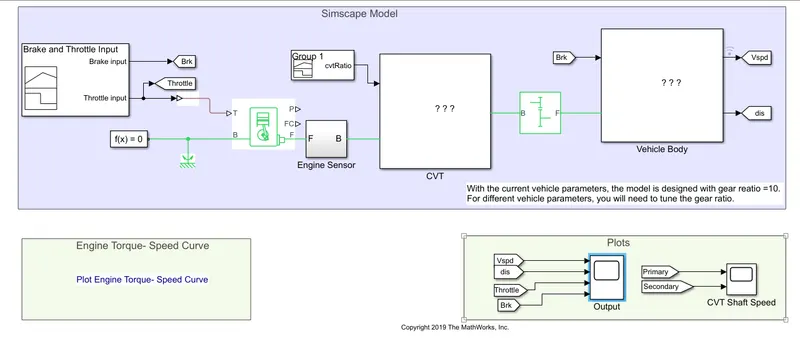
The required modifications can be done using 'Check Custom Bound' block that enables to select the suitable value of the input parameter by specifying the upper and lower bounds of the design parameter.
Another system simulation to be carried out for the model is the stopping distance of the vehicle. The vehicle accelerates and once it reaches a certain distance the driver applies the brake. To apply this logic, we use the same model with the modifications in the throttle and the brake signals as shown in the below figure.
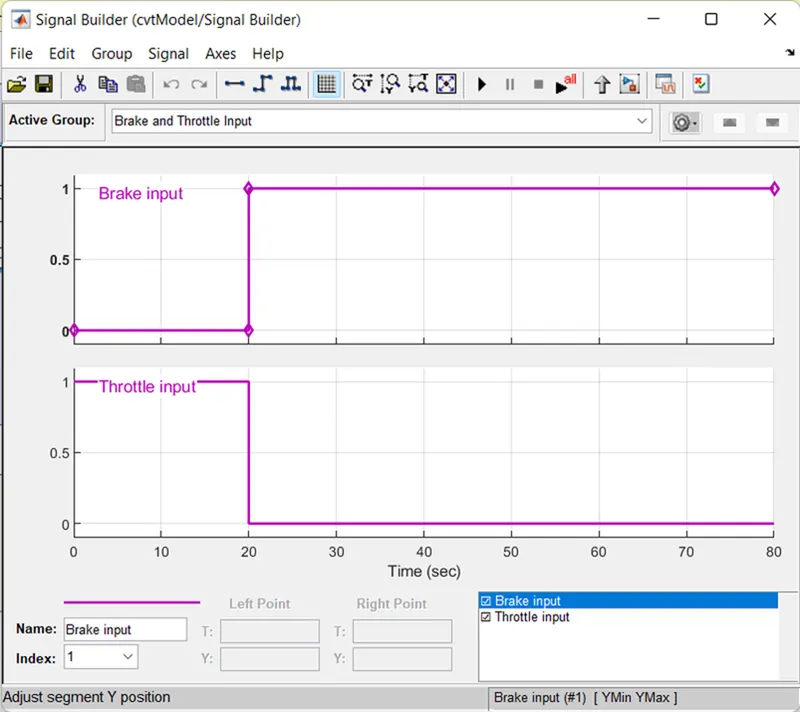
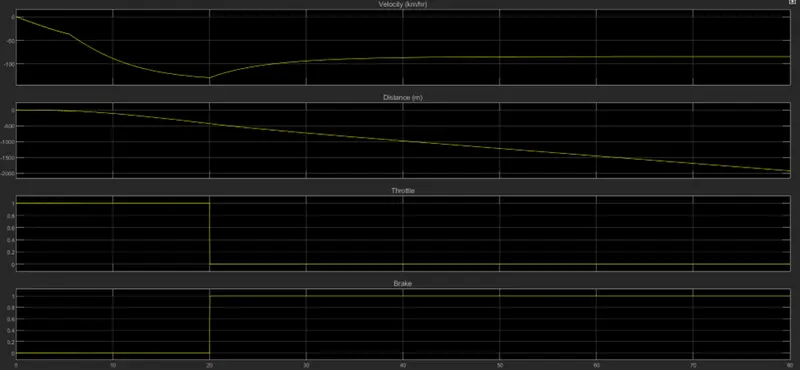
Here, the throttle is applied for 20 seconds and then removed after which the brakes are applied instantaneously.
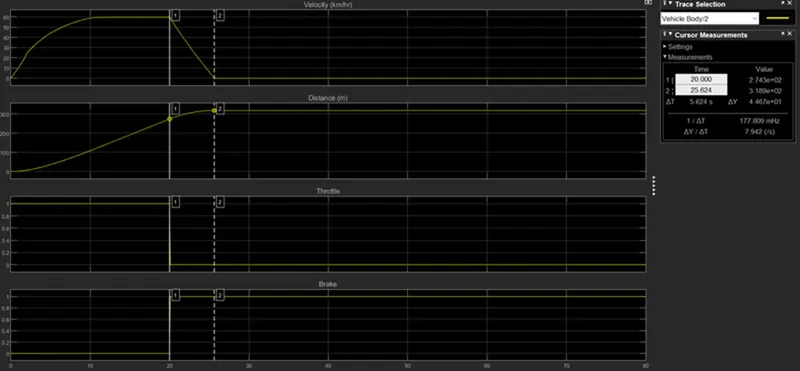
As depicted in the above graph, the braking distance is delta-y, where y represents the distance travelled by the vehicle (shown in the top-right corner of the image). The braking distance is 44.67 meters.
Another important variable that needs to be added is the road inclination. The ATVs mostly drive on roads with varying inclination. It is always recommended to use recorded terrain data such that from that data a 1d lookup table between distance travelled and road inclination can be prepared. As the data is unavailable, a simple inclination of 30 degrees is applied. Since the value is in radians, the applied value is pi/6 approximately.
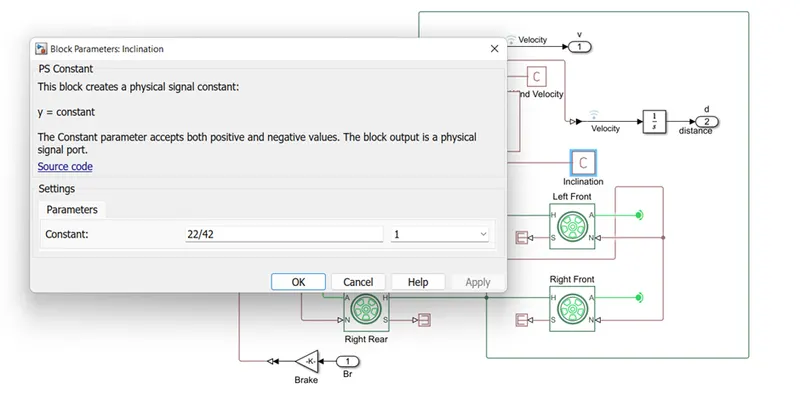
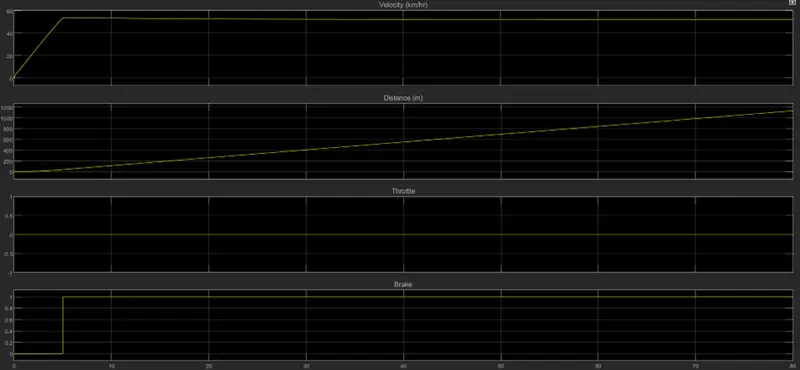
As it can be seen, the velocity quickly decreases for positive inclination and gradually decreases for negative inclination with the same simple drive cycle applied.
Conclusion:
The results obtained for the above simulations are:
- The braking distance of the vehicle is 44.67m for 0 gradient with full acceleration of 20 second before brakes are applied.
- The vehicle speed rises when going down the gradient.
- The vehicle speed reduces when going up gradient.