Project-1: Powertrain for aircraft in runways
Aim: To study the various types of aircrafts.
Objective: To search and list out the total weight of various types of aircrafts.
Explanation:
An aircraft is a vehicle that is able to fly by gaining support from the air. It counters the force of gravity by using either static lift or by using the dynamic lift of an airfoil or in a few cases the downward thrust from jet engines. Common examples of aircraft include airplanes, helicopters, gliders, paramotors and hot air balloons.
The parameters for considering the weight of an aircraft are as follows:
Manufacturer's Weight Empty (MEW)
Also called Manufacturer's Weight Empty (MWE) or Licensed Empty Weight
It is the weight of the aircraft "as built" and includes the weight of the structure, power plant, furnishings, installations, systems and other equipment that are considered an integral part of an aircraft.
This excludes any baggage, passengers, or usable fuel2.
Zero-fuel weight (ZFW)
This is the total weight of the airplane and all its contents (including unusable fuel), but excluding the total weight of the usable fuel on board.
As a flight progresses and fuel is consumed, the total weight of the airplane reduces, but the ZFW remains constant.
Maximum zero fuel weight (MZFW) is the maximum weight allowed before usable fuel and other specified usable agents (engine injection fluid, and other consumable propulsion agents) are loaded.
Operating empty weight (OEW)
It is the basic weight of an aircraft including the crew, all fluids necessary for operation such as engine oil, engine coolant, water, unusable fuel and all operator items and equipment required for flight but excluding usable fuel and the payload.
Payload
It is the carrying capacity of an aircraft. It includes cargo, people, extra fuel. In the case of a commercial airliner, it may refer only to revenue-generating cargo or paying passengers.
Maximum takeoff weight (MTOW)
This is the maximum weight at which the pilot of the aircraft is allowed to attempt to take off3.
Regulated takeoff weight (RTOW)
Depending on different factors (e.g. flap setting, altitude, air temperature, length of runway), RTOW or maximum permissible takeoff weight varies for each takeoff. It can never be higher than MTOW.
Maximum Landing Weight (MLW)
This maximum weight at which an aircraft is permitted to land
Max. Ramp Weight (MRW)
also called maximum taxi weight (MTW)
It is the maximum weight authorized for maneuvering (taxiing or towing) an aircraft on the ground.
Aircraft gross weight
It is the total aircraft weight at any moment during the flight or ground operation. This decreases during flight due to fuel and oil consumption.
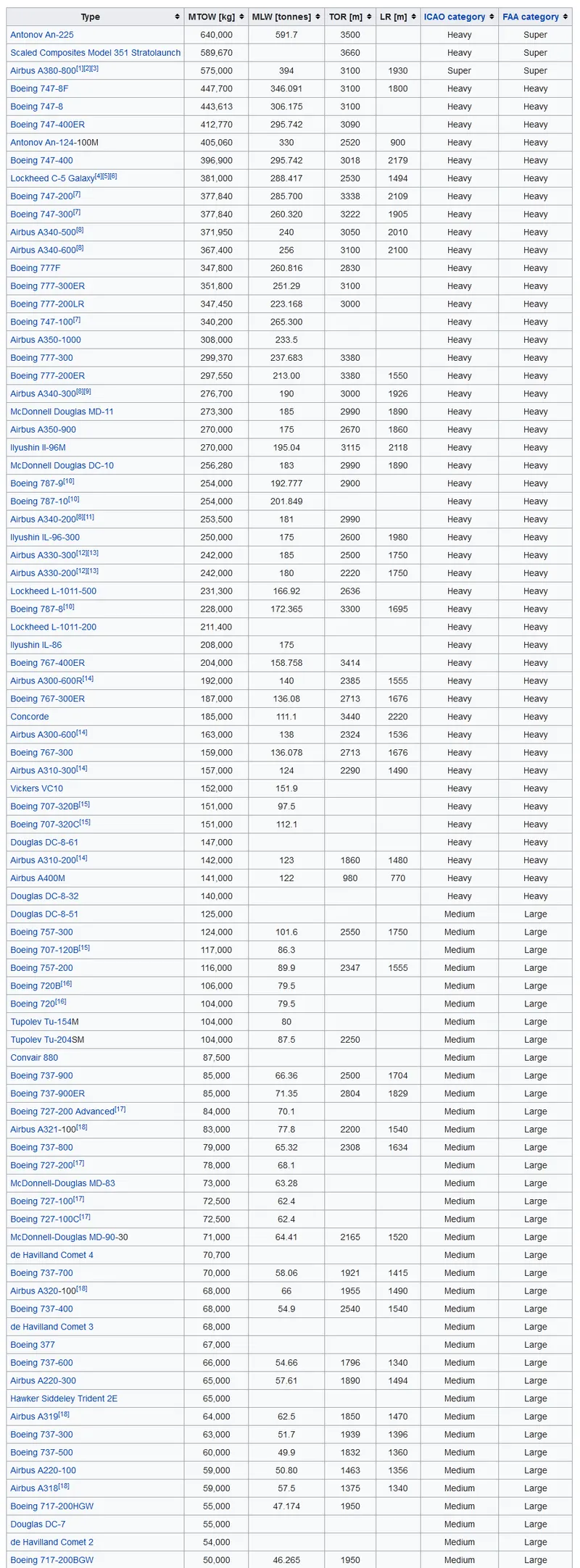
List of few Airplanes:
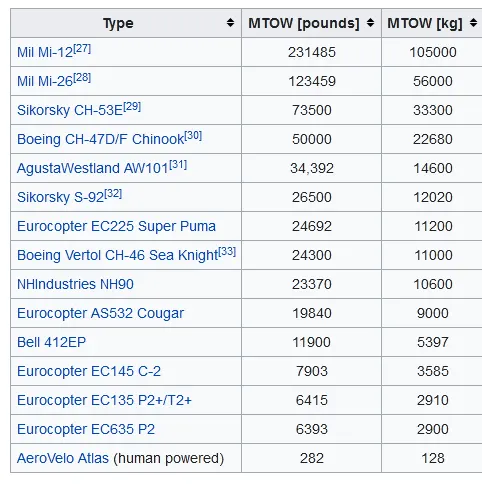
List of Helicopters:
Groundspeed and Airspeed:
Aim: To study the difference between ground speed and air speed.
Explanation:
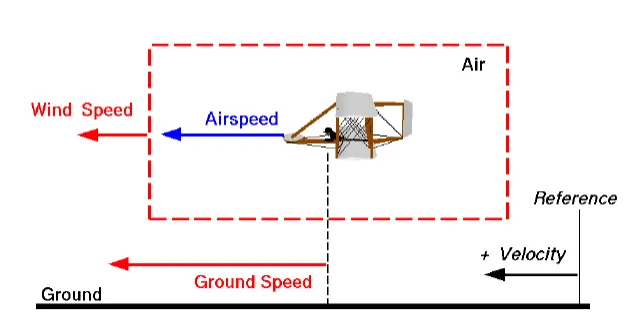
Ground speed is the horizontal speed of an aircraft relative to the Earth’s surface. It is vital for accurate navigation to the destination that the pilot has an estimate of the ground speed that will be achieved during a flight.
An aircraft diving vertically would have a ground speed of zero.
Airspeed is the speed of an aircraft relative to the air. Among the common conventions for qualifying airspeed are indicated airspeed ("IAS"), calibrated airspeed ("CAS"), equivalent airspeed ("EAS"), true airspeed ("TAS"), and density airspeed.
Indicated airspeed is simply what is read off of an airspeed gauge connected to a pitot static system, calibrated airspeed is indicated airspeed adjusted for pitot system position and installation error, and equivalent airspeed is calibrated airspeed adjusted for compressibility effects. True airspeed is equivalent airspeed adjusted for air density, and is also the speed of the aircraft through the air in which it is flying.
Difference:
Airspeed is simply the speed at which an aircraft is moving relative to the air it is flying in. As such, it’s also the speed at which the air is flowing around the aircraft’s wings.
Ground speed, on the other hand, is the aircraft’s speed relative to the ground. One thing that should be noted here is that it’s its horizontal rather than vertical speed – an aircraft climbing completely vertically would have a ground speed of zero.
In other words, while airspeed is what determines whether there is enough airflow around an aircraft to make it fly, ground speed is what determines how fast an aircraft will get to its destination.
Aircraft movement on the ground:
Aim: To study how the aircraft is moved on the ground.
Objective: To study why the aircraft engine power to move it on the ground at Airport.
Explanation:
Aircraft Engine Power is not used to move it on the ground at airport because of the following primary reasons:
- Fuel consumption.
- Wear and tear on the engine.
- Unnecessary jet blast and noise.
Most airplanes are equipped with engines rated from 18,000 to nearly 100,000 lb of thrust. Such thrust levels provide for safe takeoff, flight, and landing over a wide range of temperatures, altitudes, gross weights, and payload conditions. However, the exhaust wake from these engines can pose hazards in commercial airport environments. Operators and airport authorities must carefully consider these hazards and the resulting potential for injury to people and damage to or caused by baggage carts, service vehicles, airport infrastructure, and other airplanes.
High engine thrust during maintenance activity can cause considerable damage to airplanes and other elements in the airport environment.
Conclusion:
Using aircraft engine power to move it on the ground is not a good idea, it will cause damage to other aircrafts around it and the environment.
Aircraft movement on runway:
Aim: To study how an aircraft is pushed to runway when it is ready to take off.
Explanation:
After loading the goods and the passengers, the aircraft is ready to fly. The aircraft is to be moved to the runway this happens through pushback trucks. The pushback truck reverses the aircraft into taxiing position, pushing it with a towbar attached to the nose-wheel strut. Or, in the most modern versions, by actually lifting the wheel. That speeds up coupling and decoupling. The aircraft taxis to the runway to depart at the agreed time.
Taxiing is the movement of an aircraft on the ground, under its own power, in contrast to towing or pushback where the aircraft is moved by a tug. The aircraft usually moves on wheels, but the term also includes aircraft with skis or floats.
An airplane uses taxiways to taxi from one place on an airport to another; for example, when moving from a hangar to the runway. The term "taxiing" is not used for the accelerating run along a runway prior to takeoff, or the decelerating run immediately after landing, which are called the takeoff roll and landing rollout, respectively.
Take off power, tyre design, rolling resistance, tyre pressure, brake forces:
Aim: To study the take off power, tyre design, rolling resistance, tyre pressure, brake forces when the aircraft is landing.
Explanation:
Takeoff Power:
Takeoff is the phase of flight in which an aerospace vehicle leaves the ground and becomes airborne.
For aircraft that take off horizontally, this usually involves starting with a transition from moving along the ground on a runway. For balloons, helicopters and some specialized fixed-wing aircraft, no runway is needed.
For light aircraft, usually full power is used during takeoff. Large aircrafts may use a reduced power for takeoff, where less than full power is applied in order to prolong engine life, reduce maintenance costs and reduce noise emissions. In some emergency cases, the power used can then be increased to increase the aircraft's performance. Before takeoff, the engines, particularly piston engines, are routinely run up at high power to check for engine-related problems.
Tyre Design:
Tyres are one of the most important components of aircraft. They help to absorb the shock of landing and provide cushioning. It also provides the necessary traction for braking and stopping of an aircraft. An aircraft tyre is designed to withstand extremely heavy loads while landing, take off, taxing, and parking. The number of wheels required for aircraft increases with the weight of the aircraft, as the weight of the aeroplane needs to be distributed more evenly.
Technical aspects of the tyre:
Retreading – Retreading is methods of restoring a worn tyre by renewing the tread area or by renewing the tread area plus one or both sidewalls. Repairs are included in the tyre retreading process.
Load Rating – Load rating is the maximum permissible load at a specified inflation pressure.
Ply Rating – Ply Rating is used to identify the maximum recommended load rating and inflation pressure for a specified tyre. It is an index of tyre strength.
Speed Rating – The speed rating is the maximum takeoff speed to which the tyre has been tested.
Skid Depth – Skid depth is the distance between the tread surface and the deepest groove as measured in the mould.
Aircraft tyres must have an approved speed and load rating and have sufficient clearance when retracted through landing gear to allow for tyre growth. Tyre growth is the increase in the size of the tyre due to centrifugal forces at high speed.
Rolling Resistance:
Rolling resistance, is the force resisting the motion when a Tyre rolls on a surface. The equation for rolling resistance coefficient is,
`F = C_(rr)*N`
where,
F is the rolling resistance force.
`C_(rr)`is the rolling resistance coefficient.
N is the normal force, the force perpendicular to the surface on which the wheel is rolling.
Tyre Pressure:
Airplane wheel/tire assemblies are inflated to high pressures (many in excess of 200 psi/14bar). In addition, the pressure in the bottle or tire-servicing cart can be as high as 3,000 psi. As a result, when the high-pressure bottle is connected directly to the wheel without a regulator, the wheel is suddenly subjected to the high pressure, which can exceed the design limits for the wheel and the wheel tie bolts. Consequently, the wheel, the wheel tie bolts, or both experience an explosive fracture and become projectiles.
Inflation without a regulator will rapidly produce pressures in the wheel that are significantly beyond the capabilities of the wheel. As a result, the wheel or wheel tie bolts fracture into pieces that can severely injure the person servicing the tire or damage adjacent equipment. Aircraft tires are usually inflated with nitrogen to minimize expansion and contraction from extreme changes in ambient temperature and pressure experienced during flight. Dry nitrogen expands at the same rate as other dry atmospheric gases (normal air is about 80% nitrogen), but common compressed air sources may contain moisture, which increases the expansion rate with temperature. The requirement that an inert gas, such as nitrogen, be used instead of air for inflation of tires on certain transport category airplanes was prompted by at least three cases in which the oxygen in air-filled tires had combined with volatile gases given off by a severely overheated tire and exploded upon reaching auto ignition temperature. The use of an inert gas for tire inflation eliminates the possibility of tire explosion. A calibrated pressure gauge should always be used to measure inflation pressure. Digital and dial-type pressure gauges are more consistently accurate and preferred.
Brake Forces:
Aircraft brakes stop a moving aircraft by converting its kinetic energy to heat energy by means of friction between rotating and stationary discs located in brake assemblies in the wheels.
Brakes provide this critical stopping function during landings to enable airplanes to stop within the length of the runway. They also stop aircraft during rejected takeoff events, in which an attempted takeoff is canceled as the airplane is rolling down the runway before it lifts off from the ground due to engine failure, tire blowout, other system failure or direction from air traffic control. Aircraft brakes also prevent motion of the aircraft when it is parked, limit its speed during taxiing and can even help steer the aircraft on the ground by applying different levels of braking force to the left- and right-side brakes.
Aircraft brakes work in conjunction with other brake mechanisms such as thrust reversers, air brakes and spoilers. Thrust reversers are surfaces that are deployed into the path of the jet blast from the engines to redirect propulsive thrust in a direction that opposes the motion of the aircraft. Air brakes and spoilers are flight control surfaces that create additional aerodynamic drag when deployed into the path of air flowing around the aircraft.
Force and power calculation:
Aim: To calculate the force and power required to push / pull an aircraft by a towing vehicle.
Calculation:
Aerodrag force in Newton,
`F_(ad) = 1/2*rho*A*C_d*V^2`
where `C_d`is Drag coefficient.
Rolling Resistance Force in Newton,
`F_(rr) = mu_(rr)*m*g`
where, `mu_(rr)`is Rolling resistance coefficeint.
Aerodrag and Rolling resistance forces are calculated for both Aircraft and Tow vehicle.
Tractive Force in Newton,
`F_(te)=F_(ad)+F_(rr)`
This force includes sum of Aerodrag and Rolling resistance forces for both Aircraft and Tow vehicle.
Power in KW,
`P_(te)=F_(te)*V`
Let us consider an Aircraft of weight = 187000Kg
Tow vehicle of weight = 40000Kg
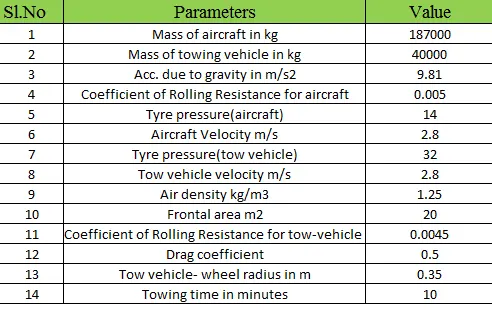
Results:
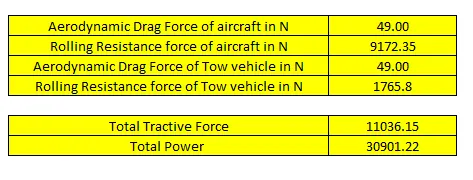
Total Tractive Force required to tow the aircraft of given mass is 11036.15N.
Total Power required to tow the aircraft is 30.9KW.
Conclusion:
For towing an aircraft of any weight, the weight of the towing vehicle is also considered. If any of the weight is increased, the towing power will increase, considering other parameters.
Electric Powertrain:
Aim: To design an electric powertrain for a type of motor.
Objective: To create a block diagram of electric powertrain with power rating, and energy requirement to fulfill aircraft towing application and to understand the control of aircraft speed from zero to highest by changing the duty cycle.
Block Diagram:
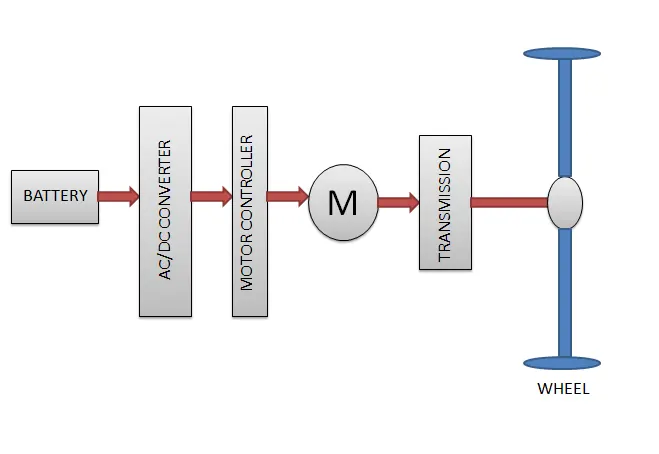
Here, energy transfer takes place from battery to the wheels. The motor sometimes acts as a generator and the energy will flow in the opposite direction.
Calculation:
Here, we are considering the above case of an aircraft and all the parameters remain the same.
The power required to tow the aircraft is 30.9KW in this case.
The energy required to tow the aircraft is,
E = Power*time
E = 30.9 * 600 (10mins = 600sec)
E = 18.54 KJ
E = 18540/3600 = 5.15KWH
The duty cycle(D) range is,
`D =( Output Power(P_o))/ (Input Power(P_i))`
Let input power = 41KW
D = 30.9/41
Duty cycle(D) = 75.4%
Results:
The power required to tow the aircraft is 30.9KW.
The energy required to tow the aircraft is 5.15KWH.
The duty cycle(D) range is 75.4%