Project-1: Powertrain for aircraft in runways
PART A :
1. Search and list out the total weight of various types of aircrafts :-
Introduction :-
- An aircraft is a vehicle that is able to fly by gaining support from the air.
- It counters the force of gravity by using either static lift or by using the dynamic lift of an airfoil, or in a few cases the downward thrust from jet engines.
- There are many factors that lead to efficient and safe operation of aircraft.
- Among these vital factors are proper weights and balance control. The maximum allowable weight for an aircraft is determined by design considerations.
- The manufacturer provides the aircraft operator with the empty weight of the aircraft and the location of its empty weight center of gravity (EWCG) at the time the certified aircraft leaves the factory.
- However, the maximum operational weight may be less than the maximum allowable weight due to such considerations as high-density altitude or high-drag field conditions caused by wet grass or water on the runway.
- The maximum operational weight may also be limited by the departure or arrival airport’s runway length.
Manufacture's Design Weight Limitations :-
- The maximum allowable weight for an aircraft is determined by design considerations by the aircraft’s manufacturer.
- However, the maximum operational weight may be less than the maximum allowable weight due to such considerations as high-density altitude or high-drag field conditions caused by wet grass or water on the runway.
- The maximum operational weight may also be limited by the departure or arrival airport’s runway length.
- The structural weight limits are based on aircraft maximum structural capability and define the envelope for the CG charts.
- Aircraft structural weight capability is established during aircraft design and certification.
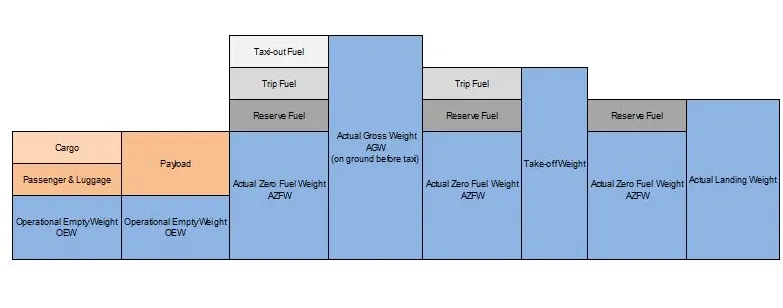
Maximum Design Taxi Weight (MDTW or MTW)
- The maximum design taxi weight or maximum design ramp weight (MDRW) is the maximum certificated design weight for aircraft ground manoeuvres as limited by aircraft strength and airworthiness requirements.
- The difference between the maximum taxi/ramp weight and the maximum take-off weight (maximum taxi fuel allowance) depends on the size of the aircraft, the number of engines, APU operation, and engines/APU fuel consumption, and is typically assumed for 10 to 15 minutes allowance of taxi and run-up operations.
Maximum Design Take-off Weight (MDTOW or MTOW):-
- The maximum design takeoff weight is the maximum certificated design weight for takeoff run as limited by aircraft strength and airworthiness requirements.
Maximum Design Landing Weight (MDLW or MLW) :-
- The Maximum design landing weight is the maximum certificated design weight for landing limited by aircraft strength and airworthiness requirements.
- It generally depends on the landing gear strength or the landing impact loads on certain parts of the wing structure.
MDLW < MDTOW < MDTW
Maximum Design Zero Fuel Weight (MDZFW) :-
- The maximum design zero-fuel weight is the maximum certificated design weight of the aircraft less all usable fuel and other specified usable agents as limited by aircraft strength and airworthiness requirements.
- It is the maximum weight permitted before usable fuel and other specified usable fluids are loaded in specified sections of the airplane.
- The weight difference between the MDTOW and the MDZFW may be utilized only for the addition of fuel.
Maximum payload = MDZFW – OEW
Minimum Flight Weight (MFW) :-
Minimum certificated weight for as limited by aircraft strength & airworthiness requirements.
Effects of Weight ,
Some of the problems caused by overloading an aircraft are - :
- The aircraft will need a higher takeoff speed, which results in a longer takeoff run.
- Both the rate and angle of climb will be reduced.
- The service ceiling will be lowered.
- The cruising speed will be reduced.
- The cruising range will be shortened.
- Maneuverability will be decreased.
- A longer landing roll will be required because the landing speed will be higher.
- Excessive loads will be imposed on the structure, especially the landing gear.
DEFINATIONS
1. Aircraft Gross Weight :-
The aircraft gross weight is the total aircraft weight at any moment during the flight or ground operation.
The aircraft gross weight decreases during flight due to fuel and oil consumption. The aircraft gross weight may also vary during flight due to payload dropping or in-flight refueling.
2. Manufacture's Empty Weight (MEW) :-
Let’s start with the aircraft itself. An aircraft “as is” includes :-
- Airframe structure with all moving mechanical parts (fuselage, wings, flaps, gear, rudder, nacelle …)
- Power generation system (APU, main engines, power plant…)
- Systems (electrical, hydraulics, pneumatic, fuel flow system, instrument, navigation, air conditioning, anti-ice, fixed furnishing)
- Fixed equipment and services considered an integral part of the aircraft
- Fixed ballast
- Closed system fluids
- Unused fuel only for small aircraft
- All these items above form the Manufacturer’s Empty Weight (MEW).
* This weight does not include :-
- Fuel
- Oil, potable water
- Payload (Cargo, passenger, luggage)
- Removable equipment
- Customer specific installations or operator items
3. Operational Empty Weight (OEP) :-
- The MEW and the operator’s items are summed up to the Operational Empty Weight (OEW).
- The OEW is usually fixed for a specific aircraft and only gets changed during maintenance or operational changes.
- OEW is the empty weight that is used in the flight simulator or the usual planning software.
The Operator's Items are :-
- fluids necessary for aircraft operation (engine oil and coolant, water, unusable fuel)
- the water for galleys and lavatories
- aircraft documentation
- passenger seats (and the life vests)
- galley structure
- catering emergency equipment
- aircraft crew and their luggage.
- standard items necessary for full operation
4. Actual Zero Fuel Weight (AZFW) :-
If we add the payload to the empty plane weight, we get the Actual Zero Fuel Weight (AZFW).
- The payload includes:
- The passenger's weight (the standard weights used defined by ICAO respectively)
- The passenger's luggage’s weight
- The cargo weight
The assumed weights vary around some kg / lbs. depending on the number of seats available on the aircraft.
- a male passenger (incl. cabin luggage) weigh around 82kg (181 lbs.)
- a female passenger around 67kg (148 lbs.)
- a child around 50kg (110lbs.)
- an infant 16kg (35 lbs.).
- These are statistical values but otherwise one would need to weigh every single passenger during check in to get his exact
weight. Additional payload consists of baggage and cargo (such as mail or goods).
5.Actual Gross Weight (AGW) :-
- In addition to the actual zero fuel weight, we add the fuel required for the flight and we get the Actual Gross Weight (AGW).
- At that time, you should have calculated your total fuel for this flight.
- The actual gross weight is the weight of aircraft ready for departure at the gate before push-back and start-up.
|
type |
1 Litre |
1 U.S. Gallon |
1 Imp. Gallon |
|
Aviation Gas |
1.58 lb. |
6.0 lb. |
7.20 lb. |
|
JP-4 |
1.76 lb. |
6.6 lb. |
8.01 lb. |
|
Kerosene |
1.85 lb. |
7.0 lb. |
8.39 lb. |
|
Oil |
1.95 lb. |
7.5 lb. |
8.5 lb. |
6.Take-Off Weight :-
Fuel burn during taxi operation to the departure runway reduces the gross weight. At the holding point, we have the Actual Take-off Weight
(ATOW) which is used for take-off performance calculation.
- The gross weight varies during flight. Fuel and oil consumption reduces the gross weight. Additionally it may vary during flight due to
inflight refuelling or payload dropping.
7.Maximum Design Take-Off Weight (MDTW):-
- The maximum takeoff weight (also known as the maximum brake-release weight) is the maximum weight authorized at brake release for takeoff, or at the start of the takeoff roll.
- The maximum takeoff weight is always less than the maximum taxi/ramp weight to allow for fuel burned during taxi by the engines and the APU.
- In operation, the maximum weight for takeoff may be limited to values less than the maximum takeoff weight due to aircraft performance, environmental conditions, airfield characteristics (takeoff field length, altitude), maximum tire speed and brake .
- At this weight, the subsequent addition of fuel will not result in the aircraft design strength being exceeded. The weight difference between the MTOW and the MZFW may be utilized only for the addition of fuel.
8.Landing Weight :-
- With the calculation of fuel consumption during flight, we can calculate the Estimated Landing Weight (ELW) which is used for landing performance calculation at the destination.
- Approaching your destination you use your current gross weight to determine the final approach speed. The gross weight now is the Actual Landing Weight (ALW). Of course before landing, you never land without any fuel in reserve.
- The regulation is strict about fuel calculation for commercial air transportation including reserve fuel.
- Except in specific situations like re-routing, multiple holding, landing at alternate or technical problems, at landing, the aircraft shall still have the expected reserve fuel if there was no extra consumption.
Graphical Summery Of Operational Weight :-
2. Is there any difference between ground speed and air speed :-
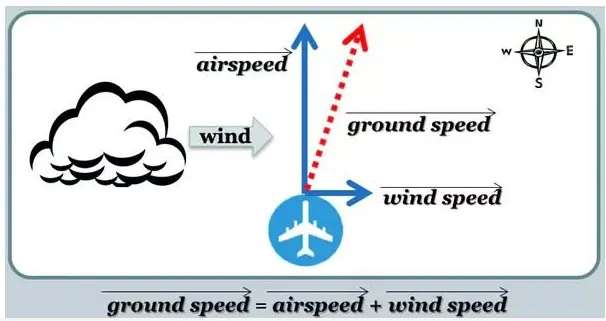
- Ground speed is the airplane’s speed relative to the surface of the Earth, airspeed – at least true airspeed – is its speed relative to the air it is flying in.
- Ground speed is the horizontal speed of an aircraft relative to the Earth's surface. ... An airspeed indicator indicates the aircraft's speed relative to the air mass.
- True airspeed is simply the speed at which an aircraft is moving relative to the air it is flying in. As such, it’s also the speed at which the air is flowing around the aircraft’s wings.
- Airspeed is simply the speed at which an aircraft is moving relative to the air it is flying in. As such, it’s also the speed at which the air is flowing around the aircraft’s wings whereas Ground speed, on the other hand, is the aircraft’s speed relative to the ground.
- In simple words, we can imagine Ground speed is how fast an airplane's shadow would move across the land. If there's a strong wind pushing an aircraft, that's reflected in the ground speed
- Ground speed, on the other hand, is the aircraft’s speed relative to the ground. One thing that should be noted here is that it’s its horizontal rather than vertical speed – an aircraft climbing completely vertically would have a ground speed of zero.
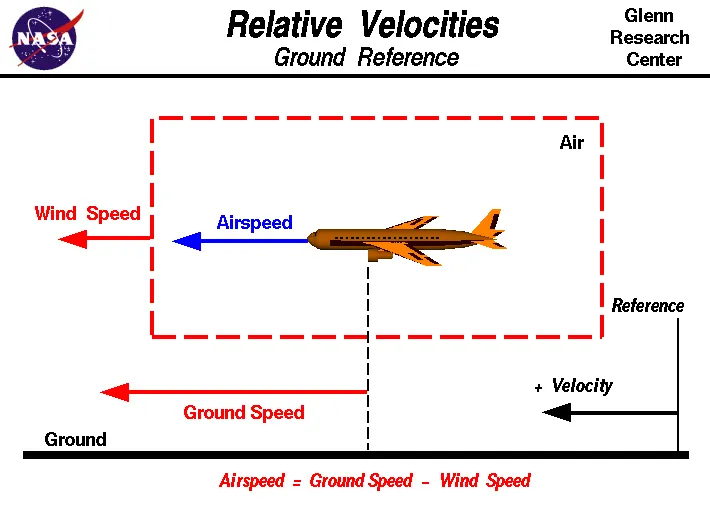
- The relationship between airspeed and ground speed is fairly simple. Ground speed is simply the sum of airspeed and wind speed.
- If the aircraft is flying in the same direction as the wind is blowing, the aircraft experiences tailwind, and its ground speed is higher than its airspeed.
-On the other hand, if the wind is blowing against the direction the aircraft is traveling in, the aircraft experiences headwind, and its ground speed is lower than its airspeed.
3. Why is it not recommended to use aircraft engine power to move it on the ground at Airport :-
- In airports, aircraft usually do not use their main engines to travel from shed's to runway i.e., when on the ground because of the following
reasons:
- The jet blast from the engines can damage the terminal building and nearby Foreign equipment. It can even throw away people standing
nearby because of huge pressure.
- Engines can blow sand and debris. Engines can suck in sand and debris which can cause serious damage to the engine. It is easier for the
truck driver to see the surroundings better than the pilot sitting in the cockpit with limited windows.
- Modern planes are huge. It is difficult to navigate such gigantic structures through limited space. An A380 is eight stories high. The pilots
won't be able to see anything directly in front of them or anything behind the wings.
- The plane engines are very loud. This noise can add up substantially when multiple planes are moving around the airport. It won't be a
pleasant experience for people sitting inside the terminal, as most people don't even like the sound of powerful motor-bikes. . It saves fuel.
- The vehicles used for this towing or moving from terminal to runway are called Taxiing. Here the fuel cost is also reduced to a great extent.
And nowadays electric taxiing is becoming more economical and efficient way.
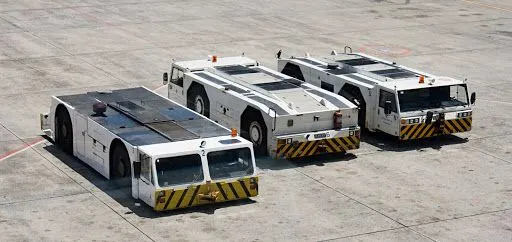
TOWING VEHICLE IN AIRPORT
- Electric taxiing systems use electric motors fitted inside the wheels of the aircraft’s landing gear. Electric power is supplied to these motors
by an on-board Auxiliary Power Unit (APU).
4. How an aircraft is pushed to runway when its ready to take off :-
- There are two ways through which an aircraft is pushed to the runway on Airport.
Pushback :-
- In aviation, pushback is an airport procedure during which an aircraft is pushed backwards away from an airport gate by external power.
Pushbacks are carried out by special, low-profile vehicles called pushback tractors or tugs. Although many aircraft are capable of moving
themselves backwards on the ground using reverse thrust (a procedure referred to as a power back), the resulting jet blast or prop wash
might cause damage to the terminal building or equipment. Engines close to the ground may also blow sand and debris forward and then
suck them into the engine, causing damage to the engine. A pushback is therefore the preferred method to move the aircraft away from the
gate. Closer to departure, an aircraft tug will park right in front of the nose wheel. The tug might be directly attached to the plane's nose gear
with a tow bar, or could be a wheel-lift tug. These tugs cradle the nose gear, then lift it up before moving the plane. That gives the tug driver
control over the plane's direction during pushback. New taxi technologies are appearing, like pilot-controlled tugs, and electric motors
mounted to the plane's landing gear. Both promise to save fuel, and reduce airport noise. When the aircraft is stopped, the brakes of the
towing vehicle alone should not be relied upon to stop the aircraft. The man in the cockpit should coordinate the use of the aircraft brakes
with those of the towing vehicle.
Taxiing :-
- Taxing is the movement of an aircraft on the ground, under its own power, in contrast to towing or push-back where the aircraft is moved by
a tug. The aircraft usually moves on wheels, but the term also includes aircraft with skis or floats for water-based travel. An airplane uses
taxiways to taxi from one place on an airport to another; for example, when moving from a hangar to the runway. The term taxiing is not
used for the accelerating run along a runway prior to take-off, or the decelerating run immediately after landing, which is called the take-off
roll and landing rollout, respectively. When taxiing, aircraft travel slowly. This ensures that they can be stopped quickly and do not risk wheel
damage on larger aircraft if they accidentally turn off the paved surface. Taxi speeds are typically 30 to 35 km/h.
5. Learn about take off power, tyre design, rolling resistance, tyre pressure, brake forces when landing :-
a) Take off power:-
- Takeoff is the phase of flight in which an aerospace vehicle leaves the ground and becomes airborne. For aircraft traveling vertically, this is
known as liftoff. For aircraft that take off horizontally, this usually involves starting with a transition from moving along the ground on
a runway. For light aircraft, usually full power is used during takeoff. Large transport category (airliner) aircraft may use a reduced power for
takeoff, where less than full power is applied in order to prolong engine life, reduce maintenance costs and reduce noise emissions.
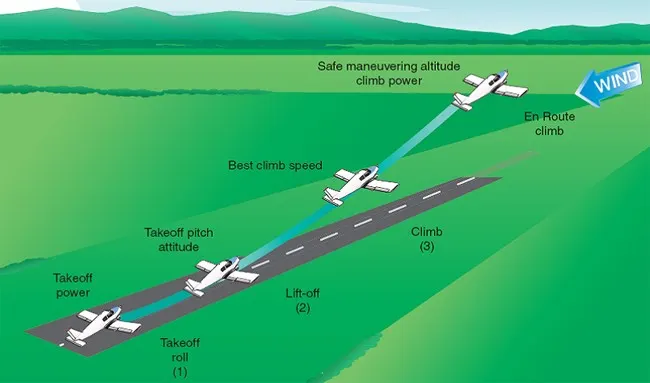
- After taxiing onto the runway, the airplane should be carefully aligned with the intended takeoff direction, and the nose wheel positioned
straight, or centered. After releasing the brakes, the throttle should be advanced smoothly and continuously to takeoff power. An abrupt
application of power may cause the airplane to yaw sharply to the left because of the torque effects of the engine and propeller. This will be
most apparent in high horsepower engines. As the airplane starts to roll forward, the pilot should assure both feet are on the rudder pedals
so that the toes or balls of the feet are on the rudder portions, not on the brake portions.
- Takeoff performance can be predicted by using a simple measure of Acceleration of the aircraft anong the runway based on force
equilibrium.
The force involved will be
T- Thrust of propulsion system pushing aircraft along runway
D- Areodynamic Drag of vehicle resisting the aircraft motion.
F- Rolling resistance friction due to the contact of wheels of skids on the ground.
During take –off run the imbalance in these forces will produce an acceleration along the runway
DV/dt = (T-D-F)/m
Where dV/dt is the acceleration along the runway and m is the mass of the vehicle.
b) Tyre design :-
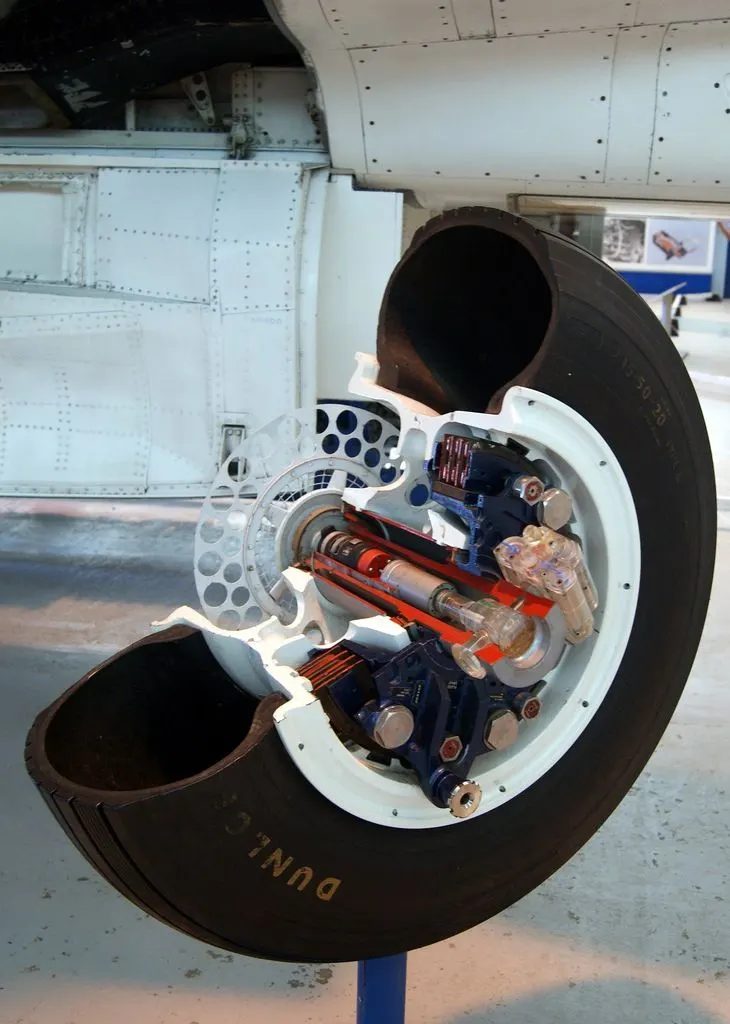
- When it comes to safety, Tyres are one of the most important components of aircraft. They help to absorb the shock of landing and provide
cushioning. It also provides the necessary traction for braking and stopping of an aircraft. An aircraft Tyre is designed to withstand extremely
heavy loads while landing, take off, taxing, and parking. The number of wheels required for aircraft increases with the weight of the aircraft,
as the weight of the aero plane needs to be distributed more evenly.
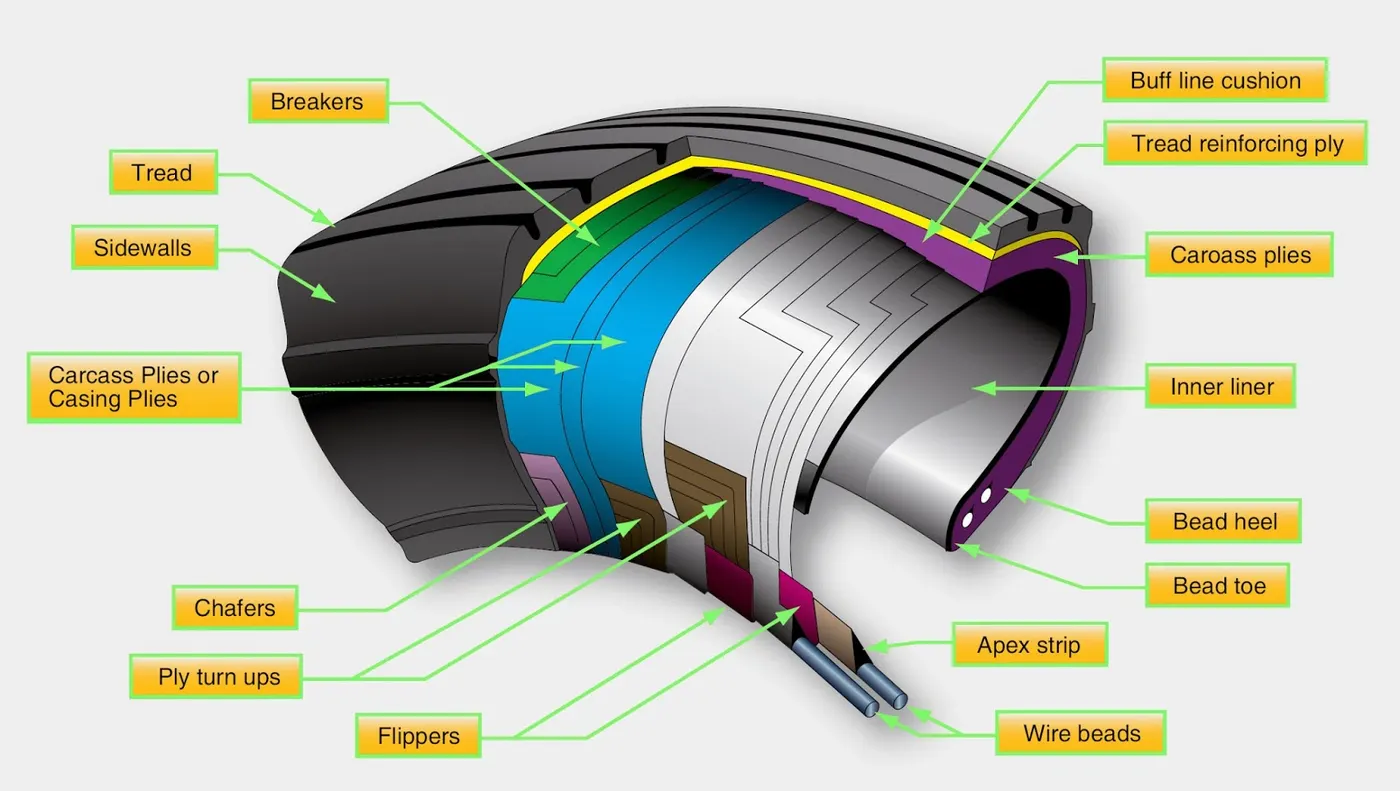
- Carcass plies are used to form the tire. They are sometimes called casing plies. An aircraft Tyre is constructed for the purpose it serves.
- They support the weight of an aircraft while it is on the ground.
- It also provides the necessary traction for braking and stopping of an aero plane.
- Tyre also helps to absorb the shock of landing and provide cushioning the roughness of takeoff, roll-out, and taxi operations.
- Unlike an automobile or truck Tyre, it does not have to carry a load for a long period of continuous operation. However, an
aircraft Tyre absorbs the high impact loads of landing, and also, it’s operating at high speeds for a short time when required.
c) Rolling Resistance :-
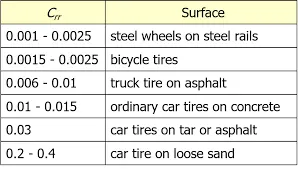
- Rolling resistance, sometimes called rolling friction or rolling drag, is the force resisting the motion when a body (such as a ball, tire, or wheel) rolls on a surface. It is mainly caused by non-elastic effects; that is, not all the energy needed for deformation (or movement) of the wheel, roadbed, etc., is recovered when the pressure is removed.
- Two forms of this are hysteresis losses (see below), and permanent (plastic) deformation of the object or the surface (e.g., soil). Note that the slippage between the wheel and the surface also results in energy dissipation.
- Although some researchers have included this term in rolling resistance, some suggest that this dissipation term should be treated separately from rolling resistance because it is due to the applied torque to the wheel and the resultant slip between the wheel and ground, which is called slip loss or slip resistance. In addition, only the so-called slip resistance involves friction, therefore the name "rolling friction" is to an extent a misnomer.
- The "rolling resistance coefficient" is defined by the following equation:
F = CrrN
where
F = Rolling resistance force
Crr = dimensionless rolling resistance coefficient or coefficient of rolling friction (CRF)
= Normal force, the force perpendicular to the surface on which the wheel is rolling.
Tyre pressure :-
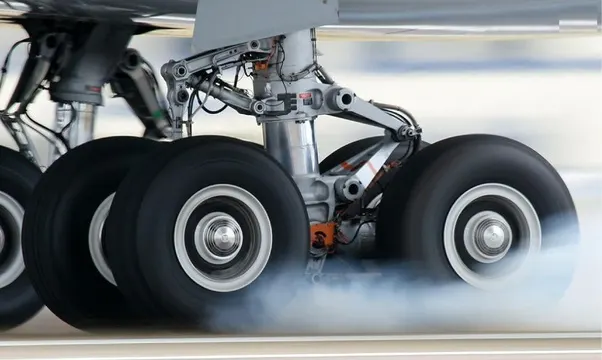
- The typical airliner tire can handle a 38-ton load. It can meet the ground 500 times before needing a re-tread, a refresh it can take on seven times in its life.
-Aircraft tires generally operate at high pressures, up to 200 psi (14 bar; 1,400 kPa) for airliners, and even higher for business jets.
-The main landing gear on the Concorde was typically inflated to 232 psi (16.0 bar), whilst its tail bumper gear tires were as high as 294 psi (20.3 bar).
d) Brake forces :-
- In aircraft types, the brake units are powered by the hydraulics system. An electrical signal is sent from the flight deck to hydraulic actuators near the main landing gear.
-Here, hydraulic fluid at 3,000 pound per square inch is used to force the brake unit against the wheel, thus slowing it down.
PART B:
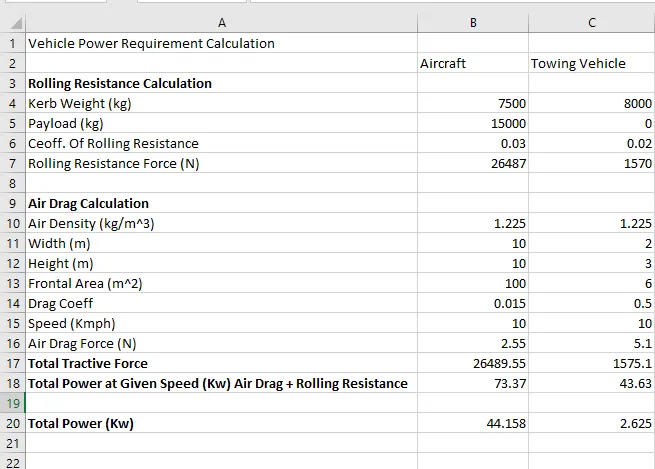
6. A. With necessary assumptions, calculate the force and power required to push / pull an aircraft by a towing vehicle - :
- The possible forces acting on the vehicle are
- Rolling resistance force
- Air drag force
- Hill climb force
- Neglecting all the losses
- Assumptions - :
Mass of the aircraft: m = 75,000 Kg
Rolling ground friction coefficient of wheels for Dry concrete or asphalt road: μ = 0.03
Acceleration due to gravity: g = 9.81ms^2
Frontal area of an aircraft: A = 100m^2
Final Velocity of an aircraft: v = 1.667m/s
Initial Velocity of an aircraft: u = 0
Coefficient of drag of an aircraft: Cd = 0.015
Density of air: ρ = 1.225kgm^3
Acceleration time of aircraft: t = 10s
6.B Develope the model for the calculated force and power using Simulink :-
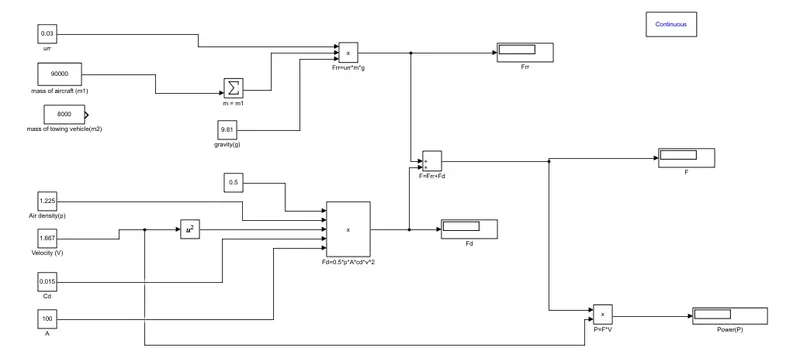
* For calculation power we have to multiply both total force (F) & velocity in m/sec for this we have used 'Product' block ( p=F*V).
* For calculating the total force (F) we have added both Frr & Fd by using 'Sum' block.
* To find the value of rolling resistance ( Frr) we used product to multiply the values Crr , Total mass (m) & gravity(g) which are to be entered in the 'Constant' block.
* Similarly for calculating Drag Force (Fd) we have to multiply the velocity in m/sec , Drag Coefficient , Frontal Area of aircraft (A) and a constant value 0.5 which are to be enterd in 'Constant' block.
* We have converted the velocity in m/sec.
7. A. Design an electric powertrain with type of motor, it’s power rating, and energy requirement to fulfill aircraft towing application in Simulink. Estimate the duty cycle range to control the aircraft speed from zero to highest. Make all required assumptions. Prepare a table of assumed parameters. Draw a block diagram of powertrain :-
Block Diagram of Powertrain :-
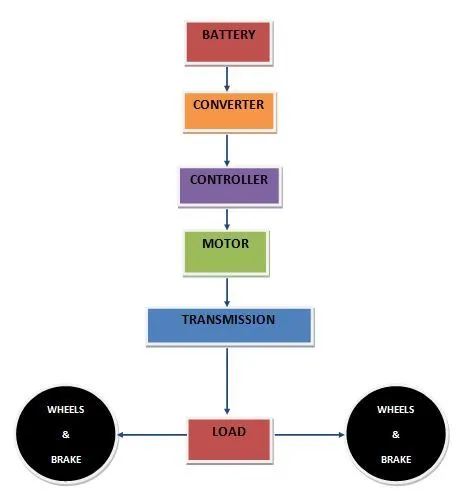
Based on the calculations done in 6A.
Force required to push/pull the aircraft =19.508 KN
Power required =135.478 kw
Let us assume,
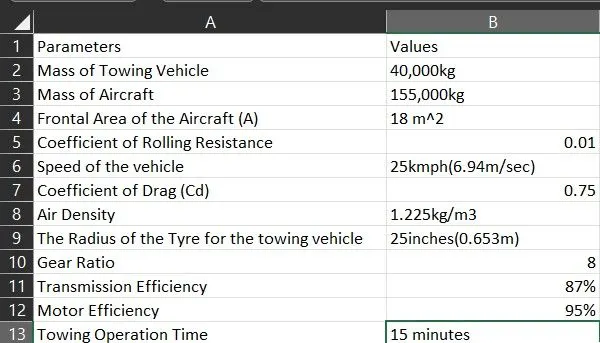
The Radius of the Tyre for the Tug = 25inches =0.635m
Gear ratio = 8
Transmission Efficiency `(eta t) = 87%`
Motor Efficiency `(etam) = 95%`
Then ,
Torque required for the wheels (Tw)
= Total Force * Radius in meters
= 19.508*0.635
= 12.387 KNm
Motor Torque = Wheel toruqe / (Gear ratio * `etat)`
= 12.387/(8*0.87)
= 1.778KNm
For `etam`= 95% , The required motor torque (Tm) = 1.778/0.95 = 1.871KNm
Similarly , The total power required by the motor considering all the efficiencies(Pt) = 135.478/(0.87*0.95)=163.917Kw
Let us assume the towing operation was done for a 15 minutes (0.25Hrs) duration.
Then, Total Energy consumed = 163.917*0.25 = 40.98 KWh
If we consider the battery capacity =220 kw is used by the towing vehicle then, The duty cycle range to control the speed from 0 to max speed (3m/s) is given as
Duty Cycle (d) = (Required Power)/ (Rated power)= 163.917/220 =0.75
Therefore the controller will be able to provide a duty cycle ranging from 0 to 75% in order to control the towing speed.
Simulink Diagram of Powertrain :-
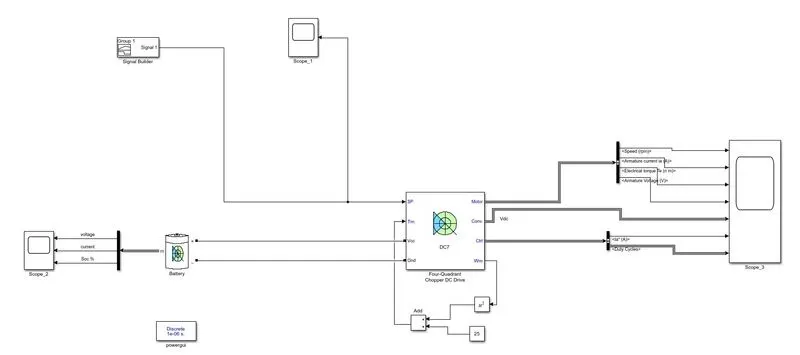
INPUTS :
Scope 1 :- Signal Builder
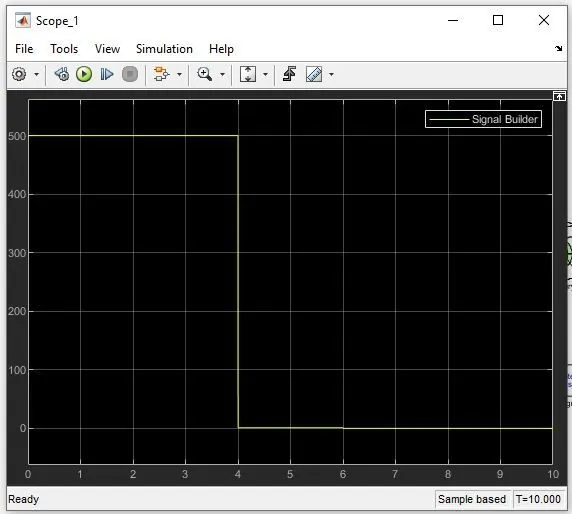
Scope 2:- Battery
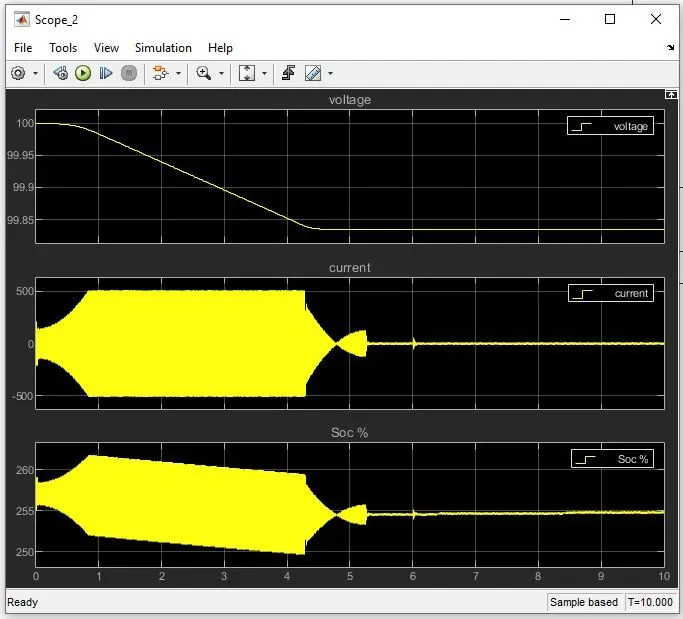
OUTPUT :
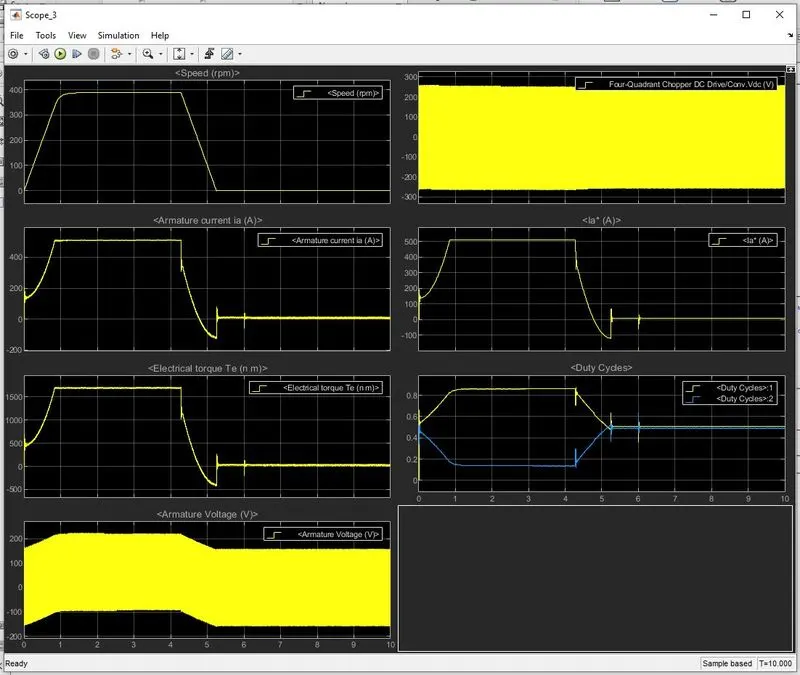
Scope 3:- DC Drive Output