Week-11 Challenge: Braking
1. For a defined driving cycle , calculate the energy required for braking :-
* A driving cycle is a series of data representing the speed of vehicle vs time.
* Energy (E) = 1/2*m*v^2
* Here mass (m) = 1000kg
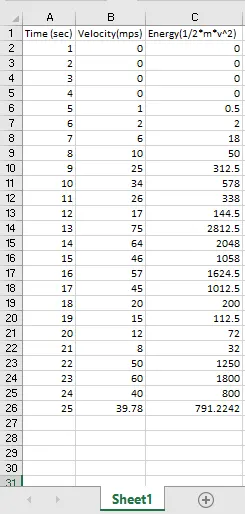
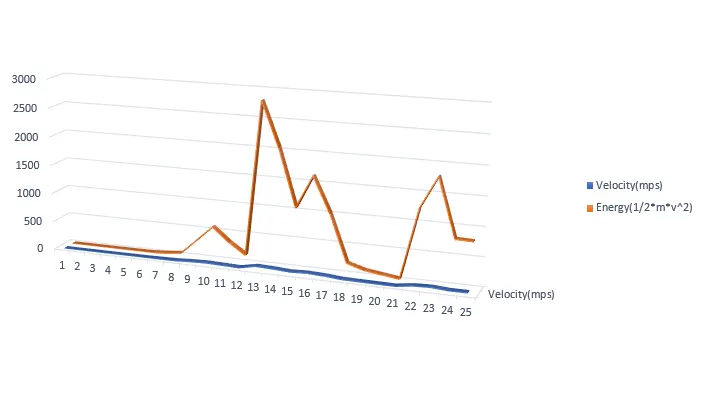
* Here the energy required is maximum upto 2081 J.
2. Why electric motor can’t develop braking torque at high speed similar to starting? How electric and mechanical brakes are coordinated :-
- Electric motor - :
An electric motor is an electrical machine that converts electrical energy into mechanical energy. Most electric motors operate through the
interaction between the motor's magnetic field and electric current in a wire winding to generate force in the form of torque applied on the
motor's shaft. Electric motors can be powered by direct current (DC) sources, such as from batteries, or rectifiers, or by alternating current
(AC) sources, such as a power grid, inverters or electrical generators. An electrical generator is mechanically identical to an electric motor,
but operates with a reversed flow of power, converting mechanical energy into electrical energy.
lets look at the speed torque characteristics of a DC motor:
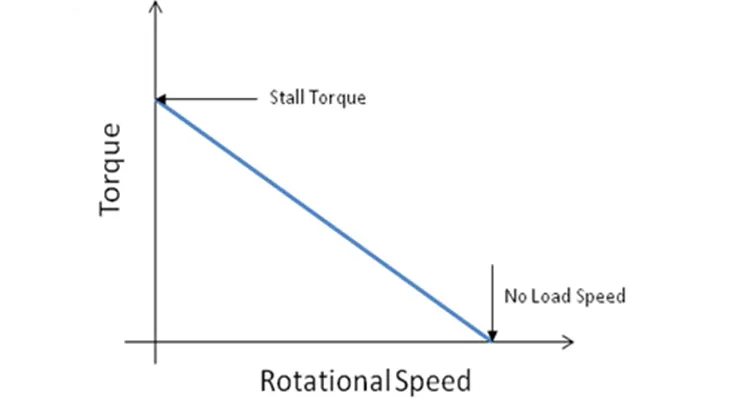
- Here you can see that as the speed of the motor is increasing the Torque is decreasing. so what happens is when the motor is starting the
speed is less so the torque develop will be more and hence there will be acceleration power available and the vehicle can accelerate easily but
during braking the vehicle will be at high speed so the torque will be low and when at high speed if we apply the brakes it won't develop the
same torque this is the reason that the regenerative braking cannot be applied effectively so basically we can say that it is a limitation of the
motor.
- There are some other reasons for electric motor failing to develop similar braking torque as starting torque and those are related to the
batteries and powerconverters,The charging rate of batteries lower are than the peak discharging rate.The battries can discharge at double
rate than there charging rate.The power converters used are bi directional converter they are bi directional because they need to use the
regenerative braking to charge the battery and if the power converter used is of complex type or it is less effective at high speed than it will
affect the regenerative braking and hence the brake torque will aslo be affected. so if we want the braking to be effective it is necessary that
we use a mechanical brake with electric brake.
- There are two types of braking used in vehicles - :
1) Mechanical brake
2) Electrical brake
- Mechanical brake :-
Mechanical brakes are assemblies consisting of mechanical elements for the slowing or stopping of shafts in equipment drives. They use
levers or linkages to transmit force from one point to another. Braking slows or stops the movement of the coupled shafts. mechanical brake
acts by generating frictional forces as two surfaces rub against each other. The stopping power or capacity of brake depends largely on the
surface area of frictional surface. They are mainly of two types (Drum brake and Disc brake). These are rough and uncomfortable and they
cause wear to braking components. In mechanical braking the whole energy is lost in the form of heat we cannot reuse it.
- Electrical brake :-
Electrical brake is a brake in which the braking is controlled by a electric current. Electric brakes are devices that use an electrical current or
magnetic actuating force to slow or stop the motion of a rotating component. They are used in industrial and vehicular braking applications
that require fast response times and precise tension control. They are of several types such as (permament brakes, electromagnetic brakes,
eddy current brakes, regenerative brake).In electric vehicles regenrative braking is widely used to charge the battery that is providing current
to the motor. These are smooth and comfortable and they do not cause any wear and here we can use that the energy that is lost in the form
of heat to recharge the battery. For low speed vehicle the electrical brake is itself capable of providing effective braking but fot high speed
vehicles it is required to use mechanical brake along with electrical brake.
- There are two brake control Strategies :-
- Series: The Regenerative Braking and the Mechanical Braking both are applied one after another.
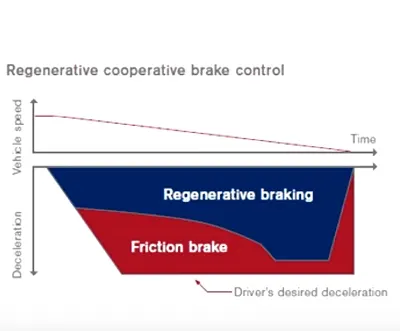
- The above fig. is an example of parallel braking of nissan car. In the fig. you can see that when the speed is high the percentage sharing of
both regenerative and friction (mechanical) brake is equal and when the speed is low the regenerative braking is doing most of the braking.
Here a controller is used which according to the speed will give signals to braking.
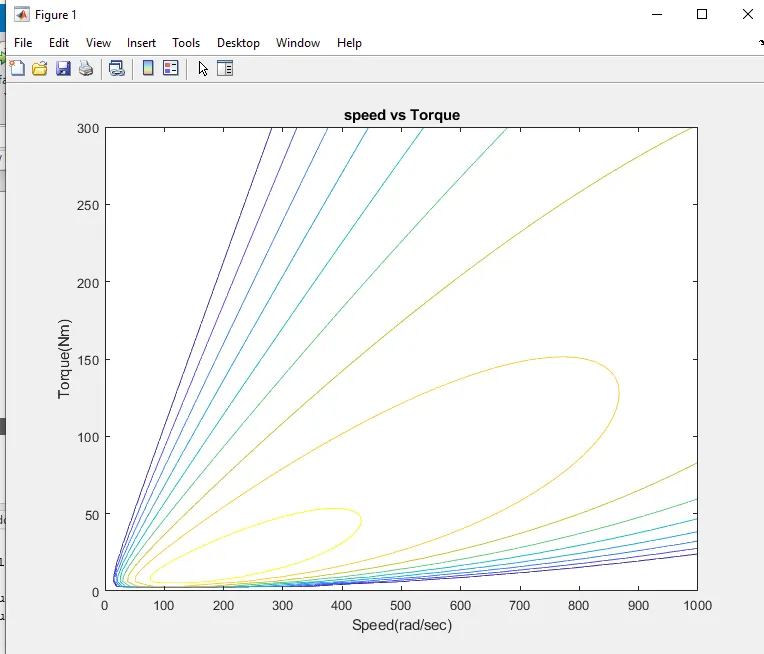
3. Make a MATLAB program which plots contour of given motor speed, torque and efficiency values:-
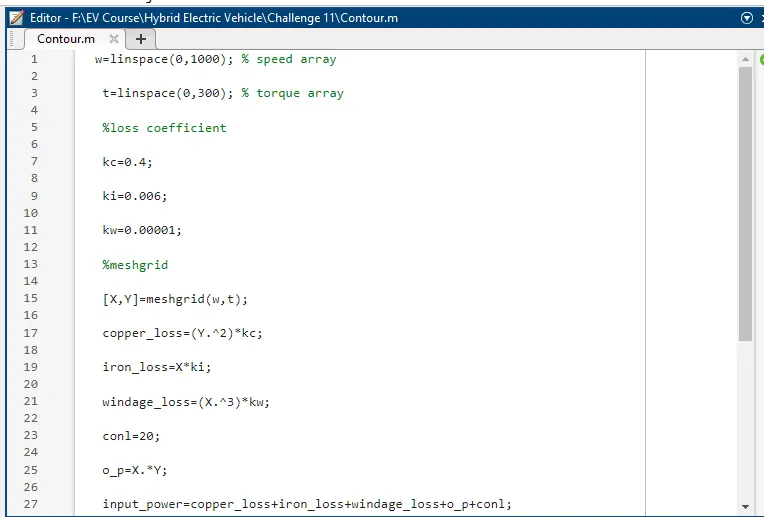
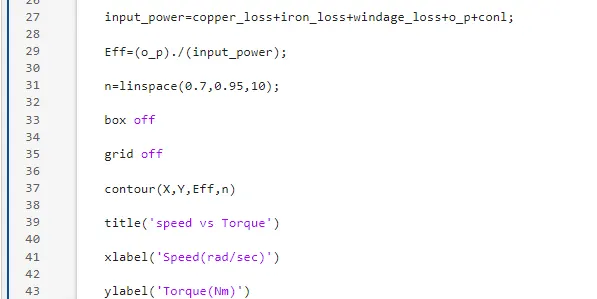

The contour plot is given ,
Conclusion :-
- In 1st question i had studied that how to calculate the braking energy required with given duty cycle of a vehicle.
- From calculation the required braking energy is 2081 J.
- In 2nd question i had studied that why electric motor can’t develop braking torque at high speed similar to starting & also how electric and mechanical brakes are coordinated.
- In last question i had studied that with help of matlab script file how contour of a motor is plotted.