Project-1: Powertrain for aircraft in runways
Part A:
1. Search and list out the total weight of various types of aircrafts.
Ans: -
MTOW = Maximum take-off weight, MLW = Maximum landing weight
| Type | MTOW [kg] | MLW [tonnes] |
| Antonov An-225 | 6,40,000 | 591.7 |
| Airbus A380-800[2][3][4] | 5,75,000 | 394 |
| Boeing 747-8F | 4,47,700 | 346.091 |
| Boeing 747-8 | 4,43,613 | 306.175 |
| Boeing 747-400ER | 4,12,770 | 295.742 |
| Antonov An-124-100M | 4,05,060 | 330 |
| Boeing 747-400 | 3,96,900 | 295.742 |
| Lockheed C-5 Galaxy[5][6][7] | 3,81,000 | 288.417 |
| Boeing 747-200[8] | 3,77,840 | 285.7 |
| Boeing 747-300[8] | 3,77,840 | 260.32 |
| Airbus A340-500[9] | 3,71,950 | 240 |
| Airbus A340-600[9] | 3,67,400 | 256 |
| Boeing 777F | 3,47,800 | 260.816 |
| Boeing 777-300ER | 3,51,800 | 251.29 |
| Boeing 777-200LR | 3,47,450 | 223.168 |
| Boeing 747-100[8] | 3,40,200 | 265.3 |
| Airbus A350-1000 | 3,08,000 | 233.5 |
| Boeing 777-300 | 2,99,370 | 237.683 |
| Boeing 777-200ER | 2,97,550 | 213 |
| Airbus A340-300[9][10] | 2,76,700 | 190 |
| McDonnell Douglas MD-11 | 2,73,300 | 185 |
| Airbus A350-900 | 2,70,000 | 175 |
| Ilyushin Il-96M | 2,70,000 | 195.04 |
| McDonnell Douglas DC-10 | 2,56,280 | 183 |
| Boeing 787-9[11] | 2,54,000 | 192.777 |
| Boeing 787-10[11] | 2,54,000 | 201.849 |
| Airbus A340-200[9][12] | 2,53,500 | 181 |
| Airbus A330-900 | 2,51,000 | 191 |
| Ilyushin IL-96-300 | 2,50,000 | 175 |
| Airbus A330-300[13][14] | 2,42,000 | 185 |
| Airbus A330-200[13][14] | 2,42,000 | 180 |
| Lockheed L-1011-500 | 2,31,300 | 166.92 |
| Boeing 787-8[11] | 2,28,000 | 172.365 |
| Lockheed L-1011-200 | 2,11,400 | |
| Ilyushin IL-86 | 2,08,000 | 175 |
| Boeing 767-400ER | 2,04,000 | 158.758 |
| Airbus A300-600R[15] | 1,92,000 | 140 |
| Boeing 767-300ER | 1,87,000 | 136.08 |
| Concorde | 1,85,000 | 111.1 |
| Airbus A300-600[15] | 1,63,000 | 138 |
| Boeing 767-300 | 1,59,000 | 136.078 |
| Airbus A310-300[15] | 1,57,000 | 124 |
| Vickers VC10 | 1,52,000 | 151.9 |
| Boeing 707-320B[16] | 1,51,000 | 97.5 |
| Boeing 707-320C[16] | 1,51,000 | 112.1 |
| Douglas DC-8-61 | 1,47,000 | |
| Airbus A310-200[15] | 1,42,000 | 123 |
| Airbus A400M | 1,41,000 | 122 |
| Douglas DC-8-32 | 1,40,000 | |
| Douglas DC-8-51 | 1,25,000 | |
| Boeing 757-300 | 1,24,000 | 101.6 |
| Boeing 707-120B[16] | 1,17,000 | 86.3 |
| Boeing 757-200 | 1,16,000 | 89.9 |
| Boeing 720B[17] | 1,06,000 | 79.5 |
| Boeing 720[17] | 1,04,000 | 79.5 |
| Tupolev Tu-154M | 1,04,000 | 80 |
| Tupolev Tu-204SM | 1,04,000 | 87.5 |
| Convair 880 | 87,500 | |
| Boeing 737-900 | 85,000 | 66.36 |
| Boeing 737-900ER | 85,000 | 71.35 |
| Boeing 727-200 Advanced[18] | 84,000 | 70.1 |
| Airbus A321-100[19] | 83,000 | 77.8 |
| Boeing 737-800 | 79,000 | 65.32 |
| Boeing 727-200[18] | 78,000 | 68.1 |
| McDonnell-Douglas MD-83 | 73,000 | 63.28 |
| Boeing 727-100[18] | 72,500 | 62.4 |
| Boeing 727-100C[18] | 72,500 | 62.4 |
| McDonnell-Douglas MD-90-30 | 71,000 | 64.41 |
| de Havilland Comet 4 | 70,700 | |
| Boeing 737-700 | 70,000 | 58.06 |
| Airbus A320-100[19] | 68,000 | 66 |
| Boeing 737-400 | 68,000 | 54.9 |
| de Havilland Comet 3 | 68,000 | |
| Boeing 377 | 67,000 | |
| Boeing 737-600 | 66,000 | 54.66 |
| Airbus A220-300 | 65,000 | 57.61 |
| Hawker Siddeley Trident 2E | 65,000 | |
| Airbus A319[19] | 64,000 | 62.5 |
| Boeing 737-300 | 63,000 | 51.7 |
| Boeing 737-500 | 60,000 | 49.9 |
| Airbus A220-100 | 59,000 | 50.8 |
| Airbus A318[19] | 59,000 | 57.5 |
| Boeing 717-200HGW | 55,000 | 47.174 |
| Douglas DC-7 | 55,000 | |
| de Havilland Comet 2 | 54,000 | |
| Boeing 717-200BGW | 50,000 | 46.265 |
| de Havilland Comet 1 | 50,000 | |
| Douglas DC-6A | 48,600 | |
| Douglas DC-6B | 48,500 | |
| Embraer 190[20] | 48,000 | 43 |
| Caravelle III | 46,000 | |
| Fokker 100 | 46,000 | 39.95 |
| Douglas DC-6 | 44,000 | |
| Avro RJ-85 | 42,000 | 36.74 |
| Handley Page Hermes | 39,000 | |
| Embraer 175[21] | 37,500 | 32.8 |
| Bombardier CRJ900[22] | 36,500 | 33.345 |
| Embraer 170[23] | 36,000 | 32.8 |
| Bombardier CRJ700 | 33,000 | 30.39 |
| Douglas DC-4 | 33,000 | |
| Vickers Viscount 800 | 30,400 | |
| Bombardier Q400 | 28,000 | 28.01 |
| Bombardier CRJ200 | 23,000 | 21.319 |
| ATR 72-600 | 22,800 | 22.35 |
| Saab 2000 | 22,800 | 21.5 |
| Embraer ERJ 145 | 22,000 | 19.3 |
| ATR 42-500 | 18,600 | 18.3 |
| Saab 340 | 13,150 | 12.93 |
| Embraer 120 Brasilia | 11,500 | 11.25 |
| BAe Jetstream 41 | 10,890 | 10.57 |
| Learjet 75[24] | 9,752 | 8.709 |
| Pilatus PC-24[25] | 8,300 | 7.665 |
| Embraer Phenom 300[26] | 8,150 | 7.65 |
| Beechcraft 1900D | 7,765 | 7.605 |
| Cessna Citation CJ4[27] | 7,761 | 7.103 |
| de Havilland Hercules | 7,000 | |
| Embraer Phenom 100 | 4,800 | 4.43 |
Maximum takeoff weight (MTOW)
The maximum takeoff weight (also known as the maximum brake-release weight) is the maximum weight authorised at brake release for takeoff, or at the start of the takeoff roll.
The maximum takeoff weight is always less than the maximum taxi/ramp weight to allow for fuel burned during taxi by the engines and the APU.
In operation, the maximum weight for takeoff may be limited to values less than the maximum takeoff weight due to aircraft performance, environmental conditions, airfield characteristics (takeoff field length, altitude), maximum tire speed and brake energy, obstacle clearances, and/or en route and landing weight requirements.
Maximum landing weight (MLW)
The maximum weight authorised for normal landing of an aircraft.The MLW must not exceed the MTOW.
2. Is there any difference between ground speed and air speed?
Ans: -
Air Speed Vs Ground Speed
As mentioned above, true airspeed is simply the speed at which an aircraft is moving relative to the air it is flying in. As such, it’s also the speed at which the air is flowing around the aircraft’s wings.
Ground speed, on the other hand, is the aircraft’s speed relative to the ground. One thing that should be noted here is that it’s its horizontal rather than vertical speed – an aircraft climbing completely vertically would have a ground speed of zero.
In other words, while airspeed is what determines whether there is enough airflow around an aircraft to make it fly, ground speed is what determines how fast an aircraft will get to its destination.
The relationship between airspeed and ground speed is fairly simple. Ground speed is simply the sum of airspeed and wind speed.
If the aircraft is flying in the same direction as the wind is blowing, the aircraft experiences tailwind, and its ground speed is higher than its airspeed. On the other hand, if the wind is blowing against the direction the aircraft is traveling in, the aircraft experiences headwind, and its ground speed is lower than its airspeed.
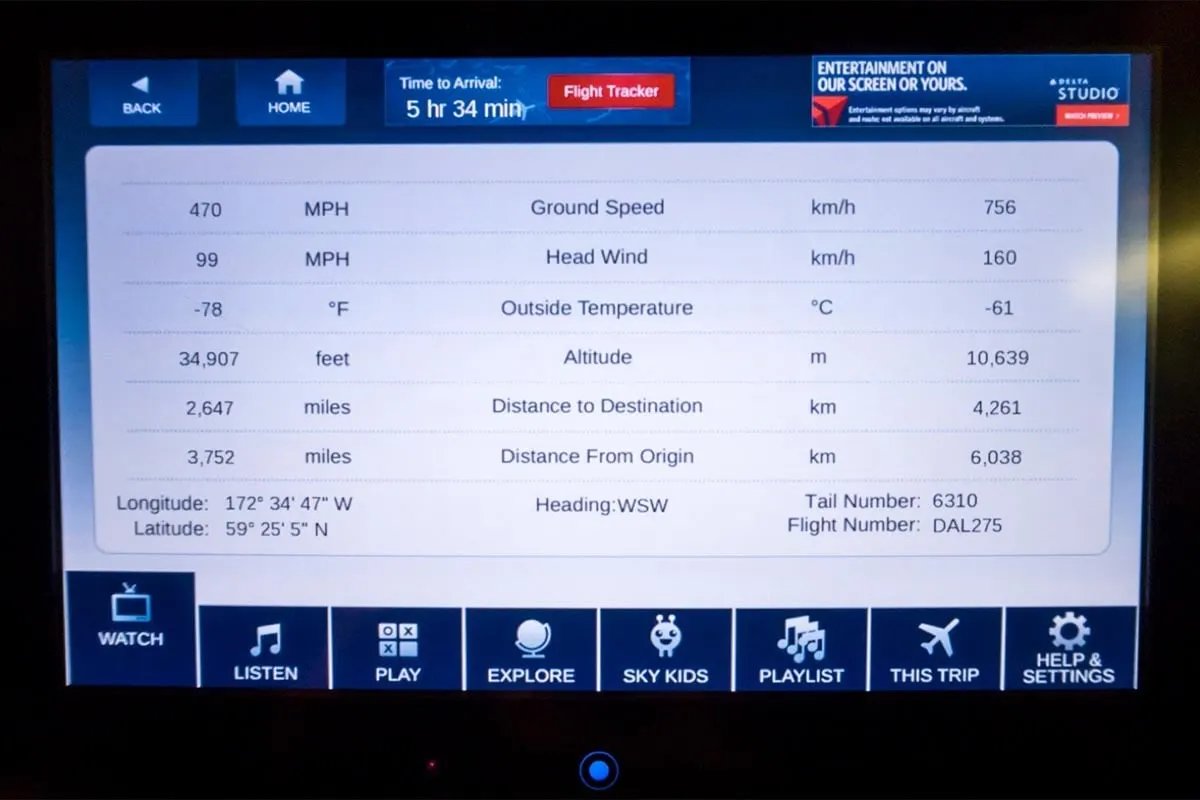
To give you an actual example, imagine an aircraft that cruises at an airspeed of 500 miles per hour that has to cover a ground distance of 2,000 miles.
If there is no wind at all, then both the aircraft’s airspeed and ground speed would be the same 500 miles per hour, and the aircraft would reach its destination in four hours.
If there was a 100 miles per hour headwind – wind blowing against the aircraft’s direction of travel – the aircraft would still be traveling at an airspeed of 500 miles per hour. However, its ground speed would be just 400 miles per hour (100 miles per hour slower than its airspeed). And as such, it would take the aircraft five hours to reach its destinations.
Finally, if there was a 100 miles per hour tailwind – wind blowing in the same direction as the aircraft’s travel – the aircraft would still be traveling at an airspeed of 500 miles per hour, but its ground speed would be 100 miles faster. And, at 600 miles an hour, the aircraft would reach its destination in just three hours and twenty minutes.
The above is the reason why some flights go “out of their way” to avoid headwinds or catch tailwinds. And, why some flights might appear to be traveling at “supersonic speeds,” even though their airspeed – the speed that would actually matter in determining whether or not the flight truly is supersonic – is subsonic.
3. Why is it not recommended to use aircraft engine power to move it on the ground at Airport?
Ans: -
- For movement on the ground the aircraft uses it own engine power, which is called taxing. Although many aircrafts are capable of moving in backward using reverse thrust, as result the jet blast or prop wash might cause damage to the terminal building or equipment.
- Engine close to ground may also blow sand and debris forward and then suck them into the engine, causing damage to the engine. Therefore there are pushback trucks in the airport. A pushback truck lifts the front weel of the aircraft, their role in most airports is to move the aircraft away from the parking spot on to the taxiways, which is called towing.
- Unwanted consequences mainly arising from the unintended movement of the aircraft during engine running.
- i) Effectively a loss of control can happen, especially during high power engine running. Damage can occur to the aircraft itself, other aircraft nearby or to airside structures.
- ii) There is a risk of injury to ground support personnel who may be in relatively close proximity to the aircraft.
- iii) It is easier for truck driver to see the surroundings better than the pilot sitting in the cockpit with limited window. The pushback driver knows the airport better than the pilot.
- iv) It also saves fuel. virgin Atlantic had proposed a new system in which pushback truck will move the aircraft all the way to runway to save fuel and reduce impact of environment.
- v) The plane engines are very loud. When more than one plane will add up their sound, than it will not be pleasent for passangers and others near airport.
4. How an aircraft is pushed to runway when its ready to take off?
Ans:-
In aviation, pushback is an airport procedure during which an aircraftis pushed backwards away from an airport gate by external power. Pushbacks are carried out by special, low-profile vehicles called pushback tractors or tugs.
Although many aircraft are capable of moving themselves backwards on the ground using reverese thrust (a procedure referred to as a powerback), the resulting jetblast or propwash might cause damage to the terminal building or equipment. Engines close to the ground may also blow sand and debris forward and then suck them into the engine, causing damage to the engine. A pushback is therefore the preferred method to move the aircraft away from the gate.
Pushbacks at busy aerodromes are usually subject to ground control clearance to facilitate ground movement on taxiways. Once clearance is obtained, the pilot will communicate with the tractor driver (or a ground handler walking alongside the aircraft in some cases) to start the pushback. To communicate, a headset may be connected near the nose gear.
Since the pilots cannot see what is behind the aircraft, steering is done by the pushback tractor driver and not by the pilots. Depending on the aircraft type and airline procedure, a bypass pin may be temporarily installed into the nose gear to disconnect it from the aircraft's normal steering mechanism.
Once the pushback is completed, the towbar is disconnected, and any bypass pin removed. The ground handler will show the bypass pin to the pilots to make it clear that it has been removed. The pushback is then complete, and the aircraft can taxi forward under its own power.
5. Learn about take off power, tyre design, rolling resistance, tyre pressure, brake forces when landing.
Ans: -
Take-Off Power:
- For light aircraft, usually full power is used during takeoff. Large transport category (airliner) aircraft may use a reduced power for takeoff, where less than full power is applied in order to prolong engine life, reduce maintenance costs and reduce noise emissions.
- In some emergency cases, the power used can then be increased to increase the aircraft's performance. Before takeoff, the engines, particularly piston engines, are routinely run up at high power to check for engine-related problems.
- The aircraft is permitted to accelerate to rotation speed (often referred to as Vr). The term rotation is used because the aircraft pivots around the axis of its main landing gear while still on the ground, usually because of gentle manipulation of the flight controls to make or facilitate this change in aircraft attitude (once proper air displacement occurs under / over the wings, an aircraft will lift off on its own; controls are to ease that in).
- The nose is raised to a nominal 5°–15° nose up pitch attitude to increase lift from the wings and effect liftoff. For most aircraft, attempting a takeoff without a pitch-up would require cruise speeds while still on the runway.
- Carcass plies are used to form the tire. They are sometimes called casing plies. An aircraft tyre is constructed for the purpose it serves.
- They support the weight of an aircraft while it is on the ground.
- It also provides the necessary traction for braking and stopping of an aeroplane.
- Tyre also helps to absorb the shock of landing and provide cushioning the roughness of takeoff, roll-out, and taxi operations.
- Unlike an automobile or truck tyre, it does not have to carry a load for a long period of continuous operation. However, an aircraft tyre absorbs the high impact loads of landing, and also it’s operating at high speeds for a short time when required.
Technical Aspects of the tyre: -
Retreading – Retreading is methods of restoring a worn tyre by renewing the tread area or by renewing the tread area plus one or both sidewalls. Repairs are included in the tyre retreading process.
Load Rating – Load rating is the maximum permissible load at a specified inflation pressure.
Ply Rating – Ply Rating is used to identify the maximum recommended load rating and inflation pressure for a specified tyre. It is an index of tyre strength.
Speed Rating – The speed rating is the maximum takeoff speed to which the tyre has been tested.
Skid Depth – Skid depth is the distance between the tread surface and the deepest groove as measured in the mould.
- Aircraft tyres must have an approved speed and load rating and have sufficient clearance when retracted through landing gear to allow for tyre growth. Tyre growth is the increase in the size of the tyre due to centrifugal forces at high speed.
Rolling Resistance:
The resistance offered by the tyres against motion of vehicle/aircraft is called as rolling resistance, the rolling resistance is produced during take off/landing in the runway.
Tyre Pressure:
Aircraft tires are usually inflated with nitrogen to minimize expansion and contraction from extreme changes in ambient temperature and pressure experienced during flight. Dry nitrogen expands at the same rate as other dry atmospheric gases (normal air is about 80% nitrogen), but common compressed air sources may contain moisture, which increases the expansion rate with temperature.
Tests of airliner aircraft tires have shown that they are able to sustain pressures of maximum 800 psi (55 bar; 5,500 kPa) before bursting. During the tests the tires have to be filled with water, to prevent the test room being blown apart by the energy that would be released by a gas when the tire bursts.
The main landing gear on the Concorde was typically inflated to 232 psi (16.0 bar), whilst its tail bumper gear tires were as high as 294 psi (20.3 bar). The high pressure and weight load on the Concorde tyres were a significant factor in the loss of Air France flight 4590
Brakes Forces When Landing:
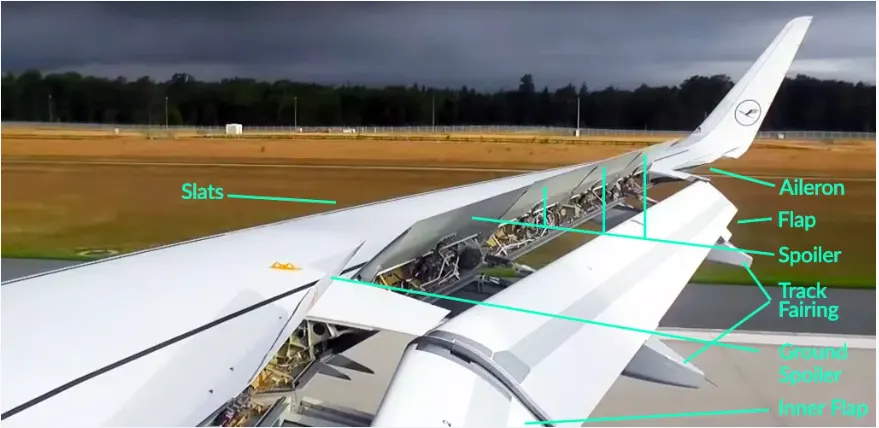
In general, when the wheels touch the ground, a set of spoilers raise up quickly, which kills the lift provided by the wings. (There are two sets seen in the image below: ground spoilers that only deploy on landing, and spoilers that are used in flight as speed brakes as well as on landing.) While the spoilers provide some drag, their primary purpose is to stop the plane from actually flying, putting all of the weight on the landing gear and in turn making the brakes that much more effective.
Aircraft have highly-engineered, multi-disc brakes made of a carbon-steel material. Manufacturers include Honeywell and Goodrich, part of Collins Aerospace. In general, the brakes are composed of discs that rotate with the wheel and separate discs that are fixed. When pressure is applied—and below you see pressure applied from the right fixed disc on all of the discs—the entire assembly compresses to create the braking action. Carbon brakes are standard today; they cool faster than steel brakes (their predecessor) and can weigh up to 700 pounds less. That represents a significant weight saving for airlines.
Auto Brakes:
Wheel brakes are usually selected to engage automatically after landing. These are called “autobrakes”.that all airliners have several levels of autobrake “severity”. The crew will decide which is the most appropriate to use for every landing depending upon factors like the length of runway, if it is wet or dry, or if the pilots want to exit the runway at a particular point. “For a short wet runway you might select autobrake 3, or MED on the Airbus. For a long dry runway you might select autobrake 1 or LOW on the Airbus".
Part B:
6. A. With necessary assumptions, calculate the force and power required to push / pull an aircraft by a towing vehicle.
B. Develop the model for the calculated force and power using Simulink.
Ans: -
The forces required to push/ pull an aircraft by a towing are rolling resistance force and areodynamic drag force. 1) Rolling resistance force:- As we have discussed in part-A 5c. It is the force resisting the motion when a body (such as a ball, tire, or wheel) rolls on a surface. Its governing equation is given as
F = CN
F=C*m*g
where,
Crr= Rolling resistance coefficient m=Mass of the body g= acceleration due to gravity
2)Aerodynamic Drag Force:
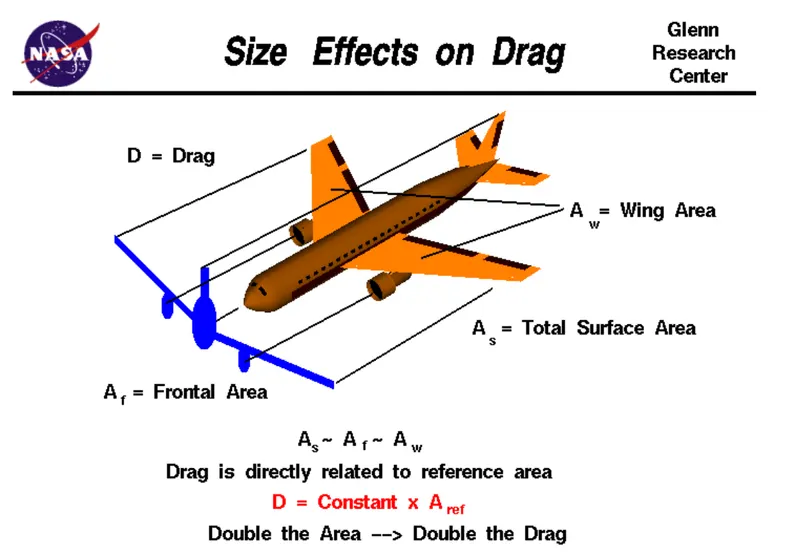
- It is the force opposing the motion of the body. The drag coefficient is a common measure in automotive design as it pertains to aerodynamics, Drag is a force that acts parallel to and in the same direction as the airflow.
- The drag coefficient of an automobile measures the way the automobile passes through the surrounding air. When automobile companies design a new vehicle, they take into consideration the automobile drag coefficient in addition to the other performance characteristics.
- Aerodynamic drag increases with the square of speed; therefore, it becomes critically important at higher speeds. Reducing the drag coefficient in an automobile improves the performance of the vehicle as it pertains to speed and fuel efficiency. The governing equation of these force is given as following:
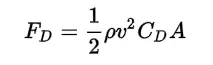
where.
F{D} = dra force
rho = r density of the air
น = flow velocity relative to the object
C{D} = drag coefficient
A = reference area
Calculation:
let us assume that,
Mass of Towing Vehicle= 40,000kg
Mass of aircraft = 155,000kg
Total mass (m)= 40,000+155,000 =195,000kg
Frontal Area of the aircraft (A) =18 m²
Speed of the vehicle (2)=25Kmph
converting it into m/sec
u=25*(1000/3600)=6.9445m/sec
Drag coefficient (Cd) =0.75
Air density (P)=1.225Kg/m³
Calculating Rolling resistance Force (Frr) =Crr*m*g
=0.01*195.000*9.8
= 19.11ON
Calculating Aerodynamic Drag Force (Fd)=0.5*p Cd*A* v^2
=0.5 *1.225 *18* 0.75* (6.9445)2
=398.769N
Therefore the total Force required to push/pull the aircrcraft by the towing vehicle (F) Frr+Fd
=19,110+398.769
=19,508.769 N
Calculating the power (p) =Force*Velocity
= 19508.769* 6.9445
=135.478kW
B. Developing the model for the calculated force and power using Simulink:
Blocks Used:
1) Constant
2) Sum
3) Product
4)Square
5)Display
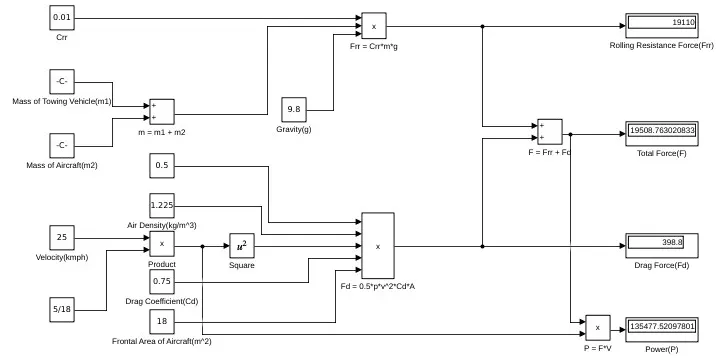
Explaination:
In order to understand the above simulink model we do reverse engineering
• For calculating power we have to multiply both total force(F) and velocity in m/sec for this we have used 'product' block (P-FV).
• For calculating the Total Force(F) we have added both Frr & Fd by using 'Surn' block as shown in the above figure
• To find the value of rolling resistance (Frr) we used product to multiply the values Crr., Total mass(m) & gravity (g) which are to be entered in the 'Constant block.
. Similarly for calculating Drag force(Fd) we have to multiply the velocity in m/sec.Drag coefficient, Frontal area of aircraft(A) and a constant value 0.5 which are to be entered in constant block.
• In order to convert velocity in Kmph to m/sec we have multiplied it with 5/18.
7. A. Design an electric powertrain with type of motor, it’s power rating, and energy requirement to fulfill aircraft towing application in Simulink. Estimate the duty cycle range to control the aircraft speed from zero to highest. Make all required assumptions. Prepare a table of assumed parameters. Draw a block diagram of powertrain.
(Hint :DC7 Block)
B. Also, Design the parameters in excel sheet.
Ans: -
Block Diagram of Powertrain:
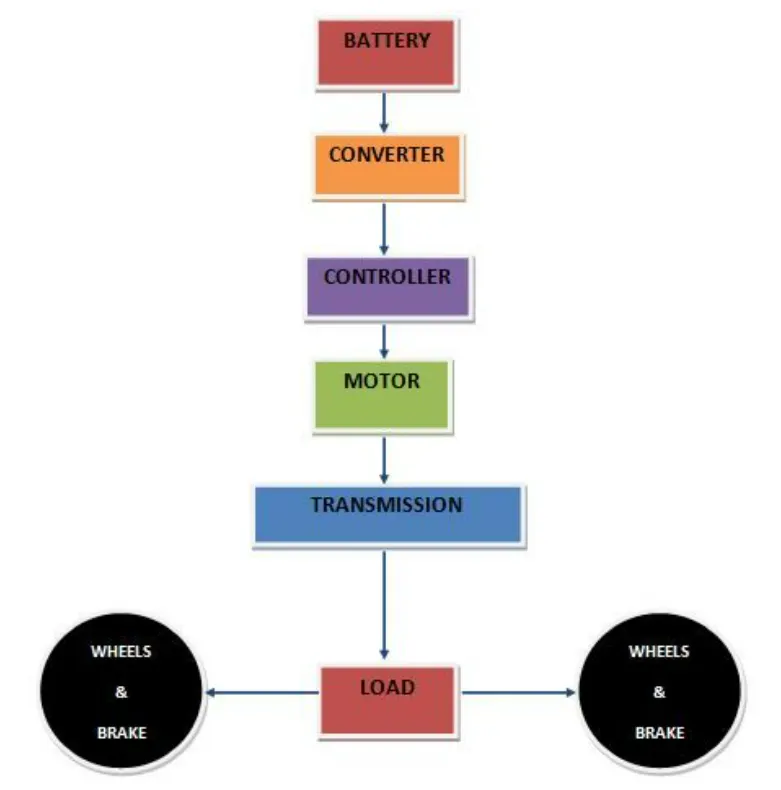
Based on the calculations done in 6A.
Force required to push/pull the aircraft =19.508 KN
Power required =135.478 kw
Let us assume,
The Radius of the Tyre for the Tug - 25inches =0.635m
Gear ratio=8
Transmission Effeciency (nt) =87%
Motor Efficiency (nm)=95%
then,
Torque required for the wheels (Tw)=Total Force *Radius in meters
=19.508 *0.635
=12.387KNm
Motor Torque-Wheel torque/(Gear ratio'nt)
=12.387/(8 0.87)
=1.778KNm
For nm =95%. The required motor Torque (Tm)= 1.778/0.95 =1.871 kNm
Similarly. The total power required by the motor considering all the efficiencies (Pt) = 135.478/(0.87*0.95)=163.917Kw
Let us assume the towing operation was done for a 15 minutes (0.25Hrs) duration.
Then, Total Energy consumed = 163.917* 0.25=40.98 KWh
If we consider the battery capacity=220 kw is used by the towing vehicle then. The duty cycle range to control the speed from O to max speed (3m/s) is given as
Duty Cycle (d)= (Required Power)/ (Rated power)= 163.917/220 =0.75
Therefore the controller will be able to provide a duty cycle ranging from 0 to 75% in order to control the towing speed.