Project-1: Powertrain for aircraft in runways
PART A
1.Search and list out the total weight of various types of aircrafts:-
The aircraft has:
- Basic Empty Weight (BEW) is the weight of the aircraft "as built" and includes the weight of the structure, power plant, furnishings, installations, systems and other equipment that are considered an integral part of an aircraft before additional operator items are added for operation.
- Dry Operating Wieght (DOW) BEW + Weight of Crew (Pilot + Cabin including their bags) + Pantry
- Operating Weight (OW) DOW + Takeoff fuel (i.e. Ramp Fuel - Taxi fuel)
- Maximum Zero Fuel Weight (MZFW) DOW + Payload (anything put on the aircraft that generates revenue to the company, e.g. passenger, baggage, cargo, mail and fret)
- Maximum Taxi Weight (MTW) MZFW + Ramp fuel
- Maximum Takeoff Weight (MTOW) MZFW + Takeoff fuel, or MTW - Taxi fuel
- Maximum Landing Weight (MLW) MTOW - Trip Fuel.
Some of the major Aircrafts and its weights as mentioned below,
| Type | MTOW [kg] | MLW [tons] |
| Antonov An-225 | 6,40,000 | 591.7 |
| Scaled Composites Model 351 Stratolaunch | 5,89,670 | - |
| Airbus A380-800[1][2] | 5,75,000 | 394 |
| Boeing 747-8F | 4,47,700 | 346.091 |
| Boeing 747-8 | 4,43,613 | 306.175 |
| Boeing 747-400ER | 4,12,770 | 295.742 |
| Antonov An-124-100M | 4,05,060 | 330 |
| Boeing 747-400 | 3,96,900 | 295.742 |
| Lockheed C-5 Galaxy[3][4][5] | 3,81,000 | 288.417 |
| Boeing 747-200[6] | 3,77,840 | 285.7 |
| Boeing 747-300[6] | 3,77,840 | 260.32 |
| Airbus A340-500[7] | 3,71,950 | 240 |
| Airbus A340-600[7] | 3,67,400 | 256 |
| Boeing 777F | 3,47,800 | 260.816 |
| Boeing 777-300ER | 3,51,800 | 251.29 |
| Boeing 777-200LR | 3,47,450 | 223.168 |
| Boeing 747-100[6] | 3,40,200 | 265.3 |
| Airbus A350-1000 | 3,08,000 | 233.5 |
| Boeing 777-300 | 2,99,370 | 237.683 |
| Boeing 777-200ER | 2,97,550 | 213 |
| Airbus A340-300[7][8] | 2,76,700 | 190 |
| McDonnell Douglas MD-11 | 2,73,300 | 185 |
| Airbus A350-900 | 2,70,000 | 175 |
2. Difference between ground speed and air speed:-
Wind Speed
For a reference point picked on the ground, the air moves relative to the reference point at the wind speed. Notice that the wind speed is a vector quantity and has both a magnitude and a direction. Direction is important. A 20 mph wind from the west is different from a 20 mph wind from the east. The wind has components in all three primary directions (north-south, east-west, and up-down). In this figure, we are considering only velocities along the aircraft's flight path. A positive velocity is defined to be in the direction of the aircraft's motion. We are neglecting cross winds, which occur perpendicular to the flight path but parallel to the ground, and updrafts and downdrafts, which occur perpendicular to the ground.
Ground Speed
For a reference point picked on the ground, the aircraft moves relative to the reference point at the ground speed. Ground speed is also a vector quantity so a comparison of the ground speed to the wind speed must be done according to rules for vector comparisons.
Airspeed
The important quantity in the generation of lift is the relative velocity between the object and the air, which is called the airspeed. Airspeed cannot be directly measured from a ground position, but must be computed from the ground speed and the wind speed. Airspeed is the vector difference between the ground speed and the wind speed.
Airspeed = Ground Speed - Wind Speed
On a perfectly still day, the airspeed is equal to the ground speed. But if the wind is blowing in the same direction that the aircraft is moving, the airspeed will be less than the ground speed.
3.Why is it not recommended to use aircraft engine power to move it on the ground at Airport:-
Aircraft towing equipment is typically used for the towing and pushback process to avoid some of the significant hazards posed by aircraft engines. When an aircraft's engine is activated, the thrust can create a high-speed wind that can easily cause damage to the airport terminal, surrounding ground vehicles, jetway, baggage and most importantly, ground personnel.
Suppressing the use of engines is especially important when towing a large aircraft, as their more powerful thrust capabilities can become exceedingly dangerous. Engine thrust can easily send any loose items airborne, turn the tiniest grains of dust into hazardous projectiles and create debris that can cause damage to multi-million dollar engines. Additionally, aircraft engines consume a great deal of fuel and generate extreme noise that can be harmful to ground personnel. Using a pushback tug for aircraft is simply a more economical and safer option than running the engines.
4. How an aircraft is pushed to runway when its ready to take off:-
When the aircraft is ready to take of pilots and airlines rely on special type vechicles called tugs to perform towing and pushback operations for commercial, private and military aircraft with general ease. The traction design incorporated into aircraft towing equipment means safe movement and stops, even on snow and ice. Towing and pushback tugs for aircraft are also used to make general maintenance easier for ground personnel. When an aircraft needs to be moved to a hangar for maintenance purposes or is not required for flight, the easiest way is to send an aircraft tug to the tow-in gate for transport. Aircraft towing frees up time for the airline, maintenance team, airport ground controllers and pilots who don't need to waste time getting the engines started. It's also not cost-efficient to start aircraft engines just to reposition an aircraft for maintenance purposes. Typically, ground personnel are trained to only need the aircraft brake system when towing a large aircraft.
5. Learn about take off power, tyre design, rolling resistance, tyre pressure, brake forces when landing:-
Take off Power:-
For light aircraft, usually full power is used during takeoff. Large transport category (airliner) aircraft may use a reduced power for takeoff, where less than full power is applied in order to prolong engine life, reduce maintenance costs and reduce noise emissions. In some emergency cases, the power used can then be increased to increase the aircraft's performance. Before takeoff, the engines, particularly piston engines, are routinely run up at high power to check for engine-related problems. The aircraft is permitted to accelerate to rotation speed (often referred to as Vr). The term rotation is used because the aircraft pivots around the axis of its main landing gear while still on the ground, usually because of gentle manipulation of the flight controls to make or facilitate this change in aircraft attitude (once proper air displacement occurs under / over the wings, an aircraft will lift off on its own; controls are to ease that in).
The nose is raised to a nominal 5°–15° nose up pitch attitude to increase lift from the wings and effect liftoff. For most aircraft, attempting a takeoff without a pitch-up would require cruise speeds while still on the runway.
Tyre Design:
Based on the type of plies used the tyres can be:
Radial ply tires - these tyres feature a flexible casing which is constructed of rubber-coated ply cords which extend around the beads and are substantially at 90° to the centerline of the tread. The casing is stabilized by an essentially inextensible circumferential belt.
Bias ply tires - these tyres feature a casing which is constructed of alternate layers of rubber-coated ply cords which extend around the beads and are at alternate angles substantially less than 90° to the center line of the tread.
Based on the method for containing the inflation gas the tyres can be:
* Tube-type tyres - these require tubes for inflation retention.
* Tubeless tyres - these do not require tubes. They are constructed with an innerliner (integral rubber lining that is engineered to prevent the diffusion of the inflation gas into the casing).
Rolling Resistance:
-Rolling resistance or rolling drag is the force resisting the motion when the body rolls on a surface and it is mainly caused by non elasticity that is not all the energy needed for deformation of wheel is recovered when the pressure is removed. Usually aircrafts have a very low rolling resistance coeffiecient of 0.06. Its given by the equation,
Frr = CW/r
Where,
Frr - Rolling Resistance Force
C - Coefficient of Rolling Friction
W - Weight of the body
r - Radius of the tyre
Tyre Pressure:
-Aircraft tyres are designed to withstand heavy loads and shocks durong landing and take off and also needs to distribute weight evenly.
-As per research and testing it is found that aircraft tyres are able to sustain pressure upto 800 psi.Generally to note the tyre pressure of an aircraft a special type of sensors are used.
Brake forces:
-Braking an aircraft is a challenging job for most of the pilots especially during landing in a rainy and cross wind environment.
-Inorder to encounter this kinds of problem pilots usually make use of spoilers and reverse thust method inorder to have a safe landing so that the energy required to apply brakes on tires can be reduced and henceforth they do not skid.
-Now there is method which determines the brake force for aircrafts and they are as follows:
k=1/2mv^2,
Where,
m= mass of aircraft,
v=velocity of aircraft.
A typical commercial landing speed will range between 150 to 165 MPH.And for passenger flight it is about 166 to 172mph.
6A. With necessary assumptions, calculate the force and power required to push / pull an aircraft by a towing vehicle.
The rolling resistance for the air plane can be calculated as
Frr = c mr ag
where
Frr = rolling resistance (N)
c = rolling resistance coefficient
mr = rolling mass (kg)
ag = acceleration of gravity (9.81 m/s2)
If the mass of a plane is 40000 kg, But
Mass of the aircraft which act as a payload to the Towing Vehicle(kg) - 150000 kg
Therefore, Total Mass of the towing vehicle(m)=150000+40000 = 190000 kg.
The rolling resistance co-efficient between the aircraft wheel and the runway is 0.02
The force required to overcome the rolling resistance can be calculated as
Frr = 0.02 * (190000 kg) *(9.8 m/s2)
Frr = 37,240 N
Similarly,for Aerodynamic Drag:
Fad = 1/2(Cd*v^2*ρ*A)
Where,
A - Frontal area of the vehicle
v - Velocity of the object
ρ - Air Density
Cd - Drag Coefficient
assuming that,
Frontal Area of the vechicle = 18 m^2
Coefficient of Drag for the towing vehicle(Cd_v) = 0.608
Coefficient of Drag for the aircraft(Cd_a) = 0.15
Air Density(ρ) = 1.225kg/m3
v= velocity of pull vehicle taken as 5 km/hr = 1.39 m/s
Now, Aerodynamic Drag,(Fad) = 0.5*(Cd_v + Cd_a)*v^2)*ρ*A
= 0.5*(0.608+0.15)*1.39^2*1.225*18
Fad = 16.12N
The power for pulling/push the aircraft can be calculated as
P=F*V = (Frr + Fad)*v
P = (37240+16.12)*1.39
= 51,786 W
= 51.74 kW
6B. Simulink Model for above calculation:-
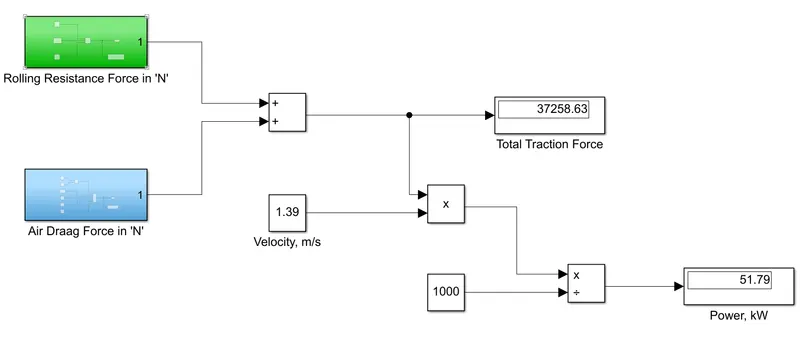
7A.
Taking the prevoius example power value 51.74 kW for this problem
Power =51.74 kW
The motor power should be greater than or equal to 52kW assuming it as 52 kW.
The energy required can be calculated as E=P*t
assuming taxi time of 5 mins.
E=52*(5*60) kJ
= 15,600kJ
From power equation
Vo*Io=ηVi*Ii
where,
Vo is the output voltage
Io is the output current
η is the power efficiency (ranging from 0 to 1)
Vi is the input voltage
Ii is the input current
Consider DC input voltage as 48V and Power as 60kW
P= Vi*Ii
60000 = 48*Ii
Ii = 1250
The efficiency is calculated as
η=52000/60000
=0.86
From the above power equation
Vo*Io=ηVi*Ii
Vo*1250=0.86*48*1250
Vo=41.28V
The Vout =Vin/1-D
41.28=48/(1-D)
D= 0.16 the duty cycle has in the range of (0,0.16)
7.B
| Sl.No | Parameters | Vehicle |
| 1 | Rolling Resistance Calculation | |
| Kerb Weight (Kg) | 150000 | |
| Payload (Kg) | 40000 | |
| Gross Weight (Kg) | 190000 | |
| Coefficient of rolling resistance,Mu | 0.02 | |
| Rolling Resistance Force (N) | 37240 | |
| 2 | Air Drag Calculation | |
| Air Density, p (Kg/m^3) | 1.225 | |
| Frontal Area, A (m^2) | 18 | |
| Drag coefficient of Towing,Cd_v | 0.608 | |
| Drag coefficient aircraft,Cd_a | 0.15 | |
| Speed (Km/Hr) | 5 | |
| Velocity, V(m/s) | 1.39 | |
| Air Drag Force (N) | 16.12 | |
| Total Tractive Force, Fte | 37256.12 | |
| Total Tractive Power, Pte (KW) | 51.74 | |
| Assumation for Powertrain Design | ||
| Parameter | Value | |
| Aircraft Mass | 150000 Kg | |
| Towing Vehicle Mass | 40000 Kg | |
| Rolling Resistance Co-efficient | 0.01 | |
| Air Density | 1.225 Kg/m^3 | |
| Towing Vehicle Drag Co-efficient | 0.608 | |
| Aircraft Drag Co-efficient | 0.15 | |
| Frontal Area | 18 m^2 | |
| Inclination Angle | 0 rad | |
| Tyre Pressure | 196 PSI/13.51 bar | |
| Towing Velocity(V) | 5 Km/hr = 1.39 m/s | |
| Towing Time(t) | 2 min | |
| Radius of the Towing Vehicle Wheel | 0.4 m | |