Powertrain for aircraft in runways
Project-1: Powertrain for aircraft in runways
OBJECTIVES:
Part A:
1. Search and list out the total weight of various types of aircrafts.
2. Is there any difference between ground speed and air speed?
3. Why is it not recommended to use aircraft engine power to move it on the ground at Airport?
4. How an aircraft is pushed to runway when its ready to take off?
5. Learn about take off power, tyre design, rolling resistance, tyre pressure, brake forces when landing.
Part B:
6. A. With necessary assumptions, calculate the force and power required to push / pull an aircraft by a towing vehicle.
B. Develop the model for the calculated force and power using Simulink.
7. A. Design an electric powertrain with type of motor, it’s power rating, and energy requirement to fulfill aircraft towing application in Simulink. Estimate the duty cycle range to control the aircraft speed from zero to highest. Make all required assumptions. Prepare a table of assumed parameters. Draw a block diagram of powertrain.
(Hint :DC7 Block)
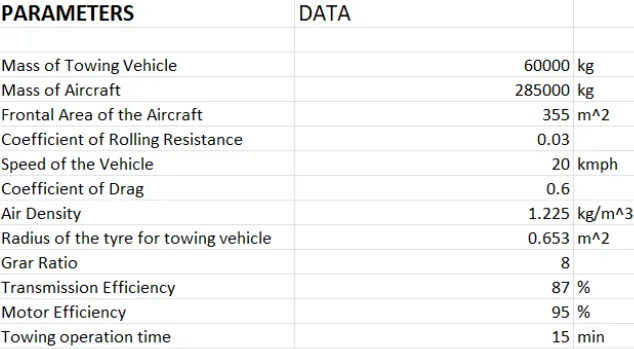
B. Also, Design the parameters in excel sheet.
SOLUTION:
Part A: 1. Search and list out the total weight of various types of aircrafts.
The overall weight of the aircraft at any point during a flight or ground operation is known as the aircraft gross weight (sometimes referred to as the all-up weight and abbreviated as AUW). Due to the consumption of fuel and lubrication, an aircraft's gross weight will drop during a flight. The gross weight of an aircraft may change throughout a flight as a result of payload loss or in-flight refueling.
The following categories apply to the Aircraft weights:
Maximum design taxi weight (MDTW):
The maximum design taxi weight, often referred to as the maximum design ramp weight (MDRW), is the highest weight allowed by certificate for aircraft moving on the ground (taxiing or towing), subject to the limitations of the aircraft's strength and airworthiness.
Maximum design takeoff weight (MDTOW):
It is the highest weight for which the manufacturer has proved compliance with the pertinent structural and engineering standards, and it is the maximum certificated design weight when the brakes are released for takeoff.
Maximum design landing weight (MDLW):
The highest certificated design weight at which the aircraft satisfies the necessary criteria for landing certification. It typically depends on the strength of the landing gear or the impact loads of the landing on certain components of the wing structure. The maximum landing weight is normally built to allow for a sink rate at impact of 10 feet per second (600 feet per minute) without causing structural damage.
Maximum design zero fuel weight (MDZFW):
The weight of the airplane at its maximum certificated design, less all useable fuel and other specified usable agents (engine injection fluid, and other consumable propulsion agents). It is the highest weight that can be carried before the airplane is loaded with useable fuel and other specified usable fluids in certain places. Strength and airworthiness standards put a cap on the MDZFW. At this weight, the supplemental fuel addition will not effect design strength.
Manufacuturer's empty weight (MEW):
It is the weight of the airplane "as built" and includes the weight of the aircraft's construction, power source, interior fittings, installations, systems, and other hardware. This does not include useful fuel, people, or any luggage.
Pay load:
It consists of extra gasoline, people, and cargo. Only payload or paying passengers may be included when referring to a commercial airplane.
Operating empty weight (OEW):
It refers to an aircraft's basic weight, which includes the crew, all operational fluids like engine oil, engine coolant, and water, as well as all operator items and equipment needed for flight but not usable fuel or payload.
Determining Aircraft Weight:
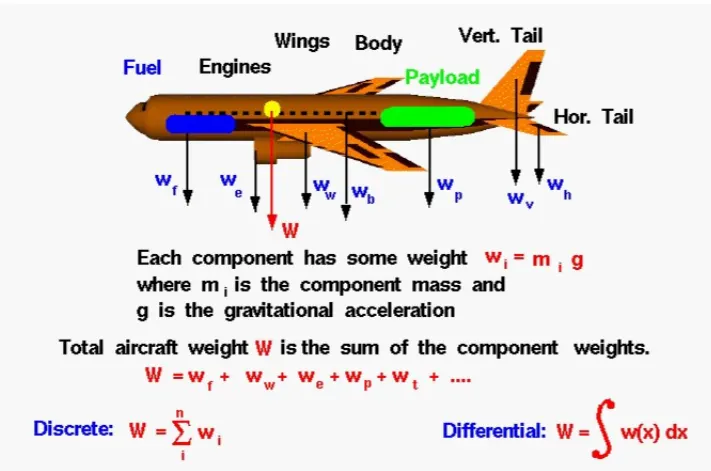
The total weight W of the aircraft is simply the sum of the weight of all of the individual components.
W = w(fuselage) + w(wing) + w(engines) + w(payload) + w(fuel) + etc..
W = SUM(i=1 to i=n) [wi]
The total weights of various types of aircraft are shown below;| Category MTOW(kg) MLW(tons) |
| Boeing 747-8F 447,700 346.091 |
| Airbus A380-800 575,000 394 |
| Concorde 185,000 111.1 |
| Antonov An225 640,000 91.7 |
| Vickers VC10 152,000 151.9 |
| Fokker 100 46,000 39.95 |
| Embraer 175(19) 37,500 32.8 |
| Avro RJ-85 42,000 36.47 |
| Tupolev Tu-154M 104,000 80 |
| Boeing 777-300 299,370 237.683 |
Here MTOW is Maximum Take Off Weight & MLW is Maximum Landing Weight.
PART A: 2. Is there any difference between ground speed and air speed?
Ground speed:
They represent the ground-related airplane speed.
They are what decide how quickly an airplane will get at a destination.
-They are figured out by adding the air and wind speeds.
Air Speed:
It describes a flying object's relative speed to the air it is in.
-They assess if an airplane has enough airflow around it to lift.
They are not impacted by ground speed.
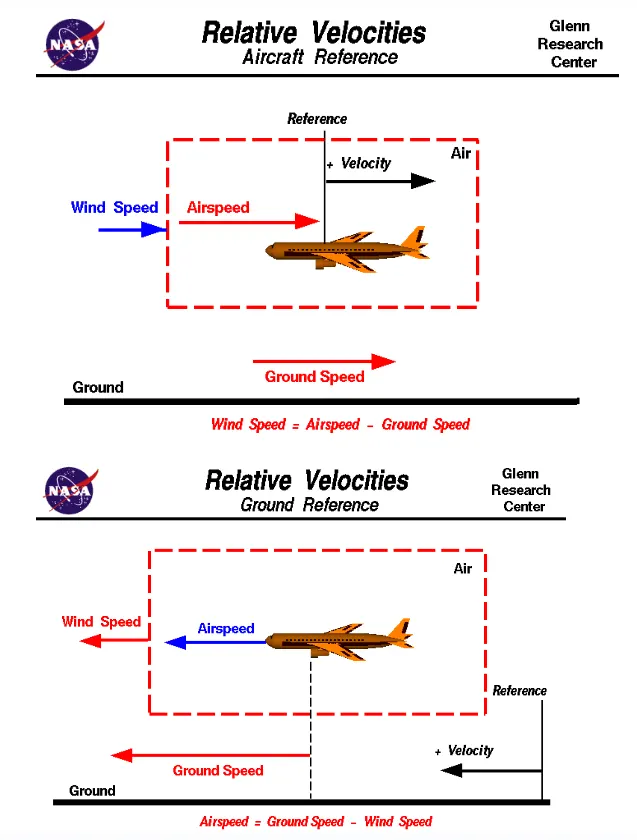
-The afore mentioned two diagrams' relative velocities when compared to ground and airplane references, respectively.
Here, the vector difference between ground speed and air speed is called wind speed.
The wind speed is 0 and equal to the ground speed on a perfectly quiet day.
-The wind speed turns positive when the measured air speed exceeds the observed ground speed.
TYPES OF AIR SPEED ACCORDING TO DIFFERENT READINGS:
1) INDICATED AIR SPEED: This airspeed is derived from the pitot-static system of an airplane. The aircraft's dynamic pressure, which is the difference between its total pressure and static pressure, is used to compute it. In addition to the aircraft's speed, the dynamic pressure is also influenced by the air's density. As a result, the disparity between the indicated and true air speed increases with altitude and decreases in air density.
2) CALIBRATED AIR SPEED: This speed has been corrected for a number of inaccuracies. The flap position is one of the things it is adjusted for, as an illustration. This is because air flows variably around the pitot-static device at various flap positions and affects the indicated airspeed readings.
3) TRUE AIR SPEED: The true speed at which an aircraft is flying compared to the air it is traveling in has been discussed countless times. Its airspeed has been calibrated to the precise circumstances (height, air temperature, etc.) in which the aircraft is flying. Airspeed, or at least real airspeed, is an airplane's speed relative to the air it is flying in, whereas ground speed is an airplane's speed relative to the Earth's surface.
Airspeed depends on the wind flow also;
- If the wind is flowing in the same direction of the flight then (air speed < ground speed ) so air speed =ground speed -wind speed.
- If the wind is flowing in the opposite to direction of the flight then (air speed > ground speed ) so air speed =ground speed+wind speed.
PART A - 3. Why it is not recommended to use aircraft engines to move it on the gorund at airport?
Most of the airplanes today do not use reverse thrust technology as it consumes a lot of fuel and makes noise and is hazardous for people working near by. Since the engine is also close to the ground it will blow off the sand and debris forward and sucks it to the engine and causes damage to it. To help with this, we use a device called a towing vehicle which helps to tow the vehicle in reverse direction and it will be tugged until it reaches a safe place.
Airbus A320ceo thrust reversers:
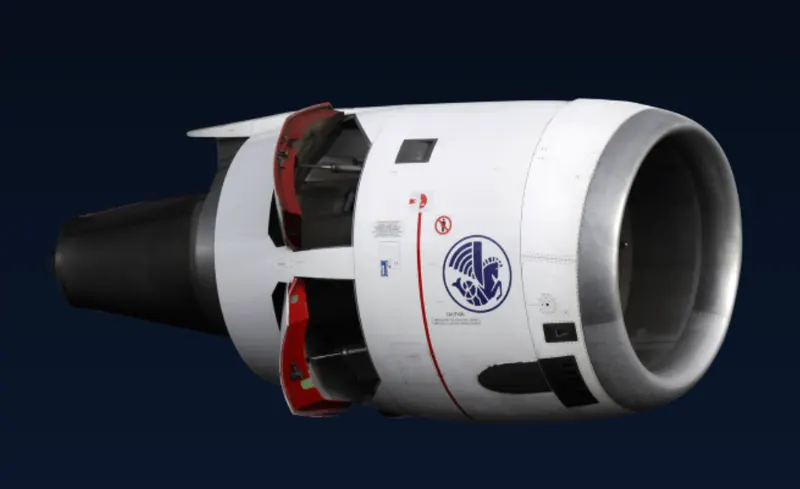
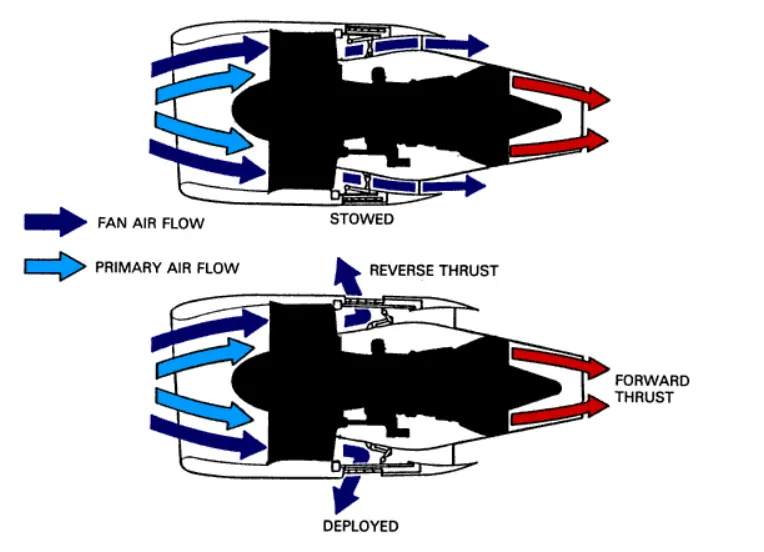
Aircraft engine power is not recommended to move on the ground. Thrust reversal involves great forces, and produces an incredible amount of noise.
PART A - 4. How an aircraft is pushed to runway when its ready to take off?
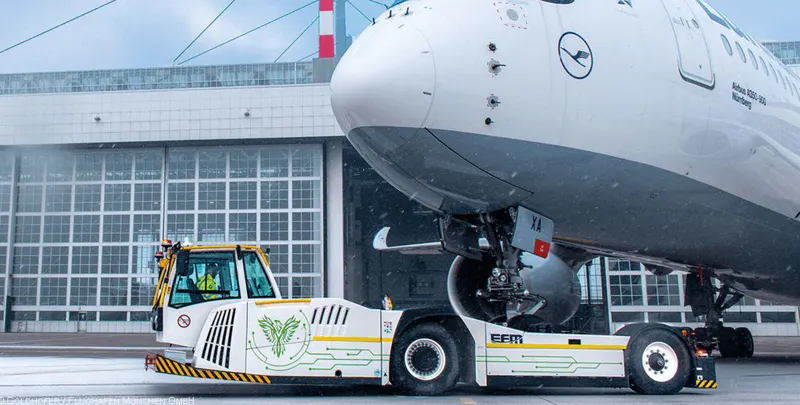
Using ground tugs to move airplanes on the ground does save fuel in Airplanes. It also allows for precise parking as the tug driver can see the area around the airplane better. In some countries, pilots can still taxi their aircraft backwards according to their desire, but you'll never see this at Schiphol.
Modern pushback tractors are able to lift the aircraft's nose wheel, and push it back using a tow bar attached to the nose wheel.
PART A - 5. Learn about take off power, tyre design, rolling resistance, tyre pressure, brake forces when landing.
Take-Off Power:
The phase of flight known as takeoff is when an aircraft departs the ground and ascends into the air. Large freight carriers use less power during takeoff than lighter aircraft in order to extend engine life, lower maintenance costs, lower engine heat, and also to ensure a smooth takeoff flight. Lighter aircraft use maximum power during takeoff.
-
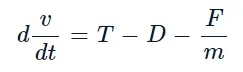
The following forces are present during takeoff:
T = thrust force, The airplane is propelled forward by thrust force as it approaches the runway.
D = Drag force opposes the aircraft's forward motion.
F = Rolling resistance force experienced by the wheel when it makes contact with the ground during takeoff and landing.
-
The difference of these forces from the Thrust force being higher will create an acceleration along the runway during takeoff.
PTO power take off system is also used to power the aircraft engine for take-off. The most typical example is a tractor or truck with a splined drive shaft that enables implements with matching fittings to be powered directly by the engine. On industrial and marine engines, power take-offs can also be semi-permanently attached.
The aircraft will now accelerate to a speed that will be determined by the aircraft controlling department when the pilot is prepared to take off. The flight will then be raised to a specific height and angle after takeoff before being made to stabilize in an equilibrium fashion.
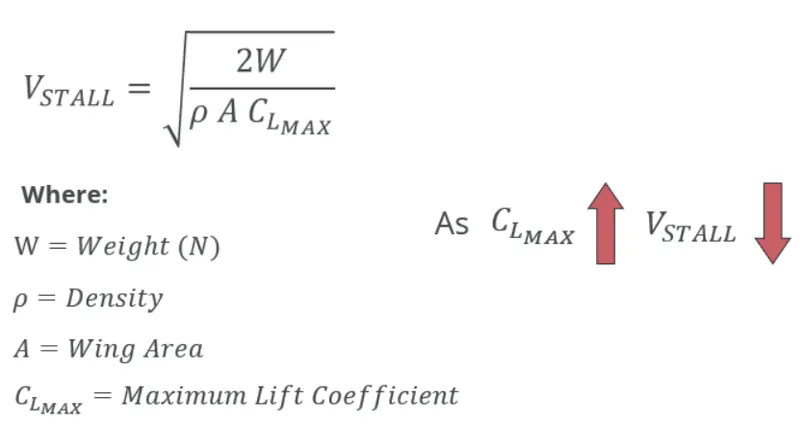
Here, safe speed, also known as rotational speed, is defined as Vr, and it plays a crucial role in predicting how well a takeoff will go.
Vr is typically calculated as 1.1*Vstall (the lowest speed at which an aircraft can be flown before the air begins to separate from the wings when the angle of attraction is too great) for safety reasons.
-Vstall can be determined using the 1g stall speed equation:
TYRE Design of an aircraft:
In order to sustain extremely heavy loads, aviation tires are designed to absorb shocks and hence provide cushioning.
The entire weight of the aircraft determines how many tires are needed because the weight must be distributed uniformly.
-Aircraft tires are made to facilitate stability in strong crosswinds, to channelize water away to minimize skidding, and to aid in providing effective braking.
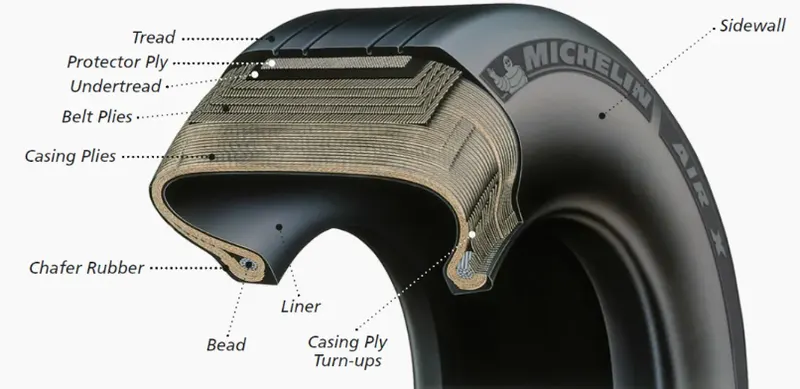
In order to prevent expansion and contraction caused by extreme fluctuations in ambient pressure and temperature, aircraft tires are typically inflated with nitrogen air. Tire explosions won't be a possibility with these inert gases.
Aircraft tires are built into an aircraft based on its intended use and the amount of clearance they need from the ground to allow for tyre growth, which occurs when centrifugal force is operating at high speed.
Rolling Resistance:
The rolling resistance or rolling friction/rolling drag is the force that opposes a body's rolling motion on a surface.. It is mostly brought on by non-elasticity, which occurs when not all of the energy required to generate wheel deformation is recovered when the pressure is released.
Rolling resistance is influenced by tire wear and tear, air pressure, and road roughness.
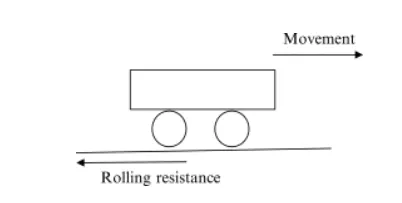
-The following equation can be used to define the rolling resistance equation:
Rolling resistance , Fr = CW/r
C = co-efficient of rolling resistance
W = weight of the body
r = radius
Note: commonly aircrafts have a very low rolling resistance coeffiecient of 0.06.
Tire Pressure:
-Aircraft tires must distribute weight properly while also being able to endure severe loads and shocks during landing and takeoff.
- According to study and testing, airplane tires can withstand pressure up to 800 psi.
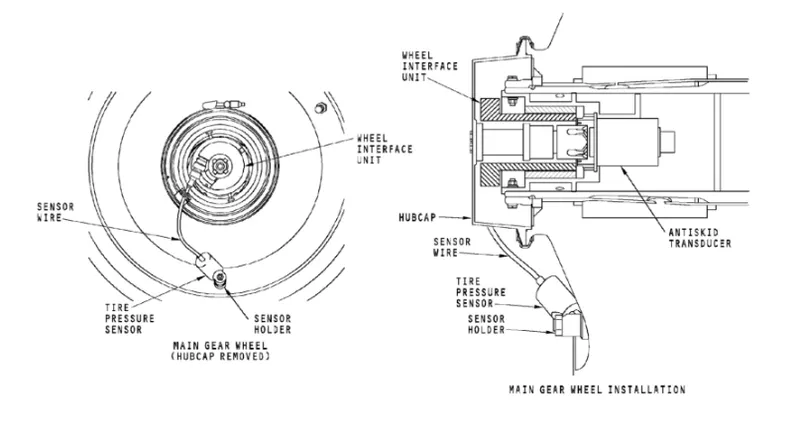
- On a Boeing 777, two nose gear wheels and each of the 12 main gear wheels has a tire pressure sensor/fill valve attached. Each of the axles has an in-axle transformer.
Three independent pressure measuring channels and an air fill valve make up the tire pressure sensor/fill valve, which accurately measures tire pressure.
The wheel has a fill valve and tire pressure sensor fitted.
The tire pressure sensor and fill valve are connected by a relay transformer hubcap assembly. The tire pressure indication system's electrical needs are met by the left 28V DC MAIN bus.
-There are two main factors that might damage airplane tires:
I)Deflation:
Here, the tire deflates under regulated conditions with minimal damage to other systems.
II) An explosive split:
In this scenario, the tire spontaneously deflates or bursts, perhaps damaging other secondary systems and increasing the risk of a serious crash landing occurrence.
Brake force:
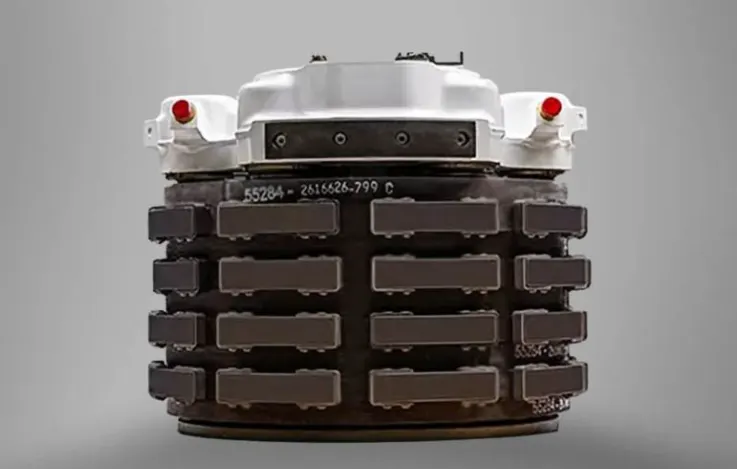
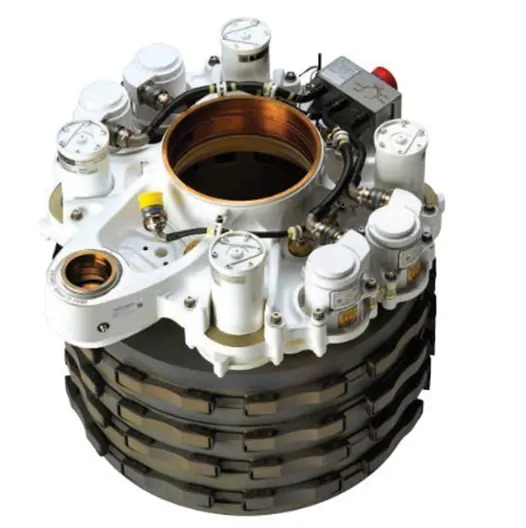
By turning kinetic energy into thermal energy through friction between spinning and stationary discs found in braking assemblies in the wheels, airplane brakes are able to halt moving aircraft. This essential stopping function is provided by brakes during landings so that aircraft can stop within the runway's length.
Most pilots find that braking an airplane is a difficult task, especially when landing in a cross-wind and rainy environment. Pilots typically employ spoilers and a reverse landing technique to avoid these types of problems and ensure a safe landing by reducing the amount of energy needed to apply the brakes to the tires, which prevents them from skidding.
-We can determine an aircraft's brake force as kinetic energy (KE) is a function of mass (m) and velocity (v) according to the equation::
k=0.5mv^2, where m is the aircraft's mass and v is its speed.
An average commercial landing speed will be in the 150–165 MPH range. And the speed for passenger flights is between 166 and 172 mph.
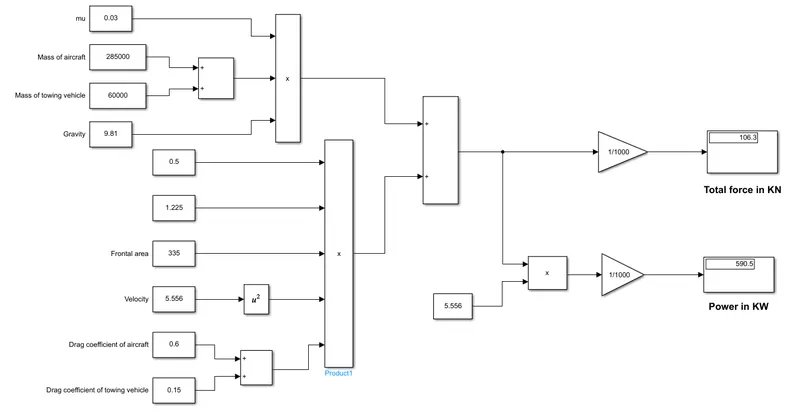
PART B - 6. A. WITH NECESSARY ASSUMPTIONS, CALCULATE THE FORCE & POWER REQUIRED TO PUSH/PULL AN AIRCRAFT BY A TOWING VEHICLE:
Let us assume;
Antonov An-225 Mirya
Mass of aircraft M1 = 285,000kg
Mass of Towing vehicle M2 = 60,000kg
Coeffiecient of rolling resistance for dry concrete road, µrr = 0.03
Frontal area of aircraft, A = 355m^2
Drag coefficient of an aircraft, Cd = 0.6
Drag coefficient of a towing vehicle, Cd = 0.15
Density of air =1.225kg/m^3
G = 9.81
Speed of an aircraft V =20 * (5/18) = 5.556 m/sec
ROLLING RESISTANCE FORCE:
For aircraft:
Frr = µrr * m * g
Frr = 0.03* 285000 * 9.81
= 83,875.5 N
For Towing Vehicle:
Frr = µrr * m * g
= 0.03*60,000 * 9.81
= 17,658N
We need to add the rolling resistance of both towing vehicle and aircraft.
Frr = Frr (aircraft) + Frr (vehicle)
Frr = 83,875.5 + 1765.8
Frr = 101,533 N
AERODYNAMIC DRAG FORCE:
Fad = (0.5) * ρ * V^2 *(Cd (aircraft) + Cd (vehicle))
= (0.5) * 1.225 * 335 * (5.556)^2 *(0.6 + 0.15)
= 4750.47 N
Total force of the towing vehicle,
F = Fad + Frr (vehicle) + Frr (aircraft)
F = 4750.47 + 17658 + 83875.5
= 106283.97 N
POWER REQUIRED:
P = F * V
= 106283.97 * 5.556
= 590.513 KW
The force and power of the towing vehicle carrying the aircraft are 106.283 KN and 590.513 KW respectively.
B. Develop the model for the calculated force and power using Simulink:
PART B - 7. A. DESIGN AN ELECTRIC POWERTRAIN WITH TYPE OF MOTOR IT'S POWER RATING & ENERGY REQUIREMENT TO FULLFILL AIRCRAFT TOWING APPLICATION, ESTIMATE THE DUTY CYCLE RANGE TO CONTROL THE AIRCRAFT SPEED FROM ZERO TO HIGHEST MAKE ALL REQUIRED ASSUMPTIONS, PREPARED A TABLE OF ASSUMED PARAMETERS, DRAW A BLOCK DIAGRAM OF POWERTRAIN:
Based on previous question,
Force required to push/pull the aircraft = 106.283 KN
Power required is = 590.513 KW
Let us assume the radius of the tyre as = 25 inches = 0.653m
Gear ratio = 8
Transmission efficiency (et) = 87%
Motor efficiency (em) = 95%
Then,
Torque required for the wheel (Tw) = Total force * Radius in meters
= 106.283 * 0.653
= 69.403KNm
Motor torque = wheel torque / (Gear ratio * et)
= 69.403 /(8 * 0.87)
= 9.9716 KNm
The required motor torque = 9.9716 / 0.95
= 10.49642
The total power required by the motor considering all efficiencies = 590.513 /(0.87 * 0.95)
=714.474KW
Let us assume the towing operation is done for 15 minutes (0.25 hrs)
Total energy consumed = 714.474 * 0.25
= 178.6185 Kwh
Duty cycle (d ) = (Required power)/ (Rated power)
= 714.474 / 950 = 0.752
= 75.2%
Thus the duty cycle range to control the aircraft speed from zero to highest is 0 to 75.2% .
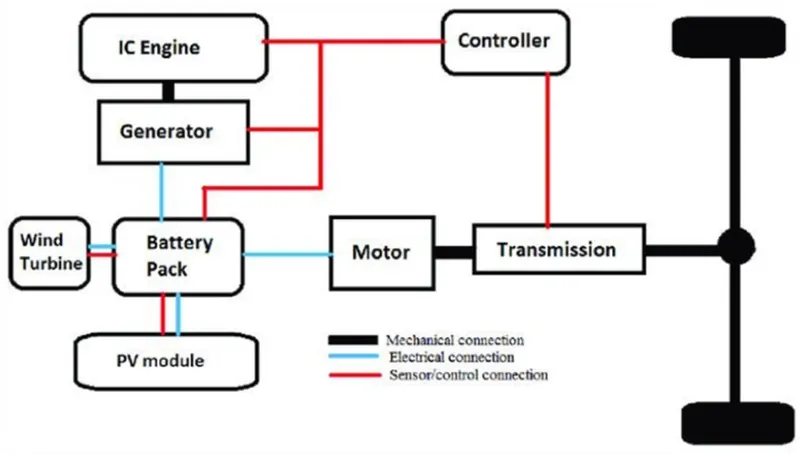
POWER TRAIN (BLOCK DIAGRAM)
The collection of all the parts that propels your car forward is called the powertrain. The engine of your car generates power, which the powertrain then transfers to the wheels on the ground. Engine, transmission, driveshaft, axles, and differential are the main parts of a powertrain.
Engine: The engine is the driving force behind your car and serves as its heart. The components of an engine are pistons that oscillate inside of cylinders and a crankshaft that converts the oscillating action into a rotating motion.
Transmission: A fundamental part of your car called the transmission ensures that the right amount of power is sent to the wheels. Similar to a car's gearbox, the transmission transfers engine power to the wheels by adjusting it in response to road conditions.
Driveshaft: The component that transmits torque from the transmission to the wheels is the driveshaft. It must work through a variety of angles and adjust its length to the movement in the suspension in order to complete this task.
Axle: A powertrain's axles are a crucial component. It is located in between the wheels and primarily serves two purposes: it supports the vehicle's weight and spins, transferring engine power to the wheels.
Diffrerential: A differential is a component of the rear axle. It enables the back wheels to rotate at various speeds. The differential, for instance, is crucial when rounding a corner since the outside wheel must turn more quickly than the inner wheel.
Your vehicle cannot move ahead without a functioning powertrain, thus it is essential. In summary, it is a collection of components that produce, transform, and use energy to propel your vehicle forward.
PART B - 7. B. Also, Design the parameters in excel sheet.