Project-1: Powertrain for aircraft in runways
PART A
QUESTION 1
All weights are in kilograms
|
S.no |
Aircraft |
Empty Weight |
Max Fuel Weight |
Max Cargo Weight |
Max Gross Takeoff Weight |
|
1 |
Antanov AN- 225 |
2,85,000 |
3,00,000 |
1,90,000 |
6,40,000 |
|
2 |
Airbus A380-800 |
2,77,000 |
2,54,000 |
84,000 |
5,75,000 |
|
3 |
Boeing 747-800 |
2,20,100 |
1,94,000 |
1,34,000 |
4,47,700 |
|
4 |
Airbus A340-500 |
1,68,000 |
1,75,500 |
54,000 |
3,72,000 |
|
5 |
Boeing 777-300ER |
1,68,000 |
1,45,500 |
67,100 |
3,52,000 |
|
6 |
Boeing 787-10 |
1,35,500 |
1,01,500 |
57,300 |
2,54,000 |
|
7 |
Cessna 172R |
770 |
170 |
225 |
1,100 |
|
8 |
Sirrus SR 22 |
1,000 |
220 |
430 |
1,630 |
|
9 |
Diamond DA50RG |
1,450 |
155 |
560 |
2,000 |
|
10 |
Learjet 75 |
6,300 |
2,750 |
1,300 |
9,700 |
Empty Weight :
An aircraft weight that consists of the airframe, engines and all items of operating equipment that have fixed locations and are permanently installed in the aircraft, including fixed ballast, hydraulic fluid, unusable fuel and fuel engine oil is known as empty weight
Maximum gross takeoff weight :
This is the maximum permissible weight that aircraft can weigh as it lifts off the ground at takeoff. This includes the aircraft’s empty weight, the fuel, the passengers and all the cargo.
Question 2
Ground speed :
The speed at which an object travels relative to a fixed point on the Earth surface is known as ground speed(GS). It is vital for accurate navigation that the pilot has an estimate of the ground speed that will be achieved during each leg of a flight. An aircraft driving vertical I would have a zero ground speed. Information Display 2 passengers through the entertainment system of airline aircraft. Usually gives the aircraft ground speed.
Air speed :
The speed which corresponds to the moment relative to the air is known as true air speed(TAS) or airspeed. Airspeed cannot be measured directly from the ground, but must be computed from the ground speed and the wind speed. Airspeed is the vector difference between the ground speed and the wind speed.
Difference :
The difference between ground speed and airspeed is caused by the influence of winds. For example, on a perfect still day, the airspeed is equal to the ground speed.
Wind affects air speed in 2 ways
- If the wind is blowing from the tell then it is known as tailwind.
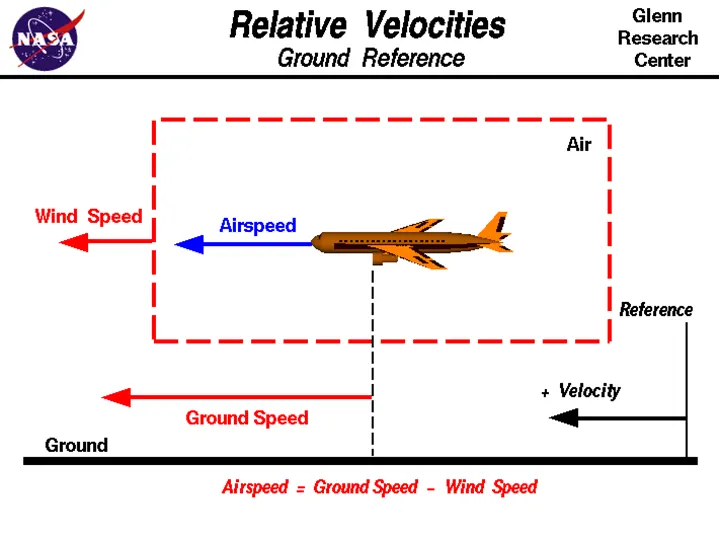
In this condition wind speed and airspeed is in same direction
GS = TAS + wind speed
2.If the wind is blowing from the head then it is known as head wind.
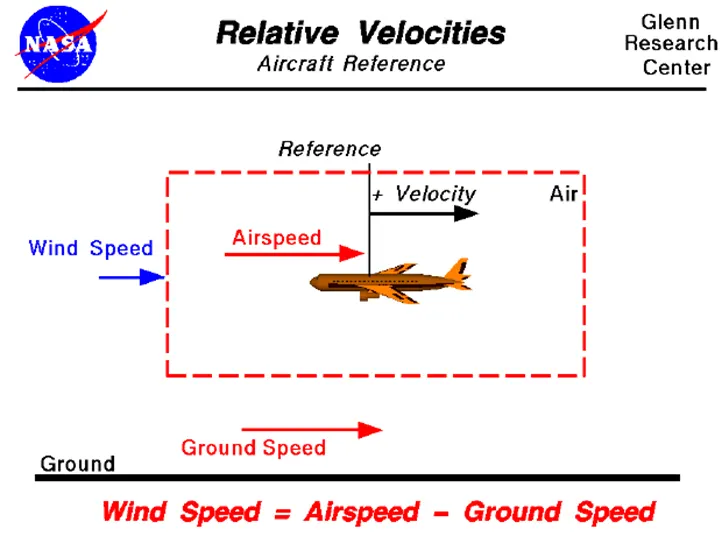
In this condition GS = TAS – wind speed
If there is no wind speed then the ground speed is equal to the airspeed.
Question 3 :
Aircrafts are designed in a way that allows them to glide through the air even with no engine thrust. It is not recommended to use aircraft engine power to move it on the ground at the airport because high engine thrust can cause considerable damage to the airplanes and other elements in the airport environment. The trust produced results jet blast might cause damage to the terminal building or equipment also. Engines close to the ground may also blow sand and debis forward and then suck them into the engine causes damage to the engine. Therefore a push back is the preferred method to move the aircraft away from the gate rather than using engine power.
Question 4
Pushback :
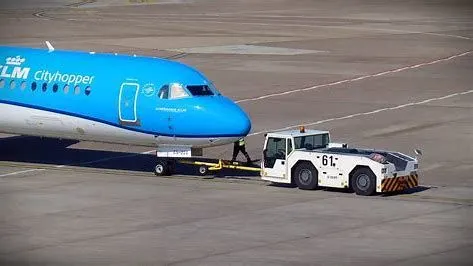
- Pushback is when an aircraft is pushed backwards away from the airport gate by vehicles called tugs or tractors.
- Closer to departure, an aircraft tug will park right in front of the nose wheel.
- The tug might be directly attached to the plane's nose gear with a tow bar, or could be a "wheel-lift" tug.
- These tugs cradle the nose gear, then lift it up before moving the plane. That gives the tug driver control over the plane's direction during pushback.
- New taxi technologies are appearing, like pilot-controlled tugs, and electric motors mounted to the plane's landing gear. Both promise to save fuel, and reduce airport noise.
Question 5
Take off power
The power required by the aircraft engines to lift into a horizontal take off is known as take off power.
The forces which help the aircraft to take off are
- Thrust(T) : It is a force that moves on aircraft in the direction of motion.
- Drag (D) : It is a force that acts opposite in the direction of motion.
- Weight (W) : It is the force caused by the gravity.
- Lift (L) : It is the force that holds an airplane in air.
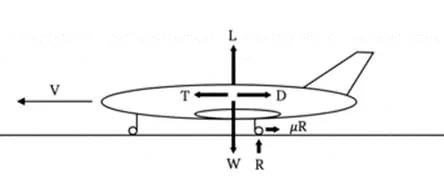
Summing the horizontal forces in the figure
`F = T - D -uR`
`m*(dv)/(dt) = T-D-uR`(since F = ma)
Finally Take off power = Force*velocity
Rolling resistance :
It is the force resisting the motion when a body rolls on a surface. It is also called as rolling friction or rolling track. In case of an aircraft, rolling resistance can be experienced on tires while take off and landing.
Frr = Urr*m*g
Frr = rolling resistance force.
Urr = coefficient of rolling resistance.
m = mass of aircraft.
g = acceleration due to gravity (9.81 m/s^2).
Tyre Design:
The role of tyre is to make connection between ground and aircraft. Tyre works as a shock observer. It should with stand high temperature and high pressure produced due to friction.
There are 2 types of tyres.
- Tube type : Tube is used to fill the gas in tyres.
- Tubeless : Tube is not used to fill the gas in tyres.
We should consider 5 factors while designing a tyre. They are
- Bead : A BD is made of strong carbon steel in the form of word. These words together made like bundles and enclosed in a rubber, and it is fitted in the dimensions of tyre.
- Carcass plies : Aircraft tyre has to compensate many things, hence we made it in the form of layers. Each layer is called as plie. The layer is made up of fibre, usually nylon, and it is sandwiched between rubber.
- Trade : This is an external part of the tyre. The trading of a tire or track refers to the rubber on its circumference which is connected directly to the ground. It has to withstand cracking, cutting, heat. Hence it is made with a high strength.
- Sidewall : Side walls of the tire protects cord plies and feature tyre marking and information such as tyre size and type.
- Chine : Thread pattern designed to facilitate stability in high crosswinds conditions. Chine is used to channel water away, to prevent hydro planning and breaking effect.
Tyre pressure :
Aircraft generally operate at high pressure, up to 200 ps (14 bar) for airlines and even higher for business jets. Aircraft tyre operates at such high extreme of pressure, load and speed. Mostly, the pressure changes with temperature. For every 5 degrees Fahrenheit change in temperature, the pressure changes about one percentage. This can lead to an under inflated condition during extreme temperature drops. It is good to know how varying temperature affects inflation and adjust type pressure appropriately. Under inflating the tire or allowing the tyre to operate when it is under flatted, will prevent the parts working together as intended.
Brake force while landing :
Brakes are used to stop or reduce the speed of aircraft. Brakes are normally installed on the main landing gear. Mostly brakes are applied when the top of rudder pedals are applied. Normally hydraulic system on the aircraft provides hydraulic pressure for the activation of bricks.
Break devices that are used to decelerate the aircraft are
- Spoilers
- Wheel brakes (Including antiskid system and auto brake system).
- Reverse thrust.
Spoilers :
Many airplanes use wing spoilers to assist with breaking Man landing. Spoilers are extendable flaps on the ends of an airplane’s wings. Pilots can raise the spoilers to decelerate the airplane as it approaches the runway. And even while on the runway, pilots will typically leave the wing spoilers raised. Raised wing spoilers create drag which essentially slows down the airplane so that its able to break more quickly.
Wheel brakes :
- Auto brakes : when auto brakes are activated. The aircraft decelerates at a predetermined rate. They reduce is pilot workload, while take off and landing, and the breaking action is also not severe.
- Antiskid : This prevents aircrafts skid. Normally skid occurs when wheels stop spinning because of severe break applications. because of skid there will be a loss of control of aircraft on runway. Anti skid operates by releasing the brakes on the wheels.
Reverse Thrust :
Finally, many jet airplanes use reverse thrust to assist with breaking during landings. Reverse thrust is a feature in jet engine airplanes that, as the name suggests, reverse thrust change the direction of engine thrust. Rather than protecting out the rare, the thrust will be projected out the front. This reversal of thrust provides deceleration that allows airplane to slow down more quickly when landing.
PART B
Question 6A
Let us consider the mass of aircraft be 6,40,000.
Consider the mass of towing vehicle as 54000.
Calculation of power
1.Rolling resistance force (Frr) :
It is the force resisting the motion when a body is on a surface.
Frr = urr*m*g
urr = coefficient of rolling resistance = 0.002
m = mass of aircraft and towing vehicle = 6,40,000 + 54,000 = 6,94,000
g = acceleration due to gravity = 9.81m/s
Frr = 0.002*694000*9.81
= 13616.28
= 13.61 kN
2.Air drag force (Fad) :
It is a force acting opposite to the relative motion of any moving object due to air.
Fad = 0.5 * rho * Cd * A * v^2
Rho = density of air = 1.225 kg/m^3
A = frontal area = 100 m^2
Cd = drag coefficient = 0.03
v = velocity = 18 kmph = 5 m/s
Fad = 0.5*1.225*0.031*100*5*5
= 47.46 N
= 0.04kN
Hill climbing force :
It is the force needed to climb a slope at a given angle. In case of aircraft it is negligible since runways are flat.
Total force =
F = Frr + Fad
F = 13.61 + 0.04 = 13.65 kN
Calculation of power (P) :
P = force * velocity
P = 13.65*5 = 68.25 kW
Question 6B
simulink model for calculated force and power
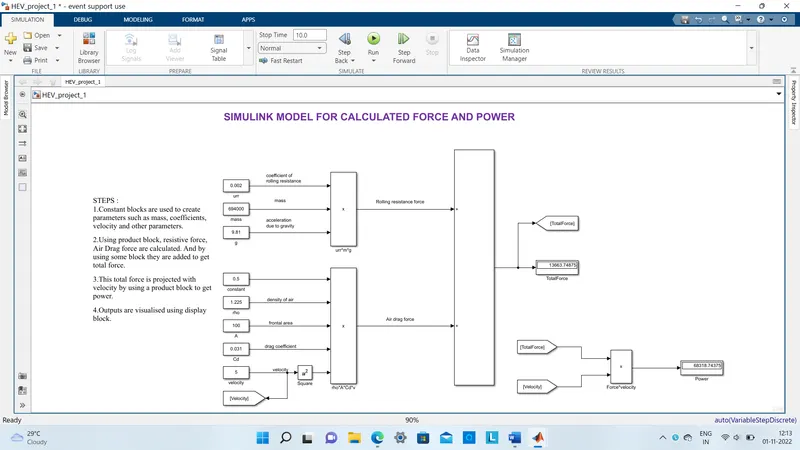
STEPS :
- Constant blocks are used to create parameters such as mass, coefficients, velocity and other parameters.
- Using product block, resistive force, Air Drag force are calculated. And by using some block they are added to get total force.
- This total force is projected with velocity by using a product block to get power.
- Outputs are visualised using display block.
Question 7
Parameters considered are
1.Weight of Aircraft 640000 kgs
2.Weight of the Towing vehicle 54000 kgs
3.Coefficient of Rolling resistance 0.002
4.The velocity 5 m/s
5.Density of Air 1.225kg/m^3
6.Frontal Area 100m^2
7.Drag coefficient 0.03
8.Power required to push the vehicle 68.25 kw
Let us assume
Gear ratio as 6
Transmission efficiency is 80%
Motor efficiency as 90%
Tyre radius is 0.5meters
Battery capacity is 400v
Wheel torque (Tw) = Force *radius = 13.65*0.5 = 6.825 kN
Motor torque (Tm) = Tw/(G*transmission efficiency) = 6.825/(6*0.8) = 1.42185kN = 1421.85 N
Required Motor torque with motor efficiency = 1421.85/0.9 = 1579.83 N
Total Power (considering all efficiencies) = 68.25/(0.8*0.9) = 94.79 kW
Rated power = 100kw
Duty cycle = Required power/Rated power = 94.79/100 = 0.94
That is duty cycle is 94%
Energy required(kwh) = power*time
Let the vehicle is operated for 15 minutes that is 0.25 hours
Total energy consumed for 15 minutes(0.25 hours) = 94.79*0.25 = 23.69kW
Simulink model
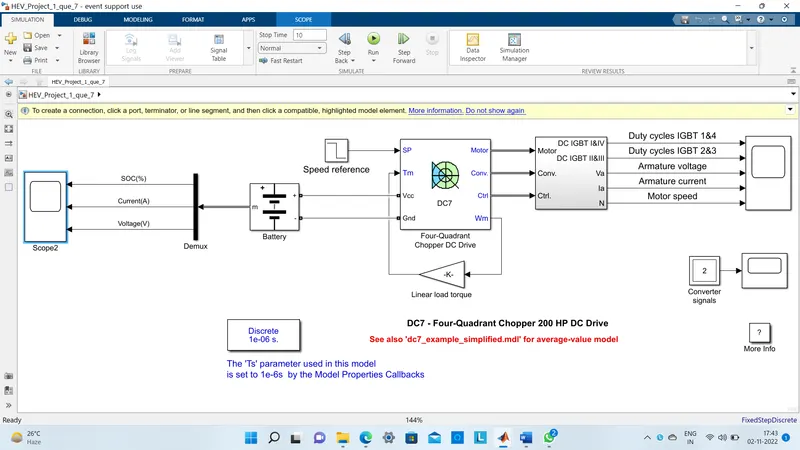
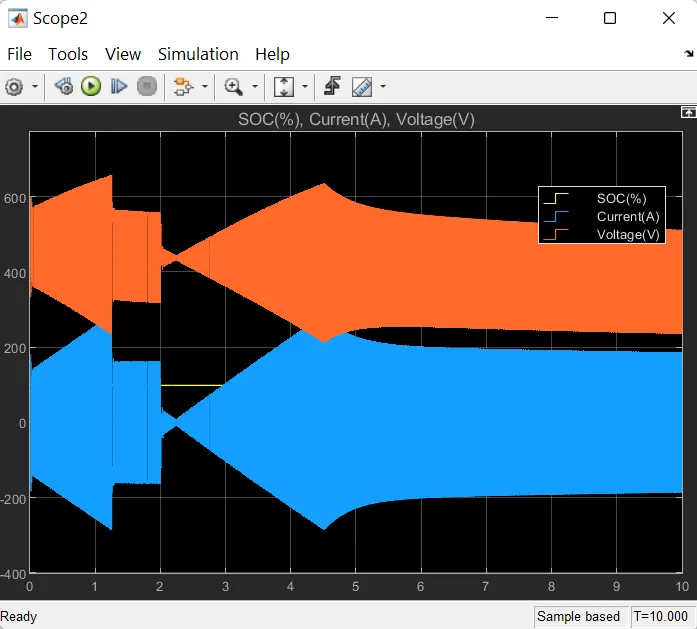
From battery
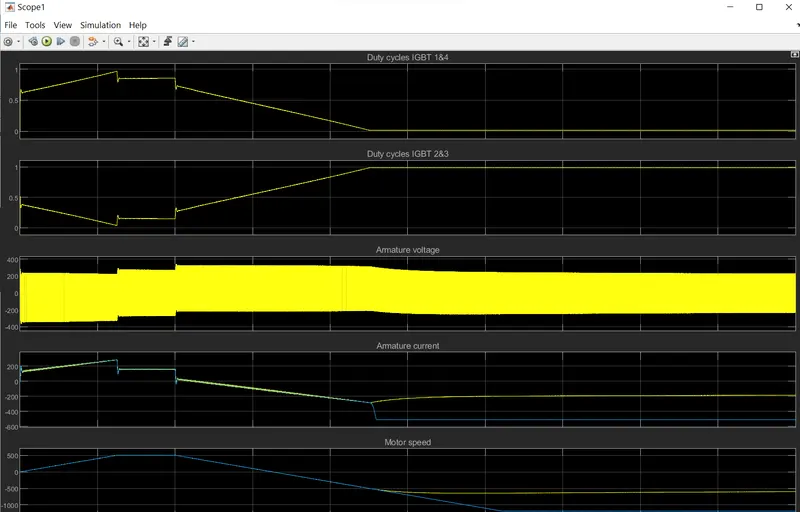
From motor
POWER TRAIN BLOCK DIAGRAM
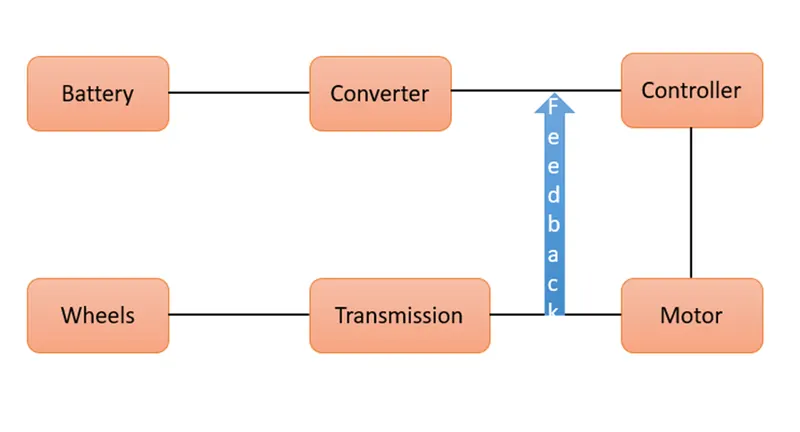
Excel sheet with parameters is attached below